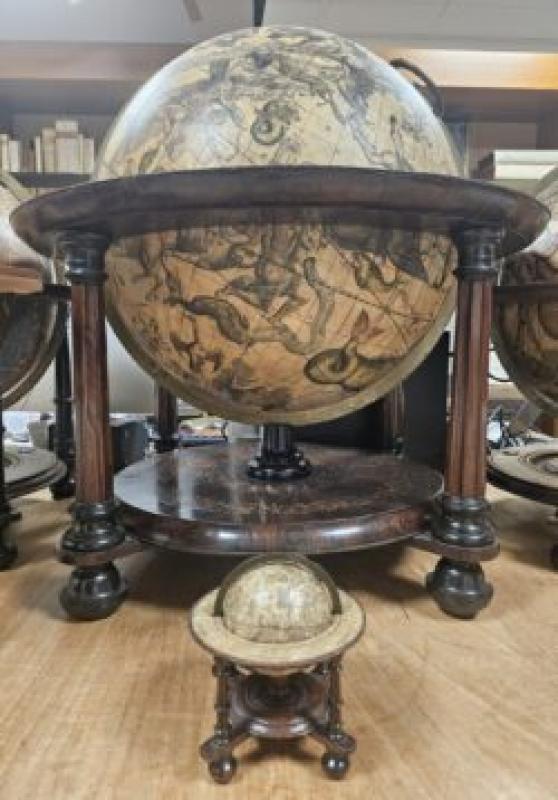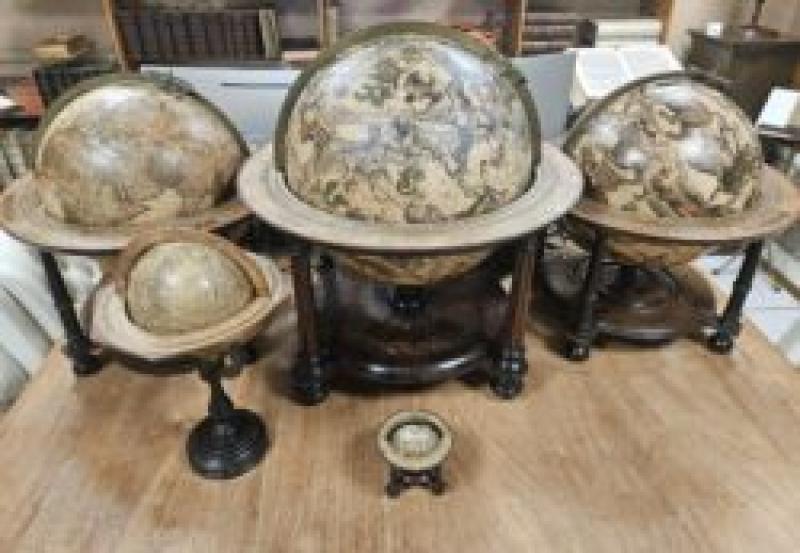
A scarce and beautiful miniature celestial globe produced in Amsterdam during the first quarter of the 18th century. Amsterdam, Gerard & Leonard Valk, 1715-1728  Auf Merkliste setzen
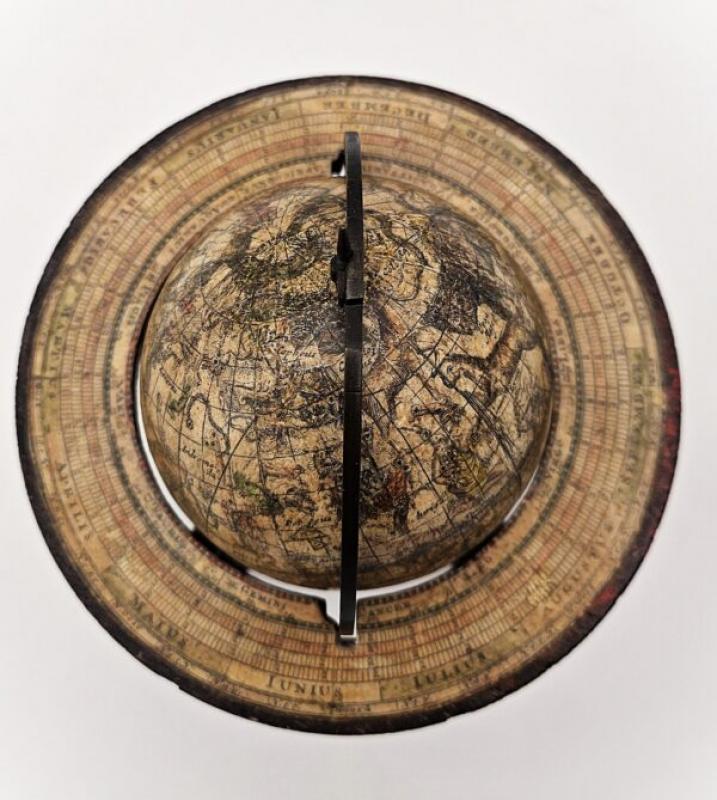
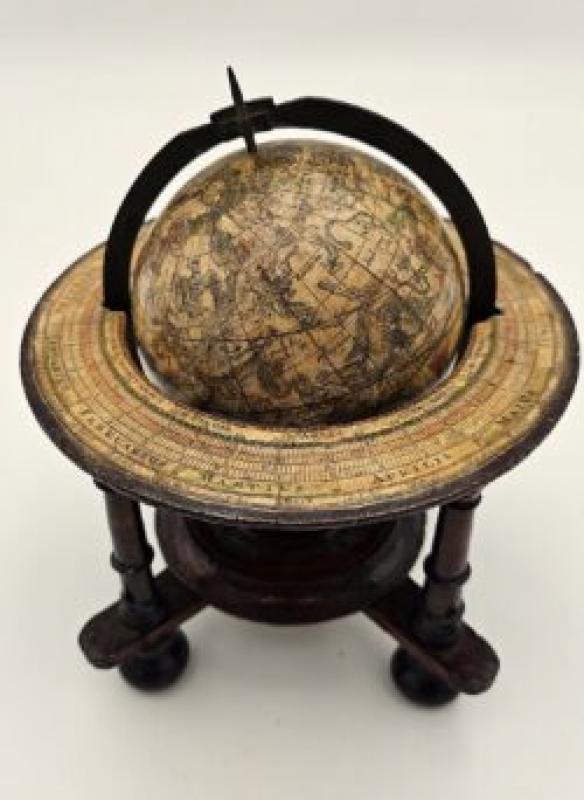
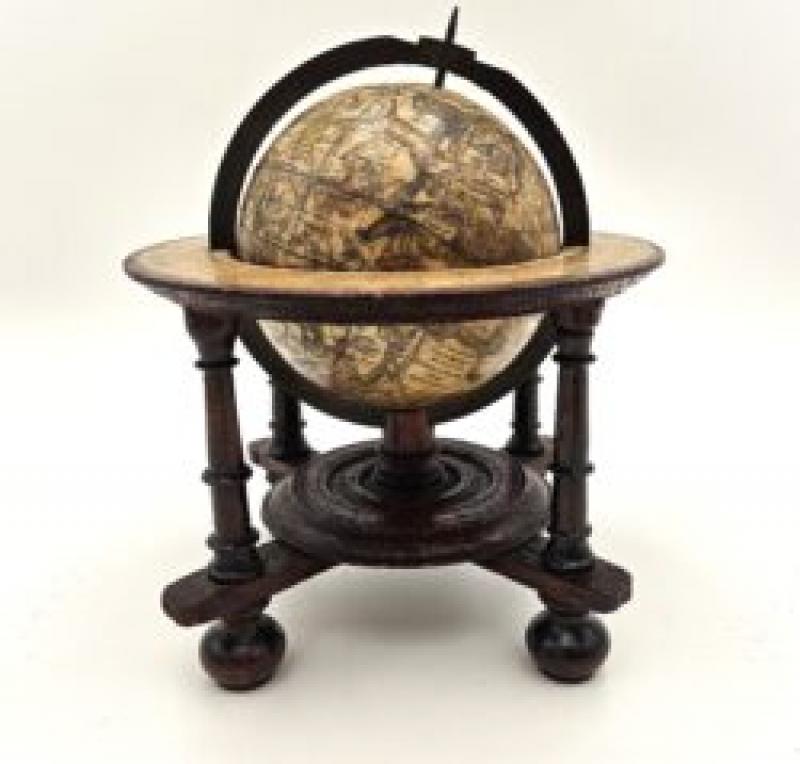
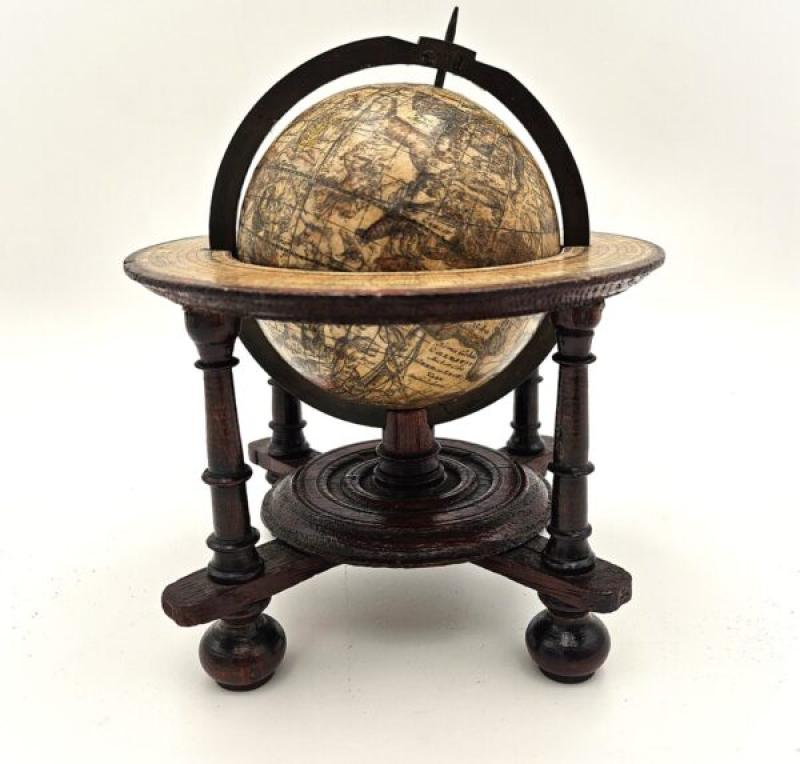
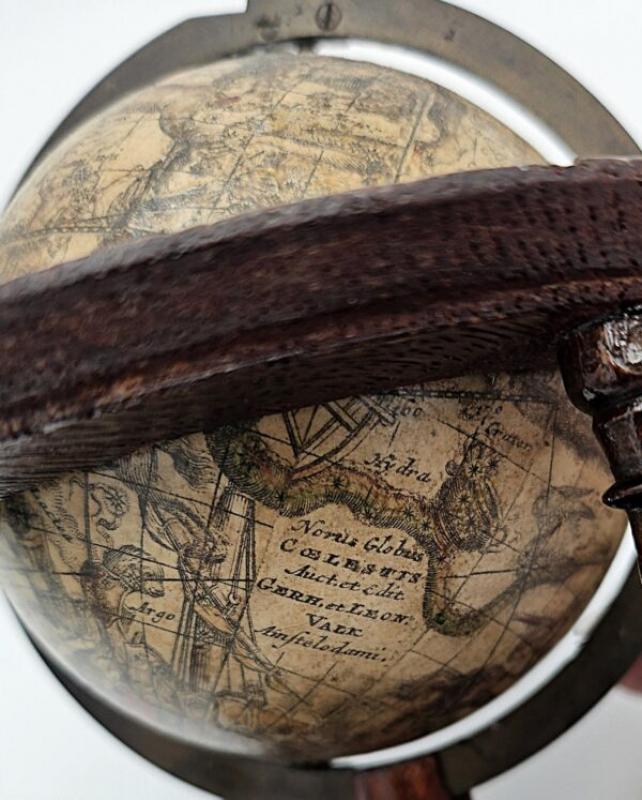
Novus Globus / COELESTIS / Auct. Et Edit. / GERH. Et LEONH. VALK / Amstelodami. Diameter globe: 3 inches / 7.6 cm. – Total height: 5,91 inches / 15 cm. A scarce and beautiful miniature celestial globe produced in Amsterdam by Gerard and Leonard Valk during the first quarter of the eighteenth century. A celestial globe is a mounted sphere, displaying the stars and zodiacs. This globe consists of twelve copper plates, original hand-coloured varnished, clipped elliptical gores, and two celestial calottes – all expertly crafted onto the papier-mache globe itself. Gores are the printed panels with curved sides that taper to a point at each end, making up a surface of the globe. They are designed to give a complete three-dimensional map when cut and adhered to the globe. The globe sits on four lovely, turned wooden mahogany stands, with rectangular cross stretchers all meeting at a central point beneath the globe. The globe has delightful bun feet. The celestial calottes are on the ecliptic poles. The globe has a brass meridian ring and hour dial with a hand-coloured printed paper ring on the wooden horizon ring, showing degrees and the days of the houses of the Zodiac. The title is (without a cartouche) situated between Hydra and Argo. Only the stars of the first five magnitudes are given; the chart is placed between Phoenix and Cetus. Highlights include: Stars: Individual stars are marked, often using different-sized dots to indicate their magnitude (brightness). Constellations: Figures representing the constellations (such as Orion, Ursa Major, Pegasus) are typically drawn and labelled, often based on the traditional 48 Ptolemaic constellations from Greek and Roman astronomy. The colouring on this miniature globe is certainly contemporary if not original. All the engraving is rendered to the highest standard. The globe is presented in excellent condition. There are a few minor dents and blemishes due to restoration, just below the Bear (Ursa Major) constellation. The horizon ring shows signs of slight wear. Gerard Valk, along with his son Leonard, was the only significant publisher of globes in the Netherlands during much of the 18th century, and enjoyed a near monopoly in the first half of the 1700s. Gerard Valk was apprenticed in London during the 1670s; however, he returned to Amsterdam during the late 1680s and quickly established his own business. In the early days, he often worked in collaboration with his brother-in-law, Petrus Schenk. Valk was tutored in the art of globemaking by Pieter Smit. Valk’s globes soon met with widespread acclaim, and he swiftly produced several globes with 3,6,9,12,15, 18, and 24” diameters. In 1711, Gerard’s son, Leonar,d joined the business and became a partner, and gained full control of the business after the death of his father in 1726. After Leonard’s own death in 1746, globe production continued under Maria Valk (nee Schenk), wife of Leonard, and daughter of Petrus. The miniature or pocket globe was a British invention, introduced to the world by Joseph Moxon in 1673 when he produced a 3” globe. To own a pocket globe is to have the whole world in miniature. Pocket globes were never to be taken very seriously; they never served any practical purpose. Their size makes accurate calculations impossible, and they tend to lack the rings and dials for the most common manipulations. No, they were seen more as a status symbol, or a lovely decorative, artistic artefact to reside on a gentleman’s desk or small table. There is a school of thought that some of the cheaper pocket globes may have aided children’s education. Today, they reflect a lost and never-to-be-forgotten bygone age of exploration and discovery. The heyday or peak time for the pocket globe was the late 18th century. A unique opportunity to acquire and own a most desirable celestial pocket globe, in very good condition, produced by one of the very finest globemakers in Europe.
A high-class miniature globe. Reference: Peter van der Krogt 3.1.52. VAL VII Cel: Title (coll. 3) p. 569. Worldwide, four locations are found.
35000,- EUR
Differenzbesteuert/Subject to margin taxation
Sachgebiete: Globen, Kartographie
Kontakt zum