Aron of Kangeq / Rinch, Hinrik.  Auf Merkliste setzen
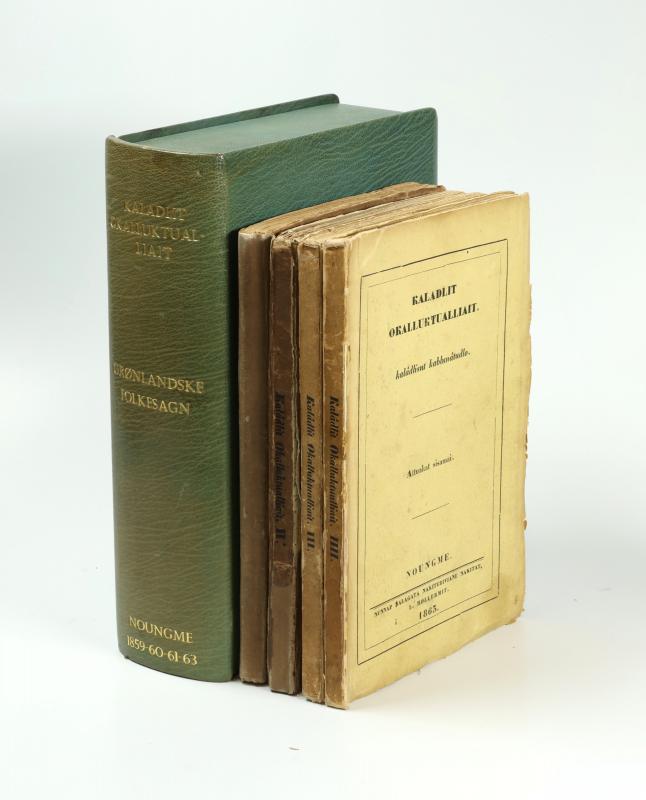
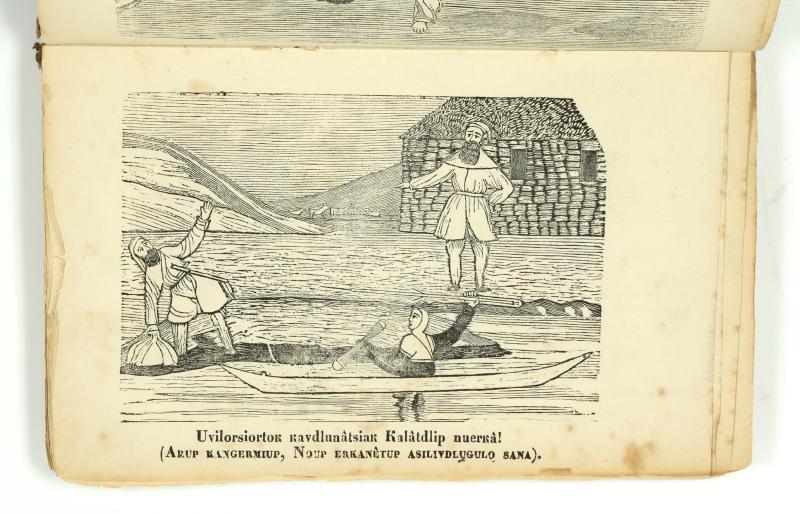
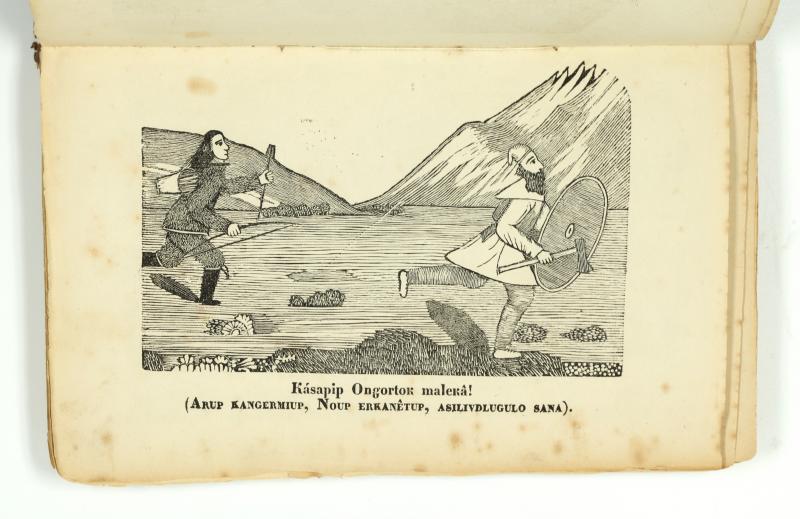
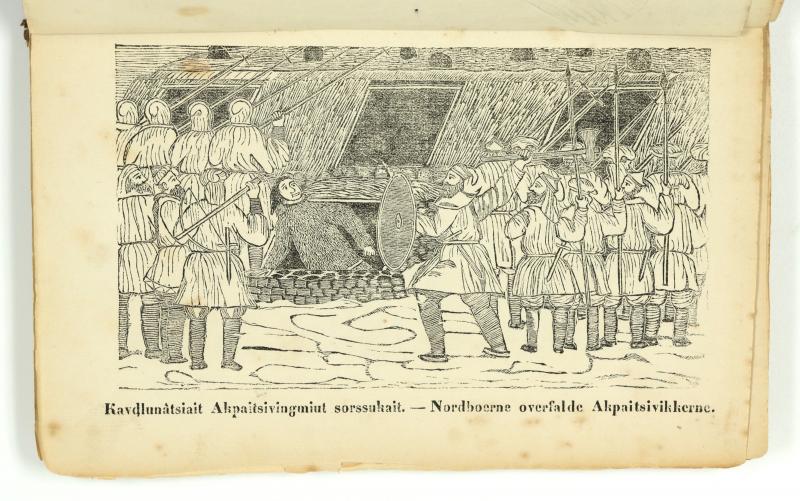
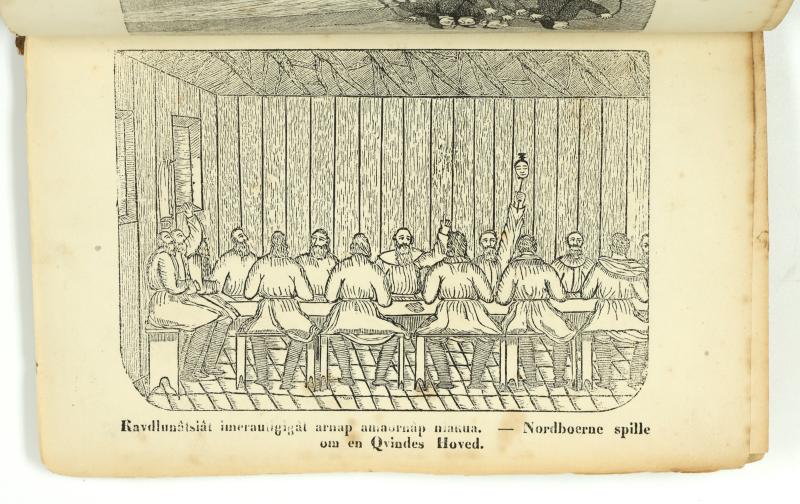
Kaladlit Okalluktualliait (Grönlandske Folkesagn / Greenlandic Folktales). Nuuk, Lars Møller, i Inspectoratets Bogtrykkeri, 1859-1863. 8vo (141 x 211 mm). 4 vols. 1) (8), 136 pp. with coloured vignette at front, 12 woodcuts and 8 lithographed plates of music. 2) (8), 111 pp. with woodcut vignette, 7 black-and-white and 12 hand-coloured woodcuts, and two folding maps of the area around Nuuk by S. Kleinschmidt. 3) (6), 136 pp. with 12 black-and-white and 2 hand-coloured lithographs. 4) (6), 123 pp. with 3 woodcut plates and 8 woodcuts in text. Original printed boards. In a custom blue-green morocco solander box. A landmark collection of Greenlandic folk-tales, told and illustrated by native Greenlanders, printed on the first major printing-press in the country. The stories drew on centuries of oral tradition, and included topics such as conflict between the Greenlanders and the Norse colonists who settled the country during the Viking Age. These four volumes are illustrated with numerous woodcuts, most of them by the native hunter and artist Aron of Kangeq, executed in a distinctive and evocative style. Although overseen by the Danish administrator Hinrich Rink, the stories, the artwork and the printing are all the work of native Greenlanders, making this work a testimony to Greenlanders' agency in preserving their culture in the face of imperialism. Some of the tales are set in the distant past, when southern Greenland still had Norse inhabitants, descendants of Viking-Age settlers, called "Kablunaks" by the Greenlanders. Although legendary in character, the tales relate how the Greenlanders and Kablunaks came into contact in the area around Nuuk and lived in harmony until strife was sown by the maid Navaranak. She tricked the Kablunaks into attacking the Greenlanders, who counterattacked in boats camoflauged with hides to look like blocks of ice. We also hear of the revenge of the Greenlander Kasape on the Kablunak chieftain Ongurtok, who had killed his brother: one of the most memorable illustrations shows Kasape holding up Ongurtok's severed arm to show it to him before he died. The tales are printed in the original Greenlandic with a facing-page Danish translation (except in Vol. III, which appends an abbreviated translation after the Greenlandic text). The collection came into being under the oversight of the Danish colonial administrator Hinrich Rink, who arrived in Greenland in 1848. Rink became concerned with the deleterious effects that colonialism and missionary work was having, not merely on the Greenlanders' physical wellbeing, but also on their language and culture. To combat this, he set up local councils, reinstated the native religious leaders (Angakoks) who had been banned by the missionaries, and began an initiative to collect oral traditions. In 1857 he established the first serious printing-press on Greenland, operated by his native assistant, Lars Møller. The first two volumes are illustrated with the work of the Greenlandic hunter Aron of Kangeq. Hearing of his artistic talent, Rink supplied with tools for producing woodcuts, and the results were works of striking, raw evocative power to accompany the narratives. Of the 30 full-page woodcuts by Aron, 12 in these volumes are hand-coloured. In volumes III and IV, the illustrations were produced by Møller on Greenland's first lithographic press. The two maps in vol. 2 are rarities in their own right and not always included with the set: also prepared from information provided by Aron of Kangeq, they show the hunting-areas and sites connected with Norse settlement discussed in the text. They were printed in 1860 by S. Kleinschmidt, also on Rink's press in Nuuk. Greenland was settled by Norse colonists from Iceland and Norway in the tenth century, during the medieval warm period, when the southern part of the island offered suitable land for agriculture. The Inuit Greenlanders, whose way of life was based on hunting and fishing, lived further north at the time. As the climate grew colder in the later Middle Ages, the Norse colony disappeared, and the Inuit spread further south. Danish-Norwegian colonists arrived under the missionary Hans Egede in 1721, hoping to find some remnants of the Norse settlers. None were found, but the new settlers brought the country under the Danish crown. Colonialism left a lasting mark on the native population and their culture, with early missionaries producing dictionaries and grammars of the Greenlandic language but also suppressing their religion and traditions. Rink and the Greenlanders he worked with played a vital role in preserving these from extinction. Rare: Rare Book Hub records only two other complete sets sold at auction within the last decades. A stunning monument to Greenlandic culture, art and language.
Boards browned and worn, spine of vol. 1 rebacked, front hinge of vol. 2 cracked, cover of vol. 3 with minor staining and marks in pencil. Internally some pages uncut or with minor marginal tears, some staining and foxing, plates not bound into volumes. In general clean and clear, a very good copy and a remarkable survival given the conditions of the Greenlandic climate. Provenance: 1) Johannes Wandall and the date 1872 inscribed on the front cover and paste-down of the second volume. 2) All volumes with the bookplate of the Danish-born physician, scholar and bibliophile Bent Juel-Jensen, Oxford (1922-2006). 3) Sold at Christie's, London, 2 June 2010. 4) European private collection.
40000,- EUR
inkl. 7% USt./incl. 7% VAT
Sachgebiete: Arktis/Antarktis, Dänemark, Indigene Kulturen, Skandinavien, Sprachwissenschaft
Kontakt zum