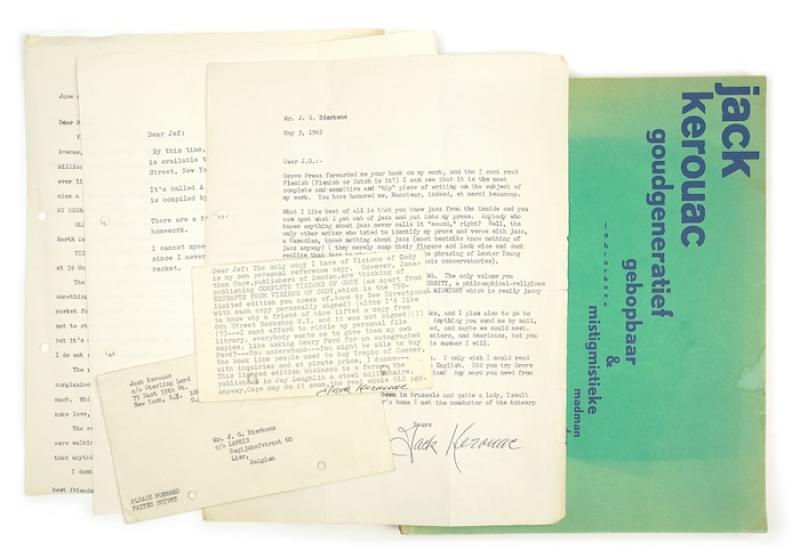
Jack Kerouac. ‘you know jazz from the inside’.  Auf Merkliste setzen
Three original typed letters and a card, each signed in ink, addressed to the Belgian author Jef Bierkens (1939-2025). Bierkens was part of the so-called Labris group and was one of the founding editors of the Belgian avant-garde magazine of the same name. Dating from 1964 to 1969, the letters were sent in care of Sterling Lord, Kerouac’s literary agent in New York. One original envelope is preserved. Unpublished. Added: J.G. Bierkens. Jack Kerouac, goudgeneratief gebopbaar & mistigmistieke madman der droevige verdwazing. (1965) Lier, Labris, Labirint-uitgave 7, first and only edition, author’s copy, 153p. 27:21,5 cm. Mimeographed.
Around 1960 young jazz fanatic and experimental poet Jef Bierkens learned from a friend that a new type of literature influenced by jazz existed, in which similar rhythm and improvisation techniques were used. Thus Bierkens discovered Beat literature, and became especially fascinated by the work of Jack Kerouac. He read and studied Kerouac’s work thoroughly, resulting in his extensive essay ‘Jack Kerouac, goudgeneratief gebopbaar & mistigmistieke madman der droevige verdwazing’ (‘Jack Kerouac, goldgenerative bebopable & misty-mystical madman of sad bewilderment’), published by Labris in 1965. This early study of Kerouac was the first in the genre to appear in the Dutch-speaking world. Its experimental flow of language in which it is written has a jazzy touch and comes close to Kerouac’s own style. Bierkens managed to collect almost all of Kerouac’s work that had been published at that time. From the few letters he received from Kerouac, which are included in this collection, we can see that Kerouac appreciated how well Bierkens understood his work. Unable to read Dutch himself, Kerouac must have formed his opinion based on the content of the letters he received from Bierkens. ‘May 3, 1965/ Dear J.G.:-/ Grove Press forwarded me your book on my work, and tho I cant read/ Flemish (Flemish or Dutch is it?) I can see that it is the most/ complete and sensitive and “hip” piece of writing on the subject of/ my work. You have honored me, Monsieur, indeed, et merci beaucoup./ What I like best of all is that you know jazz from the inside and you/ can spot what I got out of jazz and put into my prose. Anybody who/ knows anything about jazz never calls it “sound,” right? Well, the/ only other writer who tried to identify my prose and verse with jazz,/ a Canadian, knows nothing about jazz (most beatniks know nothing of/ jazz anyway) (they merely snap their fingers and look wise and dont/ realize that jazz is phrasing and that the phrasing of Lester Young/ will be studied in the next century in music conservatories).’ (Expanded description on demand)
15000,- EUR
Differenzbesteuert/Subject to margin taxation
Sachgebiete: Alternativkultur, Amerika, Autographen, Avantgarde, Handschriften
Kontakt zum