Antiquariat Daniela Kromp
MANUSCRIPTS – BERLIN – PAUL GURK.  Auf Merkliste setzen
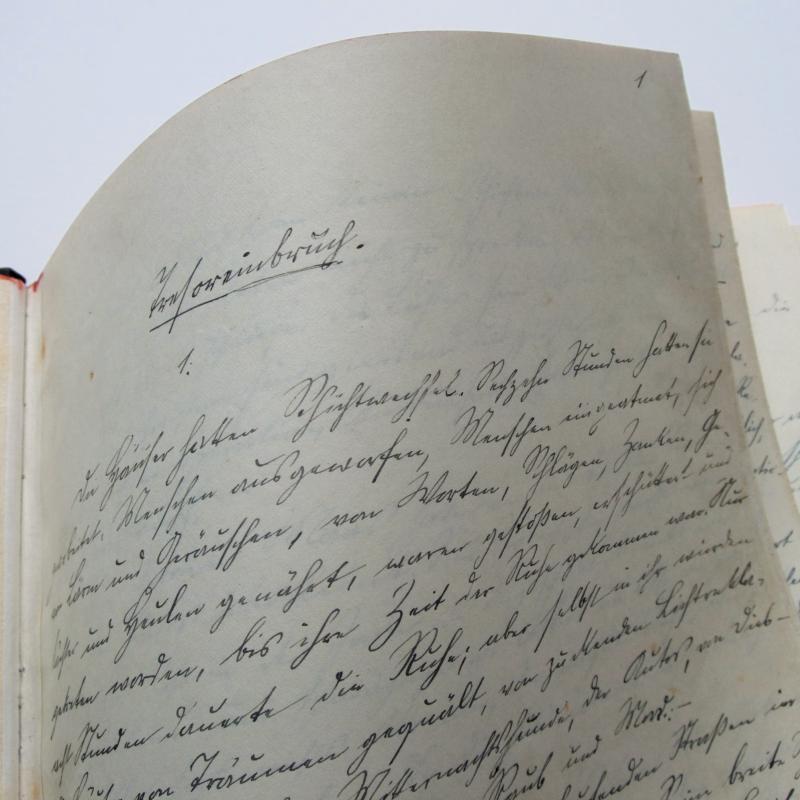
Paul Gurk: Tresoreinbruch [Bank Vault Burglary] (title to spine and heading to first leaf). Autograph manuscript in ink on cream writing paper by Paul Gurk, being the fair copy for his novel Tresoreinbruch (first published: Berlin, Holle, 1935). Berlin, [between 1929 and 1935]. 188 numbered leaves, written one-sided. Contemporary plain half morocco binding with five raised bands and gilt title lable to spine. 22 x 28,5 cm.
Paul Gurk (1880-1953) was a German novelist, playwright and artist, who was born in Frankfurt an der Oder, but spent most of his life in Berlin. "Gurk is one of those multiple artistically gifted persons, who created remarkable works not only in the field of literature, but also in the visual arts, which sadly haven’t been paid a lot of attention in their day" (translated from: Günther, p. 178). In 1921, Gurk received the Kleist prize for his historical novel Thomas Münzer. In 1935 his science fiction novel Tuzub 37 appeared, which Hans Frey considers the SF novel of the highest literary quality published during the Nazi time (cf. Frey, pp. 461-467). Furthermore, Frey states Gurk’s novel Berlin (1934) to be "definitely congenial" with Alfred Döblin’s Berlin Alexanderplatz (cf. ibid.). – Gurk’s Tresoreinbruch was banned by the Nazis immediately after its appearance in 1935 (cf. Geus, p. 113). It is a crime novel based upon facts: The legendary robbery of the Diskonto Bank in Berlin, committed by the Sass Brothers in 1929. From 1926 on, Franz (*1904) and Erich (*1906) Sass committed a series of burglaries in Berlin, until they decided to move to Copenhagen in 1933, where they went on with their "business", before they were finally arrested and jailed in 1934. Right after their release in 1938, the brothers have been extradited to Germany, there arrested again, and in 1940 been murdered by the Nazis; the money and property from the Diskonto Bank robbery has never been recovered (cf. USHMM, pp. [1-2]). – We join: A small booklet documenting an exhibition on Paul Gurk, organized by the Kleist-Gedenk- und Forschungsstätte in Frankfurt an der Oder in 1992 (23 pages, without any reproductions, stapled, no binding, 14,5 x 21 cm). – Provenance: From the collection of Munich jazz singer and graphic designer Willi Johanns (1934-2024), with a leaf of his personal handwritten notes on the Gurk manuscript in pencil loosely inserted. – Spine slightly rubbed. Else fine. – Cf. Liste des schädlichen und unerwünschten Schrifttums (1938), p. 51. Cf. Walther Killy (ed.): Literatur Lexikon, vol. 4, pp. 432–433. Cf. Walter Frey, Der Wedding und die Bücherverbrennung am 10. Mai 1933, online at: weddingweiser.de. Cf. Herbert Günther, Künstlerische Doppelbegabungen, p. 178. Cf. Klaus Geus, Zwischen Widerstand und Anpassung. Die Kritik am Nationalsozialismus in Paul Gurks dystopischem Roman TUZUB 37, in: Marco and Helena Frenschkowksi (ed.) Festschrift zu Kalju Kirdes 75. Geburtstag, pp. 105-114. Cf. Hans Frey, Aufbruch in den Abgrund. Deutsche Science Fiction zwischen Demokratie und Diktatur. Von Weimar bis zum Ende der Nazidiktatur, 1918–1945, pp. 461-467. Cf. United States Holocaust Memorial Museum (USHMM), Visit Information: Law, justice, and the Holocaust. How the courts failed in Germany. Case study – The Sass Brothers and the aftermath of the Discount Bank Robbery in Berlin, 1929, pp. [1-2], online at: ushmm.org/m/pdfs/20120828-case-study-sass-brothers.pdf
4800,- EUR Sachgebiete: Autographen, Handschriften, Literatur ab ca. 1900, Vorzugsausgaben Kontakt zum
inkl. 7% USt./incl. 7% VAT