Antiquariat Daniela Kromp
SILHOUETTES – JOSEPH WIDNMANN (?).  Auf Merkliste setzen
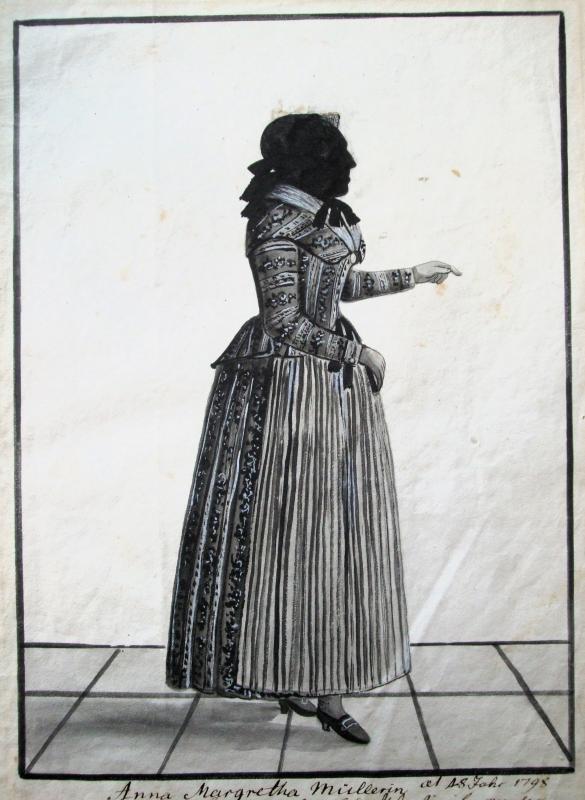
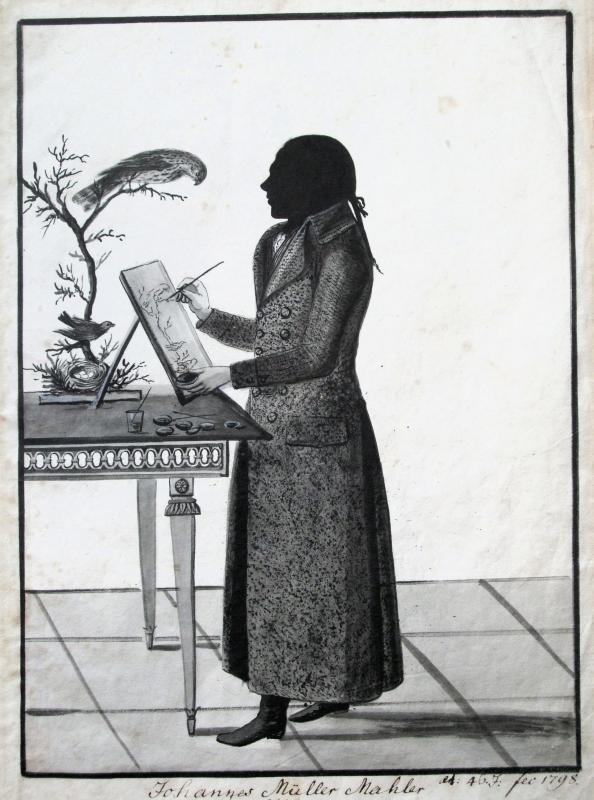
Double silhouette portrait of Nördlingen artist and antiquarian book dealer Johannes Müller (while drawing an illustration for his birds book from nature), and his wife Anna Margaretha Müller, very probably made to serve as frontispieces in the manuscript of his work on German songbirds. (Wallerstein or Nördlingen / Swabia, Germany), 1798. Black ink and wash on wove paper, heightened with white. 2 leaves, each contemporarily tipped to grey laid paper and captioned below: "Johannes Müller Mahler ǀ a[l]t 46. J[ahr] ǀ fec[it] 1798 ǀ [somewhat later:] gebohren den 10. Juli 1752."; respectively: "Anna Margretha Müllerin ǀ a[l]t 48 Jahr 1798 ǀ [somewhat later:] gebohren den 17 Sept 1750. Starb sanft so wie ihr ganzer Character war den 9 Januar 1820." (Johannes Müller, painter, aged 46 years, made 1798, born July 10th 1752; Anna Margretha Müller, aged 48 years in 1798, born September 17th 1750. She died as gentle as her whole character was on January 9th 1820). c. 18,8 x 25,9 cm (motifs); c. 21 x 32 cm (leaves); 38 x 48 cm (passepartouts).
Joseph Widnmann (1749-1825) was a lawyer born in Wallerstein (Swabia), where he was nominated "Regierungs-Secretär" (government secretary) to the royal court of Oettingen-Wallerstein in 1774, and "Kanzleiverwalter" (chancellery administrator) in 1781 (cf. Grünsteudel, p. 3). Being an amateur artist, his so-called gold ground silhouettes, a series of silhouette portraits of musicians and music ensembles, nevertheless became famous: They were taken at the Oettingen-Wallerstein court and drawn in black on golden prepared paper during the 1780s. Only parts of this silhouette series have survived, kept by the Fürstlich Oettingen-Wallerstein’sche Sammlungen (today probably at Baldern Castle, near Bopfingen). Widnmann is believed to have made a large number of these portrait silhouettes in total (also including such in black on a white ground), of which 70 still could be traced in 1898 (cf. Grünsteudel, p. 3). In fact, two portraits in black on a white ground showing Count Kraft Ernst and Countess Wilhelmine Friederike zu Oettingen-Wallerstein are very similar to the present double portrait concerning style and perspective (cf. ibid., reproductions 6 and 7), with the persons’ heads being completely black, while all other parts are drawn in detail. Although the floor design is different compared to this pair of silhouettes, the floor of our double portrait pretty much matches the floors of some of Widnmann’s gold ground silhouettes depicting musicians (cf. ibid., reproductions 1, 9 and 10). – Johannes Müller (1752-1824), sometimes also referred to as "Johann", according to Thieme/Becker was a landscape painter, etcher, engraver and form cutter from Nördlingen (cf. ibid. vol. XXV, p. 234). He was a pupil of Alois Schweigländer (1740-1812), Johann Michael Frey (1750-1819), Carl August Großmann (1741-1798), Johann Jakob Mettenleiter (1750-1825) and one "Winter zu Wallerstein" (Nagler X, p. 1), whom I wasn’t able to identify in more detail. Before becoming an artist in 1776/1778, Müller used to work as a baker from an early age (cf. ibid.). In 1782 he received the privilege to draw geographic maps and to deal with maps and paper, though without achieving economical success (cf. Kilian, p. 30). On March, 23rd in 1821, Müller announced an art auction for the 26th and 27th in the local newspaper, including paintings, engravings, bound volumes, botanical plants, two globes, as well as a small "Naturalien-Cabinet" (cf. Intelligenzblatt der Königlich Baierischen Stadt Nördlingen, vol. 1821, no. 11, p. [3]). Apart from this, not much is known about his work as an antiquarian book dealer. His numerous other professions and occupations listed in the headline I have gathered from various sources (mainly from Kilian, pp. 29-33, but also from his own publications’ title pages), and the list is not even complete! Kilian states: "Neither his historical works nor his views were always flawless, but the extent of his part-time work is impressive, especially as he had no proper artistic training." (translated from: ibid., p. 31). Johannes Müller and Anna Margaretha (1750-1820, née Klein) got married in 1773 (Nagler X, p. 1). Oddly enough, Müller shortly after her death married a woman with exactly the same forename. Interestingly, in one of Müller’s poems included in his pomology manuscript, he mentions his first wife and (very similar to the captions in our drawing) later writes down an addendum there, reading: "Sie starb den 9. Jenner 1820. So gut wie sie lebte." (She died on January 9th 1820. As well as she lived) (Dettweiler, p. 15). Although the hand in the captions on the present drawings is equal to Johannes Müller’s hand in his pomology manuscript (cf. Müller, Rieser Obstsorten, pp. 23ff.), which usually would indicate Müller as well made the portraits, it is much more conceivable they were drawn by Joseph Widnmann himself, with Müller finally only adding the captions. It is very likely Müller might have commissioned the drawings from Widnmann to use them as frontispieces, embellishing the original manuscript of his work on German songbirds, given that five watercolours connected to the same work auctioned by Lempertz in November 2014 (lot no. 1154) not only had almost exactly the same dimensions, but also the captions and page layout were very similar. In any case it isn’t unlikely at all both artists knew each other in person, as Wallerstein is merely a one hour walk from Nördlingen and Müller, being the jack of all trades that he was, must have been well connected. There’s also evidence Müller had been in touch with the royal court of Oettingen-Wallerstein earlier, when the Royal Wallerstein Library at Maihingen purchased his chronicle, comprising 5 bulky volumes, at 50 guilders (cf. Kilian, p. 30). Probably Müller hoped to sell his birds manuscript to the court as well at some high price. And there might also be an additional connection between Widnmann’s silhouette drawings and Johannes Müller, coming about the Mettenleiter family: The estate of Johann Michael Mettenleiter (1791–1859), the last Wallenstein court conductor, included a number of Widnmann’s silhouettes (cf. Grünsteudel, p. 4), and Johannes Müller has been a pupil of painter Johann Jakob Mettenleiter (1750-1825), with both Mettenleiters born in Großkuchen (today in Baden-Württemberg), not far from Nördlingen. – Georg Kaspar Nagler, Neues allgemeines Künstler-Lexicon, vol. X, pp. 1-2. Ulrich Thieme / Felix Becker, Allgemeines Lexikon der bildenden Künstler, vol. XXV, p. 234. Johann Georg Meusel, Teutsches Künstlerlexikon, vol. 2, p. 70. Cf. Ruth Kilian, Johannes Müller (1752-1824), in: Blicke auf das Ries, pp. 29-33. Cf. Wilfried Sponsel, Nördlinger Messe, in: Historisches Lexikon Bayerns online, reproduction of Müller’s watercolour Der Nördlinger Marktplatz, 1822. Cf. Herbert Dettweiler, Lebensbeschreibung des Johannes Müller, in: Johannes Müller, Abbildung von Rieser Obstsorten, Teil 1, pp. 13-21. Cf. Günther Grünsteudel, Kontur, Haltung, Ordonnanz, Schatten. Die Oettingen-Wallersteiner Goldgrund-Silhouetten und ihr Schöpfer, in: Rosetti-Nachrichten 2 (2022), pp. 1-4. References for Johannes Müller’s Die vorzüglichsten Sing-Vögel Teutschlands mit ihren Nestern und Eyern nach der Natur abgebildet und aus eigener Erfahrung beschrieben (1799-1800): Claus Nissen, Die illustrierten Vogelbücher, 656. VD18 11721227. Schlenker 246.1. Anker 347. Sitwell / Buchanan, p. 126. Ankers, p. 166. Not in Wood or Ayer.
3000,- EUR Sachgebiete: Bibliophilie, Buchwesen, Graphik, Ornithologie, Zeichnungen Kontakt zum
inkl. 7% USt./incl. 7% VAT