Antiquariat Daniela Kromp
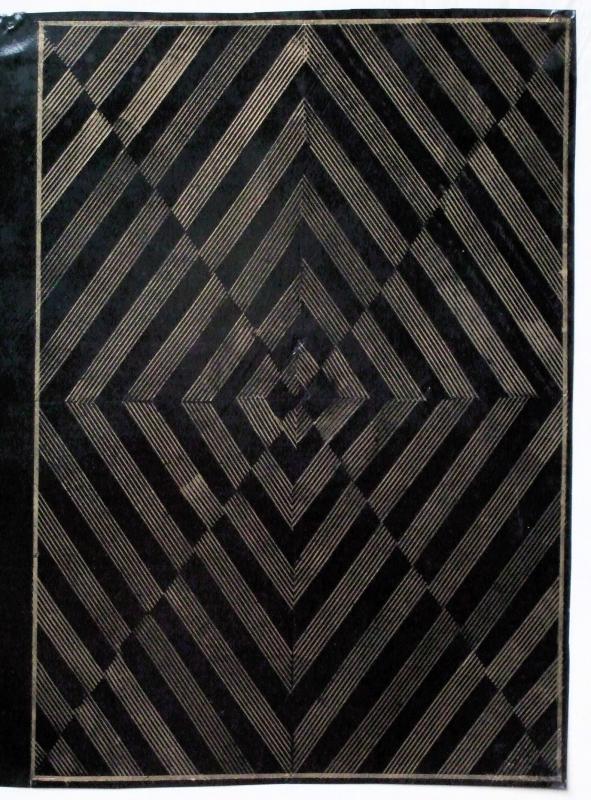
BOOKBINDING – EMIL KRETZ.  Auf Merkliste setzen
A series of 25 original designs for luxury bindings with geometrical or abstract decor. Basel, c. 1926 - (after) 1949. Mixed media on glazed paper, handmade paper, or transparent paper in various colours, some mounted to light cardboard or paper, or tipped under passepartout, two folded, one signed to verso "E Kretz". 15,5 x 21,5 cm to 39 x 64,5 cm.
The design with Kretz‘s signature also has several manuscript notes to verso, indicating it was made for Werner Reinhart to adorn Othmar Schoeck‘s Penthesilea musical score, which premiered in 1927: "Vorschlag für Othmar Schoeck / Penthesilea, in rot Maroquin lt. Muster, Rückendruck (…), Steh- Innenkanten Lederfach (?) und vertiefter Seidenspiegel / EKretz // An Herrn Werner Reinhart, Winterthur". The musical score was to be bound in red morocco with title to spine, the edges of the boards and inner edges decorated, with sunken pastedowns made from silk, maybe also including a leather pocket (?). One of the other designs is verified according to a binding signed by Kretz in the Max Hettler collection held by the WLB Stuttgart (shelfmark 51/90057), with the colours of the design exactly matching those of the actual binding. It was made for a copy of Die sieben Töchter des Canigou, a German translation of Pierre Valmigère‘s Les sept filles de Canigou, printed in Zurich in 1949 (Sammlung Max Hettler, pp. 25, 116 and 117). Another design is verified according to a signed binding sold at auction in Hamburg in 2015 (cf. Christian Hesse, Auction 11, no. 386, with reproduction): A German translation of Dostoevsky‘s A Nasty Story, printed in Munich in 1918. The manuscript notes accompanying this design read: "Vorschlag zu Dostojewski: Eine dumme Geschichte // dkl. braun Oasis Morocco // 185 fr." (Suggestion for Dostojewski: Eine dumme Geschichte // dark brown oasis morocco // 185 Swiss franc). The series offered here also includes another design for the same book by Dostoevsky, this time with a more simple design (thus offered at a lower price of 140 Swiss franc only), however to be bound in the same morocco, including a leather sample mounted. Four more designs specify the book titles they have been made for: the Johannes-Evangelium (Gospel of John); Hugo von Hoffmannsthal‘s Kleine Dramen (Short Dramas); and two times Wilhelm Matthiessen‘s Der Himmelsküster (Heaven‘s Sacristan), one of which was to be bound in "zimtbraun Oasenziegenleder" (cinnamon brown oasis gotaskin), also including a leather sample mounted. Three more designs bear fictional titles. – Emil Kretz (1896-1960) was a Swiss bookbinder and subject teacher at the Allgemeine Gewerbeschule (General Trade School) in Basel. Today he‘s famous for developing a certain kind of decorated paper, named after him ("Kretzpapier"), combining paste paper and batik technique. Kretz was born in Bremgarten, in the Canton of Argovia / Switzerland. From 1918 to 1921 he trained as a bookbinder at the Kunstgewerbeschule (School of Applied Arts) in Zurich. He received his further education in 1921 and 1922 in Berlin and at the Kunstgewerbeschule (School of Applied Arts) in Stuttgart / Germany. Afterwards, he was employed at the Großbuchbinderei Heinrich Koch, an industrial bookbindery in Stuttgart. From 1922 to 1924 he was a superintendent at the bookbindery of the Offizin Hans Schatzmann, a small print shop at Horgen / Switzerland. From 1924 to 1925 he was a bookbinder at the Officina Bodoni in Montagnola (Canton of Ticino / Switzerland), and afterwards self-employed. From 1926 until his death in 1960, he was a teacher for bookbinding at the Allgemeinen Gewerbeschule in Basel. Apart from several articles in binding journals, Emil Kretz also published two reference books: Das Buch als Gebrauchsform (1957) and Dreihundert Jahre Marmorpapier (1960), an overview on the history and manufacturing of marbled paper. – Werner Reinhart (1884-1951) was a Swiss merchant, philanthropist, amateur clarinetist, and patron of composers and writers, particularly Igor Stravinsky, Rainer Maria Rilke, Paul Hindemith, Anton Webern, Arthur Honegger, Othmar Schoeck and Ernst Krenek. Reinhart knew and corresponded with many artists and musicians of the early-mid 20th century in Europe world, and his Villa Rychenberg in Winterthur became an international meeting point for musicians and writers. He was sometimes referred to as "the Winterthur Maecenas". Avant-garde paintress Alice Bailly named Werner Reinhart L'homme aux mains d'or (the man with the golden hands), and her 1920 portrait of him is called "The Man with the Golden Heart". Oskar Kokoschka also painted his portrait in 1947. Werner Reinhart inherited his wealth from the Volkart family business, based in Winterthur. Reinhart and German conductor Hermann Scherchen played a leading role in shaping the musical life of Winterthur between 1922 and 1950, the emphasis being on contemporary music, and they were instrumental in numerous premieres being performed there. – Some minor defects and creases due to the fragility of the papers used. Three designs mounted using sellotape. – Cf. [Julia Rinck], Emil Kretz, online at: buntpapier.org (buntpapier.org/historische-buntpapiermacher/emil-kretz.html). Cf. Sammlung Max Hettler, 2. November bis 8. Dezember 1991, pp. 25, 116 and 117; on display online here: tinyurl.com/27cy6fns. – Sammlung Max Hettler in der Württembergischen Landesbibliothek Stuttgart wlb-stuttgart.de/referate/drucke/hettler/k029_oasenziegenlederband_hellbraun_kretz_1949.htm – Further reading: Marianne Moll, Emil Kretz und seine Buntpapiere / Emil Kretz and his decorated papers.
1400,- EUR Sachgebiete: Aquarelle, Buchwesen, Einbände, Kunsthandwerk, Zeichnungen Kontakt zum
inkl. 7% USt./incl. 7% VAT