Antiquariat Daniela Kromp
PROPHECY – MICHAEL NOSTRADAMUS.  Auf Merkliste setzen
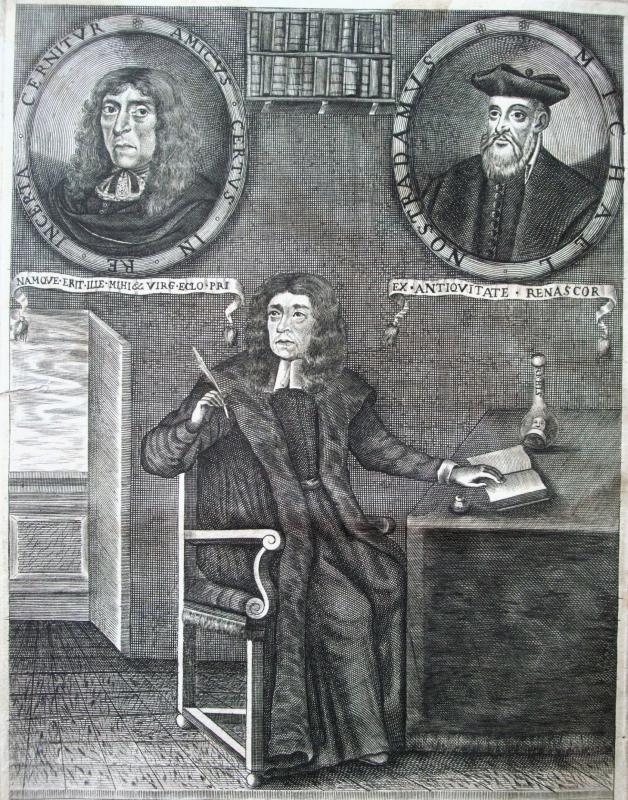
The true prophecies or prognostications. A work full of curiosity and learning. Translated and commented by Theophilus de Garencières. London, Thomas Ratcliffe and Nathaniel Thompson, 1672. Title page (printed in red and black), engraved frontispiece portrait, [34], 522 pages. Contemporary full calf. 20 x 30,5 cm.
First edition in English of Nostradamus‘ book of prophecies, first printed in France in 1555 entitled Les prophéties. Complete with the portrait frontispiece which is lacking in some copies. – Nostradamus‘ more than 1000 rhyming quatrains, arranged in "centuries" of 100 "constitute the largest body of prophetic verse prepared to that day, perhaps in all literature" (John Clute & John Grant, The Encyclopedia of Fantasy, p. 694). – [The following book description was done by Peter Harrington (London) – courtesy of Sammy Jay:] "The True Prophecies translates and annotates over 900 of the French astrologer's quatrains. – English interest in Nostradamus grew after the seismic events of the mid-17th century, as many commentators sought to understand the civil wars, Commonwealth, and Restoration within a wider divine scheme. "More than any other writer in modern times Nostradamus knew how to titillate the deep-seated craving, felt by potentate and plebian alike, to foresee the future, near and remote" (DSB). This interest in prophecy extended to surprising quarters: in the 1680s, Isaac Newton worked extensively with Henry More to interpret the biblical prophecies of Daniel and Revelation within his wider scientific worldview. – Nostradamus (1503-1566) began his prophetic career in the 1540s with yearly almanacs. Their success led to the publication of his most influential collection, Les Prophéties (1555), which forms the basis of the present work. This edition pairs the French text of each prophecy with an English translation and a brief commentary and appends a 17-page biography of Nostradamus at the beginning. The True Prophecies is organized into nine groups of 100 quatrains and an incomplete tenth, each in rhyming iambic pentameter. The first edition of 1555 published 350 quatrains, before the complete collection of 942 was published posthumously in 1568. However, the translator of the present work unwittingly based it on a counterfeit French edition of 1649 with two forged quatrains (VII-42 and 43, pp. 293-4). These forgeries sought to discredit Mazarin and supernaturally legitimize public resentment of his taxation policies; their true author is unknown. The translator, Theophilus de Garencières (1610–c.1680), was a French physician who settled in Clerkenwell after leaving the Catholic Church." [end of book description by Peter Harrington]. – Provenance: Louis Langloiserie with his owner‘s inscription in ink to title page; i.e. probably Louis-Hector Piot de Langloiserie (born c. 1695), a "French Canadian immigrant who had embraced Protestantism"; Langlois taught French at Harvard college from 1733, and has been dismissed in 1735 due to his "revivalist enthusiasm" (cf. Richard Hofstadter, Academic Freedom in the Age of the College, pp. 157 and 162; cf. Harvard College Records, vol. 15, p. CLIX). Thomas Davis jun., with his owner‘s inscription in ink to frontispiece, dated 1800. Nostradamus Collection of Dr. Elmar R. Gruber (Munich). – Lacking last blank, else complete. A poor copy: Spine and headbands replaced in the late 19th or early 20th century, reusing the original title label. Spine worn and heavily rubbed. Corners heavily bumped, with some loss of material to corners of front cover. Title page and frontispiece soiled and with some short tears to margins. Frontispiece bound in after title page (probably added from another copy). Paper stained or tanned in places. – Wing N 1399. ESTC R13646. Chomarat 259. Brunet IV, 105. Caillet 8073. Sabin 55936.
6000,- EUR Sachgebiete: Occulta Kontakt zum
inkl. 7% USt./incl. 7% VAT