Inlibris GmbH
Cicero, Marcus Tullius.  Auf Merkliste setzen
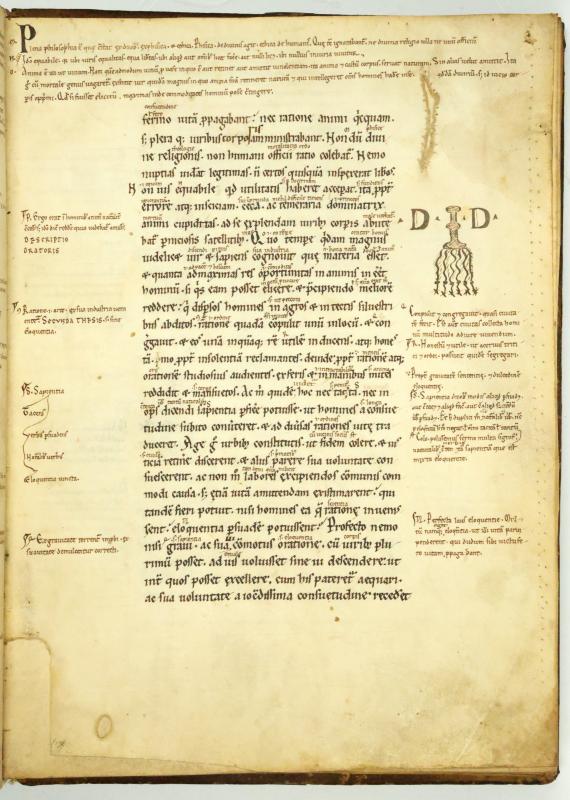
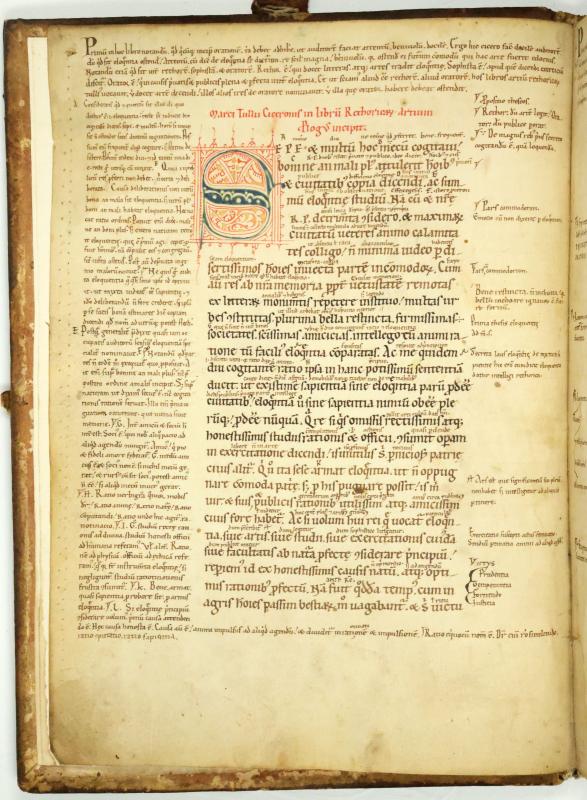
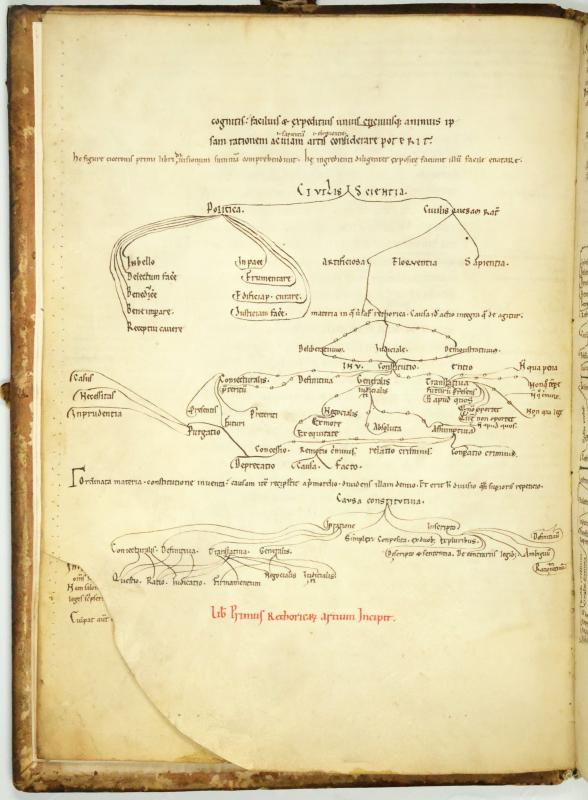
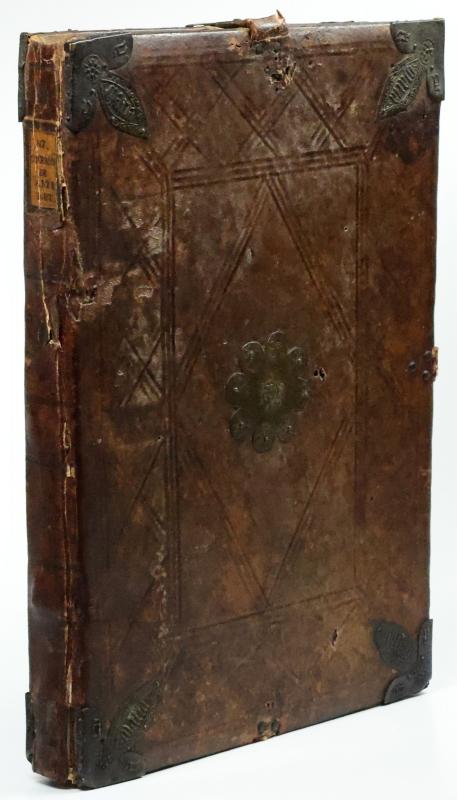
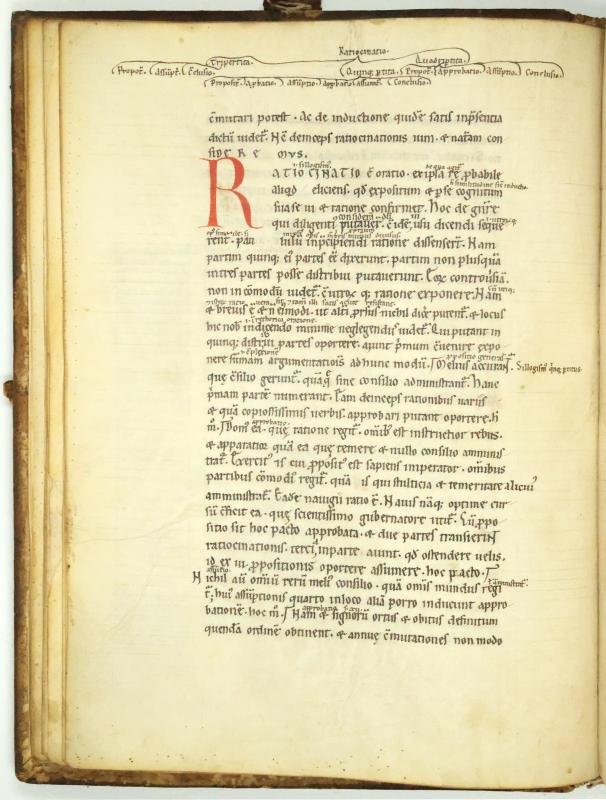
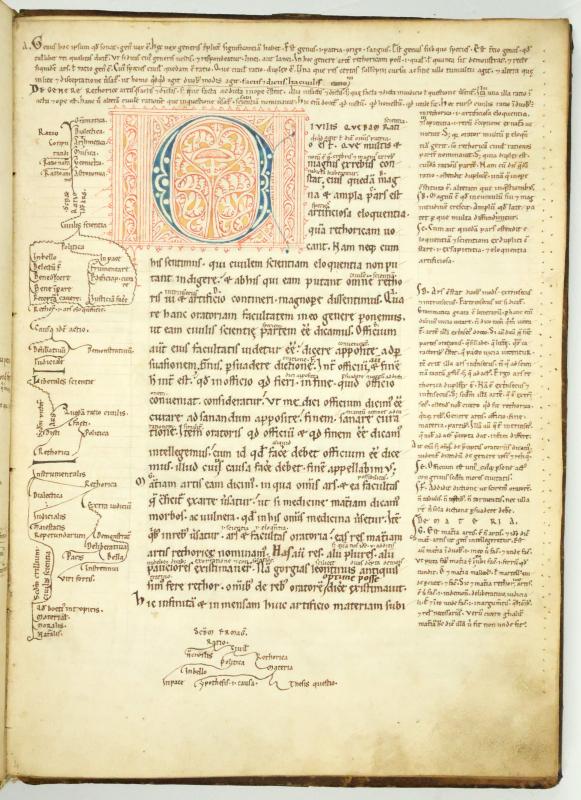
De inventione. Probably Rein Abbey, Styria, c. 1100. Folio (240 x 330 mm). 58 ff., complete. Latin manuscript on vellum, early protogothic script in three hands, ruled in lead-point with double prickings. 14th/15th-century blind-tooled leather over wooden boards, brass corner-pieces, edge guards, catches and remnants of clasps; later paper title-label to spine. Stored in a custom protective case. With rich illustrations, diagrams and glosses, this stunning manuscript of Cicero's earliest work on rhetoric is also of remarkable dimensions: only one other pre-1200 manuscript of comparable size is known, in the Bodleian Library in Oxford. The marginal additions are no less notable, containing hitherto unattested, longer versions of the so-called "Carmina Runensia", some of the oldest poetry known from Austria. This volume thus represents a once-in-a-lifetime find, providing us with an unparalleled testimony to the medieval study of classical rhetoric as well as poetic production. Immediately striking are the finely executed interlinear glosses, providing simpler alternatives to Cicero's elevated vocabulary, showing the attention that went into crafting this volume as an aid to teaching and learning. This is further illustrated by the marginal commentary providing background and elaboration, and the multiple diagrams (four full-page, one two-page) illustrating the flow of an argument with great detail and clarity. They are notably more comprehensive than similar examples in other manuscripts of the text, and were carefully planned as part of the volume, being executed in the hand of the first of the two main scribes. Unique to this manuscript are two extremely rare poems in Leonine hexameters preserved in the margins, written in a later, third hand: in one, the twelfth-century poet Meginardus praises Cicero while damning other classical authors; the second, possibly also by Meginardus, is a paean to the glories of spring. These poems are otherwise only known from a single codex, held by the Abbey of Rein in Styria. Known as the "Carmina Runensia", they are among the earliest examples of poetic art from Austria. Notably, the versions in this codex contain some 800 extra, hitherto unedited lines, providing a vital new witness to these texts. Together with palaeographical and codicological considerations, this suggests that our codex was also produced at Rein, or at least in Austria or Southern Germany. This conclusion is strengthened by the use of the commentaries both of Victorinus and Grillius, which were known in the region, being attested in the library of Tegernsee Abbey, among others. The manuscript was later in the possession of the "Domus Dei" in Trento, a community of flagellants established c. 1340. Their ownership-mark with a scourge appears throughout the text in the margins and on the front leaf. The attractive leather binding, still with its metal fixings and the remnants of clasps, was produced in the later fourteenth or early fifteenth century. Written while Cicero was still a young man, 'De inventione' is one of the oldest tracts on rhetoric to survive in Latin. Although in his old age he considered the text eclipsed by his more mature works on the subject, it remained an incredibly popular piece, both in antiquity and the Middle Ages. Beyond its explicit subject, namely the invention of rhetorical texts, Cicero also explores philosophical themes, including the foundations of a just society on notions of duty, gratitude and loyalty to the truth. In 'De inventione', we thus see the germination of Cicero's idea that philosophy and oratory could never truly be separated. A great rarity: most manuscripts of 'De inventione' are small, normally in octavo format, the only comparable pre-1200 example being in the Bodleian Library. Rare Book Hub records only three sales of manuscripts of 'De inventione' over the past 100 years, the only one of similarly early date appearing in 2001. A remarkable and unique witness to one of Cicero's earliest and most defining texts.
Boards with wear and some small holes; spine cracked, but overall in very good condition for a piece this venerable. Some old repairs to margins with parchment or paper strips, a few leaves trimmed; blank portion of final leaf cut away and replaced with later parchment. Some natural flaws and original holes to vellum, a few early repairs in yarn. Some corrections over erasures. Overall in very good condition, especially for a volume still in its medieval binding. Provenance: 1) Written in a Southern German or Austrian monastic school, probably the Cistercian monastery of Rein in Styria, founded in 1129 and noted for its scriptorium, large library, and classical holdings. 2) Church of the Domus Dei, Trento, founded circa 1340 and seat of the “Flagellantium Sodalitium”, also called the “Domus Dei Batutorum Laicorum de Tridento”: ownership inscription “Domus Dei Tridenti” legible under UV light on fols. 1r and 57v; later inscriptions “Domus Dei” on fols. 23r and 52r and “D.D.” on fols. 1r and 2r, several accompanied by a scourge or flagellum. 3) Johannes Hinderbach (1418-86), humanist, bibliophile, and Bishop of Trento from 1465/66, through whose documented relationships and book exchanges with abbots in Southern Germany and Austria, including Rein, the manuscript reached Trento. 4) Gilhofer & Ranschburg GmbH, Lucerne, Switzerland, acquired before 1968 and retained for more than fifty years as part of the firm’s historical inventory under William Schab and later Axel Erdmann. 5) PRPH Books LLC, New York, purchased from Gilhofer & Ranschburg in 2017, sold the year after at the New York Book Fair. 6) Private collection since.
580000,- EUR Sachgebiete: Antike, Handschriften, Klassizismus, Philosophie Kontakt zum
inkl. 7% USt./incl. 7% VAT