Inlibris GmbH

Stundenbuch with fragments from Ovid.  Auf Merkliste setzen
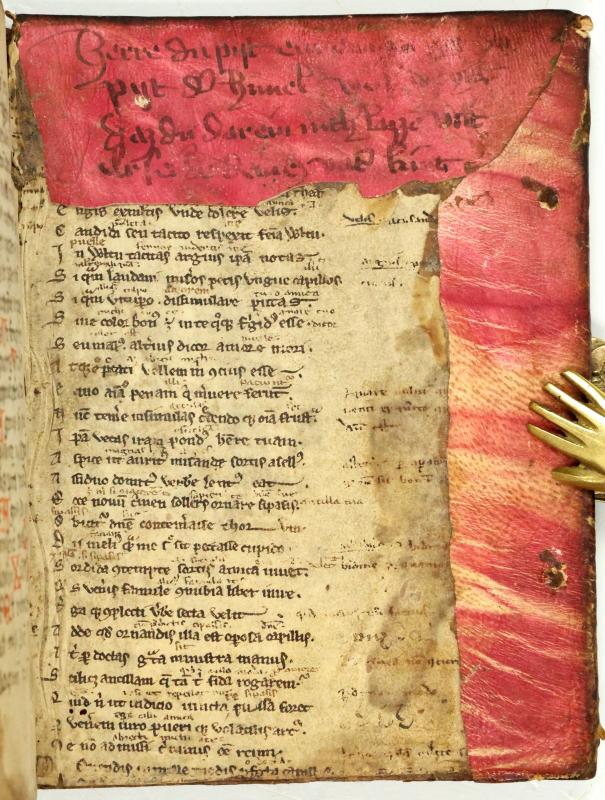
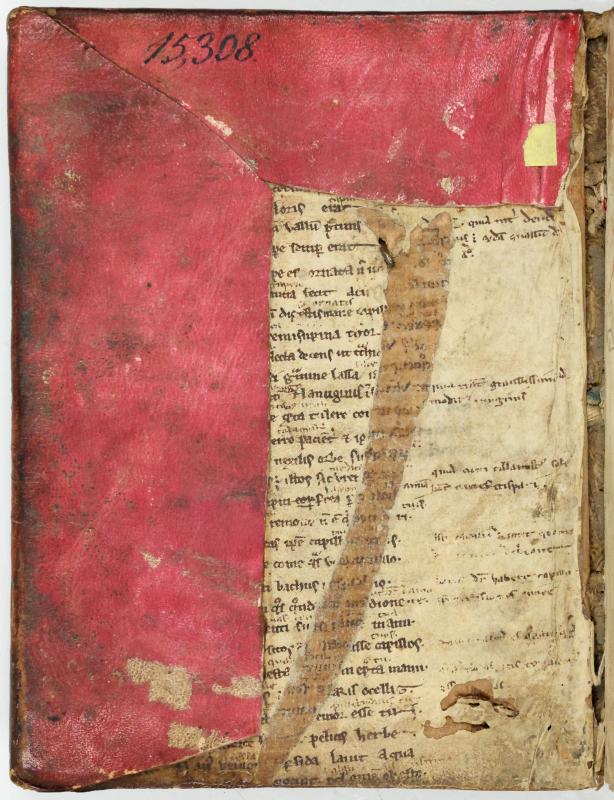
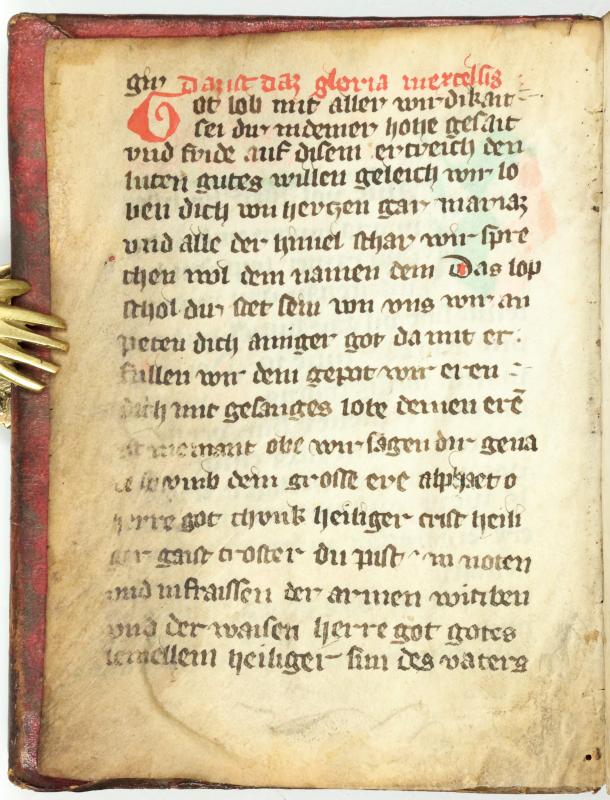
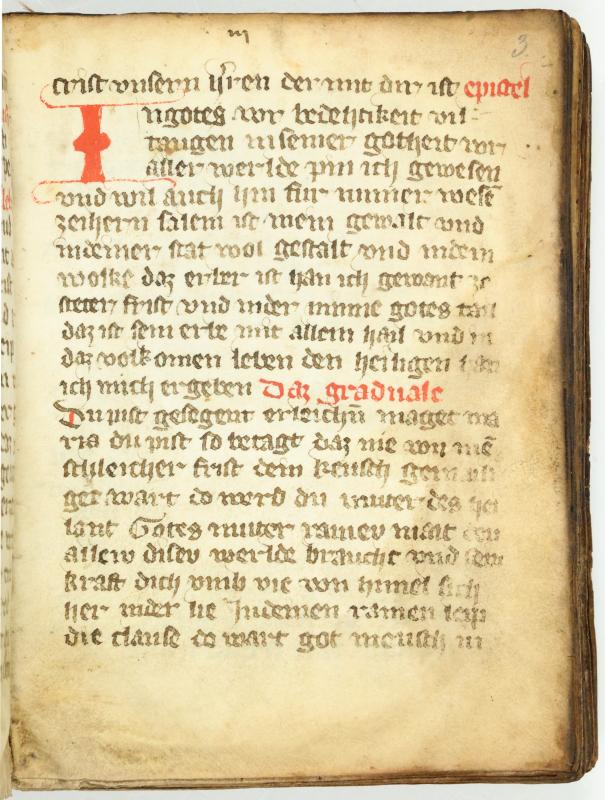
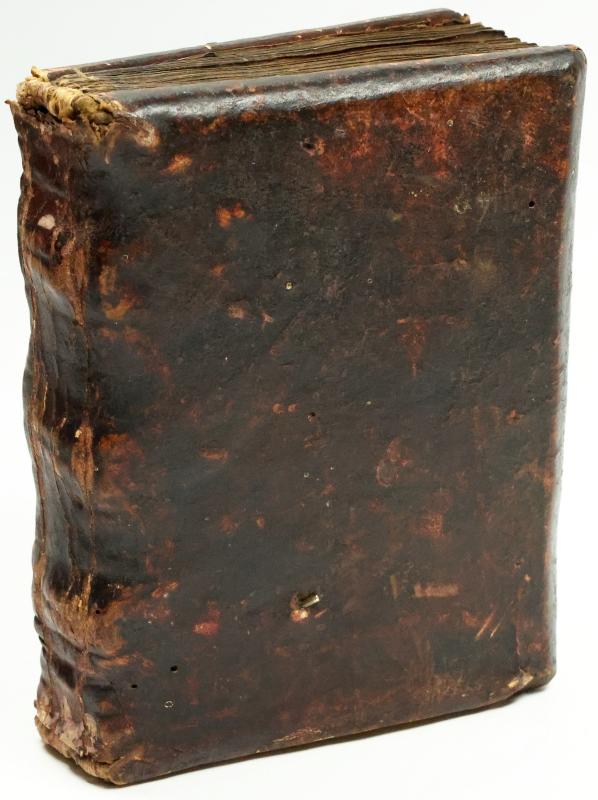
Book of Hours, in German. Nuremberg, c. 1375. 8vo (120 x 153 mm). 78 ff. German manuscript on vellum. Written in Gothic bookhand, ruled in lead point, 20-21 lines per page. Rubrics, initials in red, one large initial in red and green. Contemporary leather-covered boards, with thirteenth-century leaves containing Ovid, Amores I.14.13-41 and II.7.3-8.1 as pastedowns. Worldy love gives way to the divine, Latin to the vernacular: reused leaves containing Ovid's love poetry nestle in the original binding of this medieval Book of Hours in German. Although Books of Hours in the local language were well known during the Middle Ages in other countries, such as the Netherlands, in Germany they remained vanishingly rare (cf. Hamburger, Bilderwelten). The presence of certain saints suggests a Nuremberg provenance, giving us valuable insight into an otherwise unrecorded liturgical use in this unique volume, crafted for an individual who wanted to follow the mass and other divine services closely. The large initial S on the first leaf, in red and green, begins with a salutation to the Virgin: "Salve vol aller heilikeit Maria muter vnd mait", introducing her mass. The German text contains Latin cues, allowing the listener less versed in the liturgical language to follow along with the prayers during the service. There follow the Hours of the Virgin, the Hours of the Passion, the Office of the Dead, prayers in German and a litany of saints, providing a rounded picture of the everyday face of later medieval devotion. A very different world greets us in the pastedowns: at the front, the Roman poet Ovid laments the loss of his lover's beautiful hair, the victim of a misjudged dye and cut at the hairdresser, comparing it to the locks of pagan gods: "Formosae periere comae - quas vellet Apollo, quas vellet capiti Bacchus inesse suo!" ("That those beautiful locks have perished - which Apollo, which Bacchus would envy for their own heads!") At the back, he indignantly rebuts another lover's jealousy at the accusation that he slept with her maid, only to continue with a rhapsodic address to the same servant in the next line. Reused from a thirteenth-century codex, these leaves from Ovid are written in an impressively small Gothic hand, accompanied by glosses and marginal annotations, showing an attentive reader at work. Although the turn-ins from the binding obscure some of both leaves, it is clear that the front leaf contains at least Amores I.14.13-41 and the rear one II.7.3-8.1. A tear to the front paste-down has exposed the wood of the board underneath, which bears an offset of the verso, revealing some of its text, presumably the earlier portions of I.14 and the end of I.13. The presence among the saints of the Anglo-Saxon missionary Willibald (d. 787), who was active in what is today southern Germany, and particularly that of Sebald, a contemporary of his who became patron of Nuremberg, points to the latter city as a probable place of origin. Sebald is the only saint in the list whose first initial is distinguished with a touch of red. Books of hours in German are excessively rare, with only about 50 examples known, mostly in institutional collections. Moreover, the liturgical use for the Hours of the Virgin and the Office of the Dead are apparently otherwise unrecorded, making this volume a lone witness to devotional practice in later medieval Nuremberg. A unique volume at the cultural intersection of the Middle Ages: between Latin and the vernacular, the classical and the Christian, the secular and the divine.
Some wear and scuffing to binding, recesses in the back board for clasps, not preserved, with corresponding pins still present in the front board, unrestored. Marginal staining and soiling, lower corner of one leaf (26) clipped, repaired tear to leaf (74), all without loss to text. Both paste-downs partially covered by the turn-ins. Tear to front-paste down, revealing off-setting of text on reverse of the boards, containing the text from the verso. Overall good condition for a volume of its age that saw active use. Complete: i-vi10, vii14 (back paste-down bound with this quire, creating the impression of an incomplete gathering, however, text of this quire is complete), viii4. Quire viii probably written by a different scribe. No signs that there was ever a calendar or any other additional material that has been removed. Contents: 1. ff. 1r-5r, Mass of the Virgin: "Hie hebet sich an die loblich lang messe von unser liben frawen und dar nach. Salve vol aller heilikeit Maria muter vnd mait dem rainer leip den kunik gepar", mostly in German, with occasional Latin cues. 2. ff. 5r-38r, Hours of the Virgin: "Hie sebt sichan die metten. Domine labia meaaperies. Herre du auf mein lebsen das mein munt kunde [...] das sint laudes metten. (fol. 12v) [...] Das ist preim (fol. 19v) [...] Terz (fol. 23r) [...] Das ist die sexte (fol. 25r) [...] Die none (fol. 27v) [...] Vesp(er) (fol. 29v) [...] Completorium (fol. 34v)". 3. ff. 38r-59r, Hours of the Passion, mostly in German, with Latin cues: "Incipit cursus de passione domini. Domine labia mea aperies. Herre tu auf mein lebsen [...]", with Lauds (fol. 41r), Prime (fol. 42v), Terce (fol. 43v), Sext (fol. 44v), Nones (fol. 46r), Vespers (fol. 47r), and Compline (fol. 49r). 4. ff. 54r-59, Prayers, in German: "Das gepet sprech der mensch [...] Von der olung [...] Dar nach get aber ein [...]". 5. ff. 59r-74v, Office of the Dead, an unrecorded Use, in German with Latin cues: "Das ist die vigil &cet(er)a. Verba mea auribus percipe domine intellige clamorem meum. Herre v(er)nim mein wort mit demen oren [...]". 6. ff. 75r-76v, Two prayers in German: "Eva du lebentigew fruht [...]", and: "Herre hilf mir das ich dich also enpfangen [...]". 7. ff. 76v-78v, Litany of saints and petitions. Provenance: 1) Walter S., partially illegible inscription to f. 74v: "Quis hoc invenit [...] domino Waltero S[...]b[ur]g reddere debet". 2) Joseph Baer & Co., Booksellers in Frankfurt am Main, sold in 1860. 3) Hans Philipp Werner (1801-72), Freiherr von und zu Aufseß, Director of the Germanisches Nationalmuseum. 4) Germanisches Nationalmuseum, Nuremberg, with their shelf-mark "15,308" on front turn-in and their stamp (an eagle in a circle; Lugt no. 2809) on fol. 1r. 5) Returned due to a disagreement with Aufseß, as recorded in the the Museum accession register for 2 May 1860: "All works from this purchase from bookseller Bär (Nos. 15299-319) returned to V. Aufseß as a result of the disagreement with Bär". Dr. Johannes Pommeranz, Head of the Library at the Germanisches Nationalmuseum, has confirmed that the manuscript is not property of the museum. 6) Sotheby's, London, Western Illuminated Manuscripts, 9 Dec. 2025, Lot 15.
55000,- EUR Sachgebiete: Antike, Handschriften, Literatur bis ca. 1900, Mittelalter, Stundenbücher Kontakt zum
inkl. 7% USt./incl. 7% VAT