Antiquariat Michael Kühn

HÜBNER, Jacob.  Auf Merkliste setzen
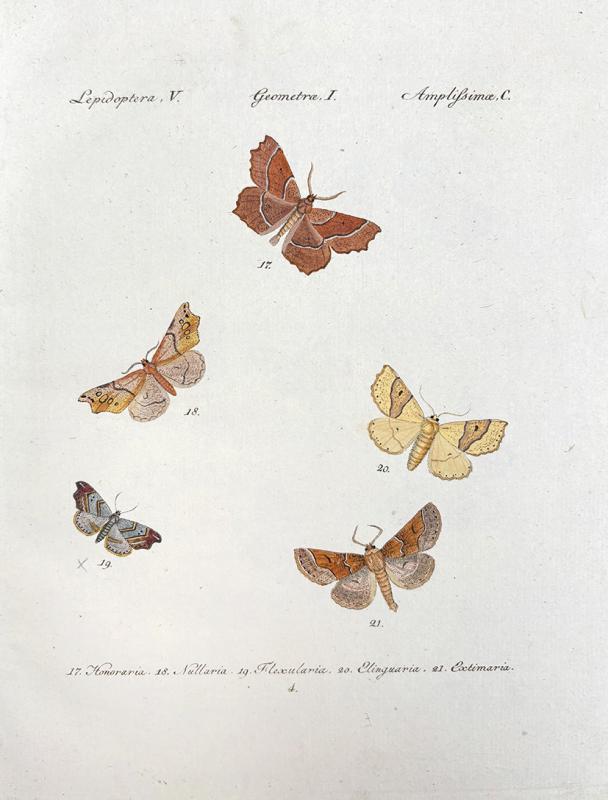
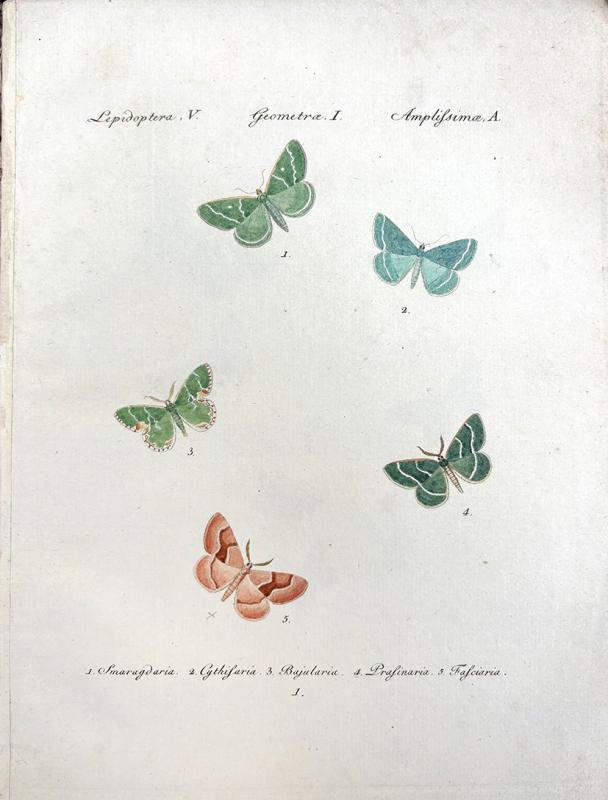
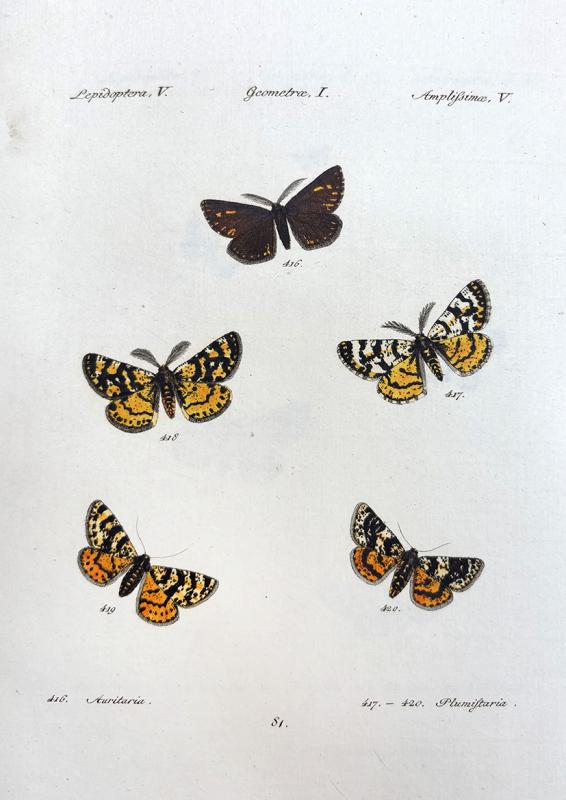
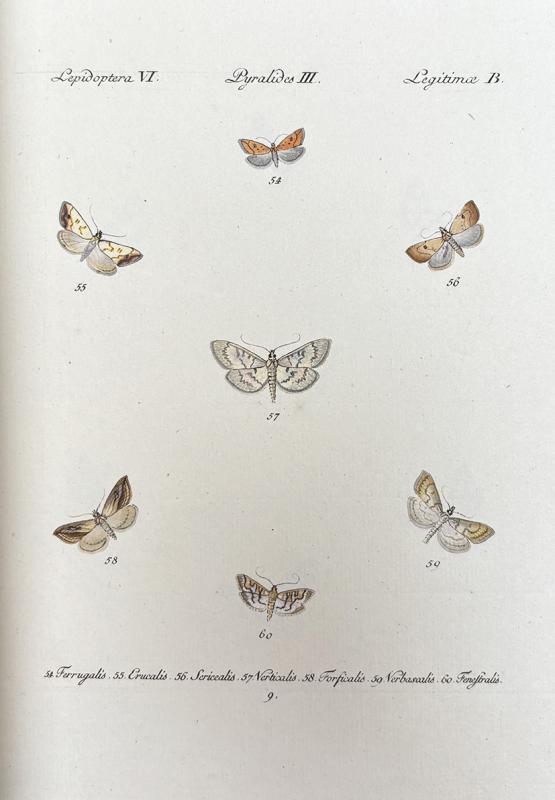
Sammlung europäischer Schmetterlinge, errichtet von Jacob Hübner in Augsburg. 7 Vols. and one folder.- Augsburg (by the author, 1796 - 1841), 1805. 4to (Text 270 x 215 mm; plates: 255 x 200; loose plates: 300 x 230 mm). With engraved title page, 789 engraved plates and additionally 56 proof plates, as well as introduction and text pages 1-194, concerning Papiliones, Sphinges, Bombyces and Noctuae, complete for the second printing of 1805, but without the text to Geometrae, Pyralidae, Tortrices and Tineae which was only published in the 1796 text vol. Text for the last part Alucites was never published. Contemporary blueish plain wrappers. Fine and clean.
Extremely rare and beautiful work on European butterflies, which introduced many new genera and species and laid the foundation for the classification of Lepidoptera, which are very seldom offered for sale. It is particularly outstanding as it has all the plates and includes a few supplementary proof sheets; it misses only the text of „Horde 5 - 8“ of 1796. The subscriber list contain 46 persons; imagining a print run less then 75, maybe 50: „It seems to be very doubtful whether any one set contains all of the text and plates ever published. Our set is the most complete we have ever seen offered for sale.“ (Junk, in 1956). The work contains „extraordinarily true-to-life images, yet idealized to a justifiable degree. Brilliance is excellently observed, the sculpture of sitting butterflies excellent. ... Even the tiniest forms are depicted in natural size, some of them accurate to the limit of the eyes’ resolving power, in all scientific cleanliness a magnificent artistic achievement.“ (Nissen 313 f.). Very little is known about Hübner’s life. The rarity of his works is due to the great upheaval caused by the French Revolution and the Napoleonic Wars and the long period of publication. The German entomologist Jacob Hübner (1761 – 1826) was one of the first specialists to work on the European Lepidoptera. His importance for entomology lies not only in the numerous descriptions and in the artistically outstanding and lifelike illustrations of little-known or unknown butterflies, but also in his scientific penetration into the problems associated with them. He was the first to develop a natural classification system, the principles of which are still valid today. Even as a schoolboy, Hübner showed great talent for drawing and painting. His parents encouraged his talent and, after he left school, apprenticed him as a fabric printer at a cotton factory in Augsburg. His great abilities quickly put him in a good and secure position, which enabled him to live a secure existence in the first half of his life. His interest in natural history became apparent early on, and in 1784 he produced his first copperplate engravings of butterflies, followed by his first publication on the same subject in 1785. Until the end of his life, Hübner devoted himself to the description and illustration of butterflies in numerous works, which sold quickly. In the period following Linné, there was an increased need to supplement the previously brief descriptions of animals with pictures. Hübner produced the colored models for the excellent engravings himself from nature and learned to recognize the characteristics of the butterflies he painted. In the process, he also came to study the stages of development and did fundamental work in this area too. He was supported by Ignaz Schiffermüller in Vienna, who remained his great role model throughout his life. In 1787-1789, Hübner worked as a fabric printer in Niemierow in the Ukraine, but also brought back a list of butterflies from there, which was published. The Napoleonic Wars caused Hübner financial difficulties which, together with serious illness and the loss of his wife, overshadowed the last years of his life. He died shortly after a trip to Strasbourg, where he had organized the entomological estate of a friend. However, his work was continued to completion by the painter Carl Geyer (1796-1841), his long-time assistant. His publications were issued in sections, some after his death, often without associated publication dates. „Nehmen wir als Beispiel die berühmten drei Schmetterlings - Iconographien des Augsburger Insecten - Malers und Muster - Zeichners in einer Kattun-Fabrik J. Hübner (1761-1826), welche als die schönsten Abbildungswerke der Entomologie gelten. Deren 1900 colorierte Tafeln sind als künstlerische Leistungen erstrangig. (Und in der Reihe solcher Abbildungswerke, die sich die Bibliophilie und die Wissenschaft streitig machen, ist das Hübner’sche Opus eines der wenigen, bei dem der Fall eintritt, dass ihm die Wissenschaft einen höheren Preiss zubilligt, als die Bibliophilie; obzwar sonst infolge der weitaus grösseren Kaufwilligkeit und Kaufkraft, die nach der Kunst hin orientierten Sammlern innewohnt, die Preise solcher auf dem Ueberschneidungs - Gebiet wachsenden Werke eben von der Bibliophilie bestimmt werden).“ (Junk. Rara pp. 244). Arthur Francis Hemming, secretary of the International Commission of Zoological Nomenclature, summarized all the citations of Hübner’s proposed taxonomic names, thereby constraining the possible dates of publication leading to the acceptance of Hübner’s works as valid taxonomic publications.- Nissen, ZBI 2039; Horn-Sch. 10903; Hagen 385.4; Engelmann 489. ( Schmetterlinge, Butterfly, Fauna, Insekten, Motten ) Collation / Condition: 5 Bll., 194 pp. incl. one colored engraved title and with 789 hand colored plates, and 56 un-colored proof plates before lettering. The text is in the second edition of 1805, complete as published, but missing the text of the „Horden“ (5-8) which was only published in 1796: 1-74 pp. (Horde 1: Papiliones/Falter; for fig. 1-636); pp. 75-100 (Horde 2: Sphinges; for fig. 1-109); pp. 101-154 (Horde 3: Bombyces, Spinner; for fig. 1-246); pp. 155 - 194 (Horde IV: Noctuae/ Eulen; for. fig. 1-653); no text to Horde 5 - 8 (Geometrae, Pyralidae, Tortrices and Tineae which were published already in 1796 (!). Text to „Horde 9“ was never published. Includes following plates (for ‚Horden‘): I. Papiliones 207 plates; II. Sphinges 38 plates (additionally one variant of plate one loosely enclosed, not counted above); III. Bombyces 83 plates; IV. Noctuae 185 plates; V. Geometrae 113 plates; VI. Pyralidae 32 plates; VII. Tortrices 53 plates; VIII. Tineae 71 plates (plate no. 1-34 previously probably bound differently, at least slightly smaller in format); IX. Alucites 7 plates. The plates published from 1823 onwards are uncut and loosely inserted in paper wrappers. The proofs of different plates and in different formats, partly trimmed, mostly with title lines, numbering and inscriptions added in pencil or ink, on different papers, all uncolored. These are divided into the individual hordes as follows: I. 30 plates, II. 2 pl., III. 2 pl., IV. 10 pl., V. 3 pl., VI. 2 pl.; VII. 2 pl., VIII. 4 pl., IX. one plate. The bound plates hardly browned and only occasionally slightly stained. Partly with additional pencil numbers in the footer, according to the entry on the inside cover of plate 2 „die Reihenfolge der Raupen von Hübner“, probably referring to Hübners Geschichte der Schmetterlinge (Nissen 2038). Occasional genus designations in ink in the lower outer corner. Plate Papiliones no. 12. somewhat wavy in the center. Plate Noctuae no. 101 bound upside down. Plate Bombyces no. 40 loose. Some of the loose plates evenly slightly browned; occasional minor spotting. Some of the proofs somewhat finger-stained. One proof plate with corner tear and one further with small marginal tear.
16000,- EUR Sachgebiete: Entomologie , Naturwissenschaften, Wissenschaftsgeschichte Kontakt zum
inkl. 7% USt./incl. 7% VAT