Susanne Schulz-Falster Rare Books

TRADE CATALOGUE. Osram.  Auf Merkliste setzen
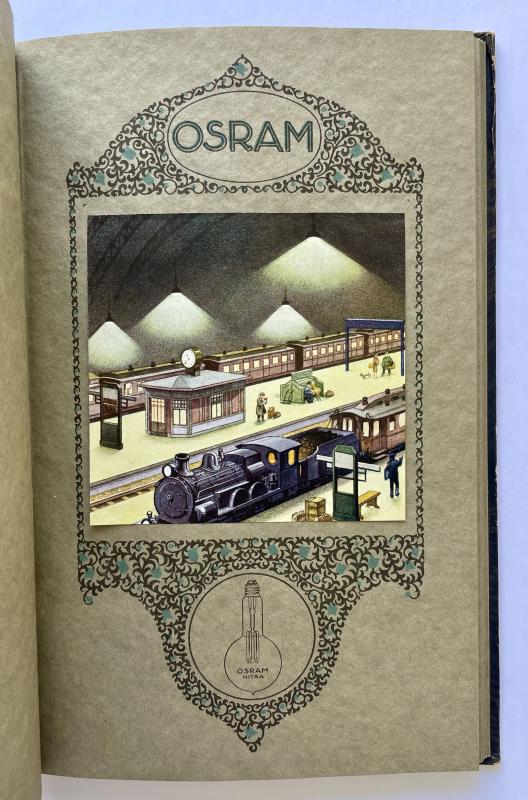
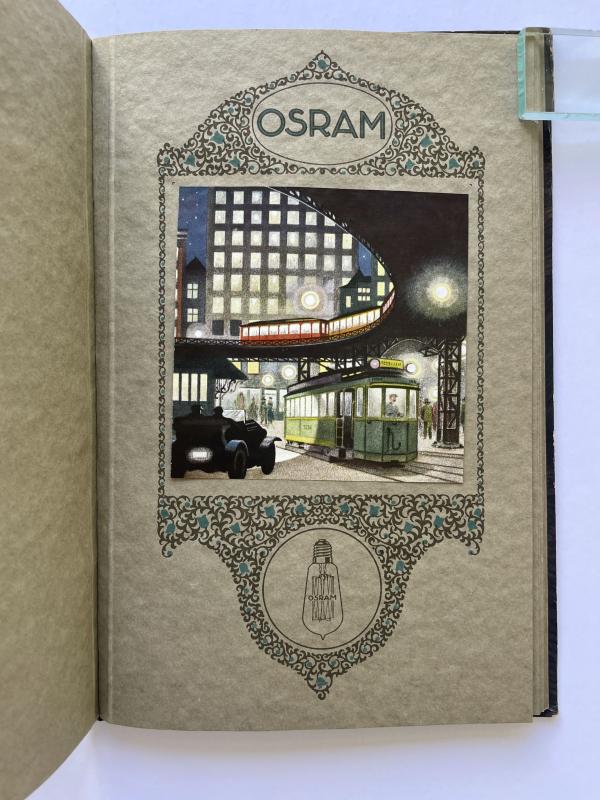
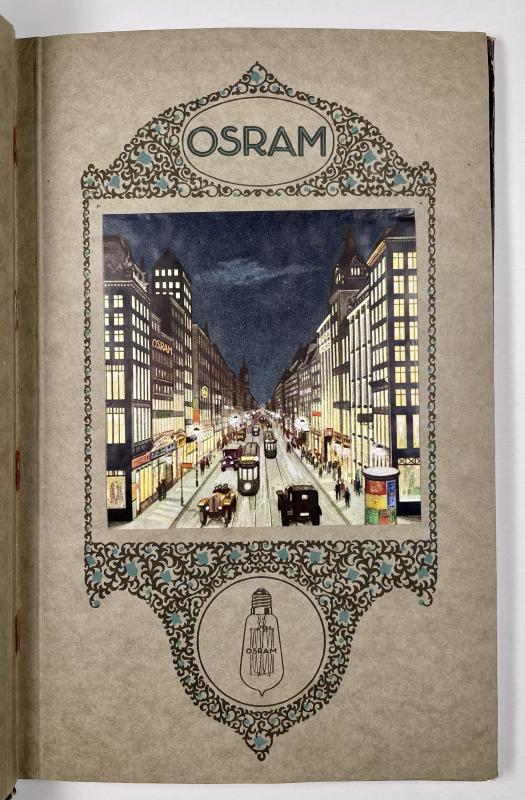
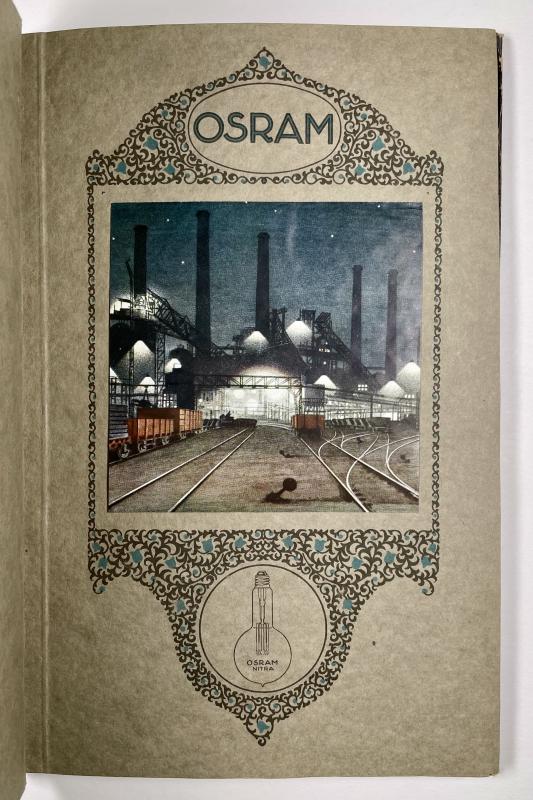
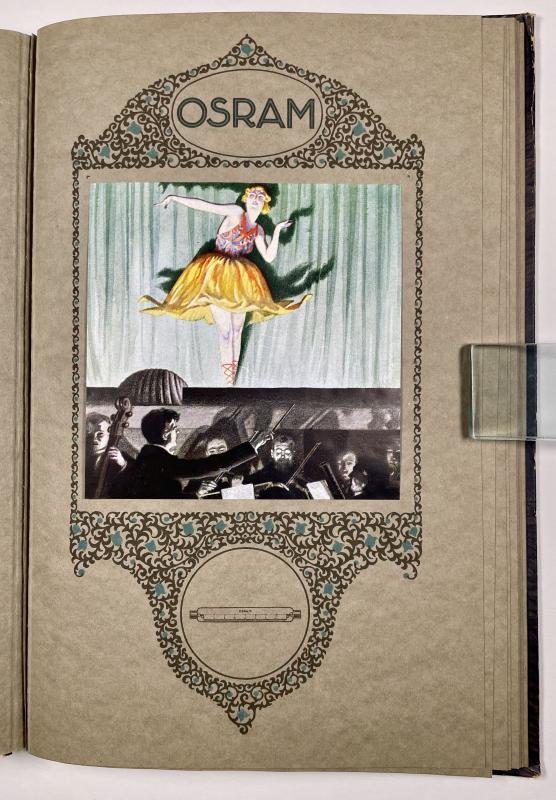
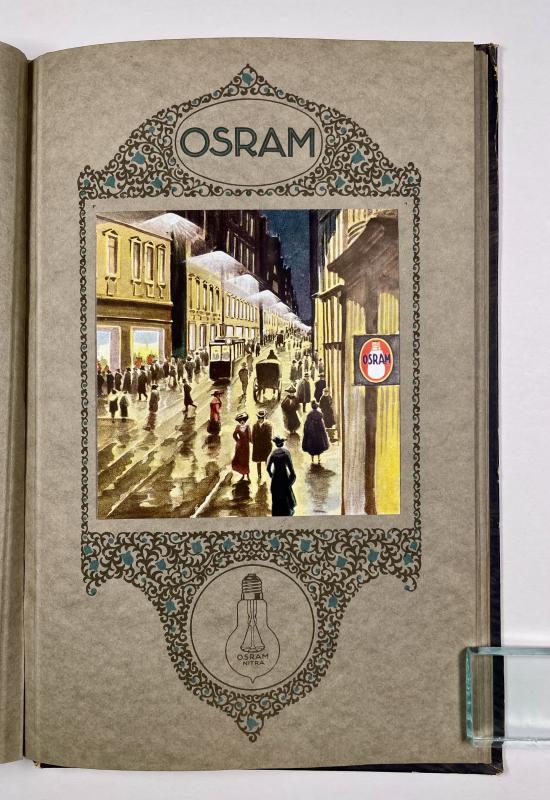
Masterpiece of Marketing TRADE CATALOGUE. Osram. (Osram Nitra). [n.p, Berlin, Osram GmbH, [1923]. 8vo (240 x 155mm), ll. [31], thin grey card with a black and green Jugendstil inspired decorative design with 30 striking colour images pasted in (100 x 100 mm); original blindpressed pastepaper boards, with relief of Osram lightbulb embossed in metallic green to upper cover; extremities a little rubbed, but in very good condition.
A striking advertising catalogue for Osram light bulbs produced in 1923, the year when Osram became the first light bulb company in the world to introduce a line of standardized lightbulbs. The catalogue is a masterpiece of marketing with its stunning images illustrating the use of a variety of Osram light bulbs in a variety of situations, from city lighting to the home, factory applications to the reading lamp next to the arm chair, bicycle lamp to cinema, the dinner table and the lit-up Christmas tree. On April 17, 1906 the OSRAM brand was registered as a trademark for ‘electrical incandescent and arc lamps’ by Auer-Gesellschaft (Deutsche Gasglühlicht-Anstalt) at the Imperial Patent Office in Berlin. The Auer-Gesellschaft, together with AEG and Siemens & Halske, founded OSRAM G.m.b.H. & KG. operating in 1919. The industrialization of lighting began in 1826 when the first gas light companies began providing service to cities and individual customers. However, gas light’s numerous disadvantages—the danger of explosion and poisoning, oxygen depletion, and the uncomfortably high temperatures it created in closed spaces—hastened the search for an alternative. This arrived in October 1879 when Thomas Edison demonstrated his first incandescent lightbulb. In 1883 the Berlin firm of Siemens & Halske launched a cooperative venture with Edison’s German licensee the Deutsche Edison Gesellschaft (DEG) to produce lightbulbs. They were the only companies in Germany permitted to produce lightbulbs after Edison’s design; and at the same time, their researchers looked for improvements that would yield brighter burning, longer lasting bulbs. In 1905, DGA introduced a further improvement, the tungsten filament lightbulb, a discovery so revolutionary that it would remain the most common of all types of household lightbulbs until the beginning of the 21st century. Looking for a striking brand name for the new bulb in 1906, DGA struck upon “Osram,” which combined the first two letters of osmium and the last three letters of Wolfram, the German word for tungsten. For the time being, however, Osram was only a product’s brand name. Plans were being made at the same time for another Osram joint venture in Russia, but they ground to a halt when World War I started in 1914. The war had other disastrous effects on the German lighting giants. Their collaborations with GE ground to a halt. They lost many of their foreign holdings, in England and France, for example. DGA even lost its trademark rights to the Osram name in Great Britain, the Commonwealth, and its colonies. Those rights would not return to Germany until 1986.
2800,- EUR Sachgebiete: Instrumente (Technik), Musterbücher, Optik, Technikgeschichte, Verkaufskataloge Kontakt zum
inkl. 7% USt./incl. 7% VAT