Jeschke Jádi Auctions Berlin GmbH
Charles Darwin  Auf Merkliste setzen
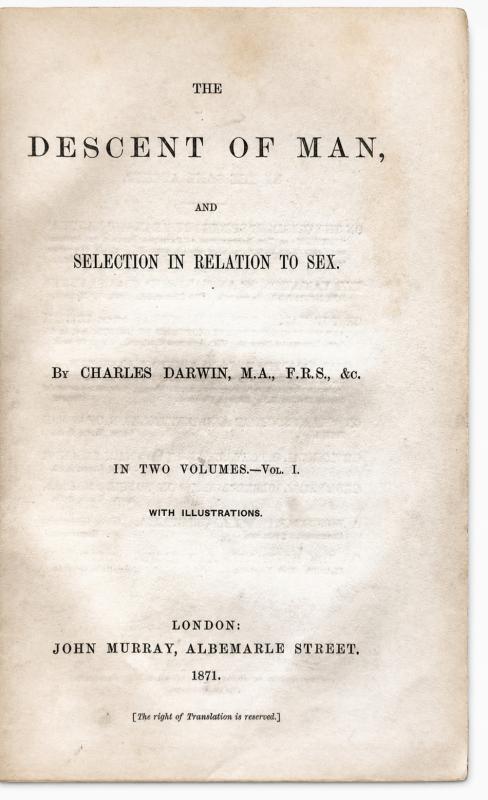
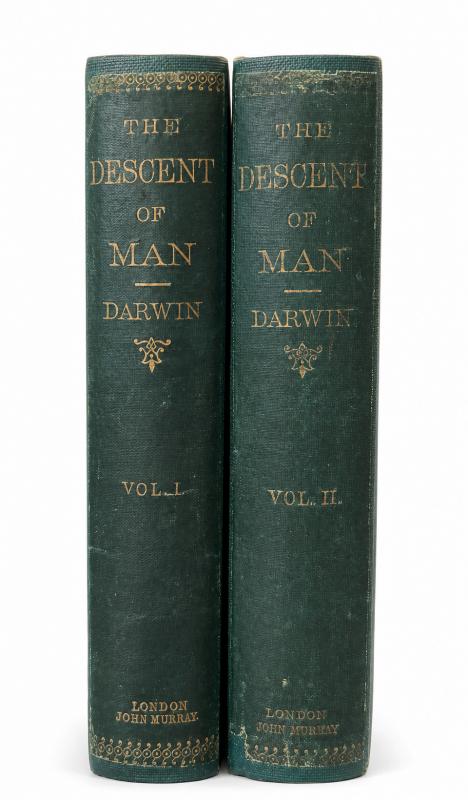
The Descent of Man. 2 Bände. With illustrations. London, Murray, 1871. VIII, 423, 16 Seiten, VIII Seiten, 1 Bl. (Postcript), 475 Seiten, 16 Seiten. Original-Rücken auf Modernen Lwd. mit RTitel. Erster Druck der ersten Ausgabe. - Bd. 1 mit "transmitted" als erstes Wort auf S. 297, Bd. 2 mit Errata verso Titel und Postcriptblatt nach S. VIII. Beide Anhänge mit Verlagswerbung "January 1871", in Bd. 1 betitelt "Popular Works", in Bd. 2: "Standard Works". - Garrison-M. 170 - Freeman, 937 - Norman, 599 - Mittelstraß I, S. 427-29 - Darwins „The Descent of Man“ ist eines der einflussreichsten Werke der Wissenschaftsgeschichte, weil es erstmals die Evolutionstheorie konsequent auf den Menschen anwendet, die sexuelle Selektion als zentrales Evolutionsprinzip ausarbeitet und grundlegende Annahmen über Herkunft, Variation und Einheit der Menschheit formuliert. Darwin argumentiert, dass der Mensch aus früheren Primatenformen hervorgegangen ist und damit Teil der natürlichen Evolution ist. Neben der natürlichen Selektion beschreibt Darwin detailliert, wie Partnerwahl und Konkurrenz um Paarungserfolg biologische Merkmale formen. Dies war neu und kontrovers. Darwin betont, dass alle Menschen einer einzigen Art angehören und eng miteinander verwandt sind – ein direkter Widerspruch zu damals verbreiteten rassistischen Mehr-Art-Theorien. Er vermutet, dass die Vorformen des Menschen in Afrika entstanden – eine Hypothese, die später durch Fossilien- und Genforschung bestätigt wurde. Insgesamt verbindet das Werk biologische, kulturelle und moralische Entwicklung des Menschen. Es zeigt, dass menschliche Vielfalt evolutionär erklärbar ist, ohne Menschen in „höhere“ oder „niedere“ Gruppen einzuteilen und markiert den Beginn einer wissenschaftlichen Anthropologie, die den Menschen als Teil der Natur versteht. - Vorsätze leicht gebräunt bzw. wenig stockfleckig, die Verlagswerbung am Schluß etwas stockfleckig, insgesamt gutes Exemplar. - First edition, first issue. – Vol. 1 with "transmitted" as the first word on p. 297; Vol. 2 with errata on the verso of the title page and the postscript leaf after p. VIII. Both volumes include publisher's advertisements dated "January 1871" at the end, titled "Popular Works" in Vol. 1 and "Standard Works" in Vol. 2. – Garrison-M. 170 – Freeman, 937 – Norman, 599 – Mittelstraß I, pp. 427-29.- Darwin's "The Descent of Man" is one of the most influential works in the history of science. For the first time, it rigorously applies the theory of evolution to human beings, establishes sexual selection as a central evolutionary principle, and formulates fundamental assumptions about the origin, variation, and unity of humankind.Darwin argues that humans emerged from earlier primate forms and are thus an integral part of natural evolution. Alongside natural selection, he describes in detail how mate choice and competition for reproductive success shape biological traits—a concept that was both groundbreaking and highly controversial at the time.Crucially, Darwin emphasizes that all humans belong to a single species and are closely related. This directly contradicted the widely held, racist polygenist (multi-species) theories of his era. He also hypothesized that early human ancestors originated in Africa—a premise later confirmed by fossil and genetic research. Overall, the work connects the biological, cultural, and moral development of humanity. It demonstrates that human diversity can be explained through evolution without dividing people into "higher" or "lower" categories, marking the beginning of a scientific anthropology that views humans as a part of nature.
4850,- EUR Sachgebiete: Anthropologie, Völkerkunde/Ethnographie, Wissenschaftsgeschichte Kontakt zum
inkl. 7% USt./incl. 7% VAT