Auf Merkliste setzen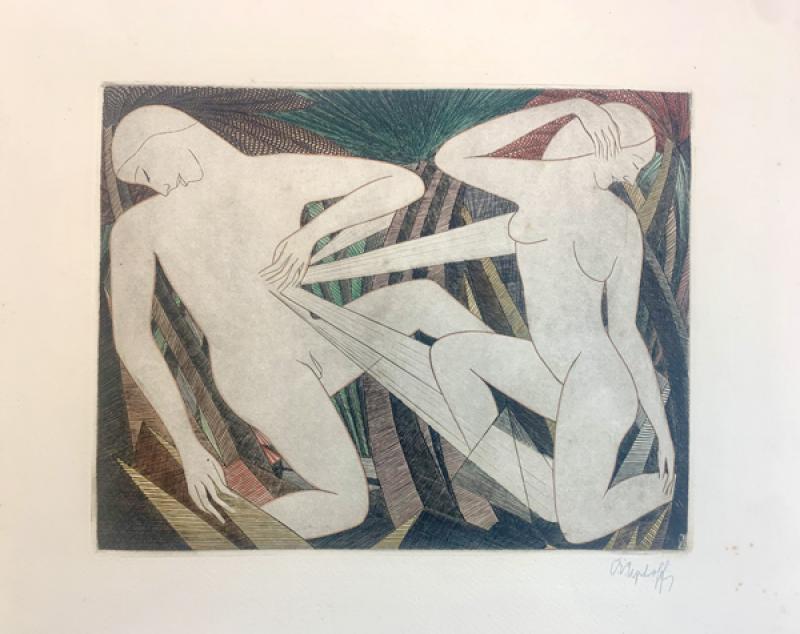
Carl Emile Uphoff (illus.)
Adam und Eva. Bremen, Germany: Worpswede, 1924. Oblong quarto. (17)ff. One of 110 copies. All etchings signed. The first book of the press. Fifteen plates by Uphoff relate in dramatic expressionist form the story of the creation and fall of mankind. Each of the text plates bears an initial of sharp lines and an array of colors. Each of the illustrations presents an exemplar of continental Modernism par excellence by wedding together the fluidity and softness of the human figure often associated with Matisse's Fauves with the angularity of the environment familiar to the German Bauhaus, the films of F. W. Murnau, and the English Vorticists. The whole presents a symphonic play of text and image, and a bold return to the Modernist movements that had flourished before the Great War but had somewhat, and temporarily, diminished in its aftermath. The Worpswede group was founded as an artists' colony in Bremen, Germany, and has been situated as a crucial predecessor to the more recognized Expressionist schools. Uphoff's entry likely arrived among the final works generated by the group, which had after the war begun to dissipate. Bound in full vellum over boards with motif in gilt to upper panel. Small, faint dampstain to uppermost margin of several leaves; binding shows some bowing and natural toning as well as a couple of minor abrasions to rear cover. Housed in a custom cloth dropback box. Near fine overall.
Sachgebiete: Expressionismus, Deutschland, Illustrierte Bücher, Pressendrucke, Religion
5650,- EUR
Differenzbesteuert/Subject to margin taxation
Auf Merkliste setzen 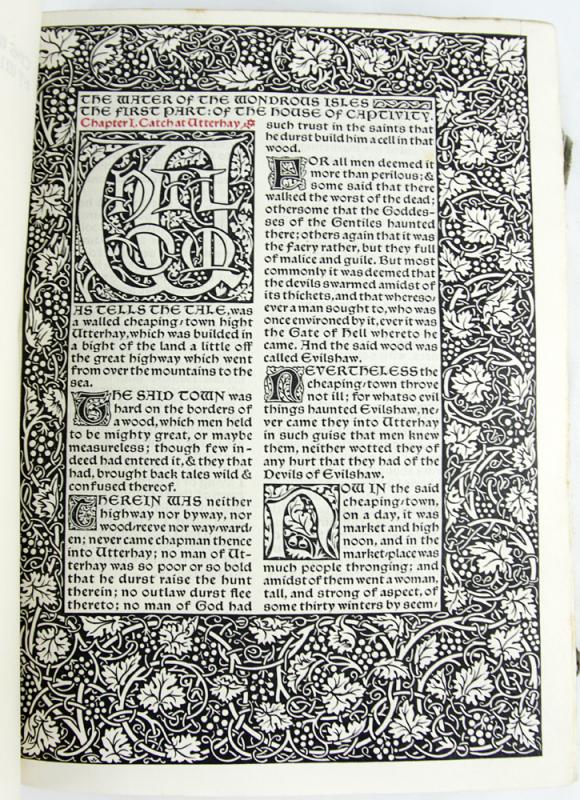
William Morris
The Water of the Wondrous Isles. (Hammersmith): Kelmscott Press, (1897). Quarto. (xii), 340, (viii)pp. One of 250 copies on paper. With numerous initials and ornaments. Printed in Chaucer type, with chapter titles and marginal notes in red. Each of the six parts begins with a wide border and a fourteen-line initial block containing the entire first word. This was the last book Morris worked on before he died. The colophon states: "The borders and ornaments were designed entirely by William Morris, except the initial words Whilom & Empty, which were completed from his unfinished designs." Sidney Cockerell wrote that Morris, in his last illness, "sat up and was going to design 'Empty' for The Water Of the Wondrous Isles, but only just managed to black in the spaces, and just rough in the word." A touch of soiling to spine and typical light spotting to edges, else a fine copy of this beautiful book, in bright, creamy full-limp vellum, with all silk ribbon ties intact. (Peterson A45).
Sachgebiete: Kunsthandwerk, Illustrierte Bücher, Pressendrucke, Großbritannien
9960,- EUR
Differenzbesteuert/Subject to margin taxation
Auf Merkliste setzen 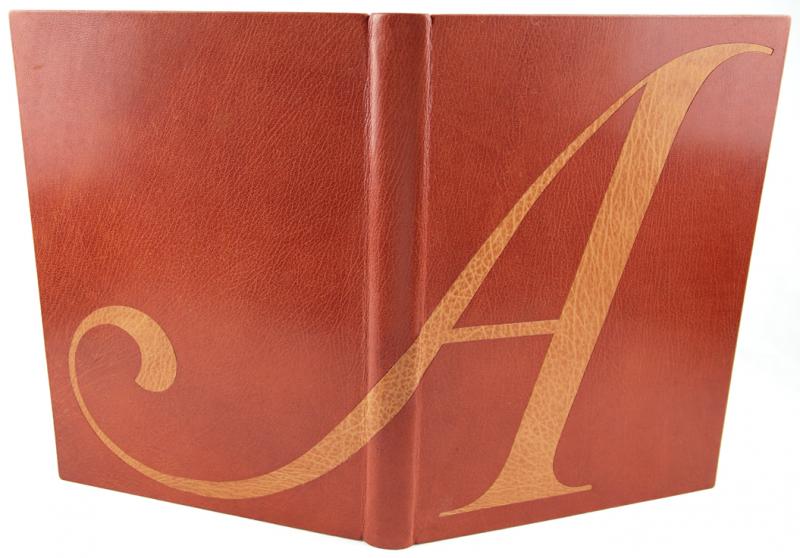
Robert Gibbings, Edward Ardizzone, et al.
A Miscellany of Type. Andoversford: Whittington Press, 1990. Folio. vii, 125pp. One of fifteen especially deluxe copies, full bound and with separate portfolio. A collection of articles and type specimens about 21 different typefaces ranging from Baskerville to Walbaum, each of them illustrated with wood engravings by Robert Gibbings, Edward Ardizzone, and several others. The body of the book is, then, a visual and textual exploration of the techniques of type, and a consideration of those techniques as extensions of aesthetic theories of the look of a book. This emphasis on design as a matter of technological, practical, and aesthetic principles is especially apparent in the complementary portfolio, which contains twelve distinct examples printing various images, typefaces, and watermarks of various papers, both marbled and not. Included are papers made for the Kelmscott Press, a broadsheet with 96-point Caslon, hand-colored illustrations, a wood-engraving by Miriam Macgregor, and marbled sheets by Colleen Gryspeerdt. The whole, with portfolio and full binding, is an admirable historical survey of 20th-century page design, useful as a printer's reference, pedagogical compilation, and typographical archive. Bound in full orange leather over boards with inlaid light-orange "A." Additional portfolio housed in quarter-leather chemise with patterned paper over boards. All stored in dropback box. A beautiful book which continues the tradition of fine printing we have come to expect from the Whittington Press. Very fine.
Sachgebiete: Buchwesen, Pressendrucke, Typographie, Großbritannien
3470,- EUR
Differenzbesteuert/Subject to margin taxation
Auf Merkliste setzen 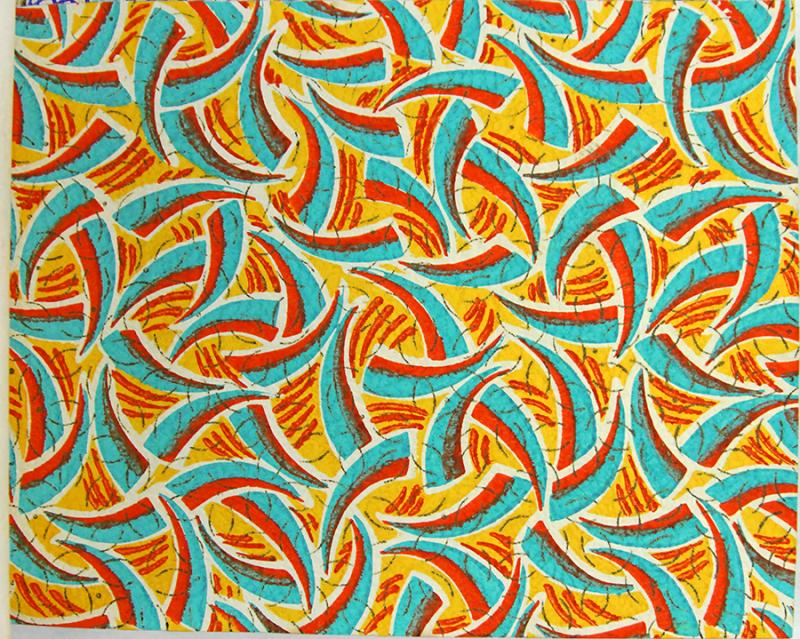
N/A
Fancy Papers [paper samples]. United Kingdom: I. & S., 1953. Oblong 16mo. 438 sample leaves of decorated papers, with metallics, stripes, florals, marbling, checks, and tartans among the offerings. Each leaf with a printed reference number at verso, with dimensions. Bound in red cloth with gilt titling to front cover and spine, plus red cord for salesman's ease of access. Slight rubs to corners and hinges, else very good.
Sachgebiete: Papier/Buntpapier, Art deco , Buchwesen, Graphik
1180,- EUR
Differenzbesteuert/Subject to margin taxation
Auf Merkliste setzen 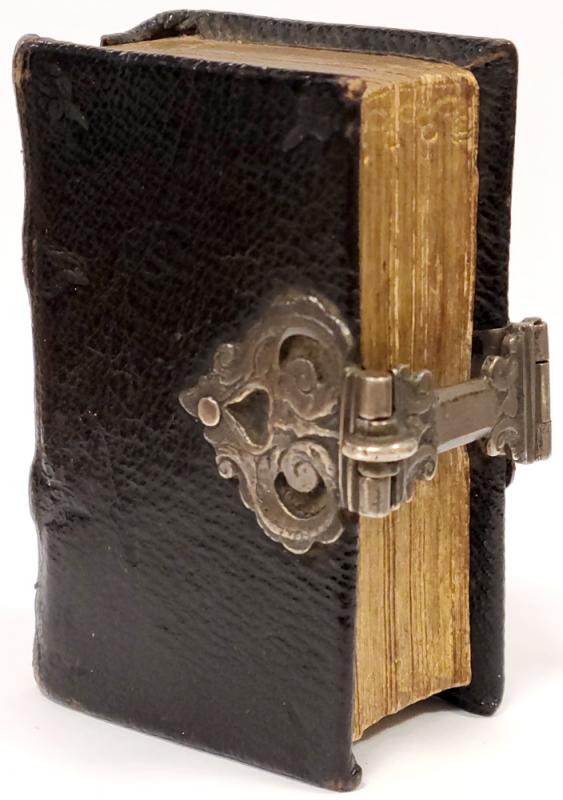
Ambrosius Lobwasser (trans.)
CL Psalmen Davids. Amsterdam: Iod. Iansson (i.e., Jodocus Janssonius), 1649. (240ff). Book of psalms with engraved title-page illustration and printed music throughout. Lobwasser's translation of the psalms into German, which was first published in 1573, and largely adapted Claude Goudimel's harmonizations, found wide use in German reform services, and remained in print until about 1771. The printer, Jodocus Janssonius, was the son of noted printer and cartographer, Johannes Janssonius, who published the Mercator/Hondius atlases. Bound in contemporary morocco, tooled in blind, silver fore-edge clasp. All edges gilt and gauffered. Block printed pastedowns in three colors. Small chip to spine head; light soil and spotting to several preliminary leaves; fore-edge gilding a trifle rubbed in spots. Overall, very good or better. (2 15/16 by 1 3/4; 74x45mm.). (Mikrobiblion no. 202; see Spielmann 428; Welsh 702).
Sachgebiete: Deutschland, Miniaturbücher, Niederlande , Religion
3040,- EUR
Differenzbesteuert/Subject to margin taxation
Auf Merkliste setzen 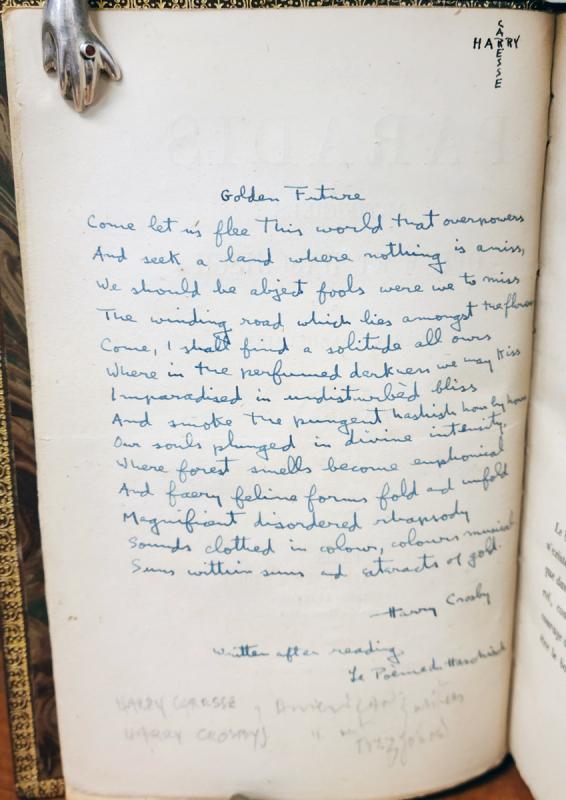
Charles Baudelaire
Les Paradis artificiels. Opium et haschisch. Paris: Poulet-Malassis et de Broise, 1860. Octavo. iv, 304pp. First edition. Harry Crosby's copy, in his binding and with ex-libris, plus handwritten sonnet, inscribed hieroglyphs, and possible bloodstain. Baudelaire's treatise on opium and hashish has spiritual overtones, advocating for substance use as a means of self-actualization and enlightenment. The subject and its splenic, proto-modernist author are apt for Crosby, an American expatriate who, with his wife Caresse, spent much of the 1920s under the influence of substances, occult spiritualities, or both. Crosby's affection for, and identification with, Baudelaire was long and enduring. Note, for example, the poem Crosby composed in his diary in honor of Baudelaire's birthday: "I think I understand you Baudelaire/With all your strangeness and perverted ways/You whose fierce hatred of dull working days/Led you to seek your macabre vision..." Look also to the verso of the title page, on which Crosby wrote the (apparently unpublished) sonnet, "Golden Future." Crosby, who hailed from a wealthy Boston Brahmin family, used his wealth to develop a salon of sorts and to start the Black Sun Press. The Press was conspicuous among other modernist small presses for its commitment to a "fine press" style that straddled the handicraft ethos of Arts & Crafts outfits (Doves, Cuala), the avant-garde publication practices of poet's presses (Hours Press, POOL), and the slick modern look of commercial French publishers (Gallimard). The Press published an impressive cross-section of European and American modernists, including Gertrude Stein, Hart Crane, D. H. Lawrence, Eugene Jolas, and James Joyce. Crosby used the Press to publish his own esoteric, diabolic poetry. Apt, then, is the possible bloodstain to the margin of page 65. At the rear flyleaf is a series of three hieroglyphs, almost certainly relevant to Crosby's personal cosmology. Sun motif embossed to front flyleaf. Bound in Crosby's personal binding of brown calf with gilt rules and rolls, with spine in six compartments including onlaid leather label. To the upper cover is a gilt stamp of the Crosbys' crest, with "Harry/Caresse" arranged in a cross. This arrangement is also used at the ex-libris at the front pastedown and handwritten above the sonnet (it was a regular motif, also used on a tombstone commissioned by Crosby). Original wrappers bound in. Mild rubbing to edges, else a near fine copy of a significant work with uncanny provenance.
Sachgebiete: Esoterik, Erstausgaben, Frankreich, Handschriften
12990,- EUR
Differenzbesteuert/Subject to margin taxation
Auf Merkliste setzen 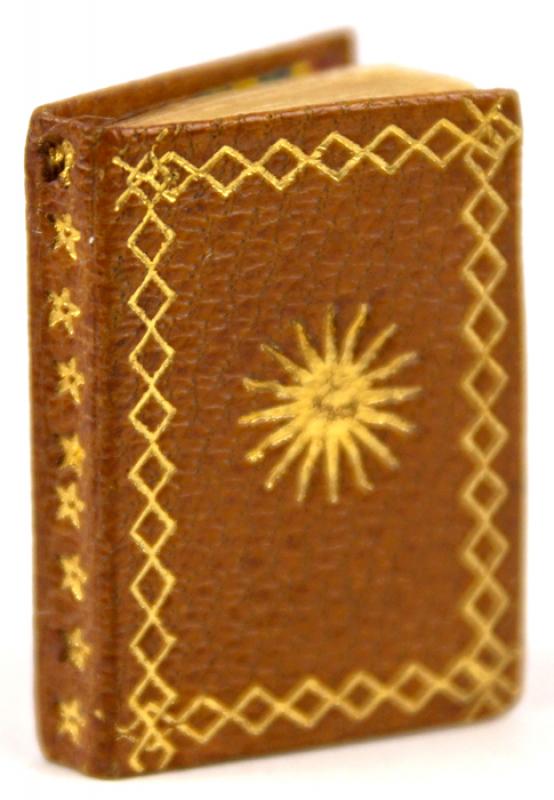
Harry Crosby
The Sun. Paris: Black Sun Press, 1929. (x), (32), (vi)pp. One of 100 copies. With an illustration from a drawing by Caresse Crosby. One of the rarest books from the Press, and, apart from a Rubaiyat that is only known in Queen Mary's Dolls' House, the only miniature book Crosby produced. His text is a paean to the sun, which is fitting, given his Icarus-like biography. Bound in brown morocco with gilt sun device and scroll border on upper and lower covers; nine gilt stars on spine. Very fine. (Minkoff A-24). (1 x 3/4 in; 2.5 x 1.9 cm).
Sachgebiete: Frankreich, Miniaturbücher, Pressendrucke
4990,- EUR
Differenzbesteuert/Subject to margin taxation
Auf Merkliste setzen 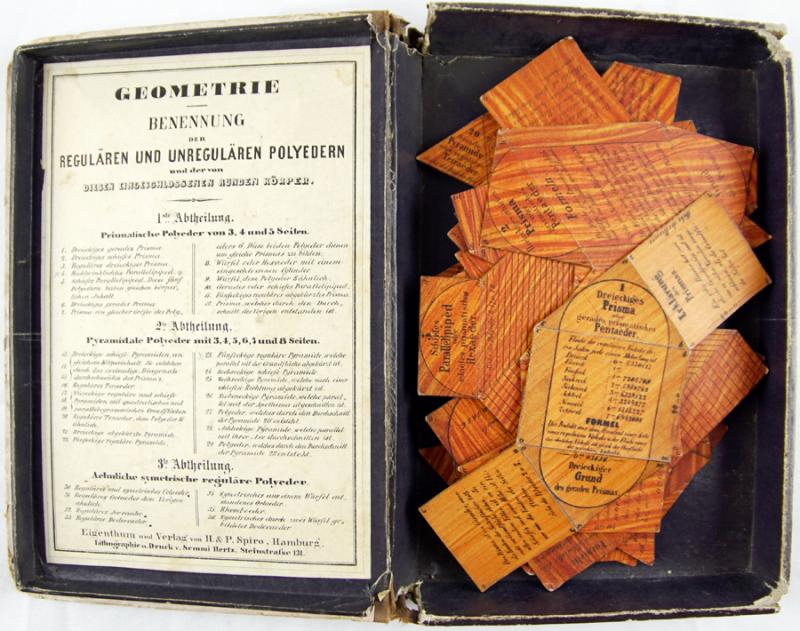
Semmi Hertz
Stereometrie oder Sammlung der Netze Regulärer und Unregulärer Polyedern. Hamburg: H & P. Spiro, (c. 1840). An unrecorded assemblage of 34 (of 36) cut-out and foldable figures, each one with lithographed text and lines orienting the user to the shape's three-dimensional structure and geometry. An exercise in applied math, the kit was designed to teach draftsmen principles of construction easily translatable to commercial design projects. The pieces are organized according to sides and styles: prisms of three, four, and five sides; pyramids of three to eight sides, and symmetrical polyhedrons. Each is quite durable, with the lithographed sheet nicely glazed and mounted to heavy stock. Semmi Hertz (1805-1862) was a small-products printer, here demonstrating his technical accuracy. The Spiro brothers would later meet greater renown, or infamy, as forgers of postage stamps (see Thomas Dalston, How to Detect Forged Stamps [1865]). All pieces fine, only a handful with stray bumps. Housed in box with instructions to underside of lid and label to top; box itself rather worn but structurally sound. Overall, as near fine as can be expected.
Sachgebiete: Spiele, Deutschland, Graphik, Mathematik
2300,- EUR
Differenzbesteuert/Subject to margin taxation
Auf Merkliste setzen 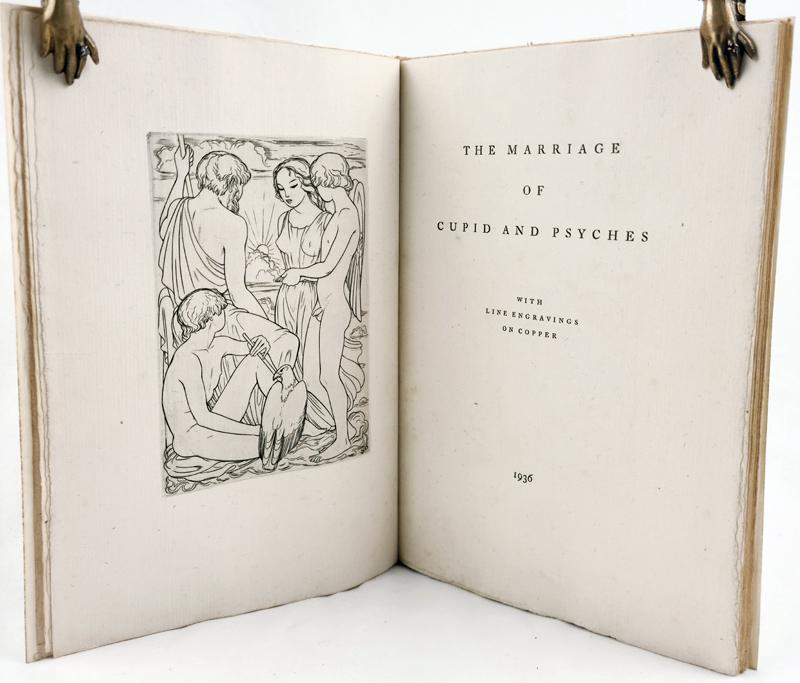
John Buckland Wright (illus.)
The Marriage of Cupid and Psyches. (Haarlem: Joh. Enschedé), 1936. Octavo. 47pp. One of fifty copies signed by the artist. Illustrated with a frontispiece, headpiece, seven full page plates and a vignette from engravings in copper by John Buckland Wright, protected with tissue guards. The text was printed by Enschedé, and the engravings were printed by the illustrator. Bound in limp vellum wrappers gilt-titled to spine, with a design of Cupid and Psyche by Buckland Wright in gilt on the front cover. Housed in a slipcase covered in paper decorated with the initials "J.B.W." printed in yellow. Light toning to slipcase edges, a touch of soiling to vellum, armorial bookplate offsetting to endleaves, otherwise about fine.
Sachgebiete: Klassizismus, Illustrierte Bücher, Niederlande , Pressendrucke
4770,- EUR
Differenzbesteuert/Subject to margin taxation
Auf Merkliste setzen 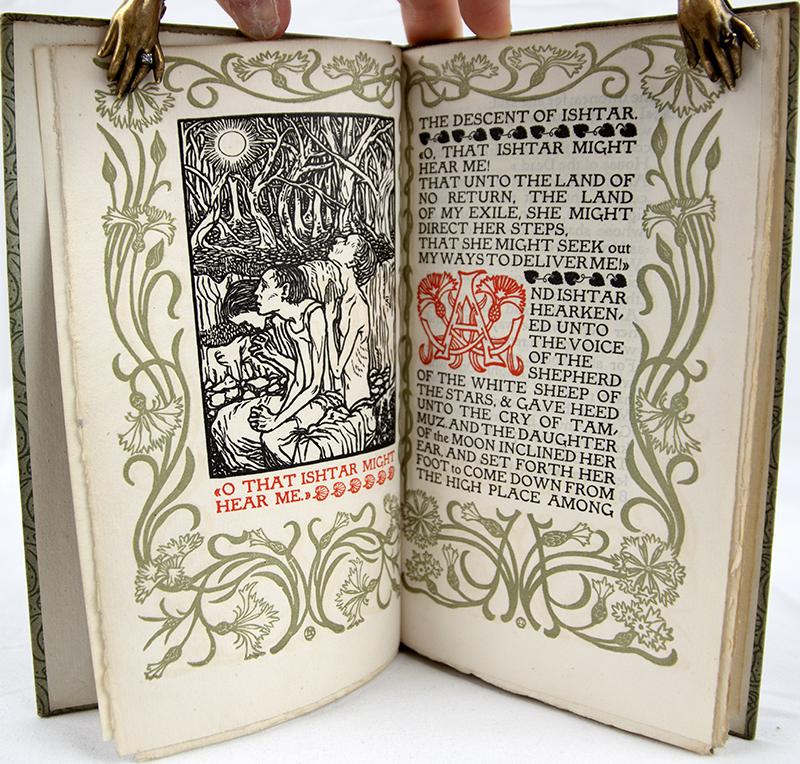
N/A
The Descent of Ishtar. (London): Eragny Press, 1903. Small octavo. 30pp. One of 226 copies. Inscribed by Lucien Pissarro on front endpaper to Gabriel Mourey, reviewer for "The Studio." Frontispiece designed by Diana White and wood engraved by Esther Pissarro. Opening borders in green and initial letters in red designed by Lucien Pissarro and engraved by Esther. Offsetting to endpapers, else a bright, fresh copy, half-bound in patterned paper over boards, and housed in a morocco-backed cloth folding case.
Sachgebiete: Volkskunde, Illustrierte Bücher, Pressendrucke, Großbritannien
1310,- EUR
Differenzbesteuert/Subject to margin taxation
Auf Merkliste setzen 
Johann Martin Bestelmeier (illus.)
Ansicht eines Seehafens. (Nuremberg), JMB (monogram), (c. 1830). Six hand-colored etched panels, the last of which serves as the background view, depicting—as the title suggests—a three-dimensional view of a seaport. The foreground consists of the pier, which is framed by buildings and shows people circulating; further on are large sailing vessels on both sides and taking up the entire background scene, while people are ferried between them in wooden dinghies. Two small cutout panels affixed to the inside of the first bellows come together in the oval view hole to provide a closure. The printed monogram on the manuscript slipcase label indicates the creator of this peepshow is Johann Martin Bestelmeier of Nuremberg. Rare: not listed in Hyde's catalogue of the Gestetner Collection, and unknown in any institutional holding. Small paper repair to lower section of first bellows, some marginal soiling, minor rubbing to coated pink paper on upper board. Overall very good or better in a vibrant paste-paper sleeve with title label. (5 3/4 x 5 in).
Sachgebiete: Spiele, Deutschland, Illustrierte Bücher, Optik, Schifffahrt
3340,- EUR
Differenzbesteuert/Subject to margin taxation
Auf Merkliste setzen 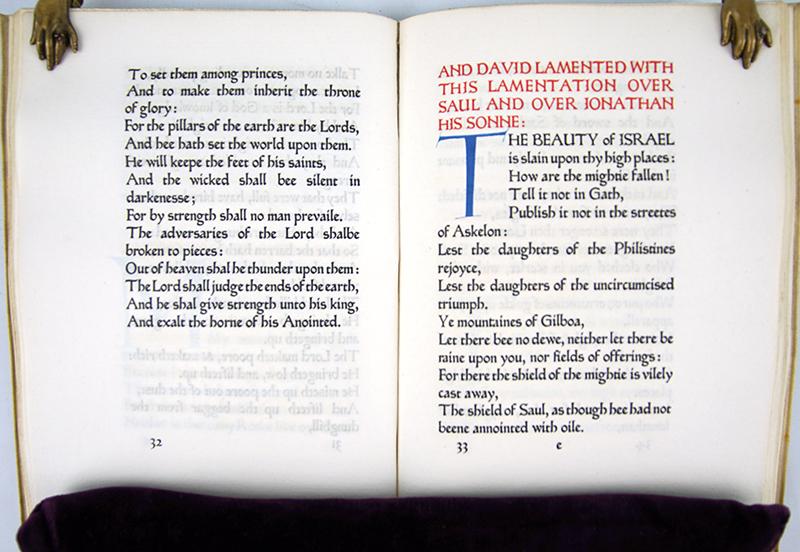
Graily Hewitt (illus.)
A Book of Songs and Poems from the Old Testament and the Apocrypha. (Chelsea): Ashendene Press, 1904. Octavo. 62pp. One of 150 copies. Printed in black and red with blue initials drawn by Graily Hewitt. Colin Franklin regards this as "a varied and beautiful work" that captures Hornby's design sensibility in which he "always sought a form which suited the text he chose to print" (The Ashendene Press, p.74-5). Very fine in full limp vellum, title in gilt on spine. Housed in a half-morocco pull-off case. (Hornby XVIII).
Sachgebiete: Pressendrucke, Religion, Großbritannien
3340,- EUR
Differenzbesteuert/Subject to margin taxation
Auf Merkliste setzen 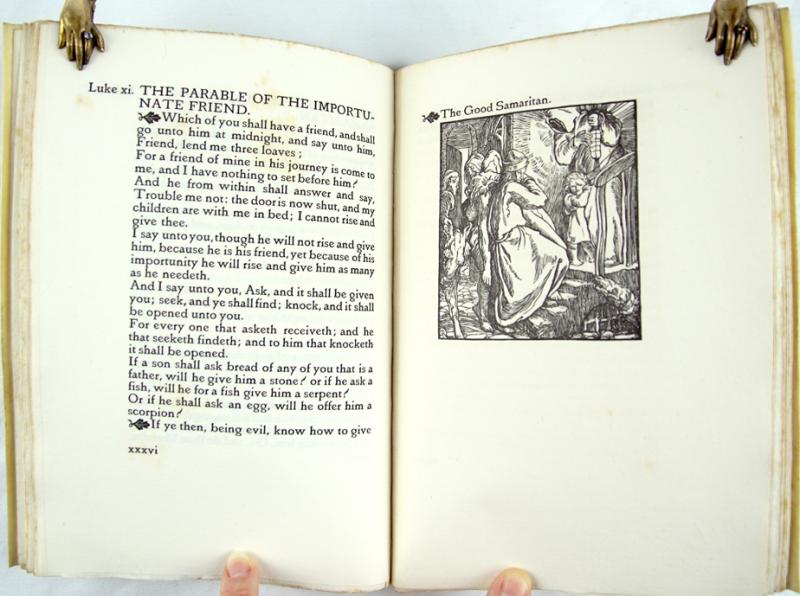
Charles Ricketts (illus.)
The Parables from the Gospels. (London: Hacon & Ricketts/Ballantyne Press), 1903. Octavo. (76)pp. One of 300 copies. Illustrated with ten wood engravings by Charles Ricketts—the largest number of illustrations in any Vale Press book. Gordon Ray cites this on his list of 100 outstanding illustrated books. (Ray/English 265). Though he never received sufficient recognition of his work from his contemporaries, the fact that Charles Ricketts is a major figure in the Art Nouveau movement is now "taken for granted." Some contend that his work marks the high point of British book design. In contrast with the books of the Kelmscott Press, Gordon Ray also notes that Vale Press books "are easier to handle, more varied in content and appearance, and pleasanter to read. Their greatest appeal, however, comes from the abundant decorations and illustrations which Ricketts himself designed and for the most part cut on wood." Charles Ricketts, in his autobiography, noted that the engravings for the Parables were "the high water-mark in my work, as far as design goes." (Ray-English, pp. 160,164). With the James Guthrie-designed bookplate of Ricketts's friend and fellow artist, T. Sturge Moore, to whom this book was dedicated. Prospectus tipped in before front endpaper. Faint scattered foxing, else fine and bright in original limp vellum, titled in gilt on spine.
Sachgebiete: Jugendstil, Pressendrucke, Religion, Großbritannien
2180,- EUR
Differenzbesteuert/Subject to margin taxation
Auf Merkliste setzen 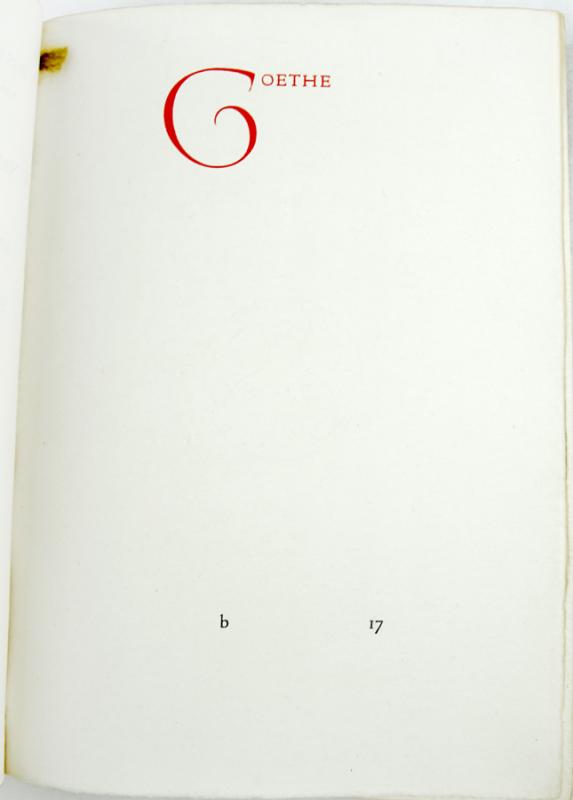
Johann Wolfgang von Goethe
Auserlesene Lieder Gedichte und Balladen. Hammersmith: Doves Press, 1916. Octavo. 226pp. One of 185 copies. Printed by T. J. Cobden-Sanderson. Marginal titles in red. According to the printer "In this Anthology, the Poems selected have been arranged in three principal groups, with four interwoven Poems indicative of Goethe's attitude to Life, in such a way as to form EIN STRAUSS; a nosegay of 'visionary flowers.'" Bound in full, tannish vellum, albeit color appears natural, shallow crease along spine, motes of foxing to top edge, else near fine with Doves Bindery stamp at rear pastedown. Inscribed by Paul Hirsch to his daughter, Renate, on February 24, 1941. Hirsch, trained as an engineer but was chiefly occupied as a writer, musician, and bibliophile, amassing a significant music library with a roster of visitors that included Theodor Adorno, Wilhelm Furtwangler, and Stefan Zweig (the presence of these latter two is foreboding, given subsequent events). After the Nazi party came into power, he organized with the help of Cambridge professor Edward J. Dent the escape of his family and the complicated train transport for his library. In early 1938 he fell ill and was then sent to recover in a Munich sanatorium. On April 25, 1941, only two months after the present inscription, he was once again committed. Based on the inscription here, it appears that he was able to continue purchasing and sending books, despite the scrutiny of Nazi censors. A Jew, he was deported to the Sobibor concentration camp on June 15, 1942, but apparently survived, going on to sell his collection to the British Museum in 1946. He died in 1951. His bookplate laid in, as is the bookplate of his daughter, Renate Hirsch Schuster.
Sachgebiete: Deutschland, Literatur bis ca. 1900, Pressendrucke, Großbritannien
1960,- EUR
Differenzbesteuert/Subject to margin taxation
Auf Merkliste setzen 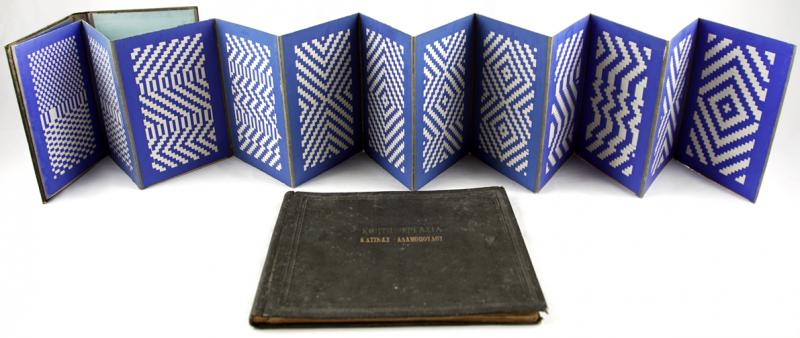
N/A
Two Greek Froebel albums. (Greece, c. 1900). Two 16mo vols. Larger volume 20ff; smaller volume 12ff, accordionfold. The first volume demonstrates a keen aptitude for paper cutting, with a particular focus on designs in negative space. Especially unusual for this genre of educational albums is the application of geometrical forms as tags to lower outer corners, which correspond to the larger cut design. It is entirely plausible that the tags were provided by the instructor as the core shape, leaving it up to the student to arrange it into a larger pattern. The smaller volume shows various forms of paper weaving, with twenty-four total examples. Here, too, the student explores the possibilities of negative space, with the added complexity of directionality of the paper. The Froebel method emphasized abstraction and creativity in hand crafts, and the program based itself on progressive challenges to dexterity and creativity. The method is generally associated with Western Europe and the United States; these are rare examples of its eastern reach. Albums bound in black cloth embossed in blind and with titling in blind and gilt. General exterior soiling and rubs to corners, but interiors quite bright and first volume retains tissue guards. Very good. Bookseller tags to pastedowns.
Sachgebiete: Handwerk, Design, Griechenland, Studentica
660,- EUR
Differenzbesteuert/Subject to margin taxation
Auf Merkliste setzen 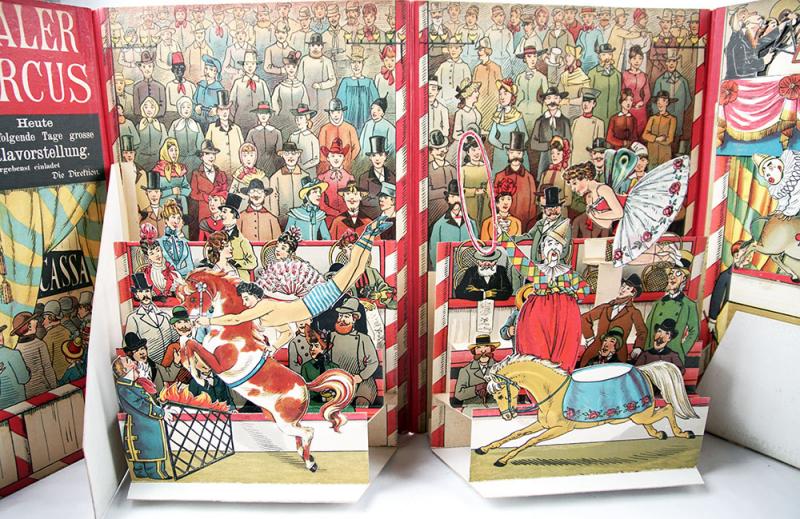
Lothar Meggendorfer (illus.)
Lothar Meggendorfer's Internationaler Circus. Esslingen & Munich: J. F. Schreiber, (c. 1887). Quarto. (8)pp, accordionfold. Third edition. The scene unfurls to show a panorama of three-dimensional images, each one of an athletic circus performance under the big top. These include horseback riders, clowns, acrobats, and balancing acts. The rear board provides the program for the entertainment in excited language fitting for an event of such impressive and exotic talent. As is common for circus materials, which trade in the fascinations of the foreign, this shows racially stereotyped figures. Bound in pictorial boards with hinges of red cloth. Evidence of professional repair to substructure, but all original parts appear present and entirely functional. Corners slightly rubbed, expert repair to a couple of weak cloth hinges, else very good.
Sachgebiete: Kinderbücher, Zirkus, Deutschland, Illustrierte Bücher
3260,- EUR
Differenzbesteuert/Subject to margin taxation