 Auf Merkliste setzen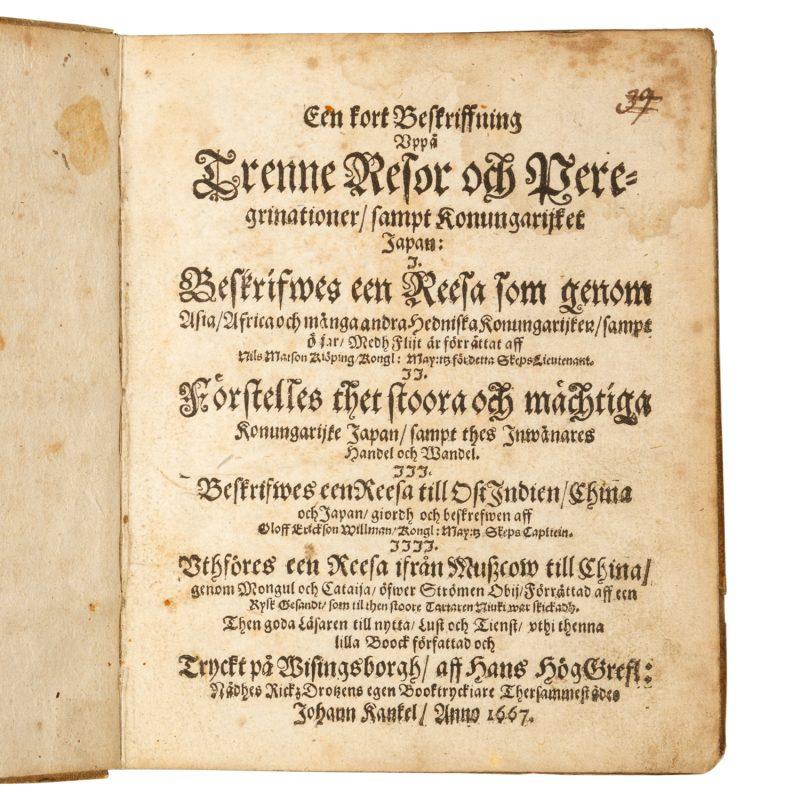
KIÖPING, Nils Mattsson; WILLMAN, Olof Eriksson; [CARON, François]
Een kort beskriffning uppå trenne resor och peregrinationer, sampt Konungarijket Japan: I. Beskrifwes een Reesa, som genom Asia, Africa och många andra hedniska Konungarijken, sampt Öjar; medh flijt är förrättat aff Nils Matson Kiöping … II. Förstelles thet stoora och machtiga Konungarijke Japan, samt thes invånares handel och wandel. III. Beskrifwes een Reesa till Ost Indien, China och Japan, giordh och beskrefwen aff Oloff Erickson Willman … IIII. Uthföres een reesa ifrån Muszcow till China, genom Mongul och Cataija … … Wisingsborgh [Visingsborg] : Johann Kankel, 1667. Four parts in one volume, quarto (195 x 160 mm), contemporary vellum over boards, spine with early manuscript lettering; front pastedown with ownership inscription (dated 1819) and manuscript notes of G. Sparre (most likely the Swedish nobleman Gabriel Adolf Gabrielsson Sparre, 1775-1844) and later armorial bookplate of Swedish politician Carl Trolle-Bonde (1843-1912); pp. [4], 257 [i.e. 258, as two pages are numbered 168]; paper typically browned, scattered foxing, front free-endpaper stained, title with pale marginal water stain; a very good example. Very rare first edition of this Swedish collection of travelogues, printed in 1667 in a run of only 500 copies by German printer Johann Kankel at the newly-established private press of Swedish nobleman, Count Per Brahe the Younger, at Visingsborg (Wisingsborg) on the island of Visingsö in Lake Vättern. Brahe’s collection was the first such anthology of travel accounts to be published in the Swedish language. Later editions appeared in 1674 and 1743. The first section contains the account of Nils Mattsson Kiöping (1621-1680), who in 1648 sailed on a Dutch ship to the coast of West Africa, the Cape of Good Hope, and then on to Persia where he remained for several years in the service of the Shah. In 1652 he continued his journey by ship to Ceylon, Java and Formosa. The second and third sections, which have their own title-pages (both with the same imprint as the main title) comprise an account of Japan by Olof Eriksson Willman, followed by a narrative of Willman’s travels in the East Indies, China and Japan. Willman was an exact contemporary of Kiöping. In 1648 he sailed with a VOC ship to the East Indies, where he stayed in Java until proceeding to Japan, arriving there in August 1651. He provides an important and detailed eyewitness description of the country, including as a participant in a Dutch embassy to Edo. His account of the Tōkaidō, or “Eastern Sea Route” – the road along the Pacific coast of Honshu connecting the imperial capital Kyoto with the shogunate capital Edo (Tokyo) – is one of the earliest by a European. He also includes a Swedish translation of François Caron’s Japan account. The fourth account – by far the briefest in the collection – is that of a Russian who travelled via Siberia and Mongolia to China. It has its own drophead title, but no imprint. Cordier, Japonica, 379-80 (“première édition très rare”); Collijn iv 456-457
Sachgebiete: Japan, Reisen/Reiseliteratur
7500,- EUR
inkl. 7% USt./incl. 7% VAT
Auf Merkliste setzen 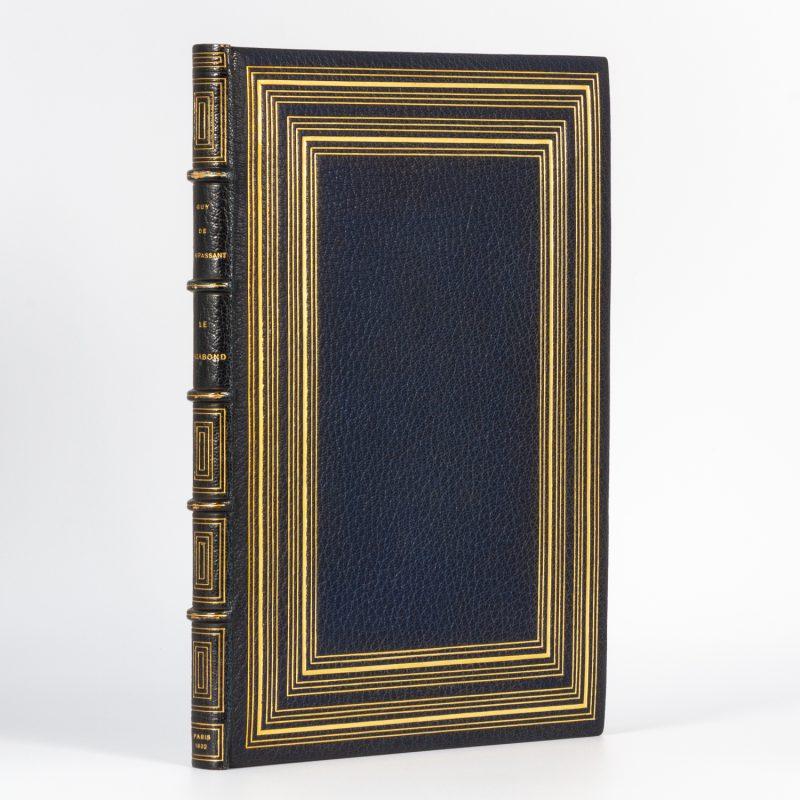
MAUPASSANT, Guy de; STEINLEN, Théophile (illustrator)
Le vagabond.Lithographies en couleurs par Steinlen. Paris : Société des Amis des Livres, 1902. Small folio, magnificently bound in full crushed morocco over bevelled boards, gilt rules and fillets, spine in compartments with prominent raised bands, lettered and ruled in gilt (a little rubbed on the bands), full morocco doublures with gilt rules and morocco fillets, further marbled paper endpapers, all edges gilt, gilt-lettered morocco collector’s label for Lucien Tissot-Dupont, preliminary and terminal blanks inserted by the binder, lithographed wrappers bound in, pp. 52; (6), illustrated with 51 colour lithographs by Theophile Alexandre Steinlen (1859-1923), housed in a morocco lined and trimmed card slipcase (edges rubbed and split along bottom edge), an exquisite work. Printed in an edition of only 115 copies. The only book with colour lithographs by Théophile Steinlen, illustrating Maupassant’s masterpiece of French realist literature. Le vagabond describes the tragic descent of Jacques Randel, a skilled 27-year-old carpenter who becomes a social outcast due to economic hardship and rejection as an ‘outsider’. Provenance: Lucien Tissot-Dupont, heir to the French luxury goods manufacturer S.T. Dupont, his book label to preliminary blank. References: Carteret, L., Livres illustrés modernes, 1875-1945, IV, p. 272 (Très belle publication […]. L’une des meilleures [illustrations] de l’artiste) Ray, G. N., French Illustrated Book, n° 340, pp. 440-446 Crauzat, E. de, Steinlen. L’oeuvre gravé et lithographié, 1913, n 519
Sachgebiete: Illustrierte Bücher, Literatur ab ca. 1900, Pressendrucke
3000,- EUR
inkl. 7% USt./incl. 7% VAT
Auf Merkliste setzen 
[KELMSCOTT PRESS]. CLANVOWE, Sir Thomas
The floure and the leafe, & the boke of Cupid, god of love, or the cuckow and the nightingale. London (Hammersmith) : Kelmscott Press, 1896. Small quarto, publisher’s Holland-backed boards, the linen spine with edge wear and traces of handwritten title, printed blue papered boards (a few small spots), bookplate for Harry Mansfield to from pastedown, printed in black and red, one of 300 copies printed on paper (an additional 10 copies were printed on vellum), light foxing to the endpapers and first few leaves, otherwise clean, a very good copy. Printed and sold by William Morris. Peterson A43. The Floure and the Leafe is an anonymous Middle English allegorical poem in 595 lines of rhyme royal, written around 1470, previously attributed to Chaucer.
Sachgebiete: Pressendrucke, Typographie
3250,- EUR
inkl. 7% USt./incl. 7% VAT
Auf Merkliste setzen 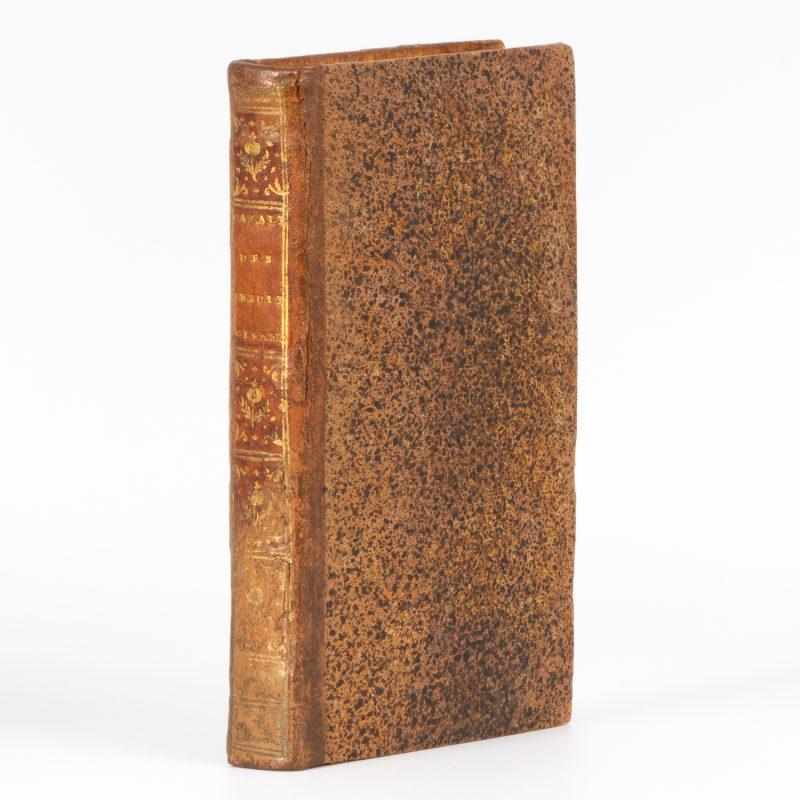
[LOUIS-LE-GRAND]
Catalogue des livres de la bibliothèque des ci-devant soi-disant Jésuites du Collége de Clermont, dont la Vente commencera le Lundi 19 Mars 1764. Paris : Saugrain & Leclerc, 1764. Octavo, contemporary sheep-backed speckled papered boards (joints expertly repaired), flat spine with gilt lettering and decoration; edges stained red; half-title leaf, pp. xviii, 488; later pencilled annotation on the title notes that the sale was finished on the 18 August 1764; a few marginal annotations, (quite possibly by the first owner of the catalogue, who attended the sale); clean throughout, a very good example, with small ex libris label of the Bibliotheca Collegii Valgirii Societatis Jesu (Library of the Valgir Jesuit College) to front pastedown, and old Jesuit library stamps to half-title and title. The rare sale catalogue of one of the most important Jesuit libraries ever assembled, that of the Collége (or Lycée) Louis-le-Grand (also known as the Collège de Clermont), in Paris. The library was renowned for its rarities and first editions of many significant works, and the catalogue is substantial, containing short title entries for 6752 books offered as individual lots, plus an index of authors. The library’s chief donors were Pierre Pithou (1539-96); the poet Philippe Desportes (1546-1606); Nicolas Fouquet (1615-80), superintendent of finance in the administration of Louis XV; and Achille de Harlay IV. The sale of the library and the ultimate dispersal of its books was the direct result of the suppression of the Jesuits in France that had been implemented in stages since 1761 through a series of decrees, which included the sequestration of the Order’s properties. Louis XV would sign a royal edict formally dissolving the Society of Jesus (Jesuits) throughout his dominions in November 1764. Rare Book Hub traces only a handful of examples of this important catalogue at auction in the last hundred years. Franklin, Les Anciennes Bibliothèques de Paris, II, pp. 245-65.
Sachgebiete: Bibliographie , Jesuiten
2000,- EUR
inkl. 7% USt./incl. 7% VAT
Auf Merkliste setzen 
SIONITA, Gabriel
Arabia, seu Arabum vicinarumque gentium Orientalium leges, ritus, sacri et profani mores, instituta et historia: accedunt praeterea varia per Arabiam itinera, in quibus multa notatu digna enarrantur. Amsterdam : Johann Jansson, 1633. Duodecimo, contemporary vellum, early ownership name to pastedown, notes to final leaf, engraved title page, pp. 297 (actually 287, with the pagination skipping pages 270 – 279), internally clean. “This important work contains early descriptions of Baghdad, Bokhara, Damascus, Medina, Mecca, and Aleppo” (Blackmer). A fine copy.
Sachgebiete: Arabistik, Reisen/Reiseliteratur
580,- EUR
inkl. 7% USt./incl. 7% VAT
Auf Merkliste setzen 
SCHMIDT, I. J. (Isaac Jacob)
Grammatik der Tibetischen Sprache, verfasst von I. J. Schmidt. St. Petersburg : Gräff ; Leipzig : Voss, 1839. Quarto (280 x 210 mm), contemporary red calf, richly gilt, spine with gilt lettering and decoration, gilt dentelles; all edges gilt; blue endpapers; pp. xv, [1 blank], 318, [2 Errata]; text in German (roman) and Tibetan script; scattered light foxing, a fine example in a beautiful binding of the period. First edition of Schmidt's Tibetan grammar, which was not only the first grammar of the language in German, but one of the first Tibetan grammars in any European language. Isaac Schmidt (1779-1847) was an Amsterdam-born Moravian missionary and Orientalist specialising in Tibetan and Mongolian. As a member of the Russian Academy of Sciences - the present work is dedicated to its president, Uwarow - he spent much of his career in St. Petersburg, devoting his later years to Bible translations in Kalmyk and Mongolian. Cordier, BS, 2932; Lust, 254
Sachgebiete: China, Sprachwissenschaft
1250,- EUR
inkl. 7% USt./incl. 7% VAT
Auf Merkliste setzen 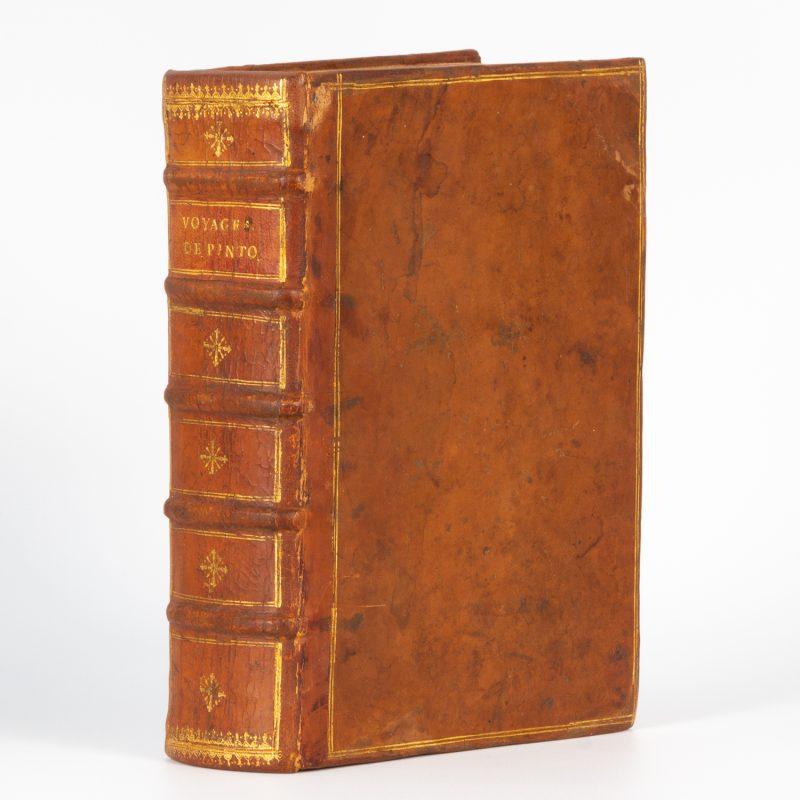
MENDES PINTO, Fernão
Les voyages advantureux de Fernand Mendez Pinto. Fidelement traduicts de Portugais en François par le Sieur Bernard Figuier, Gentil-homme Portugais. Et dédiez à Monseigneur le Cardinal de Richelieu. Le contenu de la présente histoire se verra à la page suivante. Paris : Mathurin Henault, 1628. Thick quarto (230 x 170 mm), contemporary full calf, boards with double-gilt rule (minor staining, one corner restored), spine in six compartments with raised bands and gilt lettering and decoration (leather a little dry); title in red and black (small marginal loss at bottom edge), pp. [16], 1193, [14 Table des chapitres], [1 blank]; decorated initials; pp. 75-6 restored at bottom corner (with loss of a few letters), pale marginal water stain to last 40 or so leaves, otherwise clean and sound throughout, a very good example. The first French translation of the Peregrinação, originally published in Lisbon in 1614. Pinto's work - a narrative of his two-decade voyage which commenced in Portugal in 1537 in a fleet under the command of the son of Vasco da Gama, and ended with his return in 1558 - contains some of the earliest eyewitness accounts by a Westerner of the Malay Peninsula, Siam, Cochin-China, China and Japan. Pinto was admitted to the Society of Jesus in 1554. A close acquaintance of Francis Xavier, he contributed to various missions in Japan, a country which he visited four times during his travels. The Peregrinação was enormously successful, and by 1700 had been published in nineteen editions in six languages. According to Catz, it rivalled Cervantes' Don Quixote in popularity: "It is, in fact, an exotic and imaginative composite of fact and fiction, at once a picaresque prose epic and an authentic picture of sixteenth-century Asia." (Rebecca D. Catz, The Travels of Mendes Pinto, 15). Cordier, Japonica, 37; Sinica, 2067
Sachgebiete: Asien, Nordamerika, Reisen/Reiseliteratur
1750,- EUR
inkl. 7% USt./incl. 7% VAT
Auf Merkliste setzen 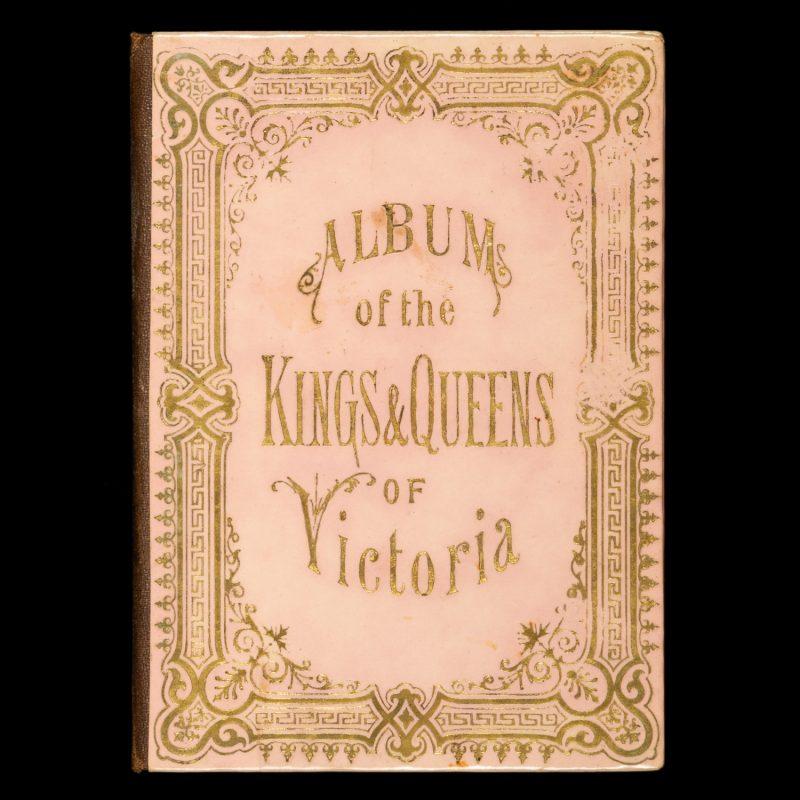
KRUGER, Johann Friedrich Carl (Fred), (1831-1888); [PERKINS, Horace]
Album of the kings & queens of Victoria. [Melbourne : compiled and published by H. Perkins & Co., The Gift Depot, c.1880]. Duodecimo, pink papered boards with gilt-stamped lettering and ornament, cloth spine; containing folding concertina of [12] panels with lithographic illustrations after Kruger's photographic portraits of surviving leaders of Aboriginal tribes of Victoria, originally taken at various times between around 1866 and 1878; the rear paste-down with the original printed yellow sheet laid in, with a short essay titled The Kings and Queens of Victoria : The Australian Aboriginal; a fine example of this rare and visually striking publication, in fine condition. One of at least three variant bindings, the others we have handled being bound in tortoiseshell or blue cloth. The subjects are captioned 'King David, Warrnambool Tribe'; 'Gellibrand, Colac Tribe'; 'Queen Mary, Ballarat Tribe'; 'King William, Mount Cole Tribe'; 'Queen Eliza, Yarra Tribe', 'King Tom, Derrinallum Tribe'; 'Mia Mia and Royal Family'; 'King Billy and his two wives'; 'Queen Rose, Ballarat Tribe', 'Tom William, Echuca Tribe'; 'Barker and son Heron, Bacchus Marsh Tribe', 'Dick, Goulburn Tribe'. From the brief essay by the publisher on the rear pastedown: '... like the aborigines of Tasmania which have become an extinct race, those of Victoria (which now number about 700) are so rapidly disappearing that at no very distant date they will have an existence in history only.' Ferguson 5809 (misdescribed)
Sachgebiete: Australien/Südsee
2200,- EUR
inkl. 7% USt./incl. 7% VAT
Auf Merkliste setzen 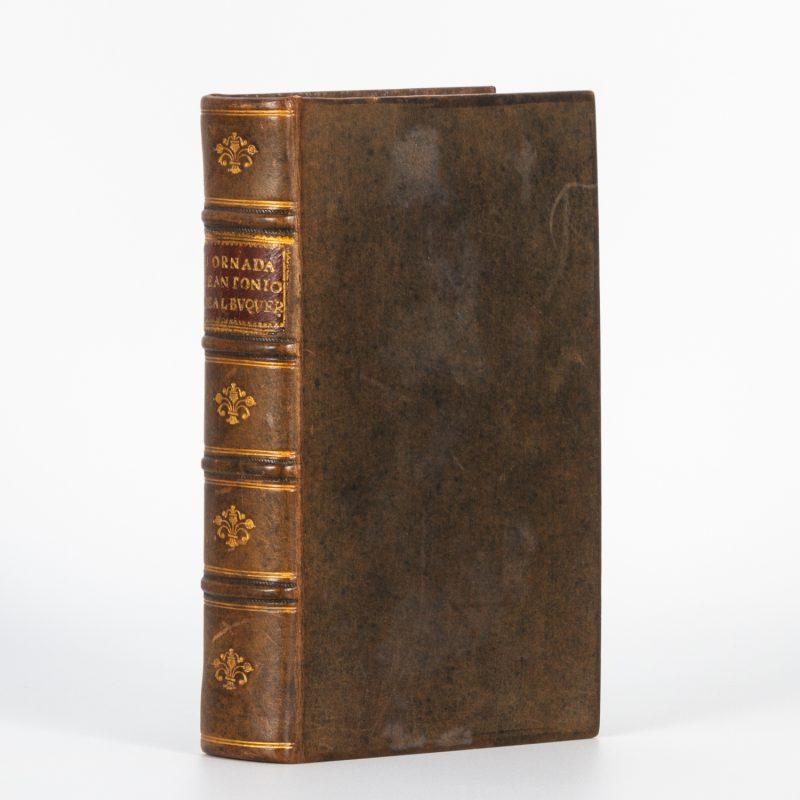
Tavares de Velles Guerreiro, João, active 1718
Jornada, que o senhor Antonio de Albuquerque Coelho, Governador, e Capitão General da Cidade do Nome de Deos de Macao na China, fez de Goa atè chegar á dita Cidade no anno de 1718. Dividida em duas partes. Escrita pelo Capitão João Tavares de Vellez Guerreiro, e dedicada a o Duque ... ... Lisboa Occidental : Na Officina da Musica, por D. Jayme de la Te y Sagau, 1732. Octavo, full calf binding by Aquarius. spine in compartments with gilt decoration and contrasting label lettered in gilt; title with the early ownership inscription of Antonio Caetano da Silva, and a (?nineteenth-century) wet stamp with a monogram surmounted by a crown; pp. [16], 427, [1 blank]; all text set within double-ruled black borders; woodcut initials, head- and tailpieces; very occasional handling marks to margins, last few leaves with some marginal worming, but overall a clean, crisp copy. Scarce second edition of this first-hand account by Tavares de Velles Guerreiro of the gruelling year-long voyage of António de Albuquerque Coelho (1682-1745) from Goa to the "City of the Name of God" - Macau - after he had been deliberately stranded in Goa. Albuquerque Coelho served as Governor of Macau from 1718-1719 and later as Governor of Timor. Tavares was Albuquerque's aide-de-campe and made the voyage with his superior from Goa that commenced in May 1717 and included an eventful six-month sojourn at Johore, during which Albuquerque became a participant in a coup-d'etat by the Sumatran Raja Kecil. The first edition, printed in Macao in 1718, was the only secular work printed by the Jesuits in China and one of the last xylographic printings they produced there. This second edition is a reprint of the extremely rare first, and is dedicated to the Duke of Cadaval by its printer and publisher, Jaime (Jayme) de la Te y Sagau. Cordier, Sinica, 2319; Howgego, A47; Löwendahl, 377
Sachgebiete: Asien, China, Reisen/Reiseliteratur
4500,- EUR
inkl. 7% USt./incl. 7% VAT
Auf Merkliste setzen 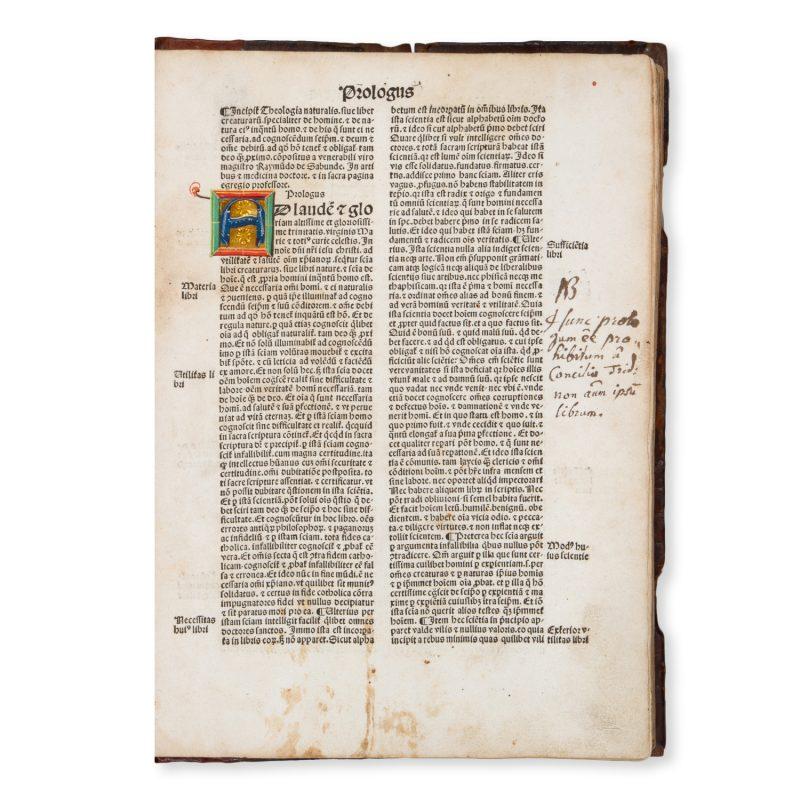
Raymond of Sabunde (c.1385-1436)
Theologia naturalis sive Liber creatura[rum] specialiter de homine [et] de natura eius in qua[n]tum homo. :[et] de his qu[a] sunt ei necessaria ad cognoscendu[m] seip[su]m [et] Deu[m] [et] om[n]e debitu[m] ad q[uo]d ho[mo] tenet[ur] et obligatur tam Deo q[uam] p[ro]ximo. Impressus Nurembergae : Per Anthoniu[m] koberger [sic] inibi co[n]cluem, 1502. Folio (290 x 210 mm), contemporary sheep over wooden boards (lacking clasps), elaborate blind-tooling to both boards, upper board including a panel containing abbreviated title, below it a partially remnant contemporary paper label with manuscript in red and black; A-Q8 R6; title with early (unidentified) ownership inscription and annotation recording the Prologue’s inclusion on the Index Prohibitorum (1595); Prologue with illuminated initial tooled into gold leaf on a gesso ground, calligraphic initials in red and blue throughout; text in two columns; marginalia to Prologue; old repair to top edge of lower board; both boards with loss of leather in places, exposing the wood; hinges cracked, but sound; later rebacking in calf, with original spine partially preserved; internally in excellent condition overall, very occasional foxing and minor rodent damage to edges of a few leaves. A key work in the development of natural theology, which attempts to reconcile twin sources of knowledge - the book of nature and the Bible - and, from that basis, argue that reason and philosophy are not incompatible with faith. Raymond of Sabunde (Ramon Sibiuda) (c.1385-1436) was a Catalan scholar and teacher of philosophy and medicine. From 1430 until his death he held a position at the University of Toulouse, during which time he wrote Theologia naturalis, between 1434 and 1436. The work was composed in a Catalan-influenced Latin. It was later translated into French by Montaigne, in 1569. Earlier editions of the work were printed in Deventer, Strasbourg and Venice, the first being undated but probably from around 1484. The printer, publisher and bookseller Anton Koberger (c.1440-1513) founded the first printing workshop in Nuremberg in 1470. He is best known as the publisher of the famous Nuremberg Chronicle. Adams R-36
Sachgebiete: Theologie
4500,- EUR
inkl. 7% USt./incl. 7% VAT
Auf Merkliste setzen 
HERALD & WEEKLY TIMES LTD. (MELBOURNE)
Press photograph of Marlene Dietrich during her 1965 Australian tour. Black-and-white press photograph on glossy paper, 205 x 250 mm; verso with wet stamp of The Herald & Weekly Times Ltd. Melbourne, Australia; a superb print with great detail, in fine condition. A wonderful, candid shot of Hollywood superstar Marlene Dietrich (1901-1992) - by this time in her career a sexagenarian sex symbol - seated atop a car, signing autographs and waving to adoring fans in Melbourne during her visit to Australia in 1965.
Sachgebiete: Photographie, Porträts
100,- EUR
inkl. 19% USt./incl. 19% VAT
Auf Merkliste setzen 
USAF (NORTHEAST AIR COMMAND)
[GREENLAND - Grönland]. Small archive of original photographs taken at Narsarssuak (Narsarsuaq) Airbase, Greenland, 1942-45. Group of 7 (seven) gelatin silver print photographs, in uniform 200 x 250 mm format; no inscriptions to versos, but presumably taken by a USAF serviceman; all of the prints are in excellent condition. These original photographs, taken sometime between 1942 and 1945, show USAF personnel at the airbase at Narsarssuak (Narsarsuaq), Greenland, which had been established by Northeast Air Command in the second half of 1941. A USAF plane pictured in two of the images features the motto Coelum Ad Proelium Elige (Choose the Weather for Battle), indicating that it belonged to one of the USAF Weather Squadrons. Another shows a wooden building with the tongue-in-cheek sign Narsarssuak Hotel de Gink (i.e. Narsarssuak Hotel for Homeless Men); and two show a Norwegian merchant vessel, the Annik (Bergen), which had taken part in dangerous North Atlantic convoys. From Wikipedia: ‘[In 1941] United States obtained rights to build bases in Greenland. In July 1941, a task force of service troops arrived at Narsarsuaq. This site had been chosen as a major staging base between Labrador and Newfoundland. Work began at once on the base, which was given the code name Bluie West One (BW-1), and the first plane set down on 24 January 1942. Work on a second west coast base further north, at Sondrestrom or Bluie West Eight, began in September 1941. A third field was placed on the east coast almost directly across from BW-1 at Angmagssalik (Bluie East Two). An interesting contribution to the defense of Greenland was the Northeast Greenland dog sledge patrol organized in the summer of 1941 as a joint endeavor of the Army, the United States Coast Guard, and the Greenland Government. All the activity on the east coast the year before had demonstrated the ease with which anyone could establish a foothold in the vast Arctic wastes, the near impossibility of finding a hostile force that had established itself, and the difficulty of dislodging one, once it was discovered. An air patrol of the east coast, even after the new bases were completed proved its worth by assisting in the capture of the trawler Buskoe on 12 September, as that vessel, a small German-controlled Norwegian ship, was attempting to establish a radio and weather station in the Mackenzie Bay area. In addition to the Army Airfields, the United States Navy Atlantic Fleet established a number of stations on Greenland to support radio, weather, and naval patrols as part of the Battle of the North Atlantic against German U-boats and the protection of Allied convoy traffic in the North Atlantic….’
Sachgebiete: Arktis/Antarktis, Photographie
150,- EUR
inkl. 7% USt./incl. 7% VAT
Auf Merkliste setzen 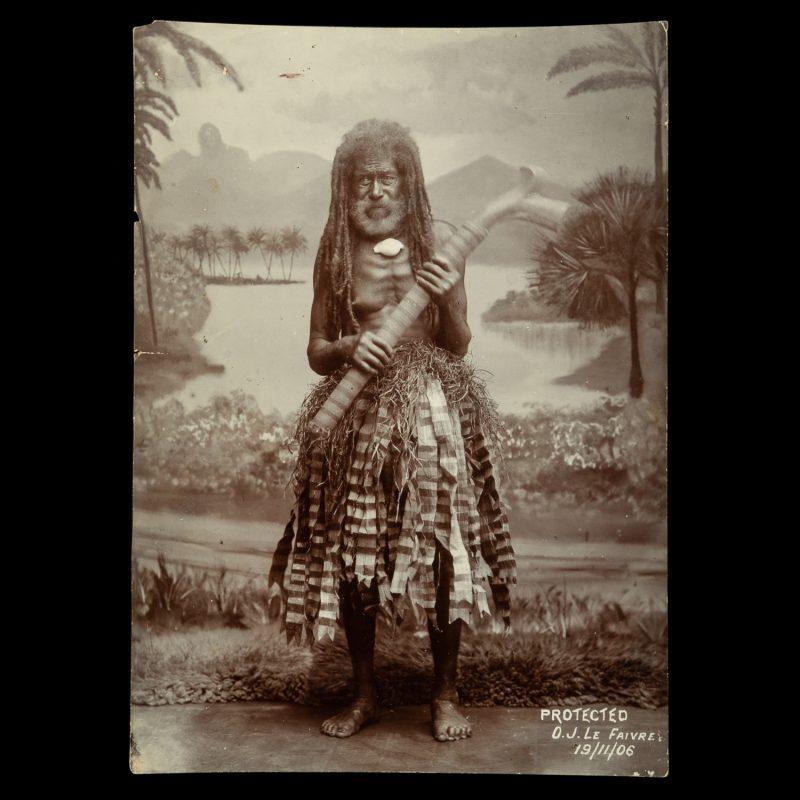
LE FAIVRE, O. J.
[FIJI - Fidschi] Studio portrait of a man known as "Cannibal Tom". Suva, 1906. Printing-out-paper print photograph, 202 x 150 mm; inscribed in negative 'Protected / O. J. Le Faivre 19.11.06'; verso with oval wet stamp worded 'More copies of this / Photo can be had from / Le Faivres Art Studioes [sic] / SUVA, FIJI'; superb clarity and tonal range; a couple of nicks to the left-hand edge and a few small tiny marks at upper left, else in very good condition (unmounted). Cannibal Tom (real name unknown) was a popular subject for photographers and postcard publishers, who often described him in their captions with the epithet "last of the cannibals" or similar. In this image he is posed in front of Suva photographer Le Faivre's suitably exotic painted backdrop, holding a type of club known as kiakavo.
Sachgebiete: Völkerkunde/Ethnographie, Photographie
150,- EUR
inkl. 7% USt./incl. 7% VAT
Auf Merkliste setzen 
SPITZ, Charles Georges (1857-1894)
Studio portrait of a tattooed Marquesan dancer. [Circa 1887]. Albumen print photograph, 200 x 140 mm, unmounted; verso with fully contemporary caption in pencil: Marquesan dancer; a strong print with rich tonal range and excellent clarity and contrast; the print is in very good condition, with the tiniest of nicks at two of the corners and some insignificant light creasing to the thin paper. This culturally significant portrait of a tattooed Marquesan dancer was taken by Charles Spitz in his studio in Papeete, Tahiti around 1887 (cf. Tréhin, 89). Along with the perhaps more well-known image by Mrs Sophia Hoare (cf. Tréhin, 85), Spitz's striking full-length portrait is one of the two key nineteenth-century photographic images documenting traditional Marquesan and, by extension, Polynesian tattooing practice. The following extract from Frederick O'Brien's Atolls of the Sun (New York : The Century Co., 1922, p. 343) records the remarks of an indigenous informant regarding the significance of tattooing in Marquesan society: ‘"Tattooing in these islands," said Nataro, "was usually begun upon those able to pay for it at the age of puberty; but there were many exceptions of tattooing commenced upon boys soon after their infancy or deferred until mature manhood. Illness, poverty, or other obstacle might prevent, and the desire of parents might cause early tattooing. The father or other relative or protector of the youth or girl paid the tuhuka but at the festivals even the very poor orphans were given opportunities to be tattooed by a general contribution, or the chief of the valley paid the fee. Years were occupied at intervals in the covering of the entire body of men, which was the aim; but many had to be content with having a part pictured, and often elaborate designs were never finished. You see many bare places, meant to be covered when the tuhuka began his work. Queen Vaekehu was converted to Christianity with but one leg done and forewent further beautification to serve her new God. Though begun in boyhood, the full adornment of a man could hardly be terminated before his thirtieth year. During his lifetime of sixty years he might have it renewed twice, and as each pore could not be duplicated exactly the third coat would make him a solid mass of color, the goal of manly beauty. Though men usually sought to look terrible so that when they faced their enemies they would inspire fear, with women the sex motif was dominant," said Nataro.' Related literature: Tréhin, Jean-Yves. Tahiti : L'Eden à l'épreuve de la photographie. (Paris : Gallimard, 2003) Provenance: James Lyle Young (1849-1929), Papeete merchant and Pacific Islands trader; by descent (Melbourne, Australia).
Sachgebiete: Völkerkunde/Ethnographie, Photographie
1750,- EUR
inkl. 7% USt./incl. 7% VAT
Auf Merkliste setzen 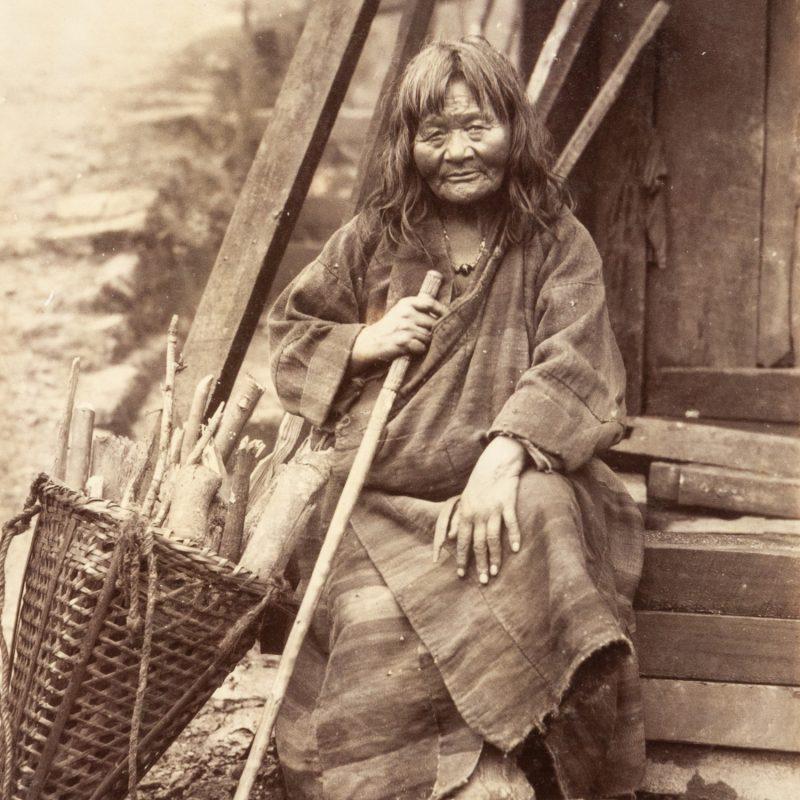
[PAAR, Theodor, attributed]
Portraits of Himalayan types, including Nepalese and Tibetan, taken in Darjeeling, 1890s. Group of 5 (five) albumen print photographs removed from the same late nineteenth-century album, all attributed to the Darjeeling photographer Theodor Paar. I. The Witch at Ghoom. [Caption on mount]. 200 x 150 mm, mounted recto of card mount; very good condition. The subject is believed to have been a Bhutia woman from Tibet, living in Darjeeling. She was photographed a number of times by Paar. II. A Porter. [Caption on mount]. 205 x 150 mm, mounted recto of card mount; very good condition. III. Family group of Nepaulese. [Caption on mount]. 205 x 150 mm, mounted recto of card mount; very good condition. IV. Praying Wheel. [Caption on mount]. 202 x 148 mm, mounted recto of card mount; very good condition. V. Nepaulese. [Caption from mount affixed]. 205 x 150 mm, skimmed from card mount; very good condition.
Sachgebiete: Asien, Indien , Photographie
850,- EUR
inkl. 7% USt./incl. 7% VAT
Auf Merkliste setzen 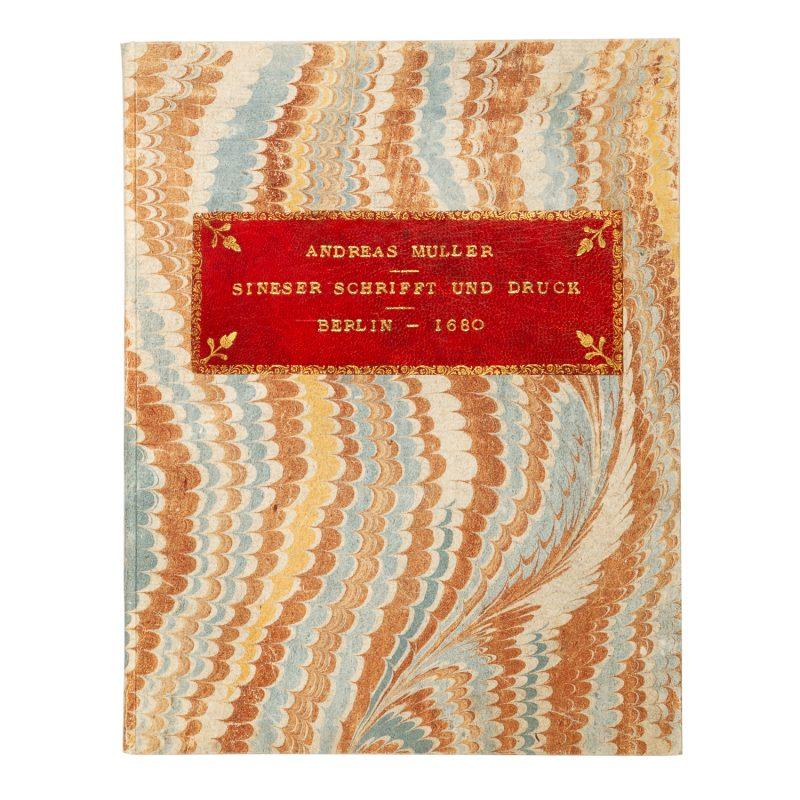
MÜLLER, Andreas
Andr. Mülleri Greiffenhagii Besser Unterricht Von der Sineser Schrifft und Druck/ Als etwa in Herrn Doct. Eliae Grebnitzen Unterricht Von der Reformirten Und Lutherischen Kirchen enthalten ist.Berlin : bey Christoff Runge, 1680. Quarto, modern papered boards with gilt-lettered red leather title label to front; pp. 28 (including title), lacking the four unnumbered Addenda leaves at rear; woodcut headpiece, Chinese character (p. 12) and various other symbols in text; first two leaves with minor restoration at gutter, paper browned; ex libris label of H. P. Kraus to front pastedown. Born in Greifenhagen an der Oder, theologian and Orientalist Andreas Müller Greiffenhagius (1630-1694) was one of the most renowned Sinologists of his time. He matriculated at the University of Rostock in 1649, and then studied in Greifswald and Wittenberg. In 1653 he was appointed rector of the municipal school in Königsberg in der Neumark, and was awarded the degree of Master of Arts by Rostock in 1654. In 1655 his work Horologium linguarum orientalium was published in Stettin, while he was serving as Provost of Treptow. In 1660 he was admitted to the Faculty of Philosophy in Rostock, although he in fact spent a year in England at this time, where he was able to establish connections with international scholars. In 1665, he became Provost of Bernau and discovered various Oriental manuscripts in the library recently established in Berlin; these manuscripts formed the basis of his work Excerpta manuscripti turcici de cognitione dei et sui ipsius (Cologne, 1665). At the end of 1666 he was appointed Provost of St. Nicolai in Berlin, making him the city’s most prominent clergyman. However, Müller devoted most of his time to the study of the Chinese language, and from around 1670 he began to publish a succession of significant contributions to scholarship in this field, including an edition of the Latin Marco Polo (1671), Monumentum Sinicum (1672), and a catalogue of Chinese books in the Berlin library (1683). Furthermore, he formulated a new method of teaching the Chinese language (although this was challenged by several leading scholars). His ideas on this subject are outlined in the present work, which also doubles as Müller’s defiant response to the misguided statements of Frankfurt Reformed theologian Elias Grebnitz (1627-1689), who in the late 1670s denounced the Chinese pictographic script as a work of the Devil that violated the Second Commandment. Reformist antagonism surrounding this issue, however, meant that Müller – an orthodox Lutheran – began to find his position in Berlin increasingly less tenable; as a consequence, he requested and was granted a discharge in 1685. Returning to Stettin, his scholarly research continuing unabated until his death. Although he burned many of his manuscripts before he died, the bulk of his library and the surviving manuscripts entered the St. Marienstift collection in Stettin, where they remain to this day. VD17 39:124138U; digitised by the Staatsbibliothek zu Berlin; not in Wiener Chinabibliographie Very rare. No copies traced in North American libraries; no sale record in the Rare Book Hub database.
Sachgebiete: China
5500,- EUR
inkl. 7% USt./incl. 7% VAT
Auf Merkliste setzen 
POLO, Marco (1254-1324)
Marco Polo Venetiano, delle merauiglie del mondo per lui vedute : del costume di varij paesi, & dello stranio viuer di quelli, della descrittione de diuersi animali, del trouar dell’oro, & dell’argento, delle pietre preciose : cosa non meno vtile, che bella. Di nuouo ristampato, & osseruato l’ordine suo vero nel dire. In Venetia: Appresso Ghirardo & Iseppo Imberti, MDCXXVI [1626]. Duodecimo, contemporary limp vellum, spine with faint manuscript lettering; gutters reinforced, title in ornamental border and with vignette printer’s device; pp. [2], 3-128; illustrated with a frontispiece woodcut initialed ‘V. F.’; head and tail-pieces, decorated initials; title with small area of restoration to worming lower left (not affecting any text), last 8 leaves with some staining and minor restoration to worming at lower margins, otherwise very good throughout. A rare later Venetian edition of the Travels of Marco Polo, originally published in Italian in 1496 (also in Venice) as Marco Polo da Veniesia De le merauegliose cose del mondo. Unquestionably, the famous account of Marco Polo is the single most important travel narrative of the Middle Ages, one that shaped Western perceptions of Asia and the Islamic world for centuries. Columbus carried a copy of the first Latin edition (1485) with him on his first voyage to the Indies, which he annotated extensively. It might also be argued – as Sabin has done – that it provided a major impetus for the exploration of the New World: ‘The travels of Marco Polo in the East claim a place in an American collection in consequence of the remarks of distinguished geographers that they were perused by Columbus, and that the revelations made by him of the wonders of Cathay and Zipanga stimulated the great navigator to accomplish through the sea, what the Venetian traveller had by land’ (Sabin). The Rare Book Hub database traces no copy of this 1626 Venice edition at auction since 1929.
Sachgebiete: Asien, China, Reisen/Reiseliteratur
15000,- EUR
inkl. 7% USt./incl. 7% VAT
Auf Merkliste setzen 
HAY, John, 1546-1607
De rebus Iaponicis, Indicis et Peruanis epistolae recentiores. A Joanne Hayo Dalgatttiensi Scoto Societatis Jesu in librum unum coacervatae. Antuerpiæ : Ex officina Martini Nutij, ad insigne duarum Ciconiarum, Anno M. DC. V. [Antwerp : Martin Nutius, 1605]. Octavo, fine Jesuit binding of full calf ruled in gilt with ornamental cornerpieces; upper board with central Jesuit device, lower board with heraldic crest; flat-panel spine tooled in gilt, contrasting red morocco title label; all edges gilt; pp 968, [46]; printer’s device on title page of two storks fighting over a snake with the motto ‘Pietas homini tvtissima virtus’; woodcut initials and tail-pieces; a few leaves browned; pale stain across upper section. First edition of this compilation by Scottish Jesuit John Hay of 55 letters from missions in Japan, India, Peru, the East Indies and the Philippines, dated between 1577 and 1604. The section on Japan is the most substantial (the first 636 pages), and contains letters by notable Japanese Christians and by Frois, Cabral, Organtino and Valignano, including one of the earliest reports of the persecution of Christians in Japan. Approximately 200 pages are devoted to letters from missions in India (“Mogor”), the majority sent from Goa. There are also shorter sections containing letters from Peru and the Philippines. It has been suggested that this volume was conceived as a companion to Nutius’ 1605 edition of Maffei’s Historiarum Indicarum: often bound in is Maffei’s Ignatii Loiolae vita (also published in 1605). Its compiler, John Hay, was expelled from Scotland in 1579 and fled to France, where he became rector of the Jesuit college at Pont-à-Mousson in Lorraine. Cordier, Japonica, 246; de Backer-Sommervogel, IV, 165, 12; Palau, 112581; Alden, 605.57; Streit, V, p. 58 (with a detailed list of contents)
Sachgebiete: Asien, Japan, Jesuiten, Orient
6750,- EUR
inkl. 7% USt./incl. 7% VAT
Auf Merkliste setzen 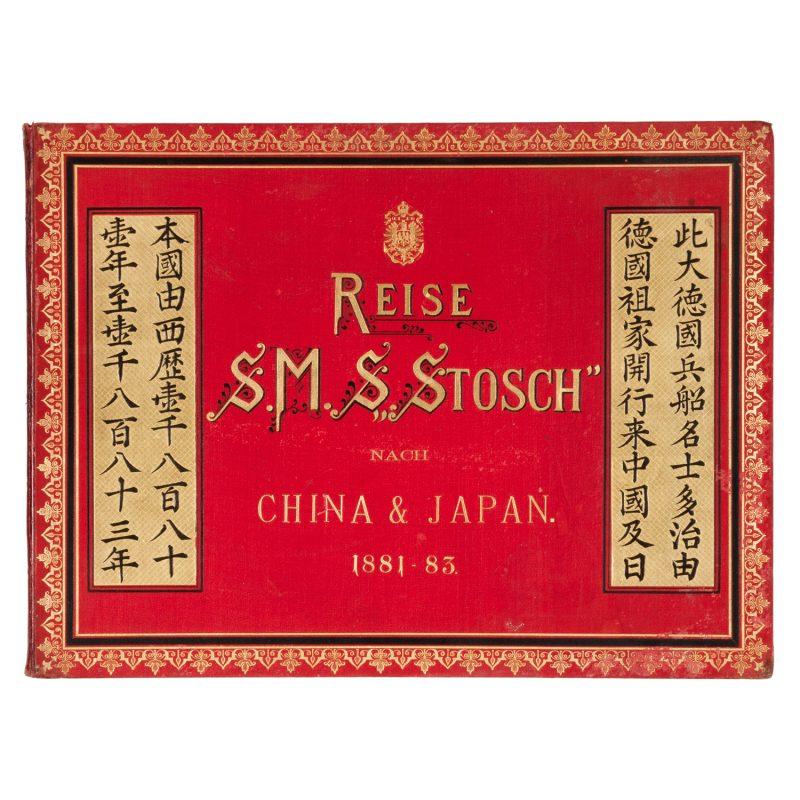
RIEMER, Gustav Adolf (1842-1899)
Reise S.M.S. Stosch nach China und Japan 1881-1883. Photographirt und herausgegeben v. G. Riemer, Marine Zahlmeister. Band II [of 2] See- und Schiffsbilder. Leipzig : F. A. Brockhaus, 1883. Oblong folio (300 x 400 mm), original red cloth over boards decorated and lettered in gilt, upper board with titles in German, Chinese and Japanese (some light flecking and minor stains, lower board with damp staining), original red morocco spine lettered in gilt; all edges gilt, original gilt-decorated endpapers; title leaf, contents leaf, 6 pp. text, illustrated with 59 Woodburytypes (numbered 59-117) mounted on rectos of 19 boards (“Taf. 20-38”); most images 100 x 165 mm, some larger, with captions printed below the images on the mount; contents – including all prints – in very fine condition. Gustav Adolf Riemer (1842-1899) joined the Prussian Marines in 1859. He served as paymaster on the voyage of the S.M.S. Hertha to the Far East and the South Sea islands in 1874-77. Riemer was a keen amateur photographer and took several hundred photographs during this expedition, documenting his ship’s visits to the Philippines, Hong Kong, Yokohama, Nagasaki, Vladivostock, Canton, Amoy, the Marianas, the Caroline Islands, the Palau Islands, Samoa, Tonga, Auckland, and King George’s Sound (Albany, Western Australia). In 1878 Riemer self-published a photographic album of the voyage, Tagebuchs-Auszug betreffend die Reise S.M.S. “Hertha” nach Ost-Asien und den Sudsee-Inseln, 1874-1877 (Wilhelmshaven : G. Riemer, 1878). After serving on the S.M.S. Meteor, Riemer was appointed paymaster on the S.M.S. Stosch. The photographs in the present album – the second in a set of two, of which the first volume is rarely found – were taken on trips which the Stosch made to China and Japan in 1881-83. The photographs record in detail the great variety of duties of a German naval crew during a long sea voyage at this time, documenting its activities above and below decks, as well as the ship undergoing repairs in dock.
1500,- EUR
inkl. 7% USt./incl. 7% VAT
Auf Merkliste setzen 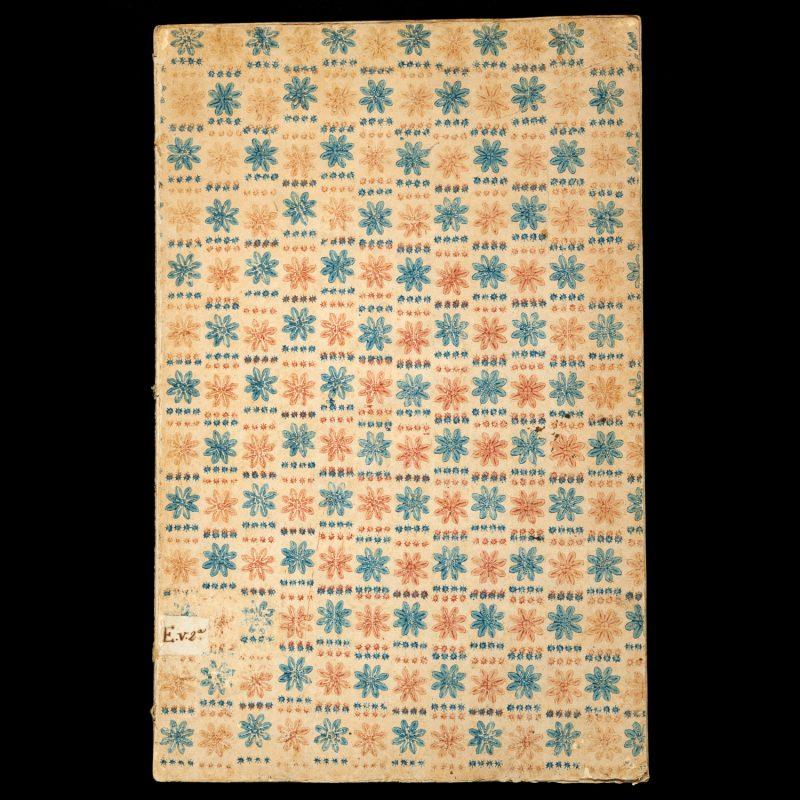
[PROPAGANDE FIDE]
Augusto Friderico, magnae Britanniae principi, Georgii Regis filio, Carmina linguis exoticis in honorem Dei pueri a tribus magis adorati … [Rome : Propaganda Fide Press, 1793], Folio (360 x 230 mm), original decorative paper wrappers (upper wrapper almost detached, and lacking backstrip); ff. [1 blank], I-XXIII (i.e. 23 numbered leaves); printed on recto only and within an ornamental border; engraved arms of the Duke of Sussex at the head of title-page; verso of first blank with early library shelf mark in manuscript, title-page with two old Propaganda Fide stamps, ‘CVPF’ and ‘BMPF’, indicating the volume was at one time in the library of the Collegium Urbanum and also (probably later) in its main library; scattered light spotting, a very good example, housed in a handsome quarter crimson morocco clamshell box with black leather title-labels in gilt. A rare polyglot publication printed in Rome on 13 January 1793 by the Sacred Congregation for the Propagation of the Faith (Propaganda Fide), consisting of 36 versions of a Latin panegyric poem in praise of the Christ Child adored by the Magi, rendered in 36 different languages. The original poem was composed by an alumnus of the Pontifical Urban College, and these 36 versions were recited in the presence of Prince Augustus Frederick (the son of King George III of Great Britain and his queen consort, Charlotte of Mecklenburg-Strelitz) to honour his visit to the college on New Year’s Day, 1793. Pope Pius VI approved the dedication to the Prince. Not only do the various versions represent a wide range of Indo-European, non-Indo-European and ancient languages, but they are rendered in their own scripts. The many typographical specimens showcase the considerable variety of exotic metal typefaces developed by the Propaganda Fide press which were in use in the eighteenth century, and which reflect the global extent of Catholic missions. The languages (and their relevant scripts) include Ethiopic, Coptic, Arabic, Persian, Armenian, Syriac, Hebrew, Chaldean, Sanskrit, Brahmi, Illyrian, Bulgarian, Albanian, Greek (Classical and Modern), Etruscan, Irish Gaelic, Polish, Russian, Chinese, Tibetan, Tangut, and Turkish.
Sachgebiete: Sprachwissenschaft
1500,- EUR
inkl. 7% USt./incl. 7% VAT