 Auf Merkliste setzen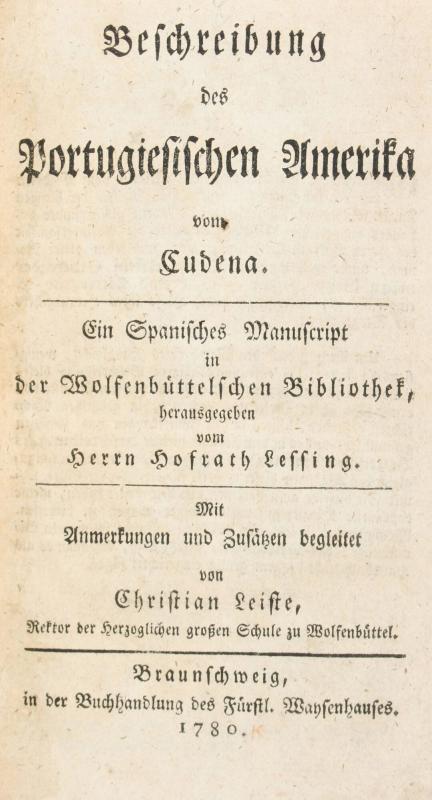
Cadena de Vilhasanti, Pedro de; Lessing, Ephraim Gotthold; Leiste, Christinan
Beschreibung des Portugiesischen Amerika vom Cudena. Ein Spanisches Manuskript in der Wolfenbüttelschen Bibliothek, herausgegeben von Herrn Hofrath Lessing. Mit Anmerkungen und Zusätzen begleitet von Christian Leiste. Rektor de herzoglichen grossen Schule zu Wolfenbüttel. Braunschweig: in der Buchhandlung des Fürstl. Waysenhauses, 1780. First edition. The original Spanish text is reproduced throughout with facing German translation. Later morocco, covers panelled in blind and gilt, spine lettered in gilt. 160 pp. Outer margin of the final leaf skilfully restored. Overall in very good condition. A rare pre-Humboldt German Braziliana; the first publication of a 1634 survey of Portuguese America’s geography, commerce, and colonial administration, issued by Lessing. One of the most significant German publications on Brazil of the eighteenth century, containing the first appearance in print of a manuscript survey of Portuguese America written in 1634 by Pedro Cadena de Vilhasanti. The manuscript was discovered in the ducal library at Wolfenbüttel by Gotthold Ephraim Lessing, who published it together with a German translation and an extensive commentary by Christian Leiste. At a time when reliable German-language information on South America remained scarce, the volume became one of the principal German sources on Brazil before the appearance of Humboldt’s works. The author, Pedro Cadena de Vilhasanti, served as provedor-mor of the Royal Treasury in Brazil and is best known for his Relação diária do cerco da Bahia de 1638, one of the principal contemporary accounts of the Dutch siege of Salvador, first published only in the twentieth century. Written for the Count-Duke of Olivares, chief minister of the Spanish monarchy, the present work reflects Cadena’s direct experience of colonial administration and constitutes a detailed administrative, economic, and geographical survey of Portuguese Brazil during the period of Dutch expansion in northeastern South America. Proceeding systematically along the coast from the mouth of the Amazon southwards, he describes the principal captaincies, including Maranhão, Pará, Rio Grande, Paraíba, and Pernambuco, recording settlements, fortifications, ports, rivers, and administrative divisions while providing extensive information on trade, taxation, sugar production, shipbuilding resources, and strategic infrastructure. Particular attention is given to exports of sugar, tobacco, cotton, brazilwood, and other commodities, the revenues they generated, the number of sugar mills in operation, navigational conditions, and the availability of timber suitable for the construction of large ocean-going vessels. The work preserves an unusually detailed snapshot of the economic and administrative structure of Portuguese Brazil in the early seventeenth century and offers a rare contemporary assessment of the colony’s strategic and commercial value. The publication originated in Lessing’s investigation into the origin of the name of the Amazon (Marañón) River. Misinterpreting the phrase “Marañón y Gran Pará” as referring to a Spanish captain rather than to a geographical designation, he believed the manuscript provided evidence for the origin of the river’s name and therefore arranged for its publication, prefacing it with a substantial introduction. Although this interpretation was later shown to be mistaken, Leiste sought to support Lessing’s reading of “Marañón y Gran Pará” before ultimately supplementing the manuscript with additional material drawn from more authoritative sources, particularly Dutch works on Brazil, thereby providing a broader account of the colony’s geography and history. His commentary reflects the growing German scholarly interest in South America during the late eighteenth century. Borba de Moraes regarded the volume as one of the most significant German publications on Brazil of the eighteenth century, noting the scarcity of original German works on the subject during that period. The edition attracted sufficient attention to be reprinted, with corrections and additional commentary, in C. G. von Murr’s Reisen einiger Missionarien der Gesellschaft Jesu in Amerika (1785).
Sachgebiete: Brasilien , Wirtschaft, Geschichte, Südamerika, Reisen/Reiseliteratur
15000,- EUR
Differenzbesteuert/Subject to margin taxation
Auf Merkliste setzen 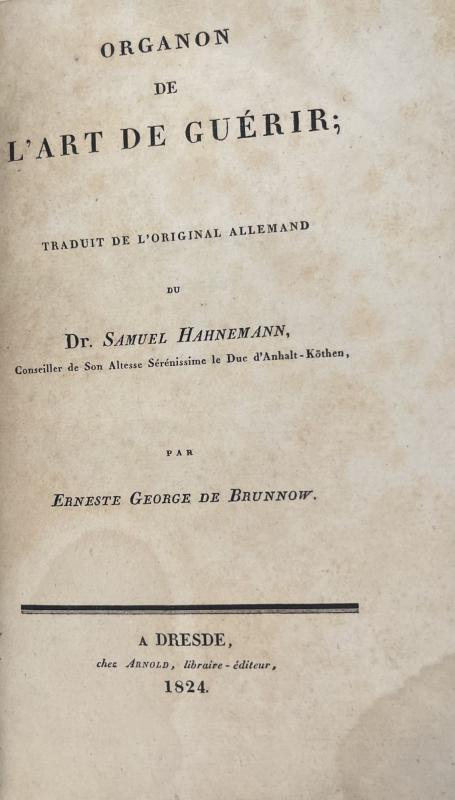
Hahnemann, Samuel; [Brunnow, Ernst George von]
Organon de l’art de guérir; traduit de l’original allemand du Dr. Samuel Hahnemann Conseiller de Son Altesse Sérénissime le Duc d’Anhalt-Köthen, par Erneste George de Brunnow. a Dresde: chez Arnold, libraire-éditeur [a Berlin, de l’imprimerie d’Auguste Guillaume Schade, Alte Grün-Strasse No. 18.], 1824. First edition. In later red half Russia in period style, ribbed spine gilt; publisher’s blue wrappers preserved. [9] X–LXII [2] [1]–271 [1] p. Untrimmed at outer and lower edges, top edge gilt. Slight fading to upper front panel; light dampstaining to lower outer corner of first 20 leaves; title lightly foxed. A fine copy overall. First French edition of the foundational treatise of homeopathy, and the first translation of the Organon into any language—a key product of Romantic-era medical and intellectual reform. Samuel Hahnemann’s Organon, first published in German in 1810, introduced a radically different model of medicine based on the principle similia similibus curentur—“like cures like.” In contrast to the dominant “heroic” treatments of the time, it advocated a gentler, individualized approach grounded in close symptom observation and the use of highly diluted substances. The Organon codified a system that drew from Enlightenment rationalism while reflecting the Romantic search for harmony between nature, spirit, and healing. This 1824 edition is the first translation of the Organon into any language, based on the revised and expanded second German edition (1819). The translator, Baron Ernest Georg von Brunnow (1796–1845), though not a physician, was a key figure in the early promotion of homeopathy in Europe. Treated successfully by Hahnemann as a young man, Brunnow became a committed advocate. His translation was instrumental in spreading Hahnemann’s ideas to French-speaking audiences in France and beyond. He also contributed to the Latin translation of Materia Medica Pura and translated several of Hahnemann’s lesser writings into French. The edition opens with a dedication to Duke Frederick Ferdinand of Anhalt-Köthen, Hahnemann’s patron after his departure from Leipzig, followed by Brunnow’s introduction situating homeopathy within ongoing medical debates. It includes the prefaces to the first (1810) and second (1819) German editions, and concludes with a French translation of Hahnemann’s treatise on small doses, excerpted from volume six of the Materia Medica Pura. Published in the midst of a broader Romantic reconsideration of science, nature, and the human body, the Organon resonated with the period’s intellectual currents—from Goethe’s natural philosophy and Schelling’s vitalism to Alexander von Humboldt’s integrative vision of the natural world. Far from being an isolated medical anomaly, it was a product of its age: a synthesis of empirical observation and speculative thought shaped by the philosophical and cultural upheavals of early 19th-century Europe. Extremely scarce. The last recorded sale on Rare Book Hub dates to 1963. Institutional holdings are limited, with most copies located in France and Germany. Only a single copy is recorded in the United States (University of Wisconsin).
Sachgebiete: Erstausgaben, Homöopathie, Medizin
6000,- EUR
Differenzbesteuert/Subject to margin taxation
Auf Merkliste setzen 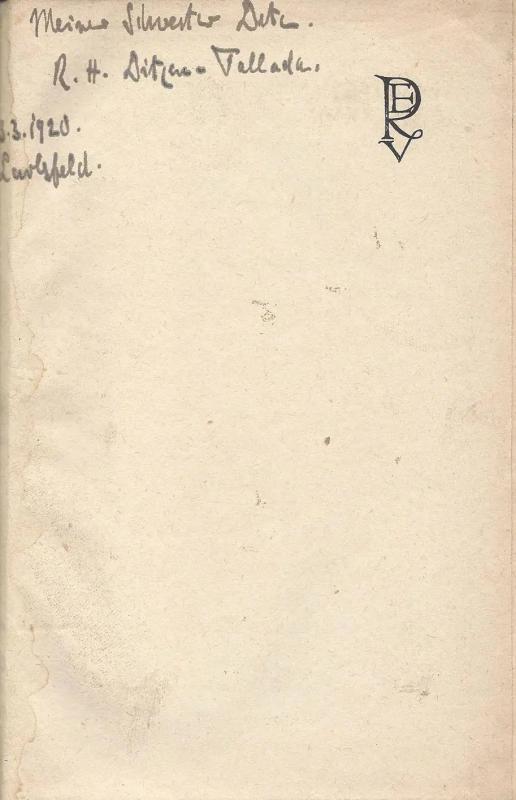
Fallada, Hans
Der junge Goedeschal. Ein Pubertätsroman von Hans Fallada. Zweite Auflage. Berlin: Ernst Rowohlt Verlag, 1920. First edition(?). Association copy, inscribed by the author to his sister. Bookplate of Margarete Bechert (supposedly Fallada’s niece) on the front flyleaf. In contemporary half cloth. 340 [2] p. In contemporary or slightly later half-cloth binding, with the original printed paper wrapper mounted on the front panel. Water stain at the gutter on the first leaves; the fourth leaf reinforced with fabric tape. Otherwise in fine condition. Fallada’s debut novel, inscribed to his sister; from the collection of the author’s niece. Inscribed by Hans Fallada to his sister, “Meiner Schwester Dete” (Margarete Bechert), and signed as “R. H. Ditzen-Fallada” (his real name was Rudolf Ditzen). Although “Zweite Auflage” (second edition) is printed on the title page, it is known that due to the novel's lack of success, Rowohlt did not reprint it after the initial run of 2,000 copies. Instead, they masked this by using fictitious edition statements, as noted by Dünnebier: “da dem Roman wenig Erfolg beschieden war und nach der ersten Auflage von 2000 Exemplaren nicht wieder nachgedruckt wurde, kaschierte Rowohlt den Mißerfolg mit fingierten Auflagenangaben” (Dünnebier).
Sachgebiete: Literatur ab ca. 1900
5000,- EUR
inkl. 19% USt./incl. 19% VAT
Auf Merkliste setzen 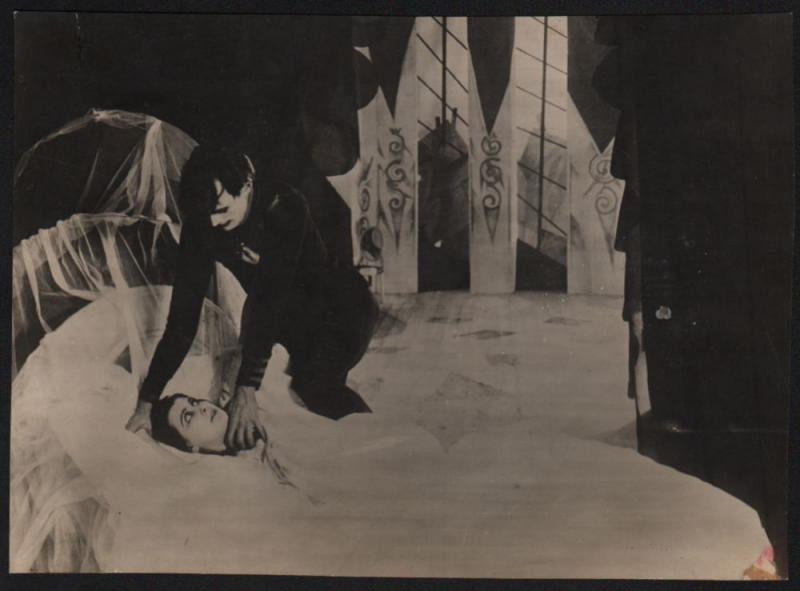
Robert Wiene
Still from “The Cabinet of Dr. Caligari” (Ca. 1920.). Original, vintage black and white photography. 215 × 155 mm. Notes and marks in blue crayon, traces of the mounting on verso. Trace of folding to the upper left edge. Small damage at lower right corner. Overall a very good copy. Vintage still from the legendary German Expressionist horror movie, “The Cabinet of Dr. Caligari”. The image shows the scene when the scary looking, black clothed Cesare (Conrad Veidt) is kidnapping Jane (Lil Dagover) who is sleeping in a white night gown. “The Cabinet of Dr. Caligari” is a 1920 German silent horror movie, written by Hans Janowitz and Carl Mayer and directed by Robert Wiene.
Sachgebiete: Film, Moderne Kunst, Photographie
7000,- EUR
Differenzbesteuert/Subject to margin taxation
Auf Merkliste setzen 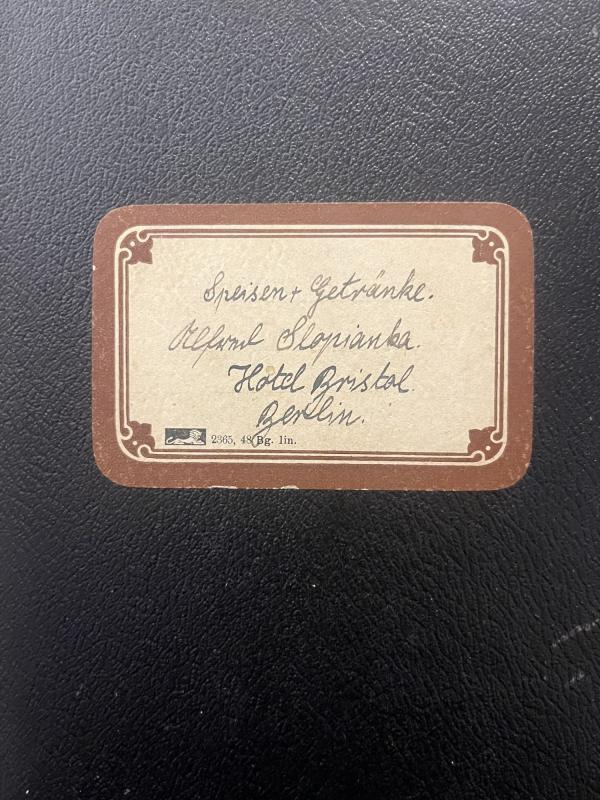
Slopianka, Alfred
[Hotel Bristol, Berlin.] Speisen und Getränke. Alfred Slopianka. Hotel Bristol Berlin. Berlin: Undated, but circa 1930. Manuscript. Accompanied by several loose notes, all related to gastronomy, including lists of beef cuts, additional dish descriptions, a translation of German dishes into French, a typewritten list of regional specialties, and a printed operational regulation for the Hotelbetrieb-Aktiengesellschaft Bristol, Kaiserhof, Bellevue, Baltic, Centralhotel from 1935. Bound in contemporary half-cloth, with hand-cut index tabs. In a larger scrapbook-style volume, with more than 30 pages containing entries in German, while the rest remain blank. In fine condition. A unique handwritten gastronomic reference book from the 1930s, compiled by a Hotel Bristol waiter, documenting dishes and beverages. Handwritten recipe book belonging to Alfred Slopianka (b. 1916), a waiter at the Hotel Bristol in Berlin, one of the city's most prestigious luxury hotels. Rather than offering precise recipes with measurements, the manuscript provides descriptions of various dishes and beverages, listing their ingredients in a way that suggests it was meant as a reference for explaining dishes to guests or for personal use in service. Today, it provides valuable insight into the diverse and refined offerings of the hotel’s restaurant, reflecting the sophistication and breadth of its cuisine. The content is organized into sections, including Appetizers (1), Soups (28), Egg Dishes (8), Fish (16), Sauces (24), Garnishes, Meat Dishes (13), Vegetables, Salads (3), Desserts (18), and two sections dedicated to beverages: ‘Amerikanische Getränke’ (American Beverages) and ‘Alkoholische Getränke’ (Alcoholic Beverages). Additionally, the manuscript includes a section on lobsters and oysters (2), a glossary of Fachausdrücke (technical terms) explaining five preparation methods, and a seasonal dishes (Saisongerichte) section spanning two pages, listing different meats and fish alongside the months in which they were typically served, with additional notes (Vermerke) on a few vegetables. A double-page chart details cooking and roasting times for various meats. The ‘Amerikanische Getränke’ section contains a description of American Grog, while the ‘Alkoholische Getränke’ section is more detailed, listing eleven drinks with more than just their ingredients—some include preparation instructions. Among them are five classic cocktails: Absinthe Cocktail, Champagne Cocktail, Manhattan Cocktail, Manhattan Dry Cocktail, and Martini Cocktail—as well as Queen Charlotte (a variation of the Stinger), Milk Punch, Prince of Wales, Prairie Oyster, Sorbet, and Sherry + Egg. These selections reflect an awareness of international drinking culture and the refined tastes of the hotel's clientele. Founded in 1891 on Unter den Linden, the Hotel Bristol was an institution of Berlin’s cosmopolitan elite, attracting aristocrats, diplomats, and intellectuals. Renowned for its excellence in service and hospitality, the hotel became a symbol of sophistication in the city. Author Vicki Baum, who later gained fame for her novel Menschen im Hotel, worked there as a chambermaid, gathering material for her portrayal of grand hotel life. The manuscript, with its precise notations, appears to have been a working tool, either for assisting in guest service or as a practical reference behind the scenes.
Sachgebiete: Autographen, Gastronomie, Handschriften
3000,- EUR
Differenzbesteuert/Subject to margin taxation
Auf Merkliste setzen 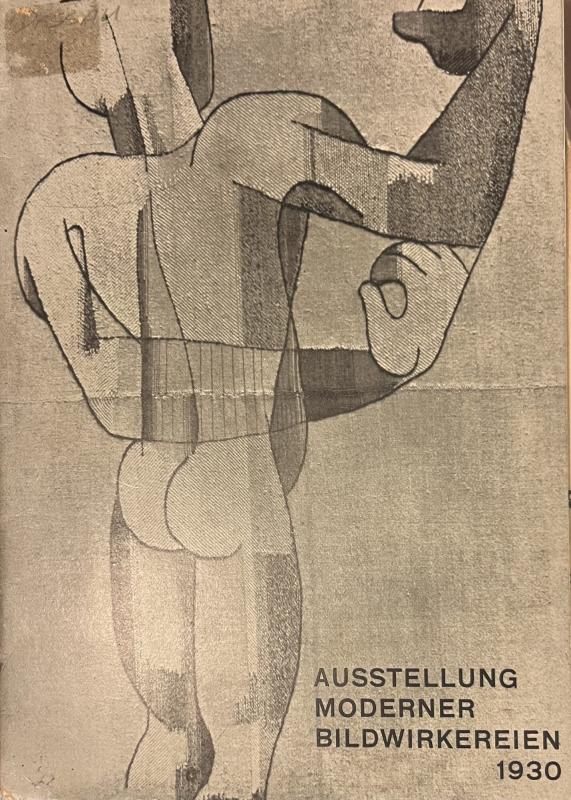
Grote, Ludwig (foreword)
Ausstellung moderner Bildwirkereien 1930. Dessau: 1930. First edition. Original wrappers. [16] p. Small stain to the upper left corner of the cover. Rare Bauhaus catalogue presenting modern tapestry as an avant-garde artistic medium. Rare Bauhaus exhibition catalogue, printed in characteristic modernist typography, documenting the traveling exhibition of modern tapestry (Bildwirkerei) initiated in Dessau. Illustrated with 15 images in the text and two on the covers. The catalogue presents weaving as an autonomous artistic medium within modern art, reflecting its central role in the Bauhaus workshops. In his introduction, Ludwig Grote acknowledges Gunta Stölzl and Anni Albers for their role in assembling the material, underscoring the direct connection to the Bauhaus weaving workshop. Grote, a Dessau-based art historian closely involved in the institutional history of the Bauhaus, situates the exhibition within the broader development of modern applied arts. The exhibition included 59 works, with contributions by Sophie Taeuber-Arp, Ida Kerkovius, Ernst Ludwig Kirchner, Christian Rohlfs, Karl Schmidt-Rottluff, Gunta Stölzl, Ruth Hollos, Hans Arp, and Fernand Léger, among others, demonstrating the intersection of avant-garde art and textile practice. The graphic design is attributed to Oskar Schlemmer, with parallels to his later exhibition catalogue for Galerie Flechtheim (Berlin, 1931).
Sachgebiete: Architektur, Bauhaus, Design, Moderne Kunst
2000,- EUR
Differenzbesteuert/Subject to margin taxation
Auf Merkliste setzen 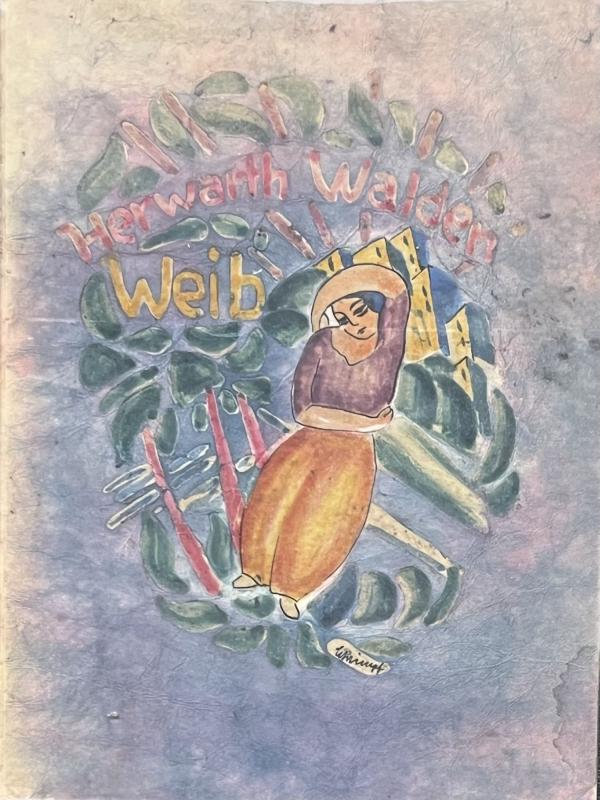
Herwarth Walden (Georg Schrimpf)
Weib. Komitragödie Berlin: Sturm, 1917. First edition. One of the 10 copies of the special edition with the watercolor cover drawing by Georg Schrimpf. Endpaper signed by Walden. In original binding. 79 p. Fine condition. Cover drawing by Georg Schrimpf (1889 – 1938). He was a German painter and graphic artist. Along with Otto Dix, George Grosz and Christian Schad, Schrimpf is broadly acknowledged as a main representative of the art movement Neue Sachlichkeit. Extremely rare.
Sachgebiete: Handzeichnungen, Erstausgaben, Moderne Kunst
10000,- EUR
Differenzbesteuert/Subject to margin taxation
Auf Merkliste setzen 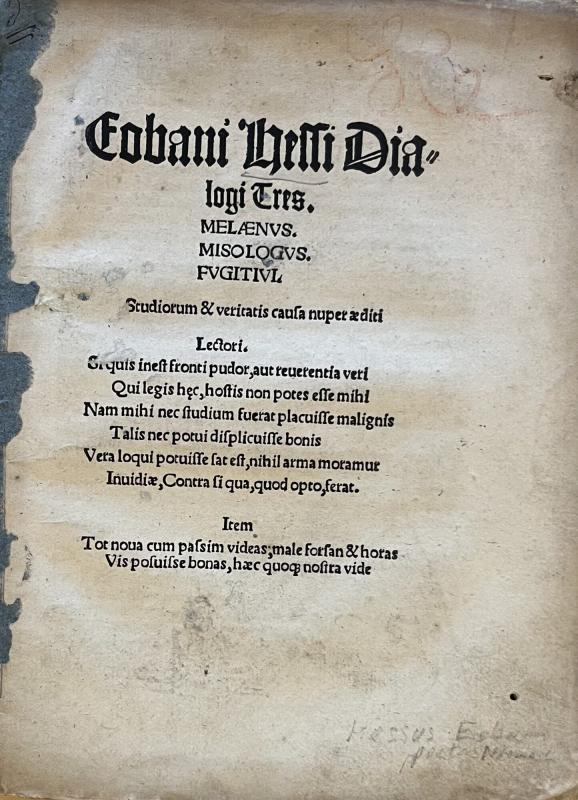
Hessus, Helius Eobanus
Dialogi Tres: Melaenus, Misologus, Fugitivi. Studiorum et veritatis causa nuper aediti. Lectori. [3 elegiac distichs]. Item [1 elegiac distich]. [Execussum Erphordie (Erfurt)]: [in officina Matthei Maler (Matthes Maler)], [Anno 1524]. First edition. Unbound, with remnants of old blue paper wrappers at the spine. 4º: A6, [3 (A2–A4 missigned Ai, Aij, Aiij) signed], B–C4, D3, 17 leaves (last blank not present). Wide-margined copy. Contemporary ink note on the verso of the title page; faint pencil annotations on the title page and final leaf. Light brown staining along the upper edge throughout. Worming to the margins, not affecting text. Otherwise a very good copy. An early humanist satire by Hessus, defending classical learning at the height of the Erfurt Reformation crisis. First edition of Hessus’s Three Dialogues, printed at Erfurt in early 1524, during the acute confessional and institutional crisis that followed the early Reformation. The work was issued by Matthes Maler and belongs to the small corpus of polemical prose produced by Hessus at a moment when his position at the university was under direct threat. Helius Eobanus Hessus (born Eoban Koch, 1488–1540) was a German Neo-Latin poet and humanist closely associated with the early Reformation. Educated at the University of Erfurt, he rose to prominence as a Latin poet and lecturer and became an outspoken defender of humane studies at a moment of intense confessional conflict. Hessus aligned himself with Erasmus of Rotterdam and later openly supported Martin Luther, while rejecting radical anti-intellectual currents within evangelical preaching. After losing his position at Erfurt amid the university’s decline, he continued his career through humanist networks connected with Philip Melanchthon, and from 1536 served as professor of poetry and history at Marburg. He was widely regarded by contemporaries as one of the most accomplished Latin poets of his age, producing epigrams, occasional verse, biblical paraphrases, and polemical writings such as the Dialogi tres. The Dialogi tres are structured after classical and Lucianic models and combine prose with frequent verse passages. Each dialogue targets a different figure emblematic of anti-humanist zeal: Melaenus (the maligner), Misologus (the hater of learning), and the Fugitivi (the “runaways,” presented as ignorant ex-monks turned agitators). The work defends the study of languages, rhetoric, medicine, and classical authors as necessary for education and theology. While sharply critical in tone, the book repeatedly insists that its attack is directed not against reform as such, but against ignorance, demagogy, and the destruction of learning. The volume is dedicated to Peter Kemnitz, Cistercian abbot of Pforta. In the dedicatory epistle, Hessus emphasizes moderation, learning, and Christian piety, and presents the work as written rapidly and without malice, in defense of humane studies under urgent circumstances. The Dialogi tres stands as a contemporary witness to early Reformation debates over education, authority, and the place of classical learning. Copies are recorded in a limited number of institutional libraries, including Wolfenbüttel, Berlin, Leipzig, Göttingen, Heidelberg, Strasbourg, and Wrocław. RBH records a single sale of a copy, dated 2004.
Sachgebiete: Alte Drucke 16. Jahrhundert , Erstausgaben, Philosophie, Renaissance
5000,- EUR
inkl. 19% USt./incl. 19% VAT
Auf Merkliste setzen 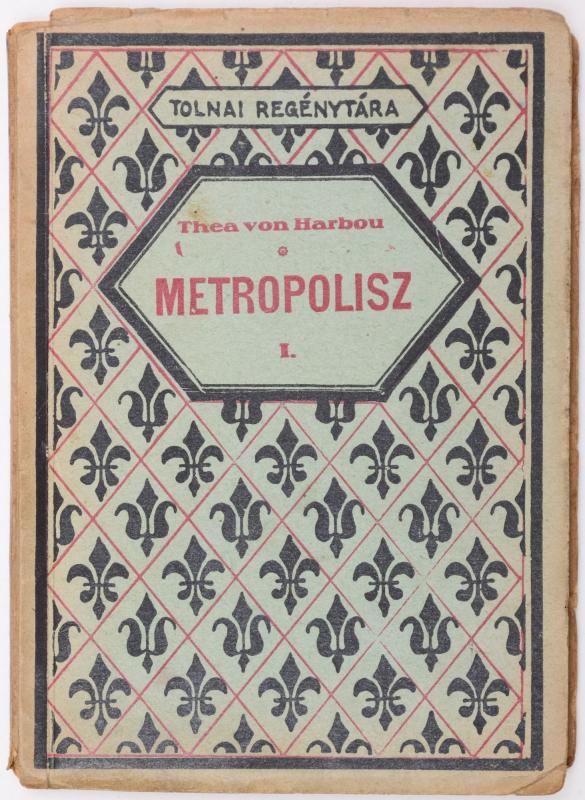
Harbou, Thea (von)
Metropolisz. Regény. I[–II]. kötet. [Metropolis] Budapest: Tolnai Nyomdai Müintézet és Kiadóvállalat R.-T. Kiadása, [1929]. First Hungarian edition. In two volumes. In original, illustrated green wrappers, printed in red and black. (5), 6–127, (1); (5), 6–127, (1) p. Spines tanned, with small damages to the tail and the head. Cover moderately yellowed and slightly chipped towards the extremities. Pages yellowed due to acidic paper. Overall in very good condition. Scarce, first Hungarian edition of the German screenwriter, Thea von Harbou’s novel on which Fritz Lang’s 1927 iconic movie is based. Extremely scarce, WorldCat locates no copies of this edition.
Sachgebiete: Film, Erstausgaben, Moderne Kunst, Science fiction
3000,- EUR
Differenzbesteuert/Subject to margin taxation
Auf Merkliste setzen 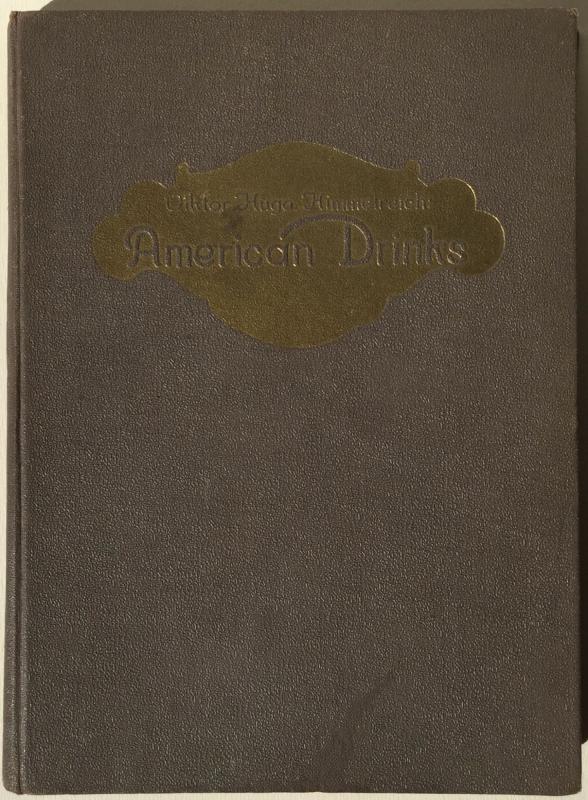
Himmelreich, Viktor Hugo
American Drinks. [Prague]: [Privately published], 1921. With 8 plates of which 7 are photographic. Titles printed in red and illustrated with small beverage ads. First edition. Text in German. In publisher’s buckram with embossed, gilt title on front and white, embossed advertisement on the rear panel. Advertisements on front and rear pastedowns printed in red and black. [1]–79, [5], [40 (advertisement)] p. and 8 plates. Light brown stains occasionally. Rear flyleaf is torn. Otherwise in fine condition. Scarce and early Czech (German language) cocktail book, with photographic illustrations. Himmelreich was the co-founder of the International Union of Bartenders in the Czechoslovak Republic (a photo of the members is included as an illustration to the book), in 1921. His handbook, the present book, American Drinks, which was published in the same year, lists more than 250 recipes, many with the name of its inventor (11 by Himmelreich himself) with photographic illustrations of the art deco interiors of the Czech bars that Himmelreich helped to set up, Bar Gri-Gri and Juliš in Prague, Blaue Maus (Modrá myš) in Ostrava (Ostrau), and the bar of Hotel Eiche in Liberec (Reichenberg) and contains forty pages of wonderfully designed advertisements of bar tools, beverages, and bars. Scarce, WorldCat locates only one copy in the National Library of the Czech Republic, we could trace another copy in the EUVS Digital Collection.
Sachgebiete: Erstausgaben, Gastronomie, Illustrierte Bücher
1400,- EUR
Differenzbesteuert/Subject to margin taxation
Auf Merkliste setzen 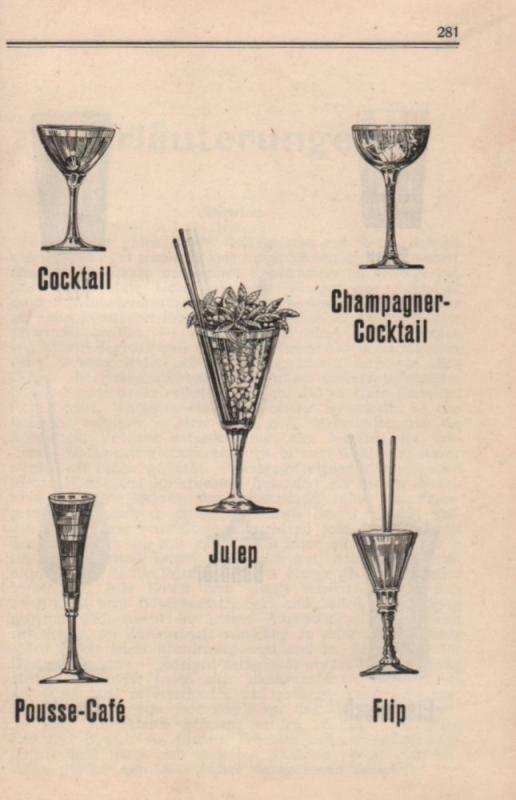
Leybold, John; Schönfeld, Hans
Lexikon der Getränke (circa 3000 Erklärungen von Getränken verschiedener Nationen.) Bearbeitet von Leybold und Schönfeld. Mitglieder der Internationalen Barkeepers-Union, Cöln a. Rh. I. Auflage. Köln: Verlag von Leybold & Schönfeld, (1913). With several illustrated advertisements throughout. First edition. In publisher’s red cloth, with gilt title on front panel. 296 p. and a plate with the portraits of the authors. In fine condition. First edition of the first German bartender’s book that became the number one reference book for the German-language bartenders. The lexicon was written and compiled by two founders of the Internationale Barkeeper-Union (1909), the first European association of bartenders. They also launched a weekly newspaper the “American Bar Journal” that was spread internationally, and they also took under the responsibility to compile this lexicon for bartenders. As it is written in the foreword, the book contains all known beverages, listed in alphabetic order and it is also a recipe book for mixed drinks, the so-called “American drinks”. Several advertisement of beverages, hotels, bars, related products and services printed after each sections. Rare, early and important publication.
Sachgebiete: Werbung, Erstausgaben, Gastronomie
4000,- EUR
Differenzbesteuert/Subject to margin taxation
Auf Merkliste setzen 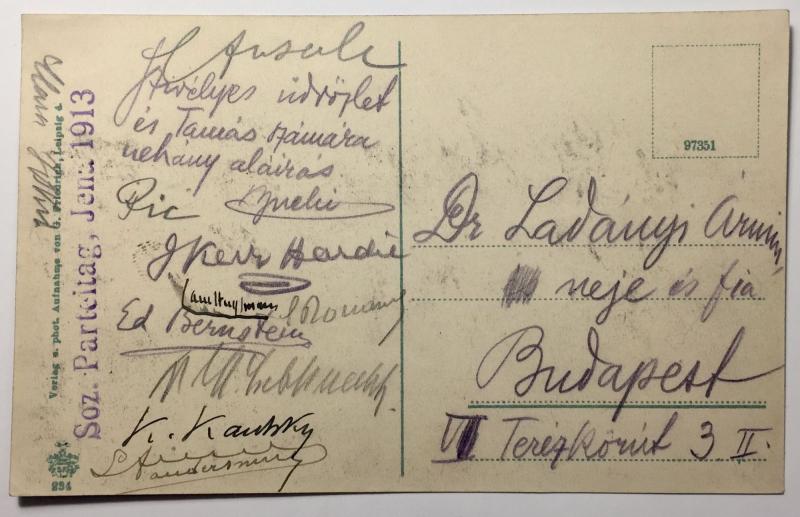
[Liebknecht, Karl]; [Zetkin, Clara]; [Kautsky, Karl]; Buchinger, Manó
Postcard Signed By Early Prominent Socialists at the Sozialdemokratische Parteitag Jena, 1913. Jena: 1913. Photographic postcard. With the official stamp of the convention. The signatures are written in pen and pencil. With the original envelope, addressed in ink by Buchinger. 139 × 87 mm. In fine condition. Postcard with signatures of ten prominent figures of the international leftist, and social democratic movement, among them Karl Liebknecht, Clara Zetkin and Karl Kautsky. The postcard was sent by the leading Hungarian social democrat politician Manó Buchinger (1875–1953), from the 1913 convention of the Social Democratic Party at Jena to his brother-in-law, Ármin Ladányi and his family. Besides him the postcard is signed by Karl Liebknecht (1871–1919; German socialist politician), Clara Zetkin (1857–1933; German socialist politician and advocate of women’s right), Karl Kautsky (1854–1938; Czech-Austrian Marxist political thinker and journalist), Eduard Bernstein (1850–1932; German social-democratic Marxist politician), Keir Hardie (1856–1915; Scottish trade unionist and politician), and Camille Huysmans (1871–1968; Belgian socialist politician); four signatures remain undeciphered.
18000,- EUR
Differenzbesteuert/Subject to margin taxation
Auf Merkliste setzen 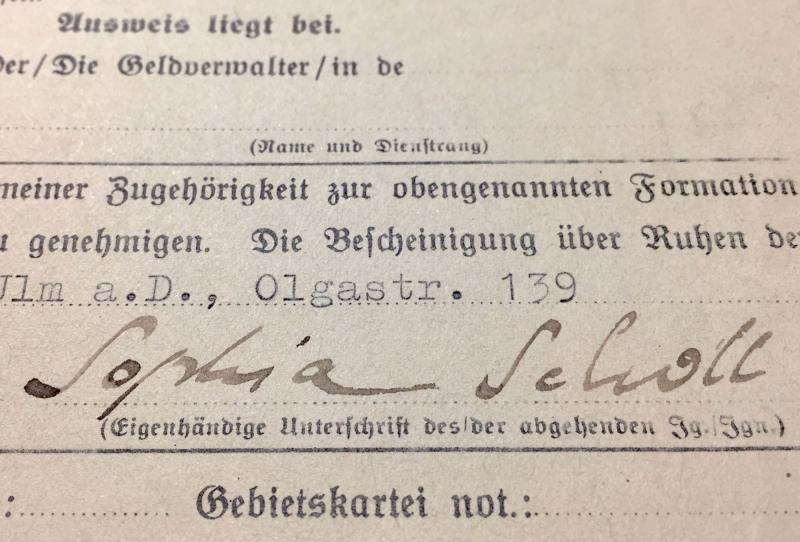
Scholl, Sophie [Sophia Magdalena]
Sophie Scholl’s Signed Membership Suspension Request From the Bund Deutscher Mädel. In Hamburg: Dated on December 4, 1939. Oblong, printed form on light green paper. Signed in ink by Sophia [Sophie] Scholl. Filled by typewriter and handwriting. With the printed letterhead of the Hitler Jugend and the stamp of the NSDAP, Bund Deutscher Mädel of Altona (Hamburg) Untergau 31. Registry stamp filled in ink. 210 × 148 mm. Folded once. Very slightly discolored at the edges and the folding due to aging. Hole punched at the left edge. Tiny tears at the upper and lower edges at the folding. Otherwise in fine condition. An extremely rare, signed document by anti-Nazi resistance figure Sophie Scholl, requesting suspension of her membership in the Bund Deutscher Mädel (BDM), the female branch of the Hitler Youth. Sophia Magdalena Scholl was a German resistance hero whose active opposition to the Nazis led to her execution in 1943. Scholl was born into a liberal Lutheran family in 1921 in Forchtenberg, a small town in southern Germany. In the early 1930s, the family moved to Ulm, where Sophie—like most German girls at age 12—joined the female section of the Hitler Youth, the Bund Deutscher Mädel (BDM; League of German Girls). Her initial enthusiasm gradually gave way to criticism of the organization’s militarism. Sophie’s father was a Nazi critic, and her brother Hans participated in the outlawed German Youth Movement; as a result, both were briefly arrested—Hans in 1937 and their father Robert in 1942. After graduating from secondary school, Sophie became a kindergarten teacher, hoping this role would serve as an alternative to the compulsory Reichsarbeitsdienst (National Labor Service) or its counterpart, the Landjahr (Country Service)—which she was actually summoned for, as the present document proves. This was not the case, however, and in November 1941, she began a six-month auxiliary war service as a nursery teacher in Blumberg. After completing her service, she enrolled at the University of Munich in May 1942, where her brother Hans was already studying. There, Sophie and Hans, along with three fellow students, formed a group called The White Rose, which soon became politically active. They began publishing and distributing leaflets calling for the restoration of democracy and justice. Sophie, Hans, and Christoph Probst, a fellow member of The White Rose, were arrested for distributing their sixth leaflet on February 18, 1943. After a brief trial, they were found guilty of high treason, condemned to death, and executed on February 22, 1943. The present document is Sophie Scholl’s request to suspend her membership in the Bund Deutscher Mädel, submitted in Hamburg, Altona, on December 4, 1939. She applied for suspension upon being summoned for the six-month compulsory Landjahr, scheduled from April 20 to December 20, 1940. The Landjahr was a rural educational program intended to prepare selected youth “to become responsible young Germans.” This signed, countersigned, and stamped document was sent to the BDM Untergau (sub-district) 120 in Ulm, where it was filed on December 12, 1939. According to a joint handwritten letter sent by Johann C. Neuhofer to Dr. Rüsch on June 25, 1954, the document was found in an old Hitler Jugend file in Ulm and was purchased by Neuhofer in 1950. Another typewritten letter, a reply from the Oberamtspflege Ludwigsburg to Neuhofer’s inquiry dated September 10, 1950, reports information found in the files of the former BDM Obergau 20 (Württemberg) regarding Sophie Scholl. It provides an account of Scholl’s history in the BDM, from her entry in 1934 until her discharge in 1941. Anything contemporary, especially signed documents related to Sophie Scholl, is virtually unobtainable. Aside from this document, we could not trace any similar items in auction records or on the market.
Sachgebiete: Autographen, Geschichte, Handschriften, Nationalsozialismus
50000,- EUR
Differenzbesteuert/Subject to margin taxation
Auf Merkliste setzen 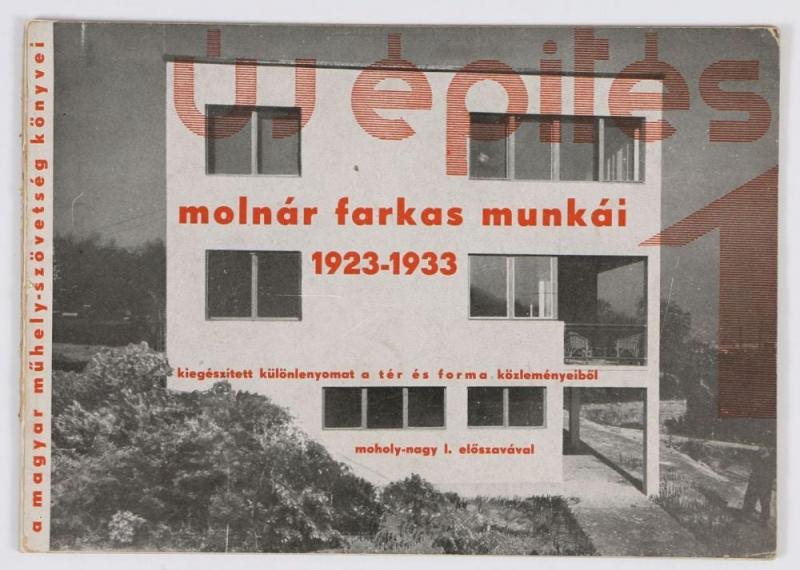
[Molnár, Farkas]; [Moholy-Nagy, László]; [Gropius Walter]
Arbeiten des Architekten F. Molnár. Molnár Farkas munkái. 1923–33. [Budapest:]: Magyar Műhely-szövetség, 1933. First edition. In original photographically illustrated wrappers, printed in red and black. With photographical and graphical illustrations on each page. Modernist typography. 48 p. Spine artistically restored. In fine condition. Scarce, richly illustrated modernist brochure introducing the works of the Hungarian Bauhausler, Farkas Molnár, with a foreword by László Moholy Nagy. Published with a short preface by Walter Gropius and a foreword by László Moholy-Nagy in Hungarian and German. Illustrated, besides the reproductions of Molnár’s plans, drawings, and paintings, photographs by Károly Escher, Ferenc Haar, and József Pécsi. The text is a compilation of extracts of Molnár’s articles written for the Hungarian modernist architectural review, Tér és Forma. In 1921, after his unfinished architectural studies in Budapest, Molnár (1897–1945) became a member of the Bauhaus University, where he studied under Johannes Itten and Walter Gropius. He was active as an architect in Hungary after 1925 and became the founder, with Marcel Breuer, of the Hungarian section of CIAM (International Congress of Modern Architecture).
Sachgebiete: Architektur, Bauhaus, Design, Moderne Kunst
6000,- EUR
Differenzbesteuert/Subject to margin taxation
Auf Merkliste setzen 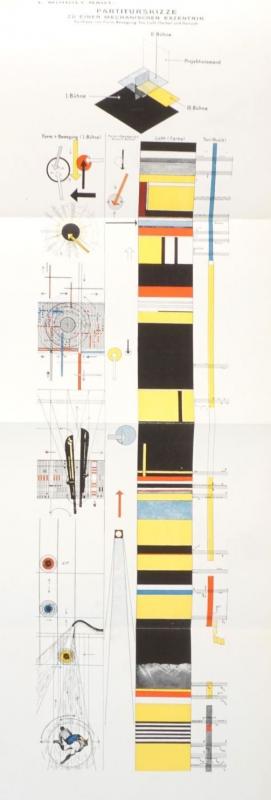
Moholy-Nagy, László; Gropius, Walter
Die Bühne im Bauhaus. Bauhausbücher 4. Munich: Albert Langen, 1924. Title illustration by Oskar Schlemmer. Typography by Moholy-Nagy. Numerous illustrations in and out of text, some printed in color; one folding plate; one printed overlay tissue guard. First edition. Association copy, inscribed by Moholy-Nagy; recipient most likely Ergy Landau. Publisher’s device on half-title. Title page and facing page designed in Bauhaus typography. Original stiff white illustrated wrappers with black lettering on cover and spine, preserved with the original dust jacket; both artistically restored. 84 [4] p. Association copy of Die Bühne im Bauhaus, typographically designed by László Moholy-Nagy and inscribed by him to “Erzsi,” most likely Ergy Landau. First edition of one of the most influential volumes in the Bauhausbücher series, devoted to stage practice and theatrical experimentation at the Bauhaus. Conceived under the general editorship of Gropius and visually shaped by Moholy-Nagy, the book documents the Bauhaus approach to performance, space, movement, light, and the relationship between body and architecture, treating the stage as a laboratory of modern form. Inscribed by László Moholy-Nagy to “Erzsi,” most likely Ergy Landau (born Erzsébet “Erzsi” Landau; 1896–1967), a Hungarian-French photographer active in Paris from the early 1920s, associated with humanist portraiture and modernist photography. Trained in Vienna and Berlin, she established her own Paris studio and maintained close ties with Moholy-Nagy; according to later accounts, she may have introduced him to the practice of photography. Includes a major contribution by Oskar Schlemmer, Mensch und Kunstfigur (Human and Art Figure), with extensive illustrations and eighteen full-page plates related to the Triadisches Ballett. László Moholy-Nagy contributes Theater, Zirkus, Varieté, outlining historical, contemporary, and future concepts of theatre, including the “theatre of totality,” illustrated with a three-color folding plate and a schematic score for Mechanische Exzentrik. Further contributions by Farkas Molnár, Kurt Schmidt, F. W. Bogler, Georg Teltscher, and Xanti Schawinsky, including a photomontage of the Bauhauskapelle. Illustrations partly printed in color. A core Bauhaus publication at the intersection of architecture, theatre, and graphic design, and one of the defining documents of interwar modernist stage theory.
Sachgebiete: Architektur, Bauhaus, Design, Erstausgaben, Theater
5000,- EUR
Differenzbesteuert/Subject to margin taxation
Auf Merkliste setzen 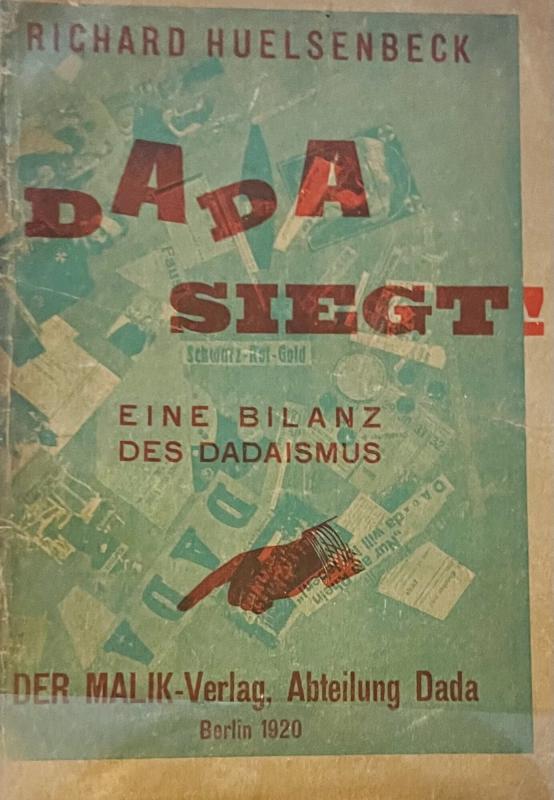
Richard Huelsenbeck
Dada siegt: Eine Bilanz des Dadaismus Berlin: Malik, 1920. Cover by Grosz and Heartfield. First edition. In original paper. 40 p. Restored. In very good condition. Very rare Dada item.
Sachgebiete: Dada, Erstausgaben, Moderne Kunst
7000,- EUR
Differenzbesteuert/Subject to margin taxation
Auf Merkliste setzen 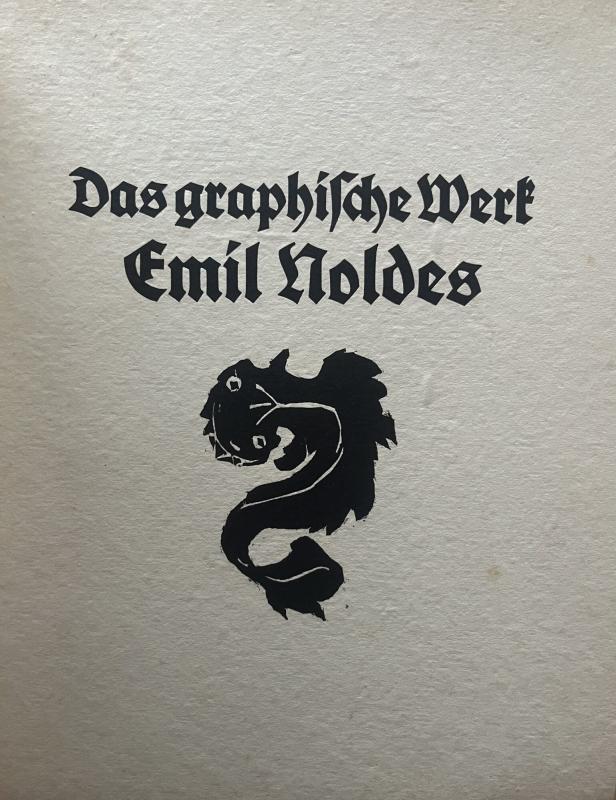
Schiefler, Gustav
Das graphische Werk Emil Noldes bis 1910. Berlin: Julius Bard, 1911. Illustrated with the woodcut “Ägypterin I” as frontispiece, and twenty-five woodcuts printed in the text. First edition. Limited numbered issue, one of 400 numbered regular copies, from a total edition of 435. Publisher’s illustrated boards with woodcut vignette on the front cover, title lettered in black; with the original blank tracing-paper dust jacket. [6] 3–139 [1] pp. In fine condition. Early catalogue raisonné of Nolde’s graphic work, illustrated with original woodcuts and a lithograph, issued at an early stage of the artist’s printmaking career. Published in 1911, this work by Gustav Schiefler constitutes the first systematic catalogue of the graphic oeuvre of Emil Nolde up to that date. Appearing only a few years after Nolde began producing prints, the book documents the artist’s early work in woodcut, etching, and lithography and reproduces several examples within the text. Schiefler, a Hamburg judge, collector, and supporter of modern art, maintained close relations with leading figures of the German avant-garde. His understanding of contemporary art was shaped in part by Alfred Lichtwark, and through these circles he became personally acquainted with Nolde in 1906. The present publication reflects this relationship: in his preface Schiefler explains that his intention was both to testify to his appreciation of Nolde’s work and to broaden the circle of collectors interested in it. The book records Nolde’s early graphic production and illustrates it with original prints, including the woodcut Ägypterin I and the lithograph Der Pflüger. These works demonstrate Nolde’s expressive approach to printmaking and belong to the formative years of German Expressionism. Schiefler later produced similarly detailed catalogues of the graphic works of artists such as Max Liebermann, Edvard Munch, and Ernst Ludwig Kirchner, but this early study of Nolde remains one of the foundational references for the artist’s printed oeuvre.
Sachgebiete: Erstausgaben, Illustrierte Bücher, Lithographie, Moderne Kunst, Holzschnitt
5000,- EUR
Differenzbesteuert/Subject to margin taxation
Auf Merkliste setzen 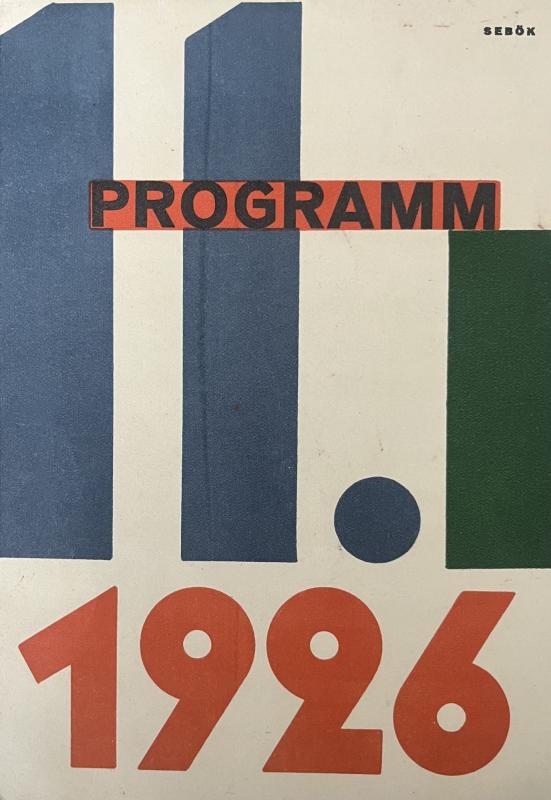
Stefan Sebok (Design by)
Dresden: 1926. Fold out. Mint condition. Stefan Sebok was a Hungarian-born architect who worked with Walter Gropius in Dessau and Berlin in the late 1920s, and then with fellow Hungarian emigré László Moholy-Nagy on his famous Light Prop, and later moved to the Soviet Union to work with the constructivist architects Moisei Ginzbrug, El Lissitzky and the Vesnin brothers. In between he carried out numerous projects of his own and found himself central to a key generation of emerging modern architects in Dresden, Berlin and Moscow. Life and work He was accepted in Dresden in 1921 at the Hochbau [Architecture] faculty at the Sächsiche Technische Hochschule, opting for the science oriented course, but chose art for his optional subject. The university records show him as a highly achieving student and he was given the opportunity to do a research project on Viennese Baroque, which he presented in 1925 as an illustrated public lecture at the Dresden Kupferstichkabinett. In 1926 he submitted his Diploma work, a project for the design of the Tanztheater, Dresden, probably inspired by the presence of the famous dancer Gret Palucca in Dresden at the time. The work had many innovative features aiming to minimise the interface between stage and spectators. He received his diploma Dip. Ing. Arch. in March 1927. Although he already had a firm position offered by Erich Mendelsohn at the time, he decided to join Walter Gropius in Dessau. The main attraction for Sebök was the recently commissioned revolutionary theatre by Erwin Piscator. Although the theatre did not materialise at the time, the concept of the possible use of films, the stage and roof design, was reworked by Sebök in several drawings over the years and it found its continuation also in a plan worked out by Gropius and Sebök in 1930 for a theatre for Kharkov for mass performances for which many of Sebök’s annotated preliminary sketches have survived. In 1928 Sebök briefly returned to Dresden, probably to re-work his Tanztheater for the Internationales Problem Theater. From 1928 till 1931 Sebök rejoined Gropius in Berlin participating in numerous projects. Sebök also collaborated closely with László Moholy-Nagy on the Kinetisch-konstruktives System [Kinetic Constructive System] and the Light space modulator. The collages for these are marked durchconstruirt [constructed] by Sebök and the technical drawings for the latter bear his signature. During 1929 he was also involved with Moholy-Nagy in various stage designs for Erwin Piscator.
Sachgebiete: Werbung, Moderne Kunst
8000,- EUR
Differenzbesteuert/Subject to margin taxation
Auf Merkliste setzen 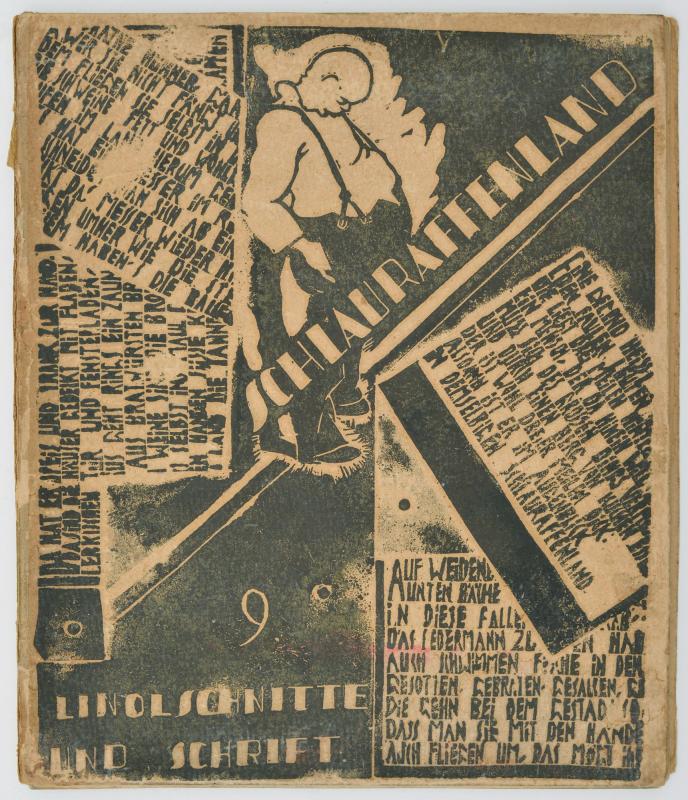
Baden, Heinz
[Cover Title:] Schlauraffenland. 9 linoschnitte und Schrift. [Germany]: [Self-published by the artist.], [1921]. Limited, numbered. 11 linocut plates printed on tracing paper in black. Each plate mounted on cardboard. 9 plates of illustration, 1 plate of double-page and 1 plate of single-page text. Last plate signed and numbered by the artist in pencil. In original illustrated folder, designed by the artist. 11 plates. Composition size varies, mostly 115 × 95 mm. Page size 200 × 255 mm. Folder slightly worn and rubbed, with a light mark in red pencil on the cover. Pages yellowed. The linocuts are in fine condition. Overall in very good condition. A portfolio of expressionist linocuts by the German painter, Heinz Baden (1887–1954). The linocut series was inspired by the German Meistersinger, Hans Sachs’ (1494–1576) 1530 poem, Schlaraffenland. The portfolio contains nine, numbered linocut illustrations along with the text of the poem, printed mainly on a large, double-page plate, continuing with a short part on the last plate. Extremely scarce, we could not trace any copies in institutional holding.
Sachgebiete: Illustrierte Bücher, Literatur ab ca. 1900, Moderne Kunst, Renaissance
3250,- EUR
Differenzbesteuert/Subject to margin taxation
Auf Merkliste setzen 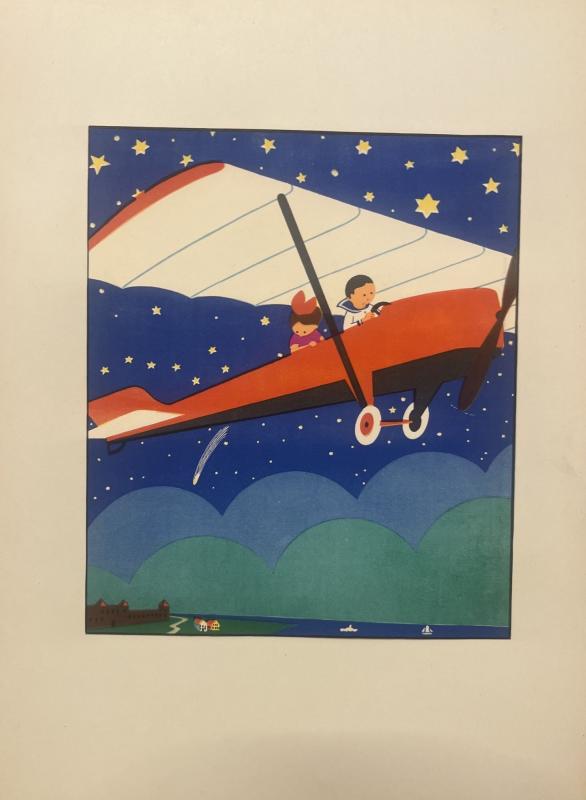
Bortnyik, Sándor
Potty és Pötty. [(Children’s Book). Proof copy.] Budapest: Ifjuság, 1932. Illustrated by the artist. First edition. Printed in a very small number of copies. Original cloth. 12 p. In fine condition. Extremely rare proof copy of Bortnyik’s only known children’s book, produced in very few copies and long regarded as a legendary work within Hungarian modernism. A substantial section is devoted to Potty és Pötty in Children’s Literature and the Avant-Garde, edited by Elina Druker and Bettina Kümmerling-Meibauer, which examines the origins and variants of the book. The authors note that it is the only children’s book attributed to Bortnyik and place it within his broader engagement with the German ideal of the Gebrauchsgraphiker—the graphic artist who reconciles artistic and commercial aims—an approach that shaped his work throughout the 1920s. They emphasize that the book functions visually, transmitting its concept without reliance on text, in a manner comparable to an advertising poster. In Children’s Literature and the Avant-Garde (John Benjamins, 2015), Samuel D. Albert describes “a fourth, intriguing version” of Potty és Pötty held by the Cotsen Children’s Library at Princeton University, characterizing it as a second, different, and unique Hungarian version, apparently an artist’s copy. The present proof copy closely corresponds to that described example.
Sachgebiete: Kinderbücher, Erstausgaben, Illustrierte Bücher, Moderne Kunst
7000,- EUR
Differenzbesteuert/Subject to margin taxation