Auf Merkliste setzen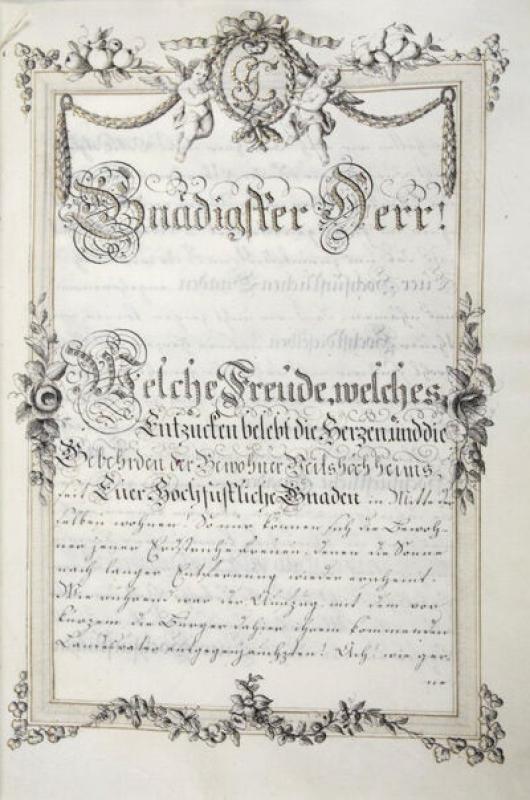
Judenschaft von Veitshöchheim. Huldigungsschrift für Georg Karl von Fechenbach, Fürstbischof von Würzburg [THE JEWISH COMMUNITY OF WÜRZBURG WELCOMES PRINCE-BISHOP GEORG KARL VON FECHENBACH] [MANUSCRIPT]
Würzburg. 1795. Manuscript. Quarto (folio). Unpaginated, 6 leaves. Original pink silk-covered boards with gilt stamped borders. Manuscript on soft vellum. First leaf with floral border design heightened in gold. The handwriting is very carefully executed and perfectly preserved. In this original document the Jewish community of Veitshöchheim expresses obedience, pays homage to and blesses Georg Karl v. Fechenbach (1749-1805), who was the last prince-bishop of Würzburg in Franconia, a region situated in northern Bavaria. This contemporary manuscript documents the formal cooperative relationship between the Jewish community and the regional government and authority through the Catholic church in the person of the prince-bishop. Veitshöchheim is a municipality in the district of Würzburg, in Bavaria, Germany. It is situated on the right bank of the Main, 6 kilometres (4 mi) northwest of Würzburg. In the town is Schloss Veitshöchheim, which was the summer palace of the Prince-Bishops of Würzburg and built in 1680–82. The palace was enlarged to its present appearance in 1753 by Balthasar Neumann. The gardens were redesigned for the Prince-Bishop by Adam Friedrich von Seinsheim (1755–1779), with lakes and waterworks, and filled with hundreds of allegorical sandstone sculptures from the workshops of the court sculptors Ferdinand Tietz and Johann Peter Wagner. The town has a railway station near the palace with a former royal pavilion Jews in Veitshöchheim were first mentioned in the 17th Century. In 1674 there were three Jewish families, only four years later its five, in 1703 eight and 22 families in 1719. Until the beginning of the 19th Century those families were traders of goods and farm animals. Those Families created a very active community life. The congregation had a synagogue, a Mikwe (a ritual bath), and a Cheder (a religious school). The teacher at the cheder was also responsible for the observance of slaughtering according to Jewish law and functioned as the Shaliakh Tzibbur (prayer leader). The congregation used the cemetary of the district of Laudenbach. In 1910 were 70 Jewish people living in Veitshöchheim. Besides being involved within the activities of the general community, there was a very active Jewish life: in the 20th century Fanny Stern founded the Women's League in 1924 and a Chevra Kaddisha was founded in 1895. The last president of the board is since 1932 Ernst Kahn, who remained there till the deportation of the last member of the Jewish congregation in 1942. In 1933 there are 36 members left, only 1.6 % of 2.285 citizens. Until 1939 24 members emigrated and the remainder pretty soon lost their sustenance and lived in poverty. On November 9th, 1938 the windows of all Jewish houses and one shop were destroyed. In February 1942 seven persons were left, only one woman, who lived in a "Mischehe" (Mixed Marriage) survived in Veitshöchheim. Text in German (Gothic script). Binding with some rippling to silk. Binding in overall good, interior in very good condition. #21897
Sachgebiete: Deutschland, Judaica, Politik, Religionsgeschichte, Renaissance
7500,- EUR
inkl. 19% USt./incl. 19% VAT
Auf Merkliste setzen 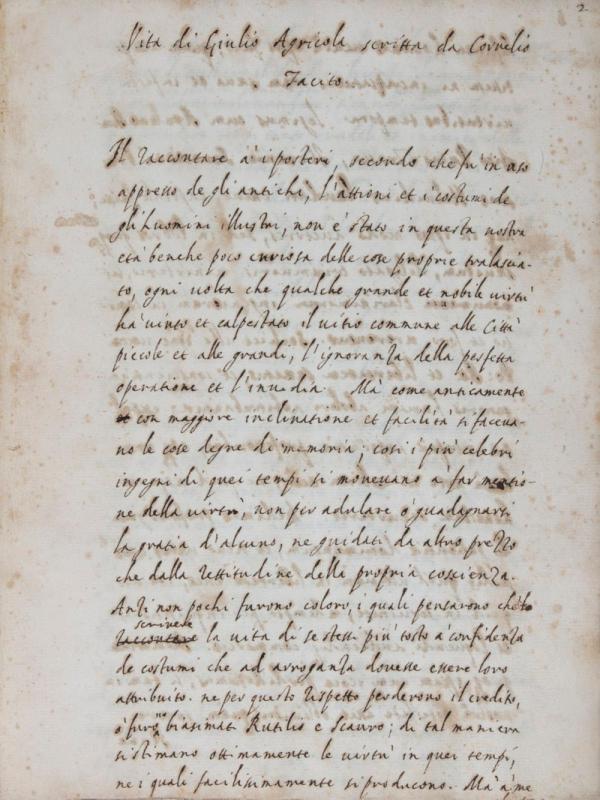
Tacitus, Gaius Cornelius. Vita di Giulio Agricola scritta da Cornelio Tacito (Life of Julius Agricola written by Cornelius Tacitus) [MANUSCRIPT FROM THE THOMAS PHILLIPPS COLLECTION]
[Italy] 1650. Manuscript. Small folio (21.5 by 26.5 cm). 124, [1]pp. Contemporary sprinkled rustica boards, with manucript title at spine: "Vita di Agricola di Tacito." First leaf loose; touches of marginal foxing, else clean, easily legible text on crisp paper. Text in Latin and Italian (with corrections in same hand) on facing pages, 20-24 lines per page. Nearly fine copy. Manuscript (ca. 17th-18th cent.) text of Tacitus' Agricola in Latin and Italian, Phillipps MS 19272. The Italian translation does not correspond to either of the following early modern versions: 1. Giovanni Maria Manelli's La Vita di Giulio Agricola Scritta Sincerissamente (London: J. Wolfe, 1585), which appears to be a rare work. The present translation varies considerably from this earlier version. 2. In: Opera (Venice: Giunti, 1628; 1644), "trasportati dalla lingua castigliana nella toscana da D. Girolamo Canini d'Anghiari" [translated from the Castilian language into Tuscan by D. Girolamo Canini d'Anghiari] noted at title, but the caption title to the Agricola in the 1644 edition notes: "Tradotta in vulgar senese dal Signor Adriano Politi, & illustrata da D. Girolamo Canini" [translated into the Sienese vernacular by Signor Adriano Politi, and illustrated by D. Girolamo Canini]. Written around 98 C.E., "Agricola" is Tacitus' first historical work. It recounts the life of his father-in-law Gnaeus Julius Agricola, an eminent Roman general. It also covers, briefly, the geography and ethnography of ancient Britain. As in the Germania, Tacitus favorably contrasts the liberty of the native Britons to the corruption and tyranny of the Empire. The work has a strong anti-despotic tone and contains eloquent and vicious polemics against the rapacity and greed of Rome. Tacitus sets the despotism of Domitian against the merits of Agricola: an incorruptible officer and a great commander, who fitted the model of the mos maiorum ("the custom of the forefathers", the presumed superior morality of an earlier time). The writer implicitly says that, as the Empire should be accepted as a necessary evil, one has to keep one's dignity without mixing up one's own responsibility with the responsibility of an arbitrary despot like Domitian. One can be an honest and scrupulous officer, doing his job with serenity and in collaboration with the regime, keeping his job and keeping the interest of the state, waiting for a better age, when a writer would be able to write in freedom. Provenance and annotations: Small printed label at spine tail with library number "12972" (Phillipps MS 12972 noted in pencil at bottom margin of the first leaf); old label with number "164." affixed to front board. Printed label affixed at rear pastedown, "Carleton P. Small," with the following information added in ink: 11/15/29; [case] 7; [section] 4; [remark] Portland, Maine; [no.] 993; 17th Cent. MS. Sir Thomas Phillips (1792-1872) assembled one of the largest private collections ever, comprised of manuscripts, books, paintings, drawings, prints, photographs, and other materials. The manuscript portion alone numbered between forty- and sixty thousand items largely collected from the dispersal of religous libraries in France and Italy in the late eighteenth- and early nineteenth centuries. Reference: Catalogus librorum manuscriptorum in bibliotheca D. Thomae Phillipps, no. 12972 (p.229): "Taciti Vita Agricolae, Latin and Italian, pp. 124." #18737
5000,- EUR
inkl. 19% USt./incl. 19% VAT
Auf Merkliste setzen 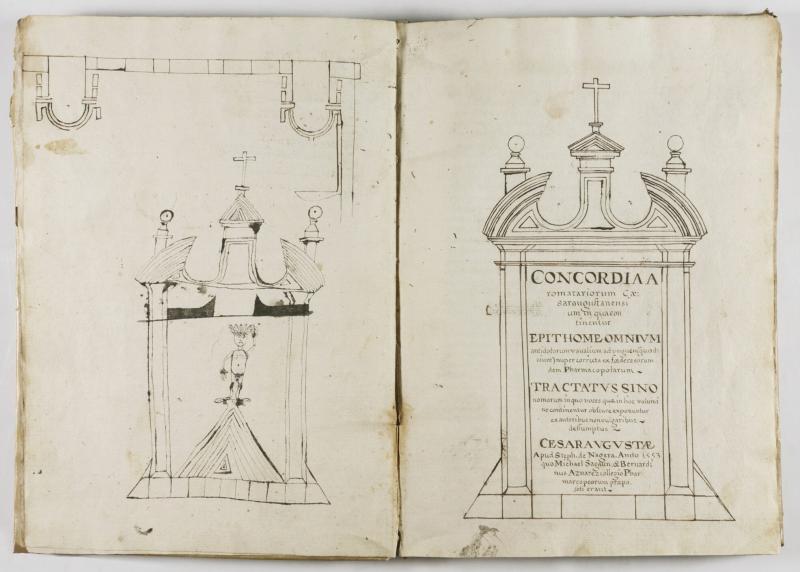
[Sagaun, Miguel; Bernardino Aznares]. Concordia aromatariorum Caesaraugustanensium [UNIQUE MANUSCRIPT COPY OF ONE OF THE EARLIEST KNOWN PHARMACOPEIAS]
[Spain] 1651. Manuscript. Large quarto (28 by 20 cm). Manuscript in brown ink. [4 (Sirup Regis Philippi; copy of title page; title page; blank)], [12 (Ad lectorem; Divisio libri; Carmina in laudem operis; Tractatus de po[n]derib[us] et mensuris; Declaracio[n] de los simples de Mesue)], [3]-177 (Epithome omnium antidotoru[m]; [Tractatus synonomorum]; Tractatus in quo precia omnium medicamentoru[m] simpliciu[m])...; Index antidotoru[m]), [5 (Index continued), [2 (addition recipes)] pp. Title within architectural frame (frame playfully copied by a somewhat later hand on the facing page with additional ornamentation. Contemporary vellum; manuscript title at spine (faded). Text in Latin and Spanish (Introducion; Los Simples de Mesue). Written throughout in a neat hand in brown ink. Due to the different quality of the paper, some quires are more tanned and foxed, and the ink ghosts stronger. Some staining and smudging throughout (but not obscuring text). Few leaves unevenly trimmed at the edges or corners. Page 75 with closed tear at lower gutter and inner margin, not affecting the text. A good or better copy on crisp paper. Unique manuscript copy of a 16th-century Spanish pharmacopeia. The present manuscript and a single surviving printed edition (Biblioteca de la Real Academia de Farmacia de Madrid) are the only early modern witnesses of this version of the text. One of the first pharmacopeias in the world, (preceded only by Florence and Barcelona), Concordia aromatariorum Caesaragustanensium, was printed at Zaragoza in 1553 by Stephen de Nagera (Esteban Godinez de Nájera) (Haebler, 1897) and is regarded as a revised and much expanded second edition of the 1546 Concordia aromatariorum ciuitatis Cesarauguste, printed by Pedro Bernuz and Bartolomé de Nájera. Besides the variant titles and authors (1546: Jerónimo Assín Mayor with Bernardino Aznares; 1553: Miguel Sagaun with Bernardino Aznares), the two works differ significantly in both structure and content, as well as in the terminolgy used for the various substances. Apart from a revised guide to pricing, the 1553 edition also includes a chapter on simple aromatics written in Spanish verse after Mesue ([Declaracion de] Los simples de Mesué), and a 10-page treatise on synonyms (Tractatus Synonomorum), in which a significant number of words appear in vulgar dialects, along with references to the classic works where they are cited, and guidance for the apothecary to substitute certain products with others to produce the same pharmacological effect. (Francés Causapé 2001, p. 17) (Devaux Guy, 2010). While the 1546 Concordia describes 248 formulations, the 1553 edition almost doubles this number to 447, and for the first time in pharmaceutical literature, classifies formulas containing opium as narcotics (stupefacentibus). (Blasco Nogués 2001, p. 7). Both Concordias are written in Latin (except for the Introduction and the aforementioned chapter on simple aromatics in the 1553 edition). They are based on the Galenic and Arabic traditions, the latter derived fundamentally from the works of Mesue (Yuhanna ibn Masawaih, ca. 777–857 , an Assyrian scholar and physician from the House of Gundishapur, one of the Sassanian centres of education). Other important influences include the medieval and Renaissance teachings of the Schools of Salerno and Montpellier, along with the French physician Guy de Chauliac, and the Italian surgeon Giovanni da Vigo. In the 1553 edition, the influence of the medical schools of Padua, Bologna, and Ferrara, along with the apothecary Giovanni Giacomo Manlio di Bosco, can be seen as well. (Devaux 2010) (Francés Causapé 2012). Written by Miguel Sagaun, then President of the Colegio de Boticarios de Zaragoza (College of Apothecaries of Zaragoza), and Bernardino Aznares (who collaborated in the writing of the earlier edition), the only known copy of the 1553 edition is held at the Biblioteca de la Real Academia de Farmacia de Madrid. It comprises a title page, a dedication to the reader (Ad lectorem) which explains the three main parts of the book, followed by a treatise on weights and measures (Tractatus de ponderibus & mensuris), an introduction in Spanish (Introducion), and the “declaration of the simples of Mesue” ([Declaracion de] Los simples de Mesué), a description of simple medical substances in Spanish verse in the genre of the Salerno School. The main text begins with the first part introduced in the Ad lectorem on antidotes (De Antidotis), divided into fifteen classes (pp. [3]-165 in our manuscript); the doses are indicated at the right margin, and many synonyms are inserted at the left, along with occasional explanatory notes. The remaining sections comprise the treatise on synonyms (Tractatus Synonomorum); the price list (Tarifa); and an Index. Our manuscript follows essentially the text and layout characteristics of the 1553 printed edition. Notably, the introduction to the price list (Tractatus in quo precia omnium medicamentorum...) is included, but the listing itself has been omitted. In addition, six extra formulations that could not be found in the printed edition are included, of which two are merged into the text, Pulb[is] hiere sim. Galeni on. pp. 56–57, and Unguentu[m] pleureticu[m] Mesue Cap. de aqua cicerum on. p. 147, and four written on the first (Sirup Regis Philippi)) and the last leaves (Ung. Cometisse […]; [unnamed]; Ung. Magistralis). The synonyms indicated on the left margins differ in places from the printed edition, some newly added to the manuscript, and some cancelled (just like the outdated price list). The closing Index here, unlike that in the only known printed copy (with major tear and gaps), appears to be complete. The dated colophon (1651) appears on p. 175, at the close of the treatise on synonyms. Provenance and annotations: Pascual Savall’s bookplate on inner front panel. The title written in pencil on the inner front panel in a later hand. A later sheet with bibliographical notes (Sanchez’s Bibliografia Aragonesa) mounted on the second free endpaper. Amended with several old, but somewhat later marginal notes in ink by another neat hand. Extra formulations written on the recto of the first leaf, and three more on the last leaf by a contemporary (probably the same) hand. This copy is mentioned in Dionisio Hidalgo’s Boletín bibliográfico español under no. 936 (Hidalgo 1864). Hidalgo claims that the printed book must have been extremely rare already in the 17th century, which is the reason for the existence of this manuscript of 1651. At the end of the entry, Hidalgo refers to the present copy, from “Biblioteca de D. Pascual Savall, en Zaragoza”, apparently Pascual Savall y Dronda, prosecutor (teniente fiscal) at the Zaragoza Court, (co)author of books on the legal history of Aragon and Zaragoza, and an eminent collector of books and manuscripts.
35000,- EUR
inkl. 19% USt./incl. 19% VAT
Auf Merkliste setzen 
Ganjavi, Nizami. Khosrow and Shirin [ILLUMINATED MANUSCRIPT WITH 8 EXQUISITE MINIATURES]
India. Ca. 1590. Manuscript. Two parts, tall octavo (21.8 by 11.5 cm). Manuscript with polychrome illumination; approximately 420 leaves, text recto and verso. Persian text in black and red ink on polished cream paper. Opening and central 2-page illuminated compositions; main text in two columns, 15 lines per page; 8 half-page polychrome miniatures; 3 pages with modest additional polychome illumination. Contemporary brown morocco wallet binding (expertly rebacked); covers with central gilt floral palmette surrounded by two smaller gilt devices. Section at bottom opening unwan leaf excised (with skillful reparation), resulting in loss of two lines of text and marginalia; several leaves with skillful repairs to fore-edges. Light smudges and stains throughout, otherwise very good, with clean miniatures. Housed in custom clamshell box. Epic poem by Nizami Ganjavi of Azerbaijan (1141–1209). Widely regarded as the greatest romantic epic poet in Persian literature, Ganjavi brought a more colloquial and realistic style to the Persian epic. His heritage is widely appreciated throughout central Asia, especially Afghanistan, Azerbaijan, Iran, Tajikistan, and the Kurdish regions. Khosrow and Shirin is the second work of his set of five poems known collectively as Khamsa; it offers a fictionalized account of the love of Sasanian emperor Khosrow II Parviz (590-628), the last great monarch of pre-Islamic Iran, for his Christian queen consort, Shirin. The basic story is already found in Ferdawsi's epic Shahnameh, and throughout the works of many other Persian writers and popular folk tales. Two full-page double suite compositions (Arab. 'unwan) with polychome ornamental headers and text within clouds on gilt background appear at the opening and again at the mid-way point of the work. The fifteen lines of the main text are situated within two sets of ruled borders: the first set in gilt and black tightly surrounds the text (13.5 by 6.5 cm); the second set in gilt, red and blue (18.5 by 9.5 cm) creates a space to surround the main text with commentary in black and red ink, penned diagonally. Breaks throughout the main text, ruled in red, contain divisional headings penned in red. The artist employs a wide palette of colors in the eight finely executed miniatures. Although illustrated in the style of late 16th-century Shiraz, the use of purples is unusual. Provenance: Unidentified 20th-century bookplate at verso final leaf, along with portion of excised catalogue description, noting "Oriental... On Love." Remains of old paper library label at spine. #55702
Sachgebiete: Arabistik, Buchmalerei, Islam, Literatur bis ca. 1900, Orient
25000,- EUR
inkl. 19% USt./incl. 19% VAT
Auf Merkliste setzen 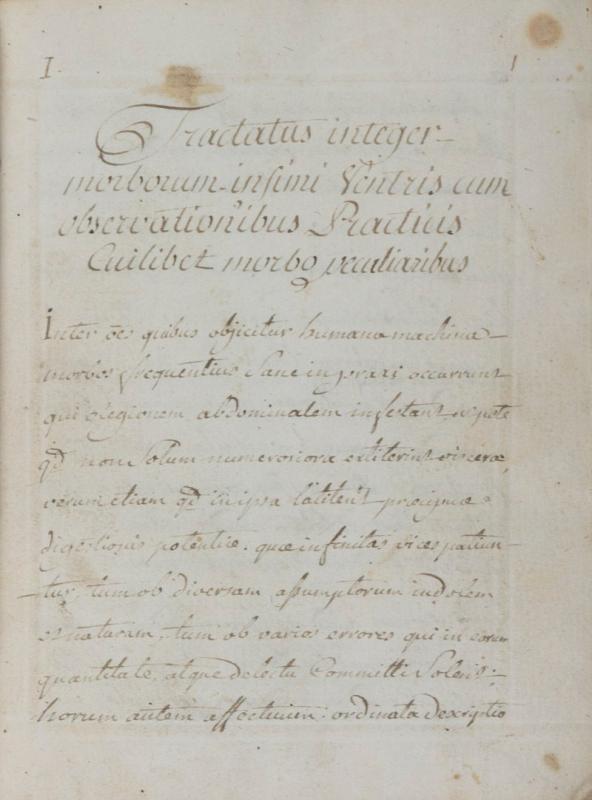
Frere, Joseph. Tractatus integer morborum infimi ventris cum observationibus practicis cuilibet morbo peculiaribus (A Complete Treatise on Diseases of the Lower Stomach with Practical Observations of Each Particular Disease) [18TH-CENT. MEDICAL MANUSCRIPT
[prior to 1750] Small quarto (19.5 by 14.8 cm). 351 (pp. 344 and 345 blank but for the note "hic nihil de est" -- there is nothing here), [2: blank], 352-449 (pp. 446-449 blank), [1: blank] pp. Bound manuscript. Text in Latin. Contemporary cat's-paw calf; gilt-tooled spine with raised bands, morocco lettering piece; marbled endleaves; edges stained red. Covers lightly rubbed with some scuffing at rear. Text crisp and fresh with a few scattered light stains. A very good or better copy housed in quarter faux leather slipcase with gilt lettering pieces. Eighteenth-century medical manuscript on diseases of the abdomen. The 30 sections, each treating a different malady, are consistently organized, beginning with a definition; followed by variations; causes; symptoms; diagnosis; prognosis; and cure. Approximately 140 pharmaceutical recipes appear throughout the curative regimens. Concluding dated observations of individuals treated by the author are provided for seven of the diseases discussed. The range of maladies includes, i.a., lack of appetite; disgust with food; heartburn; vomitting; hiccups; diarrhea; hemorrhoids; hepatitis; jaundice; edema; diabetes; nephritis; and dysuria. A brief introduction appears before the first chapter; a summary of definitions, followed by a table of chapters (with page numbers) concludes the work. Provenance and annotations: "Ex libris Josephi Frere medicinae doctoris" entered at front endleaf; recent bookplate of Otto Oren Fisher at front pastedown. At the end of the final chapter the author notes: hujusce tractatus a josepho frere artium magistro et medicinae alumno transcriptus (nunc medico 1750) / This treatise was transcribed by Joseph Frere, master of arts and student of medicine (now a physician in 1750). The last remark about becoming a physician in 1750 is penned in a lighter brown ink, as are the page numbers which appear throughout the text and in the concluding index. The author's dated observations range between 1725 and 1734. #18779
Sachgebiete: Geistesgeschichte, Judaica, Handschriften, Medizin
6000,- EUR
inkl. 19% USt./incl. 19% VAT
Auf Merkliste setzen 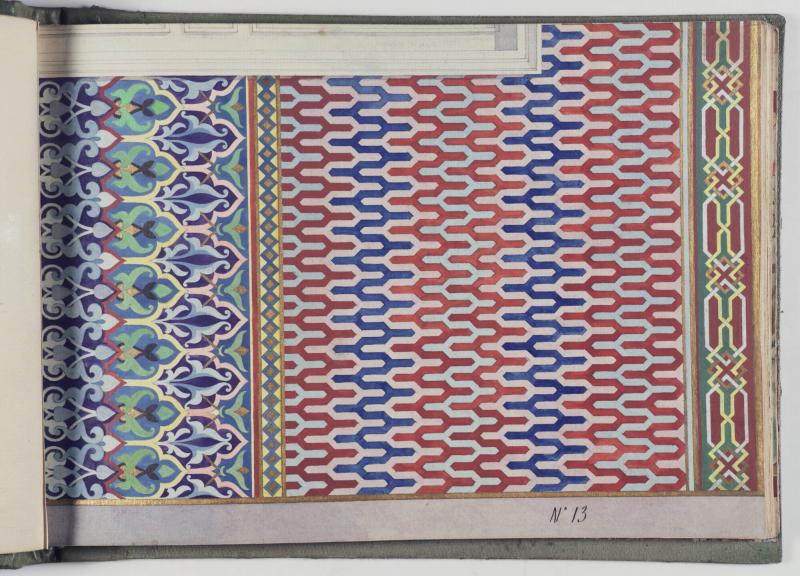
Zanussi, A. [Antonio]; [Mazzioli & Del-Turco]; [Mazzioli et Chauviret]. Album Mosaique Decorative [UNIQUE SAMPLE ALBUM WITH AT LEAST 65 ORIGINAL PAINTED GOUACHE DESIGNS FOR MOSAICS]
[Nice, France]. [Ca. 1910]. Oblong quarto (8 1/2" x 11"). 43 individual single-sided leaves (hand-numbered). Period green pebbled cloth with blind-stamped ruling and gilt lettering on the front cover. Housed in a custom green leather over marbled paper clamshell box. Marbled endpapers. This unique hand-assembled portfolio is comprised of at least 65 individual designs for polychromatic floor, wall panel and ceiling mosaics, created by Antonio Zanussi (1849-1911). The content may have existed in this state as a sample book, used by Zanussi prior to his death, or it may have been assembled posthumously, from a disparate group of loose designs created by the artist and/or "Mazzioli & Del-Turco Vve Chauviret", the noted international mosaic firm/atelier, which he oversaw during the late 19th and early 20th century. Each image is a gorgeously rendered and vibrant painting in gouache, often with phenomenal detail, shading and three-dimensionality. Additionally many images are highlighted or over-painted with lustrous metallic hues of gold and silver. The images here represent the intersection of classical designs from antiquity with the more modern sensibilities of the Belle Époque and the Art Noveau period. The content served both as speculative samples of the firm's work and in some cases maquettes or preliminary designs for specific projects commissioned to the firm. One example is a maquette for a mosaic showing the arms of the Count d'Angerville. The paintings range in size from 1 1/4 x 4 3/4" to full-page 8 1/2 x12" images, and range in complexity from simple geometric patterns and flowing natural forms, to elaborate floral, royal and heraldic motifs, as well as religiously and classically-inspired scenes and vignettes. A few of the images are accompanied with pencil or ink notes in the margins, some including emendations or corrections to the design by the artist. A few of the plates have additional small preliminary design sketches in pencil near the edges, or on the versos. The very last image is not a painting but a detailed lithograph. All designs are hand numbered in ink, usually with one image to a plate, a few with multiple images. Some plates bear the ink stamp of Zanussi and/or the Mazzioli & Del-Turco firm in the margins*. One of the designs is an elaborate and detailed natural scene, in an Art Noveau style, with exotic trees and birds, painted onto a folded sheet of parchment paper and laid into the album. The image which measures 10 x 11 3/4", is separated by black borders which render it in the form of a multi-panel display. There are remnants of other torn-off designs on parchment paper attached to the back of a few other plates. Also laid in is a manuscript receipt, in French, for the purchase of the album by a Monsieur Carassale, for the sum of 35 francs (equivalent to $175 today), dated November 22nd, 1912. Binding with spine rebacked, and very minor smudges and stains to the boards. There a number of sporadic instances of light foxing to the versos of plates or in the margins, with most images still being clean and extremely vibrant. Binding in very good, interior in overall very good- to very good condition. #10026
Sachgebiete: Architektur, Design, Buchmalerei, Ornamentik
12500,- EUR
inkl. 19% USt./incl. 19% VAT
Auf Merkliste setzen (Holy Roman Empire). An die Römisch-Kayserliche auch in Germanien und zu Jerusalem Königliche Majestät allerunterthänigst pflichtschuldigste Interventional-Anzeige j. p. h. Pro Clementissime confirmando Sententiam Appellationis denegatoriam 14. Nov. 1771
Frankfurt/Main. Burgerlicher Ausschuss und Burgerl. Neuner. [1772]. First edition. Small Folio. 168pp. Rebound in decorative paper-covered boards with manuscript title on tan spine, protected by modern mylar. Red edges. Marginalia. Decorative headpiece and historiated initial. "...latam, nec non concedendo facultatem concipiendae vovae, originariae Judaeorum Francosurtensium conditioni, praefentique eorum statui, accommodatae ordinationis & c. Anwälde beeder Kayserlichen verordnet und bestättigter Collegien des Burgerlichen Ausschusses und Burger. Neuner in Frankfurt Intervenientenby der Sache Gemeiner Judenschaft zu Frankfurt contra den Magistrat daselbst die Cramläden und Gewölber außer der Judengasse betreffend. Mit beylagen..." (continuation of title page) Holy Roman Emperor Leopold II, King of Hungary, Croatia and Bohemia's 1771 ordinance regarding Jewish storefronts and houses in Frankfurt, with reviews by officials of the city and attachments. The address to the emperor includes passages showing uninhibited disdain for the Jews: "... that the Jews in Frankfurt, since their first admission and up until now, have been detrimental and onerous for the Christian Frankfurt merchants..." The extensive report respectfully requests confirmation of the ordinance, providing several attachments making their case. The attachments include A, B, C1, C2, C3, and C4, plus D, and the text of previous ordinances, providing a historical outline and details regarding the treatment of Jews historically, with secondary attachments, concluding with an ordinance from 1616. Contains a list of houses and occupants for both sides of the Judengasse at rear, closing with the emperor's confirmation. Signed in print by Hans Ludwig von Ulm for the emperor, and Johann Rudolph Bucher for the city. Text in German, Gothic script. Some light wear along edges of binding with spine showing several small to medium chips at head, middle, including label, and tail of spine. A couple of small chips at front joint of spine. Printed label "Ex bibliotheca Johannis Augusti Speltz, J.U.D, etc., with manuscript number 113 on inside front cover. Block in very good condition. #53544
Sachgebiete: Friedrich II., der Große, Germanistik, Judaica, Jura, Politik
6500,- EUR
inkl. 19% USt./incl. 19% VAT
Auf Merkliste setzen 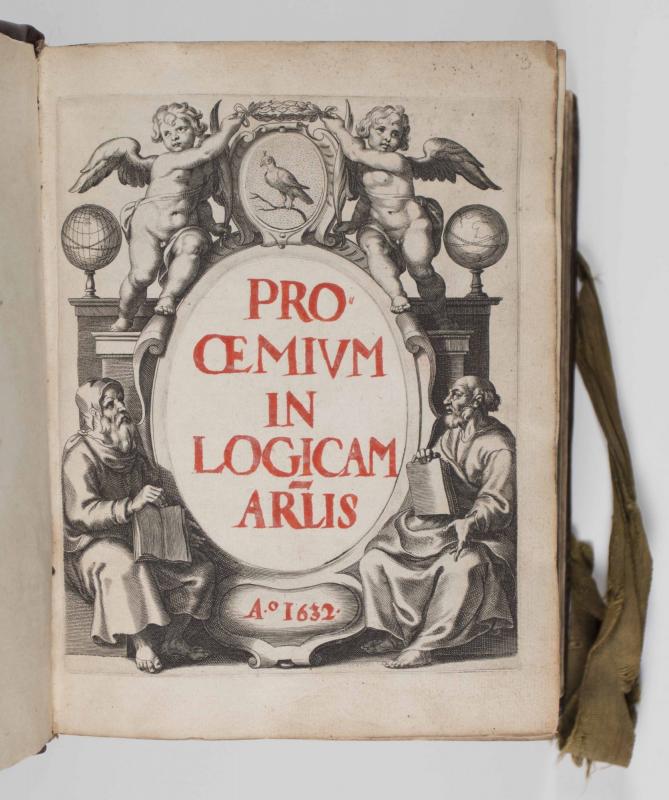
Maes, Petrus. Prooemium in Logicam Aristotelis [MANUSCRIPT: 17th-CENTURY ARISTOTELIAN SCHOOL CURRICULUM WITH ELABORATE CALLIGRAPHIC INITIALS]
Louvain. P. Maes. 1632. Twelve parts, quarto (20.5 by 15 cm). Dated manuscript on paper, 571 leaves; ca. 30 lines per page. Manuscript title in red on blank oval within engraved leaf with historiated borders. Neat cursive text in dark brown or black ink; red ink and elaborate calligraphic initials employed for the main sectional titles and further subdivisions. Contemporary calf (expertly rebacked), lettered in gilt, with stamped vignettes (dated 1632) at both boards. Green silk ties partially preserved. Occasional mild soiling. Leaves 17/18 and 259/260 partially stuck together due to offsetting of the titles; leaves 565-570 separated with some paper damage and minimal obscuring of the text. Overall, text about fine, composed in a neat hand on good quality paper, crisp and clean. Early seventeenth-century manuscript interpretation of lectures in Aristotelian logic given at the Falcon College of Louvain University, penned by Petrus Maes, originally from the Brabant village of Zichem. Relatively few such manuscripts survive from this era; the universities of Leiden and Louvain have mangaged to acquire collections numbering several dozen. Leaf 7 - Commentarius in Isagogen Porphirii - De Ar[istote]li Partib[us] Logicae. Leaf 72 - Liber praedicamentorum prooemium. Leaf 152 - Liber postpraedicamentorum Leaf 184 - Liber primus priorum prooemium Leaf 242 - Liber secundus priorum analiticorum Leaf 250 - Liber primus posteriorum analiticorum prooemium Leaf 293 - Praefatio in librum pro di dogmatum Leaf 358 - Prooemium in libros periermenias Leaf 432 - Liber secundus periermenias Leaf 446 - Liber primus topicorum Leaf 485 - Prooemium in reliquos libros topicorum Leaf 550 - Prooemium in libros elenchorum. The engraved leaf, which provides a blank oval for lettering, depicts at the top a coat of arms with crowned falcon, surrounded by two angels, and above two scholars or sages, each holding a book, at the bottom. The iconography refers to the Pedagogie De Valk. (Falcon College). Final Leaf 571 contains the chronogram: FIneM totIVs LI/bris posVIt DIVI/IgnatI VIgILIa #48965
Sachgebiete: Antike, Altphilologie, Griechenland, Philosophie
9500,- EUR
inkl. 19% USt./incl. 19% VAT
Auf Merkliste setzen 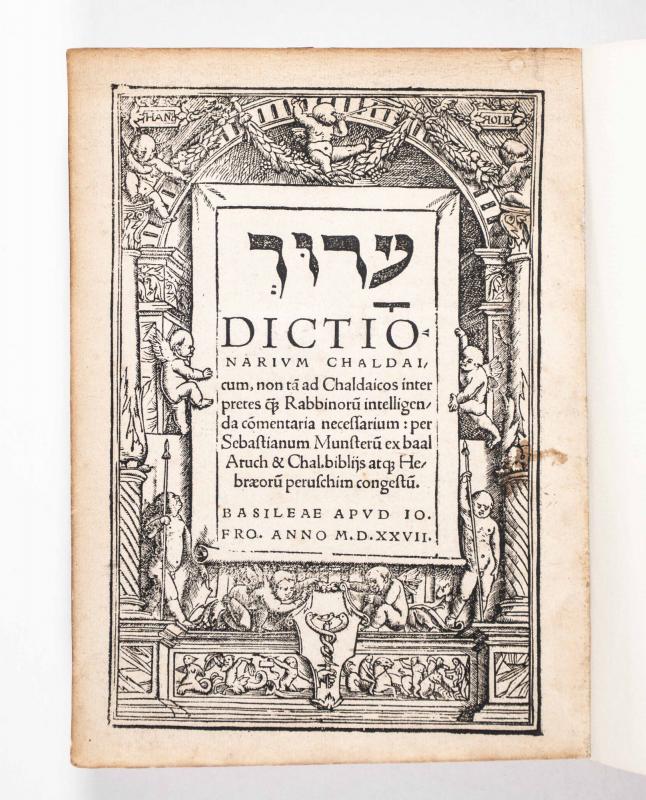
Munster, Sebastian. Arukh: Dictionarium Chaldaicum
Basel. Johann Froben. 1527. First edition. Small quarto: a-z, A-2H4, 2I6 (=222 leaves). [8], 434, [2]pp. Recent wrappers. Mild embrowning at margins, light dampstain at final leaves, else a fresh, clean copy. First edition of Sebastian Münster's Aramaic-Latin dictionary to the Targumim and Rabbinic literature. The first Aramaic dictionary edited by a Christian scholar, it is based primarily on the Arukh of Nathan ben Jehiel of Rome (1035-c.1110). "Through quotes and commentaries it explains the myriad of difficult terms and concepts in the Talmud and the Midrash collections. It is a work for advanced Talmudists and was widely used. The sizeable Aruch was also one of the first Hebrew works to be printed (Rome, c. 1470) and Christian Hebraists made use of it in their study of rabbinical literature" (Heb. Veritas Cat., 37). The celebrated polymath, cosmographer, astronomer, and Semitic language scholar Sebastian Münster (1489-1552) was born in Niederingelheim, Hesse, the son of a hospital master. Apart from some private instruction in Latin and later studies at Freiberg, along with attendance at lectures given by the Franciscans, he had no university education. After entering the Minorite order in 1506 was sent to study in Rufach under Konrad Pellikan. Münster assisted Pellikan in teaching at Pforzheim and occupied the chair of Hebrew at the University of Heidelberg from 1524 to 1529. After converting to Protestantism in 1529, he moved to Basel where he would occupy the chair of Hebrew for twenty-three years. "Sebastian Muenster was one of the first Hebraists who, by his numerous publications, firmly embedded Hebrew in protestant theology. Although he did not travel as widely as Reuchlin, Widmanstetter and, later, Masius, his unremitting industry in his home town Basle produced an astounding series of publications which provide a good view of the breadth over which the subject manifested itself" (Heide). "From about 1525, Muenster was a student of Elijah Levita, translating and editing his grammatical works. Muenster also translated a number of other Hebrew works into Latin... His jewish oeuvre, more than three-score publications, covered all aspects of Judaica, excepting Kabbalistic studies..." (Heller). Apart from his grammar books, Münster was the author of no fewer than five dictionaries in which Biblical Hebrew is usually combined with Aramaic and post-biblical Hebrew. Münster dedicates the Dictionary to the Bishop of Rochester in Kent, for his appreciation of the theological sciences. The foreword emphasizes the value of the grammatical and lexicographical writings of Elijah Levita and the Arukh from which he takes the title. Not having access to the earlier editions of Nathan ben Yehiel's rabbinic lexicon printed at Rome and Pisarro, Münster mistakenly believed the Arukh to be the work of a German Jew. J. Perles was later able to identify the German manuscript from which Münster worked (Prijs). In addition to this Latin adaptation of ben Yehiel's rabbinic lexicon, Münster's and accompanying Aramaic Grammar in the same year. The woodcut title border of cherubim cut by Hans Holbein is here reused after its appearance in De optimo reipublicae (Thomas More's Utopia; 1518) and Martin van Dorp's commentary on St. Paul's Epistles (1516). Provenance: Entry at colophon, “Calend. Januarij 1570 dono accepi hunc librum cum paraphrasi Campensis in Psalmos, ab adolescente amico L.C.G. in nominis ipsius memorium”; old owner’s entry in different hand and ink, “David Dasmeres/Dasnières [?]" #48853
Sachgebiete: Bibeln, Judaica, Judentum, Religion, Renaissance
3250,- EUR
inkl. 19% USt./incl. 19% VAT
Auf Merkliste setzen 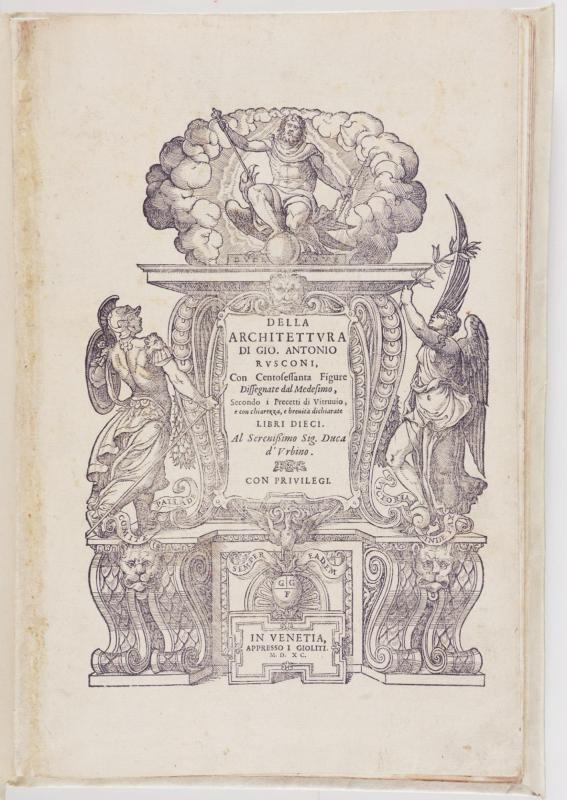
(Vitruvius Pollio, Marcus). Rusconi, Giovanni Antonio. Della Architettura di Gio. Antonio Rusconi, con centosessanta figure dissegnate dal medesimo, secondo i precetti di Vitruvio, e con chiarezza, e brevità dichiarate libri dieci
Venice. The Giolito Press [Giovanni II & Giovanni Paolo Giolito de Ferrara]. 1590. First edition. Small folio (27.3 by 18.7 cm). Signatures: a-c2, A-Z2, AA-NN2 (= 78 leaves). [xii], 143, [1, blank] pp. Title set within elaborate woodcut historiated borders; full- and half-page woodcut illustrations, plans, and diagrams throughout (a list of 144 figures appears after the contents); initials and ornaments. Recent period-style vellum; spine lettered in gilt; yapp edges, exposed thongs. Margins trimmed; occasional mild stains or smudges (mostly marginal). A nearly fine, crisp copy. First edition, first issue (without errata) of "an unusual publication in the architectural literature of the sixteenth century [in which] a remarkably effective group of illustrations was married to an underelaborated text" (Millard). Antonio Rusconi (ca. 1520-1587) was introduced to the building trades and painting as a youth; he studied mathematics at the University of Padua under Giovanni Battista Memmo and Niccolò Tartaglia. He would serve as a hydraulic engineer for the Republic of Venice throughout his life. At the urging of Pietro Lauro, who had translated Leon Battista Alberti's De Architectura into Italian, Rusconi began in 1540 to prepare a translation of Vitruvius, with commentary, illustrated with more than 300 woodcuts. While his Venetian editors, Giolito and Tommaso Porcacchi, were accorded a publication privilege by the duke of Tuscany in March 1553, they decided not to publish the work, with so many editions of Vitruvius appearing at that time. After Rusconi's death in 1587, the Venetian publisher Giovanni Giolito decided to publish the woodcuts. Giolito died before the work went to press. "The commentaries to the illustrations published by Giolito's heir in 1590 were probably not by Rusconi, but the publisher may have desired not to waste the investment made in the already cut illustrations... The author refers constantly to Renaissance architectural theorists, such as Palladio, Bárbaro, Sebastiano Serlio, and Cesariano, turning the book into an extended discourse with a knowledgeable audience. Indeed, the author himself recognizes that the sketchlike quality of his publication disqualifies it as a fundamental teaching tool for architecture (p. 143: "poiche manco il fine e l'intention nostra è stata mai d'insegnarla con queste poche annotationi" [since our aim and intention has never been to teach it with these few annotations]). This author's main contribution is in the quality of the images... His illustrations display an unusual degree of independence from that of earlier commentaries on Vitruvius, revealing a marked anticlassical attitude (Millard). The military and civil engineer Marcus Vitruvius Pollio (ca. 70-80 BCE - ca. 15 CE) is the author of the only surviving ancient treatise on architecture, arranged in ten books. By his own account, Vitruvius served in the Roman army under the command of Julius Caesar. Rediscovered by the Florentine humanist Poggio Bracciolini in the library of Saint Gall Abbey, and publicized by Leon Battista Alberti (1404-1472), Vitruvius’ De Architectura would later define the canon of classical architecture. His assertion that structures should exhibit the three qualities of stability (firmitatis), utility (utilitiatis), and beauty (venustatis) became a commonplace in architectural theory. The wide-ranging program of De Architectura deals with “principles of buildings in general, building materials, designs of theatres, temples and other public buildings, town and country houses, baths, interior decoration and wall paintings, clocks and dials, astronomy, mechanical and military engineering...” (PMM). Throughout the Renaissance, Vitruvius’ work provided inspiration for such important artists and architects as Michelangelo, Leon Battista Alberti, Donato Bramante, Lorenzo Ghiberti, Giacomo Vignola, Andrea Palladio and many others. The first printed edition of De Architectura appeared at Rome (ca. 1483-90); the first illustrated edition, at Venice (1511). Provenance and annotations: Faint early entry in Italian at verso title (privilege); a few old underlinings in black ink at early leaves; old numbers appear in manuscript at some margins; old entry in Italian at bottom margin final text page. #55413
Sachgebiete: Architektur, Klassizismus, Wissenschaftsgeschichte, Italien, Renaissance
7500,- EUR
inkl. 19% USt./incl. 19% VAT
Auf Merkliste setzen 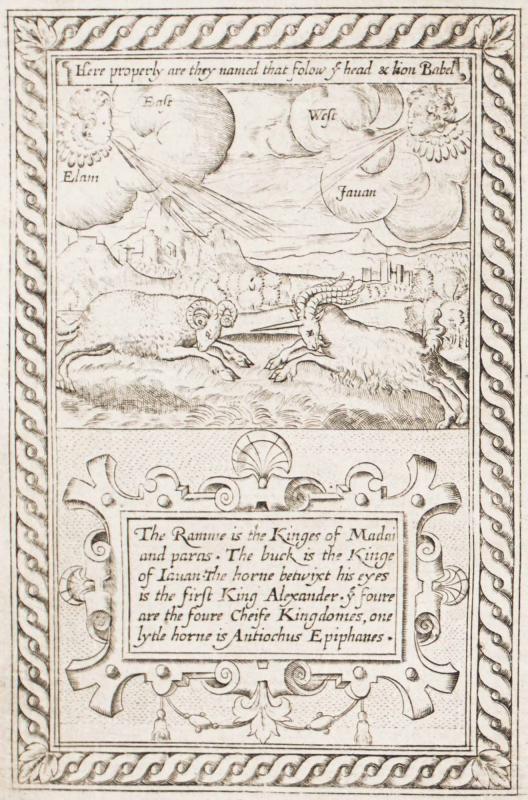
Broughton, Hugh; Saadiah Gaon. Daniel His Chaldie Visions and His Ebrew, Both Translated after the Original [WITH THE FIRST HEBREW TEXT PRINTED IN LONDON, A POEM BY SAADIAH GAON]
London. Printed by Richard Field [and Gabriel Simson], for William Young. 1596. First edition. Small quarto. [asterisk]4, A-K4, (2nd) H4, L-P4, 68 leaves. [136]pp., 3 (of 4) engraved plates. Woodcut anchor device at title; printed marginalia; woodcut lettrines. English text in black letter, italic, and roman type, some Hebrew and Greek passages, including a Hebrew poem (K3-4) printed in double columns with alternating red and black stanzas. A few early manuscript annotations. Recent wrappers (housed in professionally fitted clear mylar covers). Occasional mild (mostly marginal) dampstains, bottom corner A3 lacks 1-inch section (with no loss of text). A very good, amply margined copy, lacking one of the four engraved plates. First Edition of this translation and commentary on the biblical book of Daniel by the English puritan divine and Hebraist, Hugh Broughton (1549-1612), including the Hebrew text of Saadiah Gaon's Shir shel ha-Otiyyot. Tutored in Hebrew by the renowned French Hughenot scholar, Antoine Rodolphe Chevalier (1507-1572), “Broughton graduated at Magdalene College, Cambridge in 1570, became a Fellow of St. John’s, and then moved to Christ’s College. A disagreement with John Whitgift, archbishop of Canterbury, over the interpretation of scripture, persuaded Broughton to go to Germany in 1589, and apart from brief periodic visits to England he appears to have stayed on the continent until the last year of his life. While Broughton was abroad he engaged in religious discussions with Jews in Hebrew and made the acquaintance of several eminent Christian scholars including Joseph Justus Scaliger. He conducted a debate in the Frankfurt synagogue with a Rabbi Elias. He also records a dispute with Rabbi David Farrar. The close association which he developed with Jews and Christian Hebraists was a significant factor in his linguistic attainments, especially in a grasp of rabbinics unusual for an Elizabethan scholar... For the last twenty years of his life Broughton sought in vain to gain the support of the authorities for a new English translation of the Bible... Broughton’s writings demonstrate that he was an accomplished Hebrew scholar, who may justifiably be regarded as the most proficient English Hebraist of his day. Not only was he able to read the Old Testament in the original, he was familiar at first hand with a wide range of post-biblical Jewish authors... In addition to Targum and Talmud, he insisted that other Jewish writings must be regarded as indispensable to anyone engaged in translating the Bible. In a footnote to his Treatise of Melchisedek (1591) he listed no fewer than twenty-two Jewish sources which the serious student of the Hebrew scritptures might consult to his advantage” (ODNB). While Broughton’s contentious nature and controversial style alienated many of his contemporaries -- Scaliger described him as “furiosus et maledicus” (Van Rooden) -- his scholarship could not be doubted. In his 1824 Bibliotheca Biblica, William Orme notes that the celebrated Hebraist, “with a considerable portion of quackery, and a large portion of ill-nature, had certainly a respectable acquaintance with biblical literature... and it is alleged, was much displeased because he was not employed as one of the translators of our present English version of the Bible.” As a typographical monument the present work is highly notable, containing “the first protracted Hebrew text printed in London” (Roth). Hebrew printing had only just made its debut at the Cambridge press three years earlier in Andrew Downes’ 1593 edition of Lysias. As “[a] keen defender of the Hebrew verity” (Orme), Broughton here makes a remarkable selection of text as evidence for “The certaintie of the Ebrew,” deploying an acrostic poem by Saadiah Gaon (882-942), the greatest scholar and author of the geonic period, and an important leader of Babylonian Jewry. The poem, Shir shel ha-Otiyyot (Poem of the Letters) is printed in alternating couplets of red and black, and gives by means of words and biblical allusions the number of times that each particular letter of the alphabet occurs in the Hebrew scriptures. The engraver of the Hebrew fonts is quite possibly Jodocus Hondius the Elder, whom Broughton first met in 1583 after Hondius had fled to London from his native Ghent in the wake of Spanish persecution of protestants in the Low Countries. The engraved plates in the present work are attributed to Hondius, and appeared earlier in Broughton’s first book, A Concent of Scripture (ca. 1587-1591). As it happens, the first printed Hebrew texts to appear in Amsterdam occur in several books by Broughton, printed in 1605 and 1606, whose fonts were certainly engraved by Hondius (Fuks/Fuks-Mansfeld). While the type used in the present work, with its distinctively angled lamed, does not match those of the Amsterdam publications, it bears some similarity to Fuks Br. Squ. 2. Annotations: At the conclusion of the imprint, following “... where the other workes of the same author are to be sold” appears a contemporary manuscript notation “at ye Rose” #48834
Sachgebiete: Bibeln, Judaica, Judentum, Literatur bis ca. 1900, Renaissance
6500,- EUR
inkl. 19% USt./incl. 19% VAT
Auf Merkliste setzen 
Furtwängler, Wilhelm. Furtwängler: collection of 12 items [SIGNED]
Germany. 1915-1951. Original document. A collection of twelve items concerning the important German symphony conductor: one large format photograph with personal inscription on mount, one signed photographic postcard, one original photographic portrait, three signed typewritten letters, two signed handwritten postcards, one signed music manuscript, one original press photo, a signed program of the Berlin Philharmonic Orchestra, and an unused photographic postcard. 1. Wilhelm Furtwängler Press Photo. Frankfurt, United Press. 7 x 9 1/2 inch original b/w photograph of Wilhelm Furtwängler conversing with Ernst Fischer. Fischer was the "Vorstand der Philharmoniker" (Manager of the Berlin Philharmonic Orchestra). A rare United Press - Acne Photo dated 23.5.50. Stamped address of publisher, as well as the names of the men depicted in the photograph written in blue ink on rear of photograph. Minor creasing to photo. Attached description of image typewritten in German on piece of paper on back of photograph. Very good condition. Rare. 2. Signed photograph, 6.8 x 9.2 inch photograph mounted on 11.6 x 15.6 inch photographer's mount. “Wilhelm Furtwängler,” n.p., 9th March 1944, with an inscription. A nice head and shoulders profile photograph of Furtwängler. Signed by Furtwängler to the photographer's mount. Also signed by the photographer “HR.(?)” Slightly stained and creased. Bottom left corner of photograph chipped. 3. Signed photograph, 3.5 x 5.5 inches. Signed “Furtwängler,” in ink beneath image, n.p. n.d. Rare b/w portrait photograph. Photograph by Fayer, Vienna. 4. Signed musical manuscript (4 1/4" x 5 1/2"). “Wilhelm Furtwängler,” n.p. n.d. [1948]. Minor age toning. Additional musical notes by Philippe Boegner slightly showing through from verso. Three bars of music from an unidentified composition. Furtwängler added, “In alter, über zwanzig jähriger unwandelbarer Freundschaft.” 5. Letter from Wilhelm Furtwängler to the Herrn Generalintendendanten, dated 12 September 1930. Signed by Furtwängler. Hole punched. One ink correction in his hand. Letter to the General Director of the Prussian State Theatre, Heinz Tiejten, who was director from March1930-1945. Letter deals with a production of “Walküre” to be performed at the Berlin opera. With a postscript concerning Frau Reinhart's role in the production. 6. Signed typewritten letter. “Dr. W. Furtwängler,” Berlin, 23rd October 1931. On his printed stationary. Hole punched and folded. Letter to the publisher Gustav Bosse about an article Professor Dr. Hans Joachim Moser wants to write about him. Furtwängler gives his approval. 7. Handwritten and signed postcard. W. Furtwängler, Mannheim, 1915 (postmark), to the violinist Melanie Michaelis (1882-1941), in German. Furtwängler writes, “…Thank you very much for the lines. I am in a tremendous hurry, so I can write only these few lines. I am looking forward to seeing you…” 8. Signed typewritten letter. “Wilhelm Furtwängler,” Mailand, 15th April 1951. With corrections in his hand. Slightly staining on right border. To publisher Erich Seemann (1888-1966). Furtwängler adds the date and place of upcoming performances of the “Berliner Philharmonikern.” 9. Handwritten and signed postcard. Mannheim, dated 29 May 1924. To a music publisher in Leipzig informing him that he will be in Frankfurt between the 10th-14th of June and that they can meet at that time. 10. Unused, 3 1/5" x 5 1/4" postcard of a b/w reproduction of a photograph showing Furtwängler reading a newspaper. Name in pencil twice on back, not believed to be signed by him. Very good condition. 11. Original photographic portrait of Furtwängler. 6 1/4" x 9" mounted on 8" x 11" card. Oxidized around outside edges beginning to encroach on the image. Circa 1935. Photographer not noted. 12. Berliner Philharmonisches Orchester. 4 page fold-out pamphlet of a concert by the Berlin Philharmonic Orchestra on December 19th, 1949. Cover leaf with b/w photographic reproduction showing Furtwängler. Inscribed and dated by Furtwängler in blue ink across portrait. Illustrated with various advertisements. Text in German. Folded and creased. Closed tear repaired with tape, lower right corner on last leaf with tape remnants. Fair condition WITH Square octavo 12 page pamphlet "Berliner Philharmonisches Orchester.'" Illustrated with one b/w reproduction of the conductor as well as advertisements. Text in German. Slight creasing to pages. good+ condition.
Sachgebiete: Kulturgeschichte, Deutschland, Instrumente (Musik), Photographie, Politik
12000,- EUR
inkl. 19% USt./incl. 19% VAT
Auf Merkliste setzen 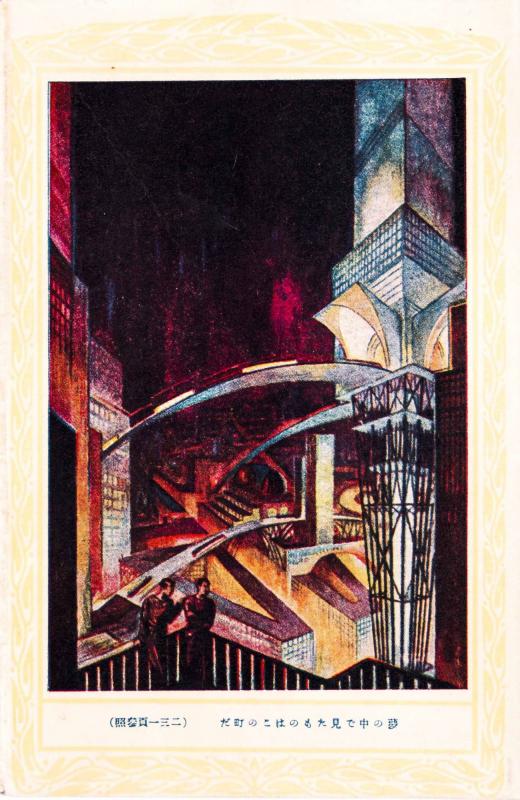
Harbou, Thea von. Metropolis (メトロポリス ; 殿方は金髮がお好き)
Tokyo. Kaizo-sha. 1928. First Illustrated Japanese language edition. Large Sextodecimo. 560 (1)pp. Original color illustrated dustjacket over red cloth with gilt lettering and tooling on spine. Title page with decorative orange ruling and publisher's device. Two plates following title page, one of them a film still in color, the other the beginning of the musical score for the film by Gottfried Huppertz with three b/w head shots. Illustrated with ten striking full-page b/w reproductions of film stills of the legendary Fritz Lang film considered the first science fiction film that premiered in 1927. The cover of the dustjacket is illustrated with the film still used on the cover of the first paperback edition. Thea von Harbou had given the manuscript of her novel to Fritz Lang in 1924. The two of them collaborated on the film script and from 1925 to 1927 Fritz Lang directed what was to become the most expensive German film productions of the time and a milestone of Expressionistic silent science-fiction movies at the same time. After the premiere the film was re-cut and shortened and only in 2010, after the rediscovery of archival material, Metropolis was reconstructed to its original version. Harbou's novel was published in installments starting in August of 1926 and as a paperback in the same year. The Japanese translation by Toyokichi Hata was published as volume 15 of the series "World Literature" in 1928. Bound in with Metropolis is the first Japanese translation of another German author, Anita Loos, with her 1925 novel "Gentlemen Prefer Blondes." Text in Japanese. DJ with light wear, very small chips along edges and head an tail of sunned spine, and rubbed. Binding with very light wear along edges and spine. Endpapers browned and some sporadic foxing of block and on edges. DJ, binding and interior in overall very good condition. #46604
4500,- EUR
inkl. 19% USt./incl. 19% VAT
Auf Merkliste setzen 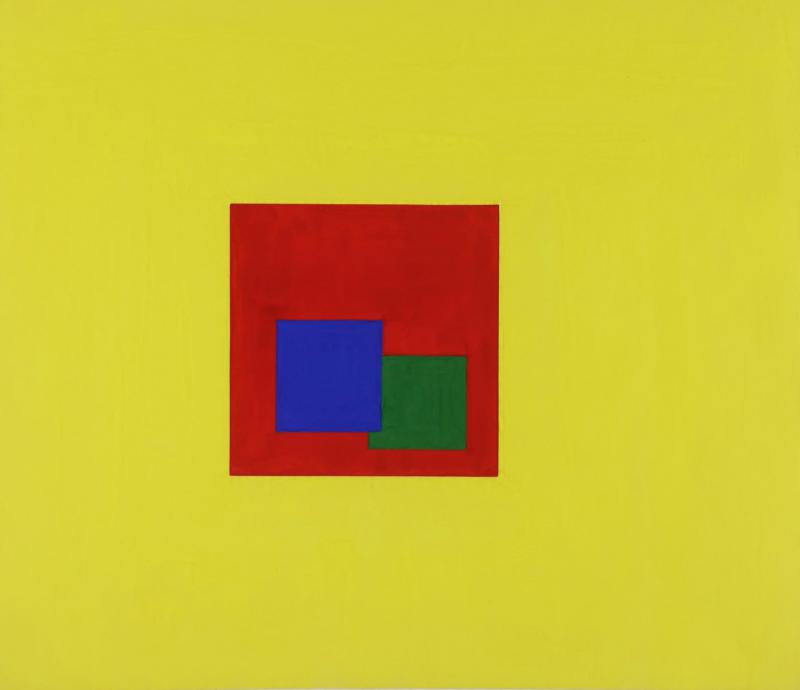
Fischinger, Oskar. 23 Original Tempera on Paper for the Abstract Animation Film "Quadrate / Squares"
Berlin. 1934. Original artwork (12 1/8 x 11 5/8"). Twenty-three paintings representing a substantial part of Oskar Fischinger's short film "Quadrate (Squares)," a four minute silent 35mm abstract animation film in color. The 271 separate "frames" for this film were painted in tempera on paper by Oskar Fischinger in July 1934, as cited by William Moritz, in "Optical Poetry The Life and Work of Oskar Fischinger," 2004. Moritz further suggests that some of these paintings may have been done a little earlier. "The drawings are numbered 1-2505 to 1-2776, indicating perhaps that they were once planned as part of a larger film... Fischinger had these 271 drawings photographed and loop-printed so that they appeared several times in the same and different colour combinations, positive and negative (which was easily possible by manipulating the filters used to print out the three-color separation master)... the serene flow of squares shaped in different colours is one of Fischinger's most striking, interesting and important compositions, prefiguring 'Radio Dynamics.' The animation paintings, like those of Kreise, are each artworks in themselves, prefiguring the balancing squares of Josef Albers." (William Moritz, as above, pages 221/2) Our 23 tempera paintings are not framed and are all stamped "Nachlass Oskar Fischinger" in the top margin. Thirteen paintings are in fine condition, incl. ## 2510, 2517, 2518, 2525, 2543, 2546, 2570, 2573, 2606, 2608, 2610, 2694, 2698. The following paintins with minor to medium blemishes as described: #2547 (1/2 x 1" light water stain at bottom edge right corner), 2567 (minor 1 x 1/8" water exposure at right lower corner), 2584 (minor, less than 1/8" wide border due to water exposure along most of bottom edge, and small water stains in orange), 2597 (1/2 x 3" water exposure), 2612 (small water stain 3/4" in diameter in blue-green square), 2679 (light 1/2" minor surface crack at upper left corner), 2688 (small area with minor ruffling, and 1/2 inch closed tear at right edge), 2691 (minor fraying along left edge), 2716 (minor blemish at bottom right, red edge), and 2724 (small water stain in blue square). Inspired when viewing Lichtspiel Opus (Play of Light), a 13 minute film of nonobjective color effects by Walter Ruttmann in 1921, Oskar Fischinger embarked on a most illustrious career as a filmmaker. Using skills from his background as an engineer he invented the so-called "Wax-Slicing Machine" to create abstract imagery for film. Fischinger also produced several films for advertising purposes using abstract animation techniques, particularly after the Nazis had taken power. Best known is his cigarette commercial "Muratti greift ein (Muratti Intervenes)." Oskar continued to produce numerous abstract animation films, now often referred to as "Optical Poetry" or "Visual Music," many times synchronizing the abstract imagery of his films with classical music. His 1934 film "Quadrate, one of Oskar's most daring experiments... was designed specifically for the GasparColor process, which used a three-color separation negative." (William Moritz. Optical Poetry, pp. 54,55). Fischinger's manipulation of filters, combined with loop printing allowed for the imagery to appear in variant sequences. Life under the Nazis regime became more and more difficult for the Fischingers. Oskar was arrested twice but, with the help of friends, was released within days. Anonymously his film "Komposition in Blau" (Composition in Blue) had been admitted to the 1935 Venice Film Festival. Despite its popularity it did not win due to the fact that Reichsfilmkammer President Fritz Scheuermann was a member of the jury. Later in 1935, an MGM agent had brought two of Oskar's films, "Composition in Blue" and "Muratti greift ein," to the attention of Ernst Lubitsch. As a result Lubitsch sent the agent back to Berlin to hire Oskar to work for him. Arrangements were made for Oskar to leave for Hollywood immediately, and Elfriede and their sons followed two month later. While working for several studios in Hollywood, Fischinger kept producing "Optical Poetry" and gradually turned to nonobjective painting. Fischinger is considered by some as a man ahead of his time. Among other capacities he is credited to be "an inventor of the music video, and prophet of Op Art as well as contemporary computer-generated motion graphics." (Nathan Vonk) His film "Composition in Blue" was awarded the King's Price at the Brussels International Exposition in 1935. In 1938 MGM released Fischinger's "Optical Poem." It was shown all across the world. His 1947 "Motion Painting No. 1" won the International Film Competition in Brussels in 1949. Fischinger's extensive work as a filmmaker is documented superbly in publications by William Morris, see above, and Cindy Keefer and Jaap Guldemond in "Oskar Fischinger 1900-1967. Experiments in Cinematic Abstractions."
Sachgebiete: Film, Kunstgeschichte, Moderne Kunst, Ornamentik, Aquarelle
100000,- EUR
inkl. 19% USt./incl. 19% VAT
Auf Merkliste setzen 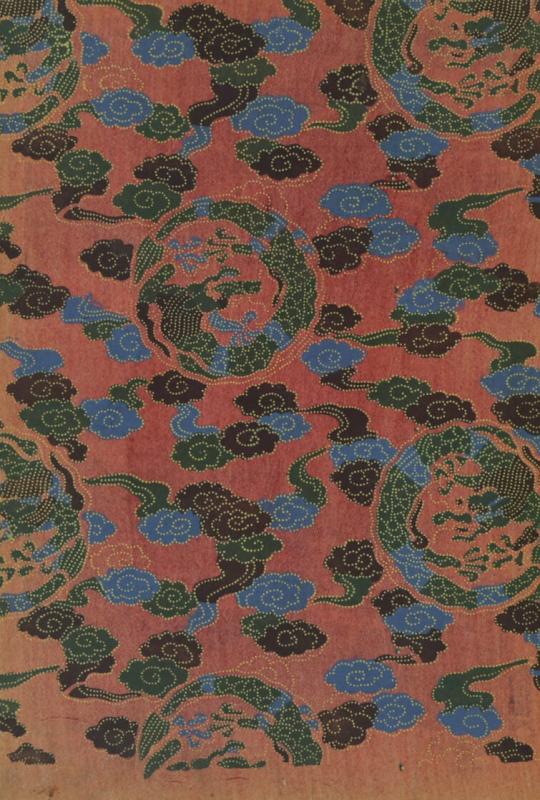
n/a. 更紗帖 Sarasa-jo (Chintz Book) [24 FABRIC SAMPLES]
[ca. late 19th century?]. Quarto. Unpaginated. Leporello binding. Tan cloth boards with a calligraphic paper label pasted on the front cover. A Japanese sample book of 24 imported sarasa (chintz) designs, likely originating in South and Southeast Asia. This style of calico fabric designs had long been enjoyed in Japan (and other East Asian countries) as decorative fabric. By the Meiji era had continued to be popular, and we believe this book can be dated to that period. The designs included here are printed on mounted paper, all based on hues of red, combined with other color accents, in the patterns displaying primarily geometric and botanical forms. Binding with some light rubbing and stains to the covers. Interior clean, with all samples vibrant. Binding in good+, interior in very good condition overall. #55167
Sachgebiete: China, Design, Mode, Orient, Textilien
1250,- EUR
inkl. 19% USt./incl. 19% VAT
Auf Merkliste setzen 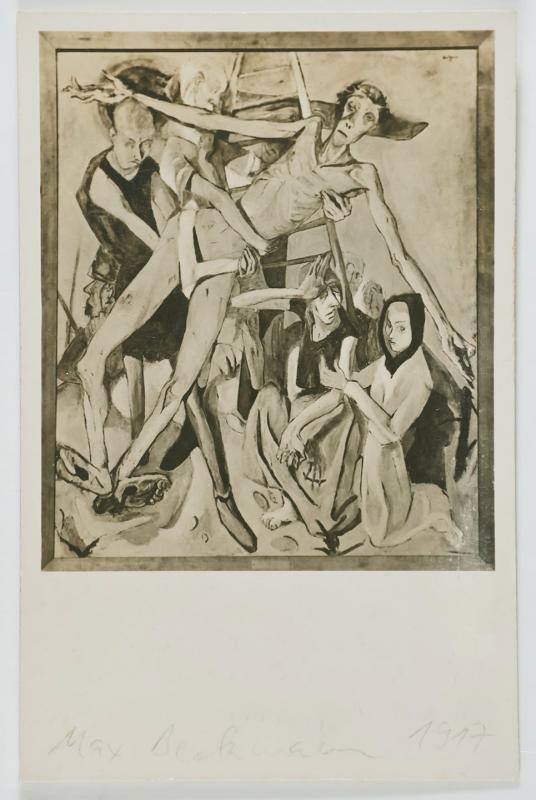
Beckmann, Max. Kreuzabnahme [PRINTED PHOTO-POSTCARD FROM THE ENTARTETE KUNST EXHIBITION, SIGNED BY MAX BECKMANN]
München. NP. 1937. Postcard (5 1/2 x 3 5/8"). Original sepia toned photo-postcard (original photograph) featuring a reproduction of Max Beckmann's painting "Kreuzabnahme", protected in mylar sleeve and taped to cream color mat. Text on verso of the postcard is visible. Printed "Ausstellung Entartete Kunst" on verso with handwritten description of camera movements for a film shoot. Exhibition organized by Adolf Ziegler and the Nazi Party opening on July 19,1937 in Munich. The original painting was rendered in oil on canvas, in 1917. Signed in pencil by Max Beckmann at the bottom of the "Max Beckmann, 1917". Verso of postcard with penciled text: "Kamera geht weiter vom Knaben weg (andere Seite) Pflanzen Ornam. Tiere fantastische Formen feuerwerkartig übersteigert, wie Anfang nur gesteigerter. Kamera geht ab zurück zum Knaben (Knabe wirkt größer. Ein ...(B or Rab?) kommt ins Bild Knabe pflückt ein Blatt, gibt es ihm. Kamera geht vom Knaben weg. Absolute Filmszene noch gesteigerter als die beiden ersten. Kamera schwenkt zurück zum Knaben. Knabe erwachsen Jüngling. Er wendet sich ab von den ... (Dl?) Tieren Formen (abweichende Bewegungen). Die Blumen verdorren und verschwinden die Tiere und Ornamente verschwinden. Eine weite unendlich weite Ferne entsteht. Er geht weg. ... (Scene?erte?) wird öde und leer ... (d(t)rocken) verlassen. TZ" #48271
2750,- EUR
inkl. 19% USt./incl. 19% VAT
Auf Merkliste setzen 
Khazin, S. B. (Engraver); Maxim Petrovich Dmitriev (Photographer). M. Gor'kii. Rasskazy "Mal'va" T. III-II [Folio Cyrillic Micrographic script portrait of Maxim Gorky]
Kiev. NP. 1903. First edition. Folio. Size approx. 28 x 20 inches (50 x 70 cm). Rare micrographic portrait of Maxim Gorky composed from the letters of his short story Malva. The portrait was engraved by S. B. Khazin based on a photograph of the famous Russian author taken in Nizhny Novgorod by the Russian photographer Maxim Petrovich Dmitriev and printed by S. V. Kul'zhenko. Portrait passed by the censor in Kiev, 23 February 1903. The technique of portraiture using words and letters first appears in Russia in 1900 with Khazin's portrait of Count Leo Tolstoy which used 4700 characters to form the work. His second portrait in this style was the present work, that of Gorky, which used the approximately 82,000 cha33059 lume of Gorky's story, as identified in the title. Little is known of Khazin except that he was mostly likely born near the town of Yarysheva Mogilev-Podolsk in the Ukraine, and that he had his portraits printed in Kiev. His technique consisted of using a well-known photograph, leaving the face untouched but washing away everything else except for an outline of the original. He then drew the portrait using the handwritten text, with the individual letters usually less than a millimeter in height, all of which needed to be engraved in mirror image so that it could be read once the print was struck. Not found in OCLC or any major European libraries. There is a copy at Centraljnaya Gorodskaya Biblioteka im. A.M. Gorjkogo, Krasnoyarsk, Russia. Sporadic and minor closed tears along edges (not affecting portrait). Moderate age-toning along edges (not affecting image). Print in overall very good condition.
Sachgebiete: Deutschland, Moderne Kunst, Nationalsozialismus, Photographie, Plastik
4500,- EUR
inkl. 19% USt./incl. 19% VAT
Auf Merkliste setzen 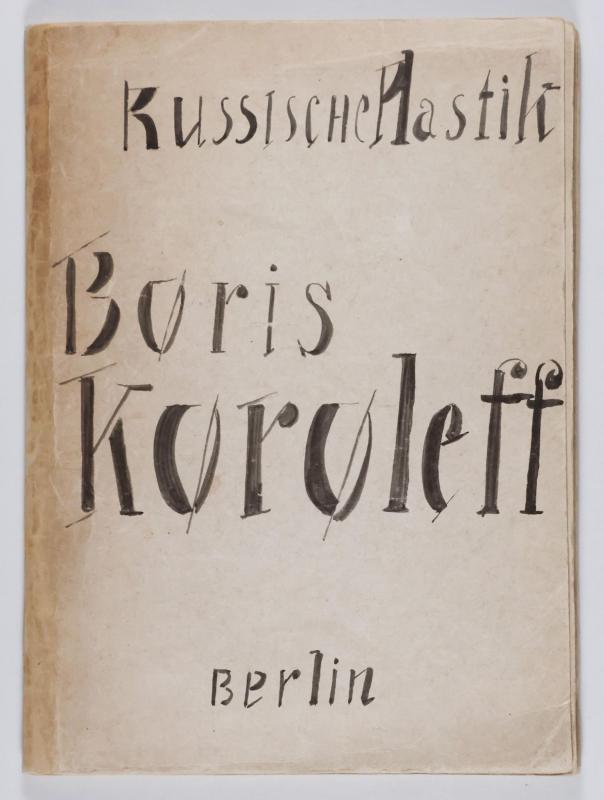
Korolev, Boris [Boris Korolyov]. Russische Plastik (Russian Sculpture) [UNIQUE COLLECTION OF 26 ORIGINAL PHOTOGRAPHS OF WORKS EXHIBITED AT THE ERSTE RUSSISCHE KUNSTAUSSTELLUNG] [SIGNED]
Berlin. [1922]. Small folio. 14 leaves, unpaginated. Hand-made string-bound paper portfolio, in paper wrappers, with calligraphic black German text on the front cover. Housed in a custom tan cloth clamshell box, with a dark brown leather label lettered in gilt on the spine. Signed by the artist on the first leaf. This unique collection is comprised of 26 mounted silver gelatin photographs, showing 20 works by acclaimed Russian sculptor Boris Korolev (Boris Korolyov, 1884-1963), 19 of which he would be exhibiting at the Erste Russische Kunstaustellung (The First Russian Art Exhibition) in Berlin in 1922. The exhibition was historically important in that it was first show devoted to Russian art to be presented in Western Europe in the years since the Russian revolution. The exhibition opened on Sunday, October 15, 1922, at the Gallery van Diemen, showing more than 700 works by 167 artists. The show was organized by the International Bureau of the Soviet People's Commissariat for Education under the auspices of David Sterenberg, Naum Gabo, and Nathan Altman, and was scheduled to run for one month, but due to the positive response by press and a large number of visitors was extended until the end of the year. The architect Adolf Behne described it as the "boldest and most extensive exhibition of creative production" that has been seen in Berlin in years. While it was originally scheduled to travel to various European capitols, the French government refused to give permission for an exhibition in Paris. Subsequently the exhibition was only shown in the Stedelijk Museum in Amsterdam in the Spring of the following year. Retrospectively the event has been seen as an important moment in the history 20th century art, which highlighted the significant Russian contributions to modern art. The first photograph is a portrait of the sculptor, with his signature below. Most of the heavy stock paper leaves contain a photograph mounted on both the rector and the verso (a few leaves are single sided only). All of the photographs, which range in size from 5 1/2 x 3 1/2 to 7 x 9 1/2", are captioned below in hand-written Cyrillic text in ink. The captions contain the title of the piece, the year of it's completion, medium used, and in some cases the name of the museum where the work was held at the time. All of the 20 individual works shown here, mostly sculpture and few sketches, were produced by the artist between 1915 and 1920. Some prints are mat, and some are glossy (some with oxidation to corners). This collection of images is significant in that it documents, in-part, Korolev's short-lived but notable cubist period (ca.1918-1923). Many of these early works in Korolev's career no longer survive, including his notorious monument to revolutionary Mikhail Bakunin, which stood for only a few months in Moscow's Turgenev Square before it was officially removed. Images of both his small scale mockup design sculpture, and the full scale monument standing in Moscow are included. This controversial design has since been acclaimed as an important moment in the history of Russian sculpture. Also shown is Korolev's even more radical cubist design for a proposed statue of Karl Marx, which was ultimately rejected in favor of a more traditional design by Georghe Lavrov (1895-1991), and erected in 1919. The final three photographs included show cubist drawings and sketches, including the artist's interesting design for the facade of the Project of the Central City Public Building, in Moscow. These and many of Korolev's other works from this period were ultimately deemed to be too experimental for even Soviet sensibilities during this early period, which was concerned with defining a new Soviet artistic identity. After the negative reception and controversy surrounding many of these works, he switched to a more realistic style, which was in line with Soviet authorities. Wrappers with minor to light stains, age toning and creasing, as well as some light rubbing to extremities. Spine of the wrappers has been re-backed and restored. Interior relatively clean, save for some minor age toning to leaves, and some oxidizing to the edges of some of the photographs. String-tied binding still holding tight. In very good- condition all things considered. #53840
39500,- EUR
inkl. 19% USt./incl. 19% VAT
Auf Merkliste setzen Bénédictus, Edouard; Yvanhoé Rambosson (Preface by). Relais 1930 Quinze planches donnant quarante-deux motifs décoratifs [COMPLETE, W/ 15 POCHOIR PLATES]
Paris. Vincent, Fréal et Cie. 1930. First edition. Folio. [4]pp. (title and text), 15 loose plates, as issued, with the original portfolio missing. Title page in green and black lettering. Published shortly after the artist's death, "Relais 1930" is a striking homage to the art and genius of Edouard Bénédictus, a French painter, writer, composer and chemist who started his career in the Art Nouveau period. This collection contains 15 vivid pochoir plates featuring 42 Art Nouveau designs which display an imaginative geometric elaboration of fields of pure color, punctuated in places with abstract floral motifs. Each plate measures 18 1/2 x 14 1/2" (pochoir illustration 14 2/8 x 11"), some of which are protected with a loose tissue-guard. Minor foxing or smudges to margins of a few plates, not affecting images. Minor smudging to the back of a few plates. In overall very good condition. Protected in modern mylar. #40611
Sachgebiete: Design, Graphik, Ornamentik, Textilien, Aquarelle
4500,- EUR
inkl. 19% USt./incl. 19% VAT
Auf Merkliste setzen Lazi, Adolf. Twenty Photogravures Signed by Adolf Lazi with Original Manuscript Letter & various related Ephemera (Presentation Copy)
Freudenstadt. Self-published. Ca. 1925. Unique copy presented to Oberforstrat A. D. Holland on the occasion of his retirement. 4to. Original full vellum with gold borders and gold-stamped florets on spine. Gold-ruled raised bands. Top edge gilt. Binding designed by Adolf Lazi. Inside front board lettering in red within golden border: "Entwurf und Bilder von Adolf Lazi. Lazi-Verlag Freudenstadt." Free front and rear endpapers in parchment. Manuscript letter, dated "Klosterreichenbach den 22. Dezember 1925," pasted on free front endpaper thanking Mr. Holland for his many years of service at the Forstverband Freudenstadt. Following is a presentation leaf with finely handwritten dedication in gold to A. D. Holland, also on parchment. Signed by thirteen officials of nine forestry agencies with names of agencies also handwritten in gold. Text and signatures within double red border (* full text of presentation leaf below). Illustrated with twenty images in photogravure by Lazi of forest scenery in the Schwarzwald (Black Forest) and surroundings. Lazi's captivating images convey the tranquillity yet powerful landscape of the Black Forest. All photogravures signed in pencil by Lazi with handwritten captions by him. From 1918-1928 Adolf Lazi had his photo-atelier in Freudenstadt. Along with Albert Renger-Patzsch and Hans Finsler, Lazi was one of the most important artist of the "Neue Sachlichkeit" (New Objectivity) photography of the twenties and thirties. In 1936 he achieved worldwide recognition with his interior photographs of the airship "Hindenburg." WITH Additional related ephemera of 3 letters and two photos, laid-in. One letter by Forstrat G. Maier to "Herr Oberforstrat" (most likely A. D. Hoffmann), dated "Stuttgart, 4. Mai 1926. Maier is also one of the officials that signed on the dedication leaf. Verso of letter with pasted 2 1/2" x 4 1/4" photograph of 3 people walking their dog on a forest path. Second letter with unidentifiable writing, dated 23. XII. 25. Original 2 1/4" x 3 1/4" photograph of Forstrat Galser, dated on rear 25. IX. 1935. Second photo measures 3 1/4" x 4 1/4" showing a winter scenery of a bridge and a stream in Klosterreichenbach. Handwritten description in pencil on verso, dated 21. Dezember 1927. Typical rippling to parchment leaves and manuscript letter. Some staining on inside of front and rear board and on bottom corner of #32097dedication leaf. Very good condition. Photogravures clean and crisp. Unique presentation copy with all photogravures signed by Lazi. #32097
Sachgebiete: Botanik, Deutschland, Naturwissenschaften, Nordrhein-Westfalen, Photographie
6000,- EUR
inkl. 19% USt./incl. 19% VAT