 Auf Merkliste setzen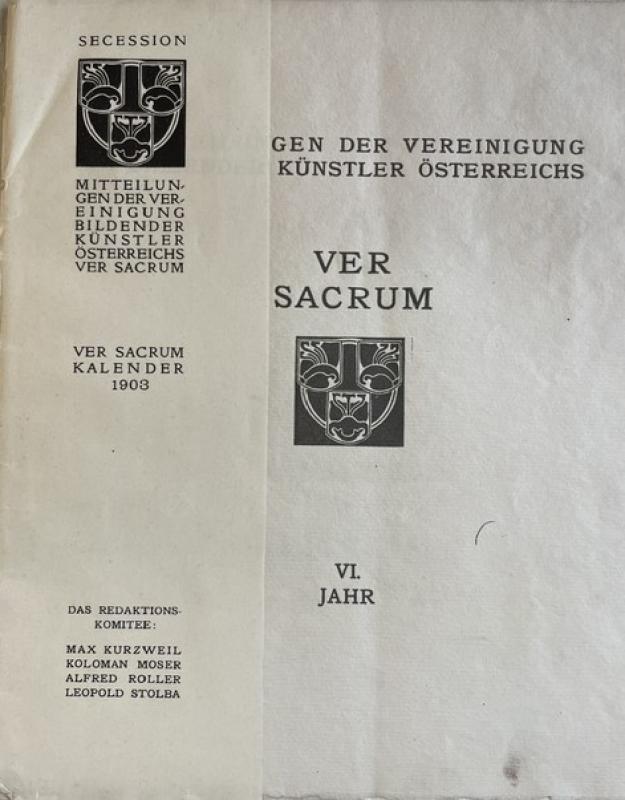
Alfred Roller
A calendar for 1903, published as a special issue (Sonderheft) of Ver Sacrum magazine. Soiled wrappers, wear to extremities with some restoration, spine splitting. Contens good. Illustrations: 12 full-page woodcuts for each month and 1 woodcut vignette of Jupiter on the half-title, printed in color from stereotypes made from the original wood blocks, by Emil Orlik, Wilhelm List, Kolomon Moser, Max Kurzweil, Alfred Roller, and other Vienna Secession artists. The Jupiter vignette, by Friedrich König, is also printed in black on the front wrapper. The calendars and decorative borders were designed by Alfred Roller. Edited by Max Kurzweil. "Sonderheft, Ver Sacrum Kalender, 1903, preis 2 K"--Printed on front wrapper. "Druck von Adolf Holzhausen...in Wien ; Zink-Clichés von der 'Graphischen Union' in Wien"--Printed on back wrapper. "Notiz für den Buchbinder..."--Back wrapper. Printed in an edition of 500 copies, of which 300 were intended for subscribers, 200 for sale. 14 leaves : ill. (col.) ; 25 x 26 cm Cream printed wrappers with König's woodcut vignette of Jupiter printed on front.
3500,- EUR
inkl. 19% USt./incl. 19% VAT
Auf Merkliste setzen 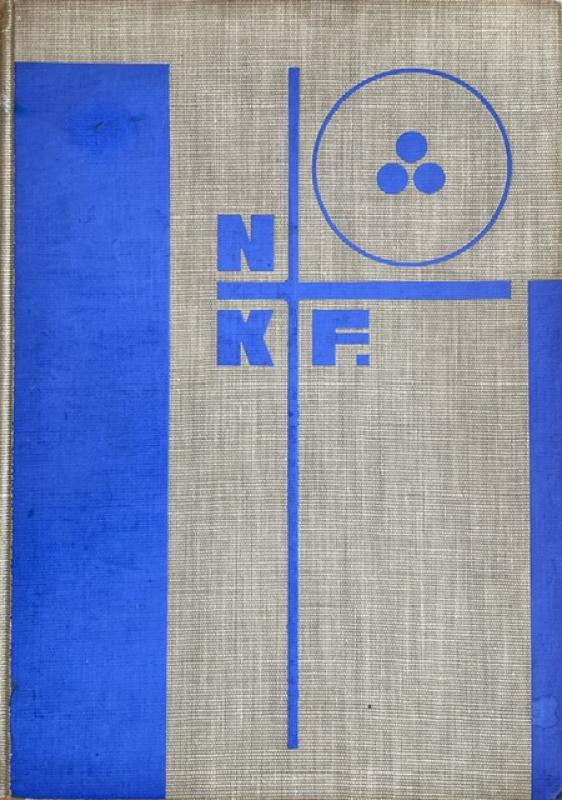
Piet Zwart
Piet Zwart, NKF. Delft, N.V. Nederlandsche Kabelfabriek, 1928, (80)p., tipped-in paper samples, printed in various colours w. typography, design, photogr. (photomontage) ills. and orig. stiff paper wrappers by PIET ZWART, large 4to. Printed by Drukkerij Trio, The Hague Deluxe Dutch edition: slight wear to the covers, a bumped corner, a stain on the back cover has been diminished, small touch-ups in the blue on the front. Else a very good copy. The rare trade-catalogue for the Netherlands Cable Works, generally considered the 'magnum opus' of Piet Zwart, WITH the loosely inserted EXTRA LEAF "?60 50? 60kM 50kV-kabel geleverd en in bedrijf (...)". Brentjens p.166ff; Broos p.46ff; Monguzzi p.39-59; Müller p.49-63 (odd pages only); Spencer p.124f; Purvis p.72ff; Purvis/ De Jong p.145; Broos/ Hefting p.86f; Andel p.209 and 264; Maan/ Van der Ree p.44; Rattemeyer p.100 ff. "In de zomer van 1926 schrijft Piet Zwart, dat hij bezig is met het ontwerpen van een catalogus 'waarin zeer opmerkelijke dingen komen, waarin ik allerlei experimenten uithaal, die, meen ik, nog niet vertoond zijn op reclamegebied'. Het is de catalogus van de Nederlandse Kabelfabriek, waarvan een nederlandse en engelse versie in 1928 en 1929 verschenen. De catalogus was inderdaad een 'zeer opmerkelijk ding'. De mogelijkheiden van een elementaire typografie, zoals Zwart die enkele jaren had kunnen uitproberen in de NKF-advertenties, werden hier aan één omvangrijk werkstuk gedemonstreerd, samen met de mogelijkheden van de door hemzelf tot op dat moment nog nauwelijks ontgonnen gebieden van fotografie, fotogram en fotomontage (...)" (Broos p.46). "(...) een van de hoogtepunten in Zwarts typografische carrière" (Brentjens p.168); "His first use of photographs was in the 1928-29 catalog for NKF in which he incorporated close-up cross-section photographs of electric cables. Products had never before been presented with such clarity. He achieved a dynamic balance between text, photograph, and white space on the page. Double-page spreads work as single compositions, and the catalogue is distinguished by dramatic contrasts, asymmetry and spaciousness" (Purvis p.72).
22000,- EUR
inkl. 19% USt./incl. 19% VAT
Auf Merkliste setzen 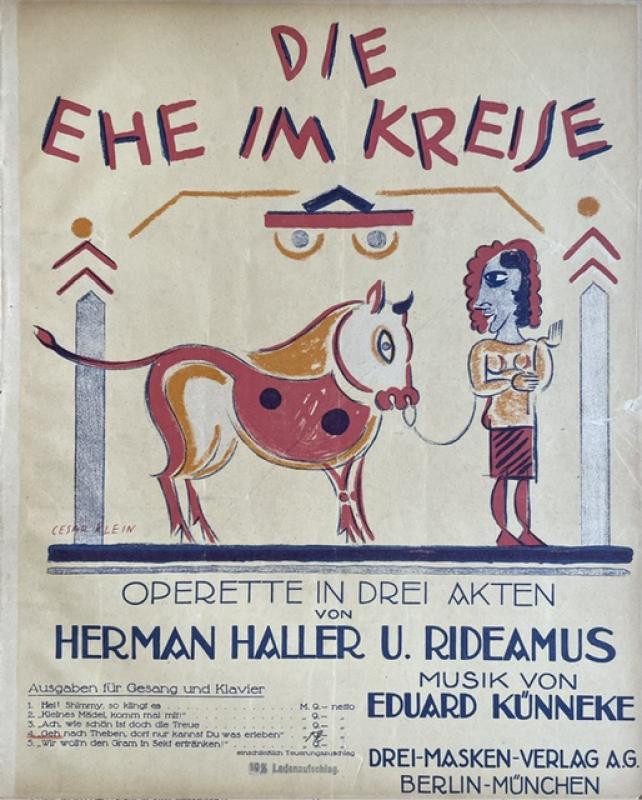
Eduard Künneke, Cesar Klein
Die Ehe im Kreise, Operette in drei Akten von Herman Haller U. Rideamus, Musik von Edouard Künneke, Drei-Masken Verlag A.G. Berlin-München, 1921. Sheet music with a lithographed front cover by Cesar Klein. 32,5 x 26 cm. Good condition with a small corner loss slower right. Rare expressionist illustration art. César Klein (14 September 1876 – 13 March 1954) was a German Expressionist painter and designer, probably best known as one of the founders the November Group and the Arbeitsrat für Kunst. He is associated with the Düsseldorf school of painting. He was born in Hamburg; when he was seventeen, his parents insisted that he be apprenticed to a craft painter. He later studied at the Hamburg School of Applied Arts, the Düsseldorf Art Academy, and the Royal Museum of Applied Arts in Berlin. In 1910, he was one of the 27 artists rejected from the Berlin Secession who responded by starting the New Secession. Klein created lithographs and woodcuts, stained glass windows and mosaics, and murals on walls and ceilings, in addition to his easel art. Given the practical bent of his training, Klein frequently "worked in media that appealed to a mass audience, such as architectural decoration, applied art, poster design, and theater and film design. In 1913 he decorated the interior of the new Marmorhaus cinema in Berlin. In the years after World War I Klein was associated with Walter Gropius, though he turned down Gropius's offer of a teaching position at the Bauhaus. Through the 1920s and after, Klein devoted much of his work to designs for theater and film production. He was the set designer for Robert Wiene's 1920 film Genuine and for the 1924 production of Ernst Toller's Hinkemann. Klein was included in the famous Degenerate Art exhibition mounted by the Nazi regime in 1937. He was able to resume his career in theatrical design after World War II. He died in 1954, at Pansdorf near Lübeck.
Sachgebiete: Avantgarde, Ephemera, Expressionismus, Musik/Noten, Theater
600,- EUR
inkl. 19% USt./incl. 19% VAT
Auf Merkliste setzen 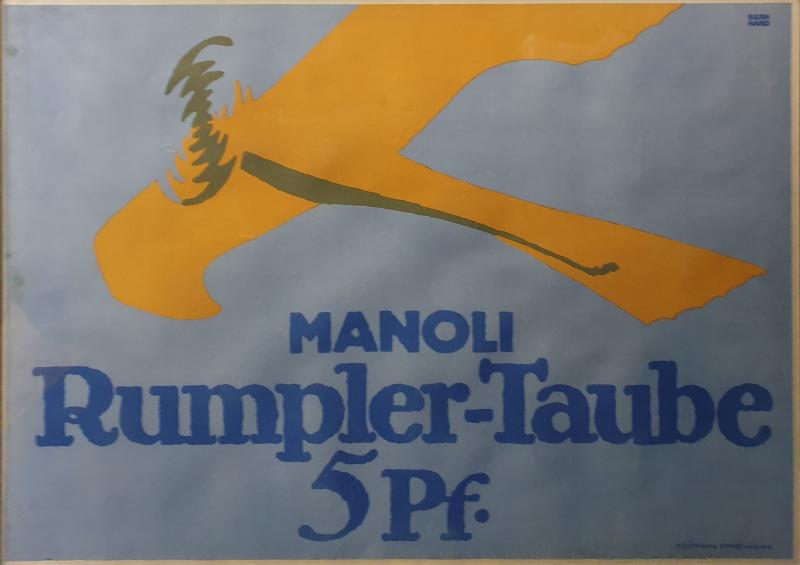
Lucian Bernahard
Lucian Bernhard (ps. Emil Kahn, 1883-1972), Manoli Rumpler-Taube, lithographed poster, printed by Hollerbaum & Schmidt, Berlin, ca. 1912. Rare poster advertising the Manoli cigarette brand by one of the Germany’s most important graphic designers in his groundbreaking “Sachplakat” style. 97 x 68 cm, backed on linen.
4800,- EUR
inkl. 19% USt./incl. 19% VAT
Auf Merkliste setzen 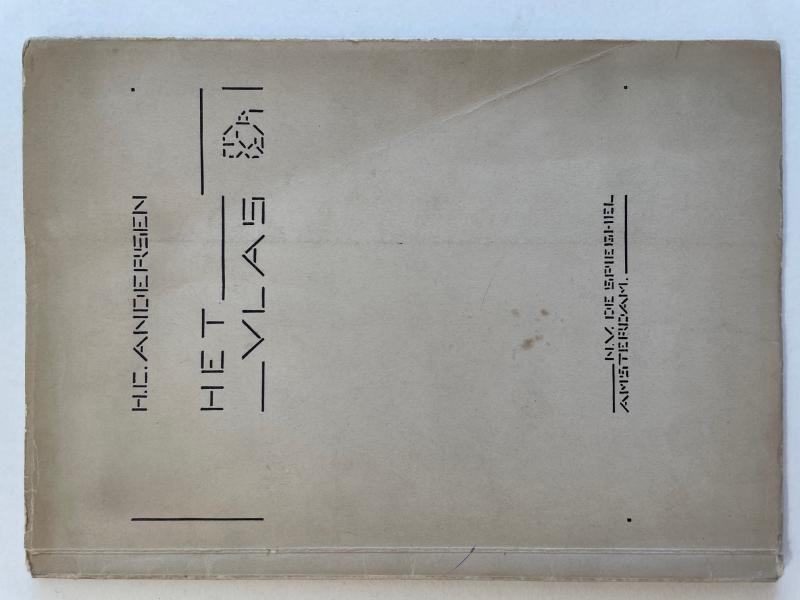
(LECK, Bart van der). ANDERSEN, H.C.
Het vlas. (Translated from the Danish by Marie Nijland-van der Meer de Walcheren. Handwriting and color drawings designed by Bart van der Leck). Amsterdam, De Spieghel, (1941). Original folding wrappers. 10 (= 24) p. Printed at De IJsel in Deventer in 550 numbered copies, this being copy #44. 1st edition. Cover slightly browned and with some inevitable creasing of the edges. Very good copy. One of the highlights of Dutch twentieth-century book design. This edition was, from the illustrations, cover, and text to the last exclamation mark, hand-drawn by Bart van der Leck in his typical angular, geometric style (the style of De Stijl). Text and image are interspersed with lines and areas in the primary colours blue, yellow, and red. 'The Flax' ('Hørren' in Danish) is an early tale by Andersen (1849)-an extraordinary message of hope and fulfillment in adverse times.
Sachgebiete: Kinderbücher, Graphik, Illustrierte Bücher
2400,- EUR
inkl. 19% USt./incl. 19% VAT