 Auf Merkliste setzen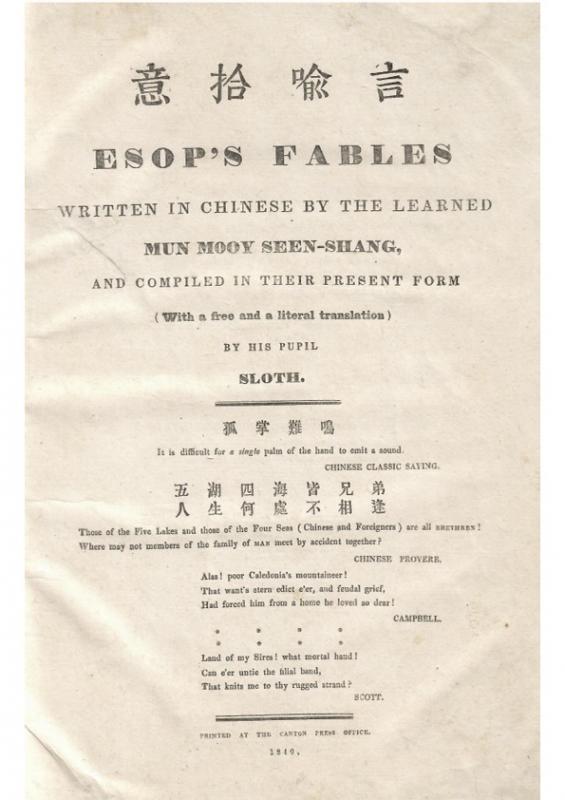
[THOM, ROBERT] (Compiler): 伊索寓言 Yishi Yuyan (Yī suǒ yùyán) Esop's Fables written in Chinese by the Learned Mun Mooy Seen-Shang, and Compiled in their present form (with a free and literal translation) by his pupil Sloth. Macao, Canton Press Office, 1840.
Folio. Pp. (ix), xxi, (iv), 104. With one lithographed plate of Chinese characters. Text in English, Chinese and romanizations in the Nanking and Cantonese dialects. Early 20th century cloth with original wrappers bound in at the end. Small marginal repairs on the title page and the two following leaves. Rare first edition of Thom's translation of Aesop's fables into Chinese. It is the first complete Chinese translation of the fables and became the most important and influential version in 19th century China. It contains 81 fables (Yùyán) mainly based on the English edition produced by Roger L'Estrange in 1692, preceded by a long preface and an introduction to written Chinese characters. The short stories are printed in Chinese characters (woodblocks) accompanied by the Mandarin pronunciation of Nanking (Roman letters) and the Cantonese dialect (italics). Both according to Dr. Morrison's orthography. In another column, a free English translation is given together with an English "direct translation" of the Chinese characters. Robert Thom came to China in 1834 and initially worked for the trading house Jardine, Matheson & Co. in Canton. He was an official linguist during the First Opium War and participated as a translator in the negotiations for the Treaty of Nanking. In 1843 he was appointed British consul in Ningbo. He dedicates this work to William Jardine, James Matheson and Henry Wright "by whose bounty the entire expense of his Chinese education was defrayed". According to the preface, this translation of the fables was selected from various ancient sources such as Phaedrus, Avanius, Barlandus, etc. Thom dictated the fables, in Mandarin, to his teacher Mun Mooy Seen-Shang, who wrote them down in a simple style called "tsã-luh", the lowest and easiest form of Chinese composition. The first selection of the stories was published in 1837-8 and was well received by the Chinese. "They had their run of the Public Courts and Offices - until the Mandarins - taking offence at seeing some of their evil customs so freely canvassed - ordered the work to be suppressed. ... The application was once perceived - and the justice of the remark admitted immediately" (Preface). The Western tradition of using fables in education and sermons indirectly paved the way for their transmission to China. In the 17th century, the Jesuits adapted and used Aesop's fables in their Chinese sermons. The fables came to influence and challenge the traditional Chinese way of writing fictional stories which had always been based on true historical events. (See Diss.: Wu, Pei-Lin "Aesop's fables in China, the transmission and transformation of the genre" (Illinois). Cordier BS 1683. Lust 1065. See: Asiatic Journal and Monthly Register for British and Foreign India, China and Australasia. Vol. XXXVI - new series. Sept. - Dec. 1841. pp. 182-3.
Sachgebiete: Asien, China, Fabeln
14000,- EUR
inkl. 7% USt./incl. 7% VAT
Auf Merkliste setzen 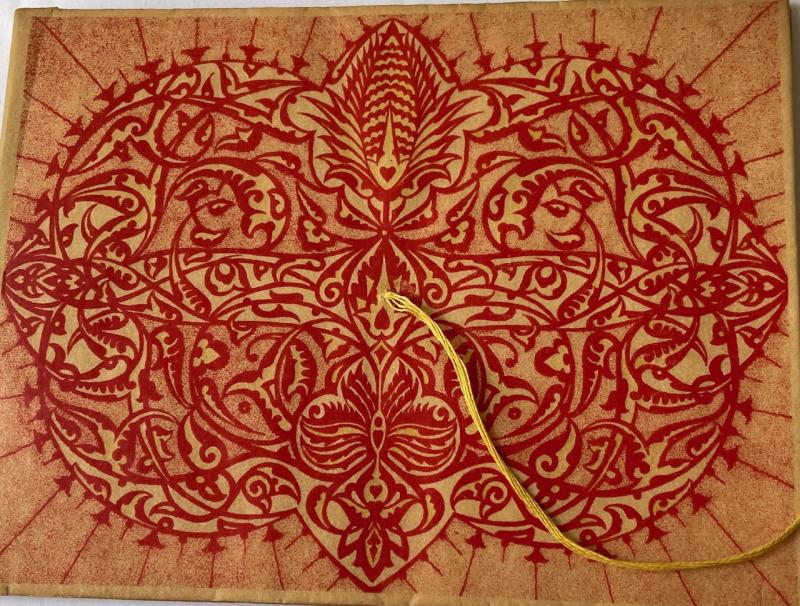
KHAYYAM, OMAR / GALAMBOS, MARGIT (Ill.): Rubáiyát of Omár Khayyám. Rendered into English Verse by Edward Fitzgerald. (Budapest 1922).
Oblong 8vo. Size: 16 x 12 cm. Lvs (14). With printed calligraphic English text. Each page with arabesque illustration printed in red and yellow. Original wrappers covered with decorated parchment paper, closed with yellow silk ties. Hungarian edition limited to 500 copies, of which this is no. 303. Comprises eighteen quatrains from the Rubaiyat. With design and calligraphy by Margit Galambos, Hungarian graphic artist and painter. Housed in the original portfolio, expertly restored.
Sachgebiete: Asien, Illustrierte Bücher, Literaturwissenschaft
800,- EUR
inkl. 7% USt./incl. 7% VAT
Auf Merkliste setzen 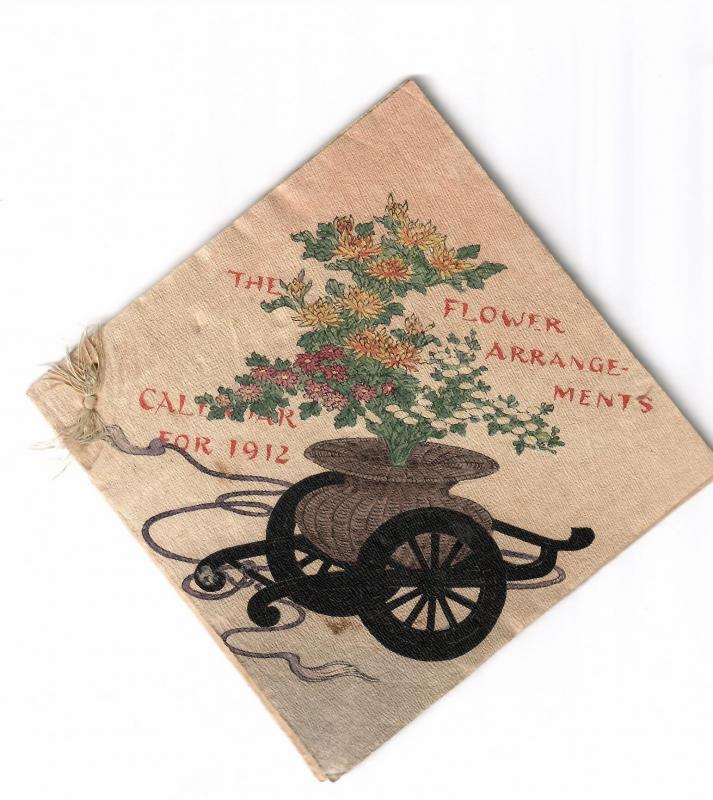
HASEGAWA, TAKEJIRO: The Flower Arrangements. Calendar for 1912. Tokyo, Hasegawa, 1911.
A diamond shaped calendar: 13.8 x 13.8 cm. Seven double folded leaves of crêpe paper bound in the Japanese style with silk ties. Original decorated covers. Text in English, Japanese title on the back cover. A beautiful calendar depicting twelve different flower arrangements, one for each month, woodblock printed in fine colours on crêpe-paper. Slight dusty on the covers. Takejiro Hasegawa (1853-1938) produced many woodcut illustrated books in the western languages, usually in small editions.
Sachgebiete: Kalender, Japan
1200,- EUR
inkl. 7% USt./incl. 7% VAT
Auf Merkliste setzen 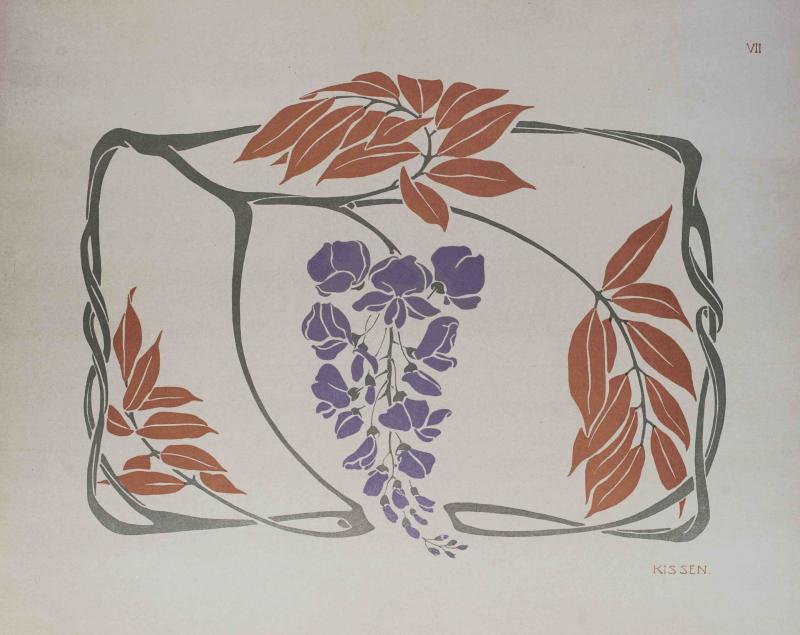
SCHMITT, HELENE: Stickereien (Embroidery). Entwürfe von Helen Schmitt. Auf Stein gezeichnet von der Verfasserin. Parts I-III (all publ.). Basel, Wassermann & Schäublin & Dresden, In Kommission bei der Verlagshandlung Wilhelm Baensch, 1906-7.
Large folio (41 x 52 cm). Contains a preface, three plates with photo illustrations and explanatory text, and twenty-two beautiful coloured lithographic plates (one double-page) printed on strong cardboard of different colours, some highlighted in gold. As issued in loose sheets in original illustrated stiff wrappers, with some wear along the corners and neat restorations. Housed in a specially made cloth portfolio by Atelier Devauchelle in Paris. First and only edition, self-published by the artist, we assume in a very small number. A gorgeous Art Nouveau work with decorative ornamental patterns for embroidery but can also be used for other techniques: wood painting and carving, book covers, furniture, curtains, clothing, etc. Helene Schmitt was a teacher of embroidery at the Frauenarbeitsschule in Basel. According to Schmitt's foreword: "The designs for embroidery, which are available here in lithographic form, are a selection from the drawings that I designed as head of the class for coloured embroidery at the Woman's Work School in Basel over the past 5 years. Part of the work was exhibited at the Basel Trade Exhibition from 1901 for the first time. Since then I have mostly reworked the designs and now publish them in this new form ..." A wonderful work in true Art Nouveau style. Some plates with small creases in the corners but overall a very good set. Extremely rare on the market.
Sachgebiete: Jugendstil, Kunsthandwerk, Textilien
6500,- EUR
inkl. 7% USt./incl. 7% VAT
Auf Merkliste setzen 
[TALE OF GENJI - CRÊPE PAPER ALBUM] An album featuring a selection of thirty illustrations of Toyokuni III's Genji series "Faithful Depictions of the Shining Prince". Nihon Bashi (Tokyo), Fukuda Hatsujiro (Gusokuya), 1897.
Leporello folded album with thirty beautiful colour woodcut prints on crêpe paper. Size: 22.4 x 17.3 cm. The images have printed captions and numbers in Japanese. Contemporary silk-covered boards, rubbed, title label on upper cover. The "Tale of Genji" is the famous Japanese novel written in the early eleventh century by the court lady Murasaki Shikibu. The story of the fictional Prince Genji captures the aesthetics, intrigue and customs of court life at the time. It has served as an inexhaustible source of inspiration for visual artists throughout the ages. An album with thirty illustrations taken from Kunisada Utagawa (Toyokuni III) publication "Faithful Depictions of the Shining Prince" in 1849-53 (which has fifty-four illustrations). Lavishly printed with views of court life and travels in different seasons set in typically luxurious settings and in beautiful gardens with a wonderful attention to detail. (flowering trees, autumn maples, ponds, birds, fine textiles, extravagant interiors, peeking into views, etc.). Gusokuya was a well-respected family business that published woodblock prints, especially ukiyo-e, in Tokyo during the Meji period.
Sachgebiete: Illustrierte Bücher, Japan, Literatur bis ca. 1900
3000,- EUR
inkl. 7% USt./incl. 7% VAT