 Auf Merkliste setzen
Stundenbuch with fragments from Ovid.
Book of Hours, in German. Nuremberg, c. 1375. 8vo (120 x 153 mm). 78 ff. German manuscript on vellum. Written in Gothic bookhand, ruled in lead point, 20-21 lines per page. Rubrics, initials in red, one large initial in red and green. Contemporary leather-covered boards, with thirteenth-century leaves containing Ovid, Amores I.14.13-41 and II.7.3-8.1 as pastedowns. Worldy love gives way to the divine, Latin to the vernacular: reused leaves containing Ovid's love poetry nestle in the original binding of this medieval Book of Hours in German. Although Books of Hours in the local language were well known during the Middle Ages in other countries, such as the Netherlands, in Germany they remained vanishingly rare (cf. Hamburger, Bilderwelten). The presence of certain saints suggests a Nuremberg provenance, giving us valuable insight into an otherwise unrecorded liturgical use in this unique volume, crafted for an individual who wanted to follow the mass and other divine services closely. The large initial S on the first leaf, in red and green, begins with a salutation to the Virgin: "Salve vol aller heilikeit Maria muter vnd mait", introducing her mass. The German text contains Latin cues, allowing the listener less versed in the liturgical language to follow along with the prayers during the service. There follow the Hours of the Virgin, the Hours of the Passion, the Office of the Dead, prayers in German and a litany of saints, providing a rounded picture of the everyday face of later medieval devotion. A very different world greets us in the pastedowns: at the front, the Roman poet Ovid laments the loss of his lover's beautiful hair, the victim of a misjudged dye and cut at the hairdresser, comparing it to the locks of pagan gods: "Formosae periere comae - quas vellet Apollo, quas vellet capiti Bacchus inesse suo!" ("That those beautiful locks have perished - which Apollo, which Bacchus would envy for their own heads!") At the back, he indignantly rebuts another lover's jealousy at the accusation that he slept with her maid, only to continue with a rhapsodic address to the same servant in the next line. Reused from a thirteenth-century codex, these leaves from Ovid are written in an impressively small Gothic hand, accompanied by glosses and marginal annotations, showing an attentive reader at work. Although the turn-ins from the binding obscure some of both leaves, it is clear that the front leaf contains at least Amores I.14.13-41 and the rear one II.7.3-8.1. A tear to the front paste-down has exposed the wood of the board underneath, which bears an offset of the verso, revealing some of its text, presumably the earlier portions of I.14 and the end of I.13. The presence among the saints of the Anglo-Saxon missionary Willibald (d. 787), who was active in what is today southern Germany, and particularly that of Sebald, a contemporary of his who became patron of Nuremberg, points to the latter city as a probable place of origin. Sebald is the only saint in the list whose first initial is distinguished with a touch of red. Books of hours in German are excessively rare, with only about 50 examples known, mostly in institutional collections. Moreover, the liturgical use for the Hours of the Virgin and the Office of the Dead are apparently otherwise unrecorded, making this volume a lone witness to devotional practice in later medieval Nuremberg. A unique volume at the cultural intersection of the Middle Ages: between Latin and the vernacular, the classical and the Christian, the secular and the divine.
Sachgebiete: Antike, Handschriften, Literatur bis ca. 1900, Mittelalter, Stundenbücher
55000,- EUR
inkl. 7% USt./incl. 7% VAT
Auf Merkliste setzen 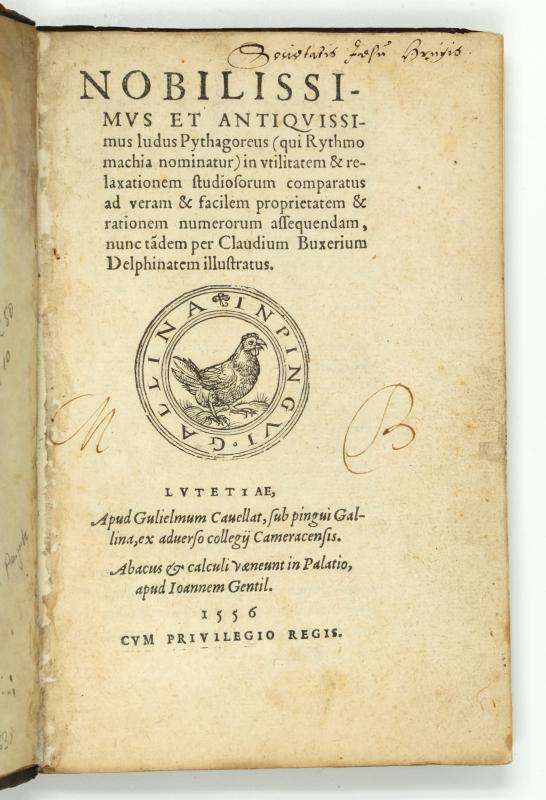
Boissière, Claude de.
Nobilissimus et antiquissimus ludus Pythagoreus (qui Rythmomachia nominatur) in utilitatem & relaxationem studiosorum. Paris, Guillaume Cavellat, 1556. 8vo (115 x 175 mm). 52 ff. Woodcut printer’s device on title-page, woodcut initials and headpieces, woodcut illustrations. Contemporary blind-tooled calf, vellum endleaves. Traces of former ties. Stored in a modern cloth folding box. First Latin edition, expanded from the original 1554 French one. "Boissière considered himself a mathematics teacher and used the game of Rythmomachia as a vehicle for teaching arithmetic" (Tomash). Rithmomachy, or the "Philosophers' Game", was a board-game popular from the Middle Ages through the end of the sixteenth century. Similar to chess but with every piece having a numerical value, it was an essential part of mathematical education for centuries. This volume, laying out the rules and offering a guide to playing, is distinctive for being one of only two known references to the sale of Rithmomachy boards and pieces, which are very poorly attested. This treatise was the clearest guide to the notoriously complicated game from its heyday of popularity in the sixteenth century. Boissière attributes its origins to the ancient Greek mathematician Pythagoras, and uses it to illustrate a number of wide-ranging principles, from mathematical ratios and musical harmonies, which remain relevant today in fields from music theory to computing. This volume was owned in the early 19th century by the French polymath and amateur mathematician Claude-Marie Pillet, of whom Hoefer writes, "Logé dans un galetas, vêtu grotesquement de vieux habits achetés à la friperie, ne vivant que de pain sec ou d'aliments grossiers et de mauvais fruits, sans feu chez lui, sans chapeau dans les rues, il bornait ses dépenses à acheter des livres". It later was part of the illustrious Erwin Tomash Library on The History of Computing, which comprised books and manuscripts relevant to the subject from the twelfth century onwards. In Rithmomachy, the board is divided into a grid, with the opposing players' pieces opposite one another. In addition to different types of pieces (round, square, triangle or the most powerful, pyramid), every piece has a numerical value, which determines how it interacts with and whether it can capture others. The game allows for multiple types of victories depending on the numerical outcomes. In spite of its alleged Pythagorean origins, Rithmomachy is first attested in the 11th century as a means of teaching the principles of mathematics in western European monastic schools. Roger Bacon, the great medieval scholar and scientist, recommended it to his students, and Sir Thomas More envisioned the inhabitants of Utopia as playing it for relaxation. In spite of its fame, Rithmomachy is poorly attested from material evidence, with no boards or pieces from the medieval or early modern period having been found. The game disappeared in the seventeenth century as new methods of teaching mathematics were developed. This volume, which on the title-page advises readers that sets can be purchased "in Palatio, apud Ioannem Gentil", is one of only two known references to physical Rithmomachy sets. Claude de Boissière (fl. 1554-1608) was a mathematician and lecturer at the Collège Royal in Paris. His guide to Rithmomachy was first published in French in 1554; he issued a revised and augmented edition in 1556, which was then published in a Latin edition for an international educated audience. Rare, particularly on the private market: USTC lists 21 copies in institutional holdings, mainly in western Europe, while Rare Book Hub records only 3 other copies sold since 1978. A testimony to the enduring creative potential of mathematics both for education and pleasure.
Sachgebiete: Alte Drucke 16. Jahrhundert , Mathematik, Spiele
12500,- EUR
inkl. 7% USt./incl. 7% VAT
Auf Merkliste setzen 
Erasmus von Rotterdam, Desiderius.
Das Theür und künstlich Büchlin Morie Encomion das ist, Ein Lob der Thorhait. Ulm, Hans Varnier, 1534. 4to (141 × 198 mm). (4), 170, (6) ff. Later half sheepskin over marbled boards, covers ruled and spine tooled in blind. First German edition. The best-known of Erasmus's works, "In Praise of Folly" is a biting satire which criticizes all human professions, from monks and theologians to grammarians, poets, and rhetoricians like himself. Erasmus's inversions and double-entendres begin with the title, playing with the name of his friend and host Thomas More, in whose London house he wrote the book, and continue by having a personified Folly tell the tale, so that Folly ridicules folly. Erasmus followed classical models of ironical eulogies by Isocrates, Lucian and Seneca, in its composition, and infused it with Christian Platonism. The translation is by the German humanist and freethinker Sebastian Franck (1499-1542), whose sympathies with “heretics” led to his imprisonment in Strasbourg in 1531 and subsequent expulsion from that city. In 1534 he settled in Ulm, and published the present work. His edition is augmented with the second German edition of Heinrich Cornelius Agrippa's "De incertitudine et vanitate scientiarum declamatio invectiva" (rendered by Franck as "Von der Heillosigkeit, Eitelkeit und Ungewißheit aller menschlichen Künste und Weisheit") as well as the first printing of Franck's own "Von dem Baum des Wissens Gut und Böse, davon Adam den Tod hat gessen". One of two Ulm editions printed in 1534; Bibliotheca Belgica gives priority to the present issue. Rare, only one copy recorded at auction.
Sachgebiete: Alte Drucke 16. Jahrhundert , Literatur bis ca. 1900, Philosophie
28000,- EUR
inkl. 7% USt./incl. 7% VAT
Auf Merkliste setzen 
Aron of Kangeq / Rinch, Hinrik.
Kaladlit Okalluktualliait (Grönlandske Folkesagn / Greenlandic Folktales). Nuuk, Lars Møller, i Inspectoratets Bogtrykkeri, 1859-1863. 8vo (141 x 211 mm). 4 vols. 1) (8), 136 pp. with coloured vignette at front, 12 woodcuts and 8 lithographed plates of music. 2) (8), 111 pp. with woodcut vignette, 7 black-and-white and 12 hand-coloured woodcuts, and two folding maps of the area around Nuuk by S. Kleinschmidt. 3) (6), 136 pp. with 12 black-and-white and 2 hand-coloured lithographs. 4) (6), 123 pp. with 3 woodcut plates and 8 woodcuts in text. Original printed boards. In a custom blue-green morocco solander box. A landmark collection of Greenlandic folk-tales, told and illustrated by native Greenlanders, printed on the first major printing-press in the country. The stories drew on centuries of oral tradition, and included topics such as conflict between the Greenlanders and the Norse colonists who settled the country during the Viking Age. These four volumes are illustrated with numerous woodcuts, most of them by the native hunter and artist Aron of Kangeq, executed in a distinctive and evocative style. Although overseen by the Danish administrator Hinrich Rink, the stories, the artwork and the printing are all the work of native Greenlanders, making this work a testimony to Greenlanders' agency in preserving their culture in the face of imperialism. Some of the tales are set in the distant past, when southern Greenland still had Norse inhabitants, descendants of Viking-Age settlers, called "Kablunaks" by the Greenlanders. Although legendary in character, the tales relate how the Greenlanders and Kablunaks came into contact in the area around Nuuk and lived in harmony until strife was sown by the maid Navaranak. She tricked the Kablunaks into attacking the Greenlanders, who counterattacked in boats camoflauged with hides to look like blocks of ice. We also hear of the revenge of the Greenlander Kasape on the Kablunak chieftain Ongurtok, who had killed his brother: one of the most memorable illustrations shows Kasape holding up Ongurtok's severed arm to show it to him before he died. The tales are printed in the original Greenlandic with a facing-page Danish translation (except in Vol. III, which appends an abbreviated translation after the Greenlandic text). The collection came into being under the oversight of the Danish colonial administrator Hinrich Rink, who arrived in Greenland in 1848. Rink became concerned with the deleterious effects that colonialism and missionary work was having, not merely on the Greenlanders' physical wellbeing, but also on their language and culture. To combat this, he set up local councils, reinstated the native religious leaders (Angakoks) who had been banned by the missionaries, and began an initiative to collect oral traditions. In 1857 he established the first serious printing-press on Greenland, operated by his native assistant, Lars Møller. The first two volumes are illustrated with the work of the Greenlandic hunter Aron of Kangeq. Hearing of his artistic talent, Rink supplied with tools for producing woodcuts, and the results were works of striking, raw evocative power to accompany the narratives. Of the 30 full-page woodcuts by Aron, 12 in these volumes are hand-coloured. In volumes III and IV, the illustrations were produced by Møller on Greenland's first lithographic press. The two maps in vol. 2 are rarities in their own right and not always included with the set: also prepared from information provided by Aron of Kangeq, they show the hunting-areas and sites connected with Norse settlement discussed in the text. They were printed in 1860 by S. Kleinschmidt, also on Rink's press in Nuuk. Greenland was settled by Norse colonists from Iceland and Norway in the tenth century, during the medieval warm period, when the southern part of the island offered suitable land for agriculture. The Inuit Greenlanders, whose way of life was based on hunting and fishing, lived further north at the time. As the climate grew colder in the later Middle Ages, the Norse colony disappeared, and the Inuit spread further south. Danish-Norwegian colonists arrived under the missionary Hans Egede in 1721, hoping to find some remnants of the Norse settlers. None were found, but the new settlers brought the country under the Danish crown. Colonialism left a lasting mark on the native population and their culture, with early missionaries producing dictionaries and grammars of the Greenlandic language but also suppressing their religion and traditions. Rink and the Greenlanders he worked with played a vital role in preserving these from extinction. Rare: Rare Book Hub records only two other complete sets sold at auction within the last decades. A stunning monument to Greenlandic culture, art and language.
Sachgebiete: Arktis/Antarktis, Dänemark, Indigene Kulturen, Skandinavien, Sprachwissenschaft
40000,- EUR
inkl. 7% USt./incl. 7% VAT
Auf Merkliste setzen 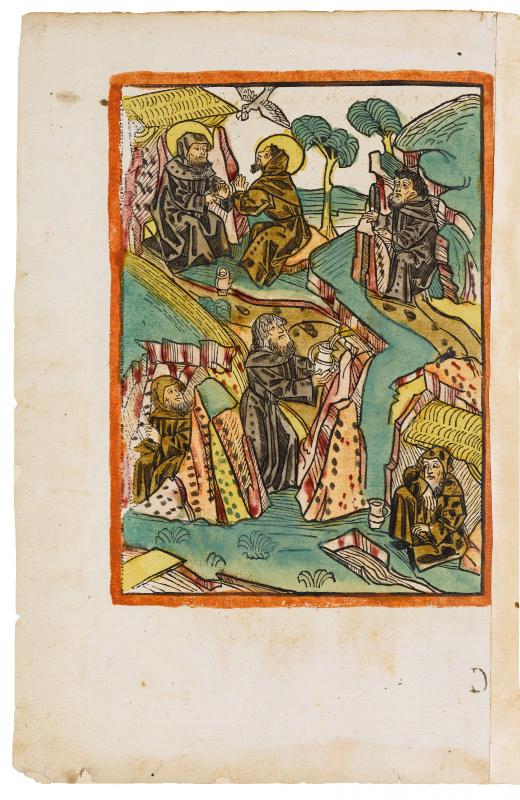
Pseudo-Jerome.
Der altväter leben. Augsburg, Anton Sorg, 25. IX. 1482. Folio (214 x 296 mm). 391 ff., lacking only the final blank, otherwise complete. With 19 large Maiblumen initials, large woodcut frontispiece and 275 woodcut illustrations, all in contemporary colour. Contemporary boards, original covering replaced in the 17th century with tooled Spanish leather, boards with supralibros and a complicated brocade design of parallel curved and straight lines, small squares and discs, fixed with a metallic film and glue, painted in reddish gilt, silver, and black; somewhat worn, joints restored, clasps removed, preserved in a dark green cloth Solander box. An influential early work on the lives of the Saints of Christendom, each woodcut in vibrant contemporary colour. The first edition with this illustration cycle; second German edition overall. This stimulating work is a collection of biographies of the so-called Desert Fathers, both male and female: early Christian hermits who retreated from secular life into the deserts to practice ascetism and a life of devotion. The earliest versions of these "Vitae" were written in the third and fourth centuries and were extremely popular in early monastic circles. There was never a standardized order or set of these texts; rather, they were adapted according to the varying focuses of the convents for which they were made. A special appeal of the printed editions is the great number of often highly vivid woodcut illustrations, which made it easier and more enjoyable to read and hear these stories. Our copy is furthermore heightened with handsome contemporary colouring. Transmitted under the Latin title of "Vitae sanctorum patrum" or "Vitas patrum", this collection consists of stories about early Christian hermits who, from the third century on, had retreated from cities and villages to the deserts of North Africa and Asia Minor to lead a life of devotion and ascetism. There was never a canonical combination of texts that formed the corpus of the "Vitas patrum"; instead, the choice of texts could vary according to the focus of the respective institution that owned the book. From the sixth century onward, the Rule of St. Benedict recommended the "Vitas patrum" as essential reading for monks. St. Dominic was ardently devoted to the lives of the Desert Fathers, and the influence of these texts on the development of Western monastic culture can hardly be overestimated. Virtually every monastery owned a copy of this "textbook for ascetism" (another designation for these compilations of narratives). In the Middle Ages, these accounts of the lives, deeds, and sayings of the Saints were attributed to St Jerome, although he in fact wrote only three of the biographies: he was responsible for the lives of SS. Hilarion, Malchus, and Paul the Hermit. The present German edition was preceded only by the one printed in Strasbourg before 1482, by the unknown "printer of the Antichrist". That edition contained only a reduced number of exempla from the original collection, but boasted sayings from sources other than the "Vitas patrum", making this a different and shorter work. For the considerably extended Augsburg edition at hand, the printer Anton Sorg added the Bavarian "Verba seniorum", a collection of about 750 exempla originating in Bavaria, ca. 1400. The printer’s purpose was clearly to offer the most complete combination of the German texts on the subject. Apparently, this edition satisfied the demand with regards to content, as later editions were not augmented. This is one of the most lavishly illustrated incunables printed in Augsburg. It is adorned with 276 woodcuts printed from 204 blocks. The opening full-page woodcut depicts six of the hermits in a landscape; apart from the full-page title cut (195 x 140 mm) and the author portrait showing St. Jerome (100 x 80 mm), the text illustrations measure ca. 73 x 68 mm. Many of the stories are long adventures, calling for more than one illustration. The story of Malchus the monk, for example, is accompanied by four illustrations: against the insistent warnings of the abbot, Malchus leaves his convent in the desert to visit his native town in Syria to comfort his widowed mother. On their way, the travel group is taken captive by the Saracens. The abductors keep Malchus as their slave and shepherd, after a while urging him to marry a young Christian woman among the other captives. Since she is still married to another man, Malchus is appalled and tries to refuse the alliance. His captors threaten him badly, however, so he yields, and he and his new wife live together in chastity, eventually deciding to escape from the Saracens' camp. In preparation, Malchus slaughters two of his goats, makes bags of their skin, and takes the meat as supplies for their flight. On their way to freedom, they must cross a wide river, and they inflate the goat bags, floating to the other side in safety. This narrative is remarkable because it invites the illustration of nudity, which would normally be considered indecorous within a pious book from a medieval point of view. While Adam and Eve and perhaps tortured martyrs might appear nude, the theme did not extend much further. Our story, however, explains that the Saracens' slaves were often naked, since their garments would fall to pieces and they were not provided with new ones. The master of the Sorg cuts knew and used the Strasbourg compositions as models. It is clear that he did not make mere copies, but rather had to adapt the composition from a horizontal image to one that was nearly square. The resulting composition, focused squarely on the bodies in flight, offers a more vivid, physical illustration of the escape. The models for the second part, the exempla, must have been adapted from another source, possibly a manuscript, as the Strasbourg edition provided only four pictures for this part. It is also conceivable that the talented artist who designed the illustrations for the first part also invented the designs for the remaining woodcuts himself (cf. Musper, "Dialekte und Idiome im frühen Buchholzschnitt", Gutenberg-Jahrbuch 1940, p. 108). All the illustrations and the large woodcut initials are in a beautiful contemporary colour. Specific details on the organization of hand colouring in Sorg's printshop are lacking; evidently, these enhancements were commissioned by the publisher or the retailer. Often, however, a buyer provided for the embellishment according to his own taste and means. In our case, we can find some similarities between the colouring of the Augsburg copy and the one at hand, which might suggest that the present book’s colouring also comes from Sorg's workshop. These magnificent woodcut sets proved popular, and re-appeared in 1492 in an edition printed by Sorg’s son-in-law, Hans Schobser, and later in 1488 by Peter Berger, 1485/87 and 1497 by Johann Schönsperger. This work is very scarce in the trade and rarely found complete. Apart from the present copy, we could trace only one complete copy at auction since 1950 (1958, Karl & Faber, auction 65, lot 40a); the other five copies were imperfect (the last one 2007 at Christie’s). ISTC records 28 copies (four in the USA), at least 13 of which are incomplete or even fragmentary.
Sachgebiete: Alte Drucke 16. Jahrhundert , Illustrierte Bücher, Inkunabeln, Theologie
140000,- EUR
inkl. 7% USt./incl. 7% VAT
Auf Merkliste setzen 
Grosz, George / Meyer, Alfred Richard.
Lady Hamilton oder Die Posen-Emma oder vom Dienstmädchen zum Beefsteak à la Nelson. Berlin, Fritz Gurlitt, 1923. Folio (303 x 253 mm). 52, (4) SS. auf imitiertem Japan-Bütten. Mit 8 handkolorierten Lithographien, jeweils eigenh. vom Künstler signiert. Illustrierter Originalpappband. Nummer IV von 50 römisch numerierten Exemplaren der absoluten Vorzugsausgabe, bei der alle Lithographien koloriert und signiert wurden. Bei den nächsten 100 Exemplaren wurden sie nur signiert, bei den weiteren 150 Exemplaren hatte der Künstler "nur noch die Kraft einer zwofachen Signierung" (Druckvermerk). Im Druckvermerk vom Verfasser signiert. "Gedruckt - unglaublicherweise! - in der Stefan George-Type" (Kobbe). Dass Alfred Richard Meyer für seinen deftigen Text just diese Schrift aus dem Bestand bei Otto von Holten auswählte, wirft ein Licht auf seine parodistische Verwendung von Typographie. - Alfred Richard Meyer (1882-1956) war ein ebenso erfolgreicher wie lebenszugewandter Verleger, Schriftsteller und Bohemien. Früh verkehrte er in expressionistischen Kreisen, Dichter wie Heinrich Lautensack, Paul Zech, Gottfried Benn, Else Lasker-Schüler, Alfred Lichtenstein oder Yvan Goll ließen ihre frühesten Veröffentlichungen bei ihm drucken. Tadelloses Exemplar.
Sachgebiete: Erotica, Kulturgeschichte, Literatur ab ca. 1900, Sittengeschichte
8500,- EUR
inkl. 7% USt./incl. 7% VAT
Auf Merkliste setzen 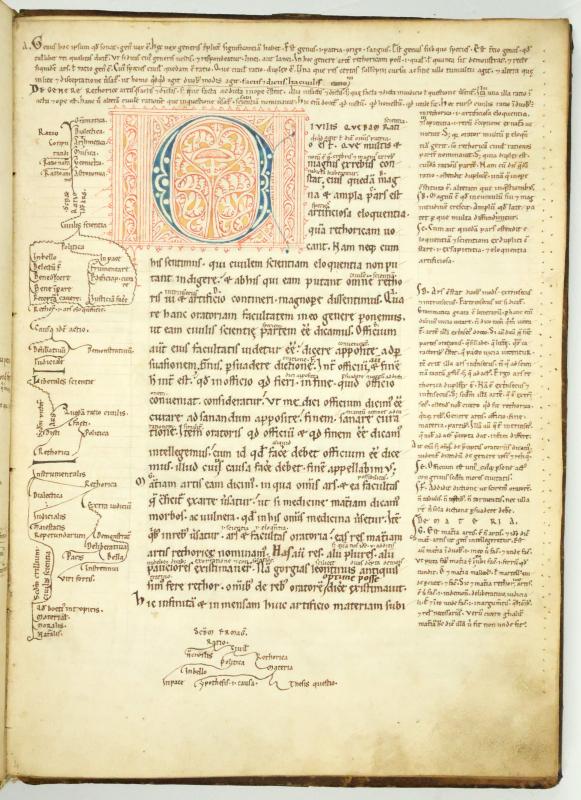
Cicero, Marcus Tullius.
De inventione. Probably Rein Abbey, Styria, c. 1100. Folio (240 x 330 mm). 58 ff., complete. Latin manuscript on vellum, early protogothic script in three hands, ruled in lead-point with double prickings. 14th/15th-century blind-tooled leather over wooden boards, brass corner-pieces, edge guards, catches and remnants of clasps; later paper title-label to spine. Stored in a custom protective case. With rich illustrations, diagrams and glosses, this stunning manuscript of Cicero's earliest work on rhetoric is also of remarkable dimensions: only one other pre-1200 manuscript of comparable size is known, in the Bodleian Library in Oxford. The marginal additions are no less notable, containing hitherto unattested, longer versions of the so-called "Carmina Runensia", some of the oldest poetry known from Austria. This volume thus represents a once-in-a-lifetime find, providing us with an unparalleled testimony to the medieval study of classical rhetoric as well as poetic production. Immediately striking are the finely executed interlinear glosses, providing simpler alternatives to Cicero's elevated vocabulary, showing the attention that went into crafting this volume as an aid to teaching and learning. This is further illustrated by the marginal commentary providing background and elaboration, and the multiple diagrams (four full-page, one two-page) illustrating the flow of an argument with great detail and clarity. They are notably more comprehensive than similar examples in other manuscripts of the text, and were carefully planned as part of the volume, being executed in the hand of the first of the two main scribes. Unique to this manuscript are two extremely rare poems in Leonine hexameters preserved in the margins, written in a later, third hand: in one, the twelfth-century poet Meginardus praises Cicero while damning other classical authors; the second, possibly also by Meginardus, is a paean to the glories of spring. These poems are otherwise only known from a single codex, held by the Abbey of Rein in Styria. Known as the "Carmina Runensia", they are among the earliest examples of poetic art from Austria. Notably, the versions in this codex contain some 800 extra, hitherto unedited lines, providing a vital new witness to these texts. Together with palaeographical and codicological considerations, this suggests that our codex was also produced at Rein, or at least in Austria or Southern Germany. This conclusion is strengthened by the use of the commentaries both of Victorinus and Grillius, which were known in the region, being attested in the library of Tegernsee Abbey, among others. The manuscript was later in the possession of the "Domus Dei" in Trento, a community of flagellants established c. 1340. Their ownership-mark with a scourge appears throughout the text in the margins and on the front leaf. The attractive leather binding, still with its metal fixings and the remnants of clasps, was produced in the later fourteenth or early fifteenth century. Written while Cicero was still a young man, 'De inventione' is one of the oldest tracts on rhetoric to survive in Latin. Although in his old age he considered the text eclipsed by his more mature works on the subject, it remained an incredibly popular piece, both in antiquity and the Middle Ages. Beyond its explicit subject, namely the invention of rhetorical texts, Cicero also explores philosophical themes, including the foundations of a just society on notions of duty, gratitude and loyalty to the truth. In 'De inventione', we thus see the germination of Cicero's idea that philosophy and oratory could never truly be separated. A great rarity: most manuscripts of 'De inventione' are small, normally in octavo format, the only comparable pre-1200 example being in the Bodleian Library. Rare Book Hub records only three sales of manuscripts of 'De inventione' over the past 100 years, the only one of similarly early date appearing in 2001. A remarkable and unique witness to one of Cicero's earliest and most defining texts.
Sachgebiete: Antike, Handschriften, Klassizismus, Philosophie
580000,- EUR
inkl. 7% USt./incl. 7% VAT
Auf Merkliste setzen 
Gudea, King of Lagash (c. 2144-2124 BCE).
Dedication cone of Gudea for the Temple of Ningirsu at Lagash. Girsu, Lagash, Mesopotamia, c. 2124 BCE. Clay cone (67 x 161 mm). Inscription in Sumerian cuneiform. Housed in a custom velvet-lined full morocco clamshell slipcase. Foundation 'nail' issued by the great king of Lagash, Gudea, whose famous seated statues have made him one of the most recognisable Mesopotamian kings. The occasion was the foundation of the splendid E-Ninnu or Temple of Ningirsu, the festivities for which are described in a semi-mythical manner in our longest surviving Sumerian texts, the so-called "Gudea cylinders". The Sumerian text is written in large, clear and easily distinguishable cuneiform characters on a nail-shaped cone, with the inscription: "[To the God] Ningirsu, the mighty Warrior, Lord of the exalted Temple, Gudea, en-si of Lagash, its foundation he built; the Temple of E-Ninnu to Ningirsu he dedicated, and built; its foundation he established". This and several similar nails would have been buried under the foundations of the building as part of the consecration of the structure. The E-Ninnu ("House of 50") was the great temple that dominated the city of Girsu, in the territory of the state of Lagash. Although first built in the reign of Ur-Nanshe (c. 2520 BCE), the refoundation under Gudea (c. 2144-24 BCE) rendered the complex into its most definitive and impressive state. Lagash was one of the larger Mesopotamian city-states that resurged after the fall of the Akkadian empire, in a reassertion of Sumerian linguistic and cultural identity. During his reign, Gudea ushered in a golden age in Lagash, with his inscriptions testifying to the building of irrigation channels and temples, and the subjugation of Elam and Anshun. In spite of this, he never took the traditional royal title of "lu-gal" (literally, "Great Man") and did not claim divine status during his lifetime, opting instead for the name of "en-si" ("town-ruler"). Several notable finds have been excavated from Girsu since the nineteenth century, many of them associated with Gudea, such as his distinctive square-like seated statues in diorite, and the Gudea cylinders, describing the elaborate rituals involved in his foundation of the E-Ninnu in semi-mythological tones. Many of the foundation nails from the Temple are in the collections of notable museums worldwide. The fine condition of the text and the nail overall make this cone a striking occurrence on the private market, on which it has been documented since 1930 when it appeared in the catalogue of Maggs Bros. A strikingly well preserved artefact of one of ancient Mesopotamia's greatest structures.
Sachgebiete: Antike, Antiquitäten, Geschichte
25000,- EUR
inkl. 7% USt./incl. 7% VAT
Auf Merkliste setzen 
Biblia Georgiana.
Georgian Gospel Lectionary. Greece or Southern Caucasus, c. 1200. 4to (170 x 192 mm). 226 ff., missing some leaves, including at beginning and end. Georgian manuscript on vellum. Armenian quire-signatures. Written in Khutsuri script, black ink with red initials and rubrics in two columns. Full leather binding of c. 1600 over wooden boards, alla greca style, tooled in blind with a large cross pattern within a decorative border on the front cover. Fore-edge semi-flap, remains of ties. Stored in a custom-fitted black half morocco case with gilt spine title by P. Goy & C. Vilaine. Rescued and restored around 1600 CE as an act of devotion, this Gospel book represents an extremely rare occurrence, namely the appearance of a hitherto unknown medieval Georgian codex. Offering extensive readings from the revised "Athonite" text of the New Testament produced by medieval scholars, this volume is an extremely important witness to one of the most understudied Biblical traditions. "I, Dilana, bought this holy Gospel from some infidels" can be found in an early modern Nuskhuri hand on f. 53v. The price is stated as having been 10 pluri (florins) for the Gospel and a basin. Dilana then had the book rebound, probably in the surviving Greek-style (alla Greca) binding. At some point, quire signatures were written in Armenian numerals. The term "infidels" may point to Muslims, or perhaps also from Roman Catholics: the stated price in "pluri" ("florins") points to an area where western, in particular Italian currency was in circulation. Such coins would have been known in Greece, home to the Georgian monastery Iviron ("of the Iberians", i.e. Georgians) on Mount Athos. It was there that a group of scholars, beginning with Euthymius the Athonite (d. 1024), began correcting the old Georgian Gospel translations against the Greek originals, to provide their countrymen with a more accurate understanding of the Word of God. Although Georgia was one of the first countries to adopt Christianity as an official religion (in 319 CE), the earliest Georgian versions of the Gospels seem to have been translated from Armenian rather than Greek. This volume thus captures the Georgian Gospel tradition at a crucial crossroads. Dr Adam Bremer-McCollum has established the text of our manuscript as that of the Athonite revision and dated it to the thirteenth century, while Dr Timothy Bolton has argued for a slightly earlier dating of the eleventh to thirteenth century on the basis of its palaeographical features. The Khutsuri script used by the scribe arose from the tenth century onwards as a mixture of Asomtavruli, the oldest Georgian alphabet and primarily used for inscriptions, and Nuskhuri, a minuscule which allowed for more fluid writing. Khutsuri was primarily used by clerics and combines the two as capital and lowercase letters. Although today it is exclusively found in liturgical contexts, it was in wider use until the nineteenth century. The Schoenberg Database of Manuscripts lists only two early Georgian manuscripts in institutional collections, at Princeton and Harvard. No Georgian manuscript of even remotely comparable importance is known in private hands; even the Schøyen Collection contained only a handful of single-leaf fragments, two of which are currently offered by us. A unique witness to Biblical tradition in one of the world's oldest Christian cultures.
350000,- EUR
inkl. 7% USt./incl. 7% VAT
Auf Merkliste setzen 
Wagner, Hanns.
Kurtze doch gegründte beschreibung des Durchleuchtigen Fürsten Wilhalmen, Pfaltzgraven bey Rhein. München, Adam Berg, 1568. Folio (300 x 410 mm). 67 ff. With 15 folding etched plates; woodcut initials and ornamental tailpieces. Title with large woodcut arms of Bavaria and Lorraine in contemporary colour. 19th-century half vellum and marbled paper over boards, green leather label lettered in gilt on upper cover, manuscript title to spine. First edition of this monumental Bavarian festival book, considered one of the rarest, most significant and most lavish produced in sixteenth-century Europe. Wagner’s official narrative records the Munich wedding festivities of Wilhelm V, Duke of Bavaria, and Renata of Lorraine, and preserves them as a statement of Wittelsbach dynastic theatre. This is one of the special copies where each fête plate is strikingly bordered in black and fully coloured by a contemporary 16th-century hand, a level of finish not present in the ordinary issue. - The volume opens with the armorial title and proceeds to the great etched sequence after Nikolaus Solis, whose vast fold-outs choreograph processions, ceremonies, banquets, dances, masquerade, and the tournament programme in the city square. Solis’s plates are among the defining graphic documents of German court spectacle, rendered with a precision that makes them primary evidence for costume, ephemeral architecture, and interior decoration in the later Renaissance. - Festival books of this kind functioned as portable monuments: commissioned to fix a fleeting event, they circulated as curated images of princely magnificence and political order. Produced with remarkable speed after the celebrations of February/March 1568, Wagner’s account crystallises the rhetoric of chivalric display at the moment when court festival culture was taking on its mature, pan-European form. - The present copy is complete with 15 plates, including the extraordinary long folding plate (ca. 151.5 cm), and retains fine contemporary colouring throughout, enhancing the black-bordered framing that intensifies the theatrical effect of the scenes. A tall, wide-margined copy, preserving the full visual impact of the fold-outs and the intended contrast between dense Fraktur text and the expansive pictorial sequence.
Sachgebiete: Alte Drucke 16. Jahrhundert , Festlichkeiten, Geschichte, Illustrierte Bücher
55000,- EUR
inkl. 7% USt./incl. 7% VAT
Auf Merkliste setzen 
Daihannya-kyo (Mahaprajnaparamita sutra). Books 1 and 100.
Japan, Nara, monastery of Kofuku-ji, 1227. 2 woodblock-printed scrolls (26.3 x 892 cm; 26.3 x 864 cm), the first made up of 14 joined leaves, the second of 9 joined leaves. Chinese text. Stored in a fitted wooden case. Rare survival from the completed 1227 Kofuku-ji printing of the Daihannya-kyo, the monumental Mahaprajnaparamita sutra, here preserving Books 1 and 100 in their original handscroll format, with the distinction of documented temple provenance. Printed at the Nara monastery of Kofuku-ji, the set belongs to the great medieval Japanese campaigns of Buddhist textual production, in which the physical multiplication of scripture served not only study and recitation but also the ritual projection of merit and protection. The text had entered East Asia through the translation made by Xuan Zhuang in 663, and the present scrolls stand within that long afterlife of transmission, showing how the vast scripture continued to be stabilized, circulated, and used in Kamakura-period Japan. Their preservation as two substantial fascicles, each still measuring more than eight metres in length, gives the object an immediately persuasive material authority; the wooden storage box further retains the character of the ensemble as a temple book-object rather than a detached textual fragment. Produced in the same year that the Karoku-ban campaign reached completion, these scrolls constitute a concise witness to one of the defining centres of Buddhist printing in medieval Nara and to the enduring prestige of the Daihannya-kyo in Japanese religious culture.
Sachgebiete: Buddhismus, Japan, Philosophie, Theologie
65000,- EUR
inkl. 7% USt./incl. 7% VAT
Auf Merkliste setzen 
Pseudo-Athanasius of Alexandria.
Quaestiones ad Antiochum ducem 94-97, in Georgian. Georgia, c. 1000 CE. Bifolium (185 x 226 mm). 2 ff. Georgian manuscript on vellum, blind-ruled for a single column of 22 lines in brown ink in Asomtavruli bookhand, ruled space 140 x 180 mm. Bound in grey buckram at the Quaritch bindery. Important witness to late antique Christian tradition in the earliest Georgian alphabet. Structured around questions and answers, the "Quaestiones ad Antiochum ducem" ("Questions to Duke Antiochus") address a series of what might be called Frequently Asked Questions about Christian doctrine and behaviour. As the textual transmission is still poorly understood, this fragment of the Georgian version represents a vital testimony to the tradition. Why can Christian men not have multiple wives, as in the Old Testament? Why are dreams sometimes true and sometimes false? Is it true that even virtuous Jews and Pagans will not see the Kingdom of Heaven if they never embrace Christianity? These and other such questions clearly crossed believers' minds, and the resulting compendium of answers proved to be so useful for clergy that it was translated from the original Greek into Latin, Old Church Slavonic, Ge'ez, Arabic, Armenian and Georgian. A later Nuskhuri hand has added numbers to the questions in the margins, indicating that we have the end of question 94 through question 97. These appear to correspond to numbers 98-102 in the Greek (as 99 and 100 in the Greek are very short and related, they seem to be rendered together as 95 in the Georgian). The text is written in Asomtavruli, the oldest Georgian alphabet, in use since at least the fourth century CE. Following the rise of the more fluid Nuskhuri minuscule in the ninth century, the use of Asomtavruli became confined to inscriptions, although manuscripts written entirely in it can be found through the eleventh century. Palaeographical similarities between our bifolium and a fragment of the Georgian text in the Leipzig University Library from the tenth or eleventh century suggests that ours is of similar date. As the text was accorded a high degree of authority, the "Quaestiones ad Antiochum ducem" were commonly attributed to St Athanasius of Alexandria (c. 296-373 CE), but it appears to have been the work of a cleric in Palestine. The presence of questions about the worship of icons points to the eighth century CE as the most likely time of composition, in the wake of the iconoclast controversy. A rare and elegant witness to Christian instruction in Georgia's oldest alphabet.
Sachgebiete: Literatur bis ca. 1900, Religion, Religionsgeschichte, Theologie
65000,- EUR
inkl. 7% USt./incl. 7% VAT
Auf Merkliste setzen 
Train, Joseph Karl von.
Chochemer Loschen. Wörterbuch der Gauner- und Diebs- vulgo Jenischen Sprache. Regensburg, Friedrich Pustet, 1832. 8vo (110 x 180 mm). Title page, XII (instead of XIV), 294, (2) pp. With 2 lithographed plates (one printed on both sides) showing ciphers. Contemporary brown marbled wrappers. - (Includes:) "Jenische Sprache". German and Yenish manuscript on bluish paper. 4 ff. of linguistic specimens and translations on 2 bifolia and a single sheet. Folio (215 x 335 mm). The extremely rare first edition, printed for the Royal Bavarian Gendarmerie, of Train's pioneering handbook and dictionary of criminal cant, here preserved together with a contemporary Yenish manuscript supplement. This copy matters particularly for the survival of the accompanying manuscript, which transforms the printed manual into a working witness of actual use within the linguistic milieu it sought to police. This "continuously valued book of 'scoundrel literature'" (Hayn/G.) was compiled from criminal and court records as well as direct encounters with speakers of the jargon, and was expressly designed for practical investigative use. A German-Yenish and Yenish-German dictionary occupies most of the volume; it is followed by an introduction to secret writing systems, illustrated on plates, and by a scene from "criminal life" in Yenish with German translation. - This first issue was acquired en bloc by the Bavarian police force, which is why it almost never is seen in the trade, and only two institutional copies appear to survive (at the Bayerische Staatsbibliothek and the New York Public Library). A second edition for public sale appeared in the same year, and a third, with Meissen imprint, in 1833. Yenisch belongs to the group of Central European cant languages associated with travelling communities in southwest Germany, Switzerland, and Austria, drawing on German, Yiddish, Romani, and criminal slang. In the early 19th century such vocabularies were not merely descriptive curiosities but instruments of surveillance and prosecution. The accompanying manuscript, written in a not always easily legible individual hand, appears to have been compiled by a police officer as a privately researched addendum to the printed manual. It contains a list of German words and phrases with Yenish translations and a draft German-Yenish letter to a "Lieber Freund", ending with the striking formula: "Wir wollen in Zukunft immer Chochemer Loschen waldibern". As an adjunct to the printed book, this manuscript considerably sharpens the copy's documentary interest.
Sachgebiete: Handschriften, Kulturgeschichte, Sittengeschichte, Sprachwissenschaft
6500,- EUR
inkl. 7% USt./incl. 7% VAT
Auf Merkliste setzen 
Old Believers.
The Passion Narrative, The Life of St Basil the New, The Visions of St Gregory and St Theodora, The Legend of Joseph, The Creation and Fate of the Soul, A Son rescuing his mother from Purgatory. Russia, 18th century. 4to (184 x 236 mm). Russian Church Slavonic manuscript on paper. 366 ff., ca. 20 lines of Cyrillic half-uncial in three hands. Watermarks: arms of Amsterdam and Pro Patria. Rubricated titles and initials, decorated headpieces, initials, and borders; 143 full-page colour-wash miniatures within decorated borders. Contemporary Russian red velvet over bevelled wooden boards, 2 brass clasps with velvet-covered leather straps, brass furniture on rear cover, all edges gilt and goffered. A splendidly illustrated Old Believer miscellany devoted to the Passion, exemplary sanctity, and the fate of the soul. This copy stands out for the scale and ambition of its pictorial programme, preserving 143 full-page miniatures in a rich contemporary Russian velvet binding. The volume assembles five key didactic and devotional texts from the Old Believer manuscript tradition, blending biblical, hagiographic, apocryphal, and popular material in a form designed to instruct as much as to move. The Passion Narrative recounts the events of Holy Week; the Life of St Basil the New with the visions of St Theodora and St Gregory unfolds the punishments of sinners and the posthumous passage of the soul; the Legend of Joseph follows the patriarch from birth to Egypt and Pharaoh’s dream; the final two texts, conceived as picture books with minimal text, treat Creation, the destiny of the soul, and filial redemption from Purgatory. Particularly striking are the eschatological scenes in the vision of St Theodora, where the soul passes through the aerial toll-houses and confronts demons who record sins on scrolls and attempt to drag it to hell. Elsewhere the manuscript dwells on the Harrowing of Hell, the Crucifixion, Cain and Abel, the decay of the body after death, and the charitable rescue of a mother's soul, shaping coherent moral instruction through image as much as text. Old Believer book culture regarded the manuscript as a synthesis of verbal and visual art, and its communities deliberately sustained archaic textual and pictorial modes in resistance to both ecclesiastical reform and the authority of print. Produced after the schism provoked by the reforms of Patriarch Nikon and the Synod of 1666, manuscripts of this kind linked persecuted communities to an imagined continuity with Ancient Russia while serving as vehicles of devotion, instruction, and confessional identity. The present manuscript is thus both a major survival of Old Believer visual culture and an unusually luxurious witness to its devotional life, preserved with its full cycle of miniatures, ornamental apparatus, and sumptuous contemporary binding.
Sachgebiete: Handschriften, Illustrierte Bücher, Theologie
85000,- EUR
inkl. 7% USt./incl. 7% VAT
Auf Merkliste setzen 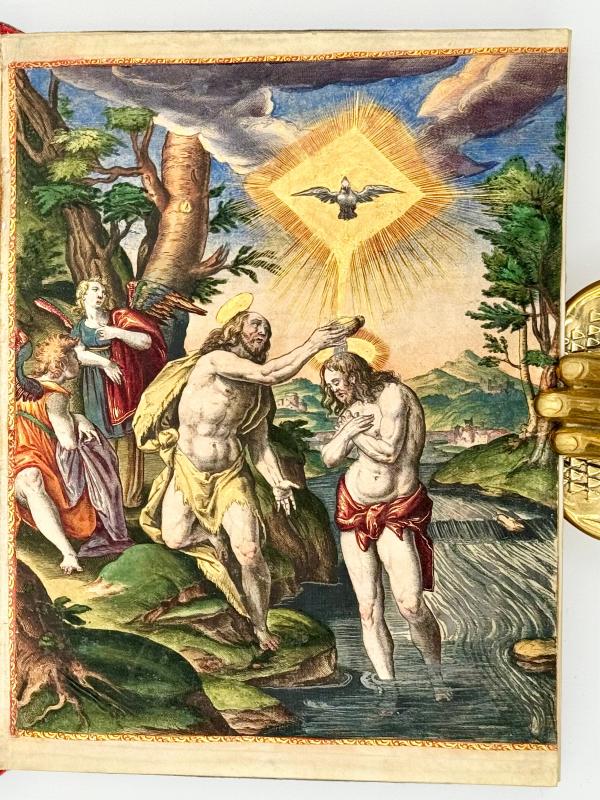
Oertl, Hieronymus.
Der christlich Glaube Mit Gottseligen christlichen und hoch tröstlichen Gebeten wie ein jeder Christ Täglich vor den Augen des Herrn seines Gottes erscheinen mag. Nuremberg, ca. 1600. 4to (ca. 212 x 156 mm). German manuscript on vellum. 37 ff.; 1 separate leaf. With 16 mounted full-page engravings, illuminated in gilt and colours, 12 bearing single-line captions in Latin. Modern purple silk binding with floral ornamentation, over wooden boards, on four raised bands. Vellum endpapers. All edges gilt. Stored in felt-lined black half-morocco case with gilt spine title, signed "J. & S. Brockman". Unique prayer book manuscript on vellum, containing sixteen full-page illuminated engravings after Marten de Vos: a highly expressive devotional work of the waning 16th century. One of only eight known manuscripts by Hieronymus Oertl, it provides a "unique example of the art of book arts around 1600" (Baeyer, p. 6), highlighting the transitory period between the Middle Ages and the Baroque, between manuscript and printed book. The twelve engravings illustrate the individual articles of the Creed from Creation to the Resurrection and eternal life. Both content and iconography stand out from Oertl's other efforts: only the "frontispiece" was also used in another of his works (albeit with different illumination). The suite is based on a 13-sheet set of engravings after drawings from de Vos's "Credo", printed in Amsterdam in 1633 as "XII Fidei Apostolicae Symbola". The signature "Ioann Collaert sculp." testifies to the engravers Adrian and Jan Collaert II (while the information "M. de Vos invent." and "Adrian Collaert sculp." or "excud." is trimmed away). The splendid engravings boast gilt highlights and a richly differentiated colour scheme, "ranging from delicate and sensitive translucent washes to pastose coloring" (Baeyer, p. 64). Indeed, Oertl was not only "a fine scribe, but [...] one of the best illuminators of his generation. He was responsible for the selection of the Biblical texts, for writing the prayers, for coloring and gilding the drawings and for illuminating the prints" (ibid., p. 54). On the title-page, Oertl cut out the central medallion, instead inserting his own title inscription to the vellum below. A cartouche proclaims: "All the dead will be resurrected when God's trumpet will sound", and the conclusion reads: "Whosoever departs from this world will be buried in the heavenly fatherland". Written in uniform Gothic script without initials, Oertl structures the prayer text through the size and colour of the letters, the decoration of the headings, and the use of structuring lines composed of pen and ink filigree. A decorative frame in the form of a narrow, gilt red paper border with black rules encloses text and images. The innovative and elaborate combination of old and new makes this illuminated prayer manuscript a precious possession. Three unattributable engravings are included before Oertl's suite of illustrations: a genre scene (Elisabeth and St John as a child visit the stable in Bethlehem), the baptism of the Christ, and - as a frontispiece - the triumphant boy Jesus. An unfinished vellum sheet with the mounted engraving of a crucifix by H. Wierix after de Vos appears to be a later addition; however, Oertl himself used this in two other manuscripts.
Sachgebiete: Handschriften, Illustrierte Bücher, Theologie
295000,- EUR
inkl. 7% USt./incl. 7% VAT
Auf Merkliste setzen 
Michelangelo.
Album with 70 ink and wash studies after the "Last Judgment", preserving Michelangelo's original fresco designs. Rome, ca. 1560. Small folio (210 x 270 mm). Album of 70 mostly double-sided drawings, rendered in ink, with watercolour in bistre, sepia, lapis lazuli, and sanguine. 37 ff. (misnumbered "40", in ink in the upper right corner). Collation: a14, b10, c12, d1 (singleton); ff. 15v, 23v, 24r, 25v blank. The watermark indicates the paper was produced in Rome around 1560. Early 18th century brown morocco, covers within gilt floral frame. Smooth spine, richly gilt-tooled, title lettered in gilt, rather faded. Marbled pastedowns and flyleaves. Stored in a custom-made purple full morocco box. Album of seventy studies after the "Last Judgment", preserving Michelangelo's original fresco designs and thus almost certainly made during his lifetime, as the frescoes were bowdlerized on the orders of the Council of Trent shortly after his death in 1564. From the famous library of the Italian art historian and collector Leopoldo Cicognara (1767-1834). The figures from "The Last Judgment" are rendered with such precision as to suggest the artist's intimate familiarity of the original work: obviously, he either saw the work in person, having joined Michelangelo on the scaffolding, or he must have had access to the original, now-lost cartoni of the frescoes. Most importantly, the drawings show the figures in their original state as painted by Michelangelo. After his death in 1564, the male genitalia in the frescoes, regarded as objectionable, were covered with drapery by the artist Daniele da Volterra, thenceforth known as "Il Braghettone" ("the breeches-maker"). The frescoes were only partly restored to their original stage in the 1980s. This album therefore stands as an important and early first-hand iconographical documentation of Michelangelo's masterpiece. The proximity to the work in its original state, as well as the expensive colours and materials employed (including ultramarine, by far the most costly and treasured colour, made from the precious powder of crushed lapis lazuli), suggest that this very elegant album was at least not made by a student. It is also possible that the album is the product of different hands from the same pictorial school, since some of the drawings, particularly that on fol. 16, appear to have been executed by a more mature hand with a stronger and steadier stroke, while remaining stylistically consistent with the rest of the drawings. It also appears that the artist was so concerned with the Hellenic perfection of Michelangelo’s nude bodies that the drawings are unnaturally cropped in order to exclude every other element of the pictorial background: it therefore stands to reason that the album was realized by someone who had in mind the importance of nudity in Michelangelo's work and, perhaps, the sin of overpainting his astonishing masterpiece. Michelangelo's "The Last Judgment" ("Il Giudizio Universale"), executed on the altar wall of the Vatican's Sistine Chapel, is widely regarded as one of the most important artworks of all time. It depicts the Second Coming of Christ and God's final and eternal judgment of all humanity, with humans rising and descending to their fates as judged by Christ, who is presented surrounded by prominent saints. Completed in four years, between 1536 and 1541, it ended up being censored by the Catholic church: the album of drawings presented here captures a substantial part of the fresco in its original state, marking a critical moment in its history as well as that of art in general. Michelangelo’s fresco - an exquisite example of his keen attention to musculature and the naked body - was the subject of intense debate between those who appreciated the artist's aesthetic genius and Mannerist style, and, on the other hand, critics from the Catholic Counter-Reformation who accused the work of being insensitive to proper decorum, and of flaunting personal style over appropriate depictions of content. After the Pope's Master of Ceremonies, Biagio da Cesena, stated that "it was most disgraceful that in so sacred a place there should have been depicted all those nude figures, exposing themselves so shamefully", and that it was no work for a papal chapel but rather "for the public baths and taverns", Michelangelo retaliated by painting Cesena's likeness onto the face of Minos (judge of the underworld, whose inclusion here, along with that of Charon, was inspired by Dante's Inferno), with donkey ears suggesting foolishness and a coiled snake biting his membrum. It is said that when Cesena complained to the Pope, the pontiff joked that his jurisdiction did not extend to hell, so the portrait would have to remain. The debate grew steadily, and a few years after the fresco was completed, the decrees of the Council of Trent urged a tightening-up of church control over "unusual" sacred images; thus, after Michelangelo’s death in 1564, the genitalia in the fresco, regarded as "objectionable", were covered with drapery by the Mannerist artist Daniele da Volterra. Volterra was the first in a series of 'braghettoni' painters to cover the original frescoes with multi-coloured veils and other deceptions to keep Michelangelo's work from being seen in its original incarnation. He is also responsible for chiselling away part of the fresco and repainting the larger part of St Catherine and the entire figure of Saint Blaise behind her. This was done because in the original version the latter appeared to be looking at the former's naked buttocks, and to some observers the position of their bodies even suggested intercourse. St Catherine, who had been nude, was redressed in a green and yellow smock; St Blaise, who was bowed down, was repainted in an upright position with his head turned in a direction opposite to that which had been painted by Michelangelo, thus ruining the geometry of the scene and distorting the meaning of the work. The fresco was restored along with the Sistine vault between 1980 and 1994 under the supervision of Vatican Museum's curator Fabrizio Mancinelli. Over the course of the restoration about half the censorship from the "Fig-Leaf Campaign" was undone, and numerous other buried details, trapped under years of smoke and grime, were revealed; indeed, it was only after this restoration that the coiled snake biting Biagio de Cesena's genitalia was revealed once more. Remarkably, all these details - lost or altered after the 'Braghettoni' covered the fresco - and, perhaps most importantly, the destroyed portion of St Catherine and St Blaise, are reproduced in this elegant collection of drawings - a rare and extraordinary curiosity, and a contemporary art historical source worthy of further study. As a note on the front flyleaf attests, the album later belonged to the outstanding Italian art historian and collector Leopoldo Cicognara, well known for his celebrated art bibliography. Throughout his collecting and writing, Cicognara amassed a fabulous art library, the inventory of which - published in 1821 - may today be his most consulted text. He was highly esteemed by his contemporaries such as Goethe, Quatremère de Quincy, Giordani and Monti, David and Canova.
450000,- EUR
inkl. 7% USt./incl. 7% VAT
Auf Merkliste setzen 
Mansur ibn Ilyas.
Tashrih-i Mansuri (Mansur's Anatomy). Folio (216 x 300 mm). Main text is 31 ff. of a total of 89 ff. Persian manuscript on paper. Black nasta'liq script, with important words and phrases picked out in red. With 6 large hand-painted medical diagrams. Contemporary black morocco decorated in gilt, with later spine. The famous and fabulously illustrated book of anatomy by Mansur ibn Ilyas, featuring six large medical diagrams of humans. Each diagram shows a different aspect of the human anatomy, such as the digestive tract, the female reproductive system, the ocular nerves and spinal column, and the skeleton; important aspects of these anatomies (in one case the ribs, in another the intestines) are picked out in gold, and nerves and blood vessels are traced in green and orange. Mansur was a physician from Shiraz at the height of the Timurid Empire, and dedicated this medical work to the grandson of Tamerlane. In Mansur's time, medical diagrams were all but unheard of, especially in Muslim manuscripts. Debate continues among scholars over whether he was truly the first Muslim physician to create an illustrated anatomy, but the impact and novelty of his effort was indisputable, especially his relatively accurate depiction of pregnancy. The diagrams in a manuscript of "Tashrih-i Mansuri" are considered as integral to the work as the text itself, and were thus preserved in the manuscript tradition for hundreds of years. Collected alongside Mansur's magnum opus is a fascinating collection of shorter medical works, including "Dar Mazar Tarakib-i Afyun" ("On the harms of opioid compounds"), Mawlana Yusufi's "Tibb-i Yusufi" (here under the variant title "Jami' al-fava'id"), "Risalah Dar Marifat-i Hamiyat" ("A treatise on fevers") by an anonymous author, and a dictionary of medical terms.
Sachgebiete: Handschriften, Islam, Medizin
45000,- EUR
inkl. 7% USt./incl. 7% VAT
Auf Merkliste setzen 
Horváth, Ödön von.
Zur schönen Aussicht. Komödie in drei Akten. Berlin, Vervielfältigungsbüro Koegler für die Volksbühnen-Verlags- und Vertriebs-GmbH, 1927. 4to (150 x 200 mm). (4), 81, (1) pp. Original yellow wrappers with black cloth spine. Family presentation copy of an unpublished early play. Horváth's "Zur schönen Aussicht", issued in 1927 for stage circulation only, is inscribed on the title-page, "Für Gustl und Luci / von Ihrem Ödön / Berlin, Oktober 1927”. The recipient pair were Auguste ("Gustl") Emhardt, a friend of the author's since the days of his youth and (since 1925) the wife of Horváth's younger brother Lajos, and Lajos himself, known as "Luci". Marked on the title-page “Den Bühnen gegenüber als Manuskript vervielfältigt”, the edition was not released through the book trade but issued for theatrical use only; the text proper is presented as a typescript reproduction. This semi-private form makes it materially distinct from the later reading editions in which the text was never independently published. After his first work "Das Buch der Tänze" (1922), the present play text predates the author's second published work ("Der ewige Spießer", 1930) by three years. Indeed, although Horváth completed the comedy in 1926, it was not premiered until 1969 (at the Schauspielhaus Graz). Both the eponymous boarding house and several of the characters are said to have been inspired by real models in Murnau, where Horváth lived for a time with his parents. The play thus already shows the transformation of observed provincial milieus into the brittle social theatre that would become one of Horváth's defining achievements.
Sachgebiete: Literatur ab ca. 1900, Theater, Widmungsexemplare
6500,- EUR
inkl. 7% USt./incl. 7% VAT
Auf Merkliste setzen 
Trčka, Anton Josef.
Portrait Gustav Klimts. Wien, 1914. 118:88 mm. Bislang unbekannter Originalabzug aus der ikonischen Reihe von Portraits, die Anton Josef Trcka 1914 von Gustav Klimt im blauen Malerkittel schuf. Der Kontakt zwischen den beiden dürfte über Josef Maria Eder zustandegekommen sein, den Leiter der k. k. Lehr- und Versuchsanstalt für Photographie und Reproduktionsverfahren, an der Trcka von 1911 bis 1915 studierte. - Verso ist sehr schwach lesbar in rotem Farbstift von nicht identifizierter Hand notiert: "Arch. Prof. Hoffmann", gefolgt von einer vierstelligen Nummer ("1129"?) und einer Formatangabe "8¼ x 11¼".
Sachgebiete: Autographen, Malerei, Österreich, Photographie
12500,- EUR
inkl. 7% USt./incl. 7% VAT