 Auf Merkliste setzen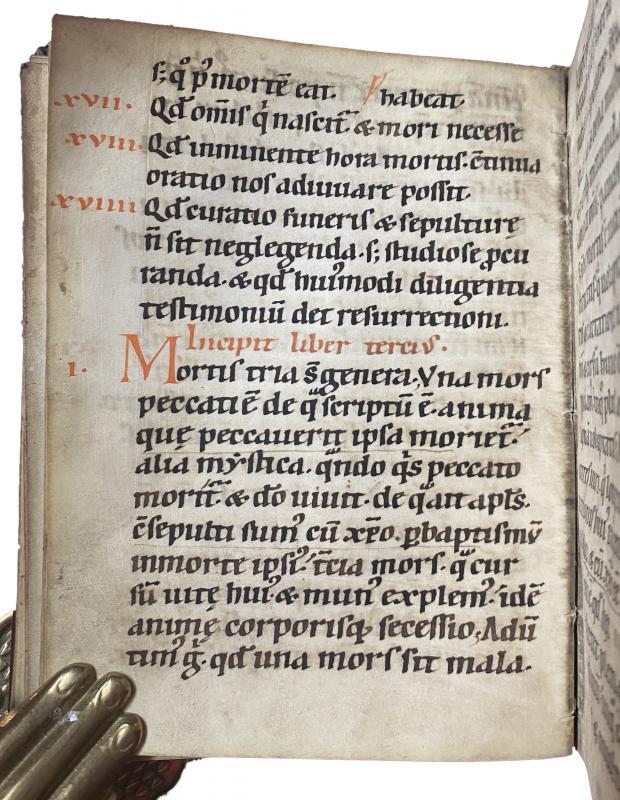
Admonitiones ad consolationem infirmorum, with Ordo commendationis animae and Flores Augustini.
Germany, probably Hildesheim, Lower Saxony, , (i) late eleventh century, (ii) fifteenth and (iii) thirteenth century. Small 4to. 160x120mm. (i) 93 + 1 ll. complete. (ii) 4ll. (iii) 48ll., complete, likely late eleventh century, (plus fifteenth-century paper endleaves at front and back), original Romanesque book, collation: (i) i-xi8, xii6 (last 2 leaves blank cancels), (ii) xiii4 (probably very early fifteenth century; last 2 leaves cut away), (iii) xiv-xvii8, xviii6, xix10, (thirteenth century). Original Romanesque leaves (c.1080) single column, 19 lines per page in a square and squat German Romanesque hand, rubrics and large initials in orange-red, capitals touched in same colour. Second work fourteenth/fifteenth century in single column of 25/26 lines per page with pale red rubrics and capitals, last text thirteenth century, single column of 29 lines with rubrics in bright red and capitals in same, underlining in red through middle of crucial words in keeping with medieval practice. Fourteenth- or perhaps early fifteenth-century binding fragments from a liturgical manual citing Ecclesiastes visible where book block meets the back board, trimmed at edges (more noticeably with the original Romanesque leaves) but text unharmed. A few spots and light stains, generally very good, in mid fifteenth-century tooled leather over heavy wooden boards (tooled with floral compartments enclosing sprigs of thistle-like foliage on front board and eagles and flower heads on back), sewn on three large double-thongs, single working clasp with brass fittings at horizontal edge, some chips and bumps, but a remarkable manuscript sammelband, in box. In folding cloth box. Provenance, and the stages of construction of this volume: The main part of this codex was written and decorated in Germany before 1100, most probably in a monastery for the use of the monks. This section (here fols. 1-94) was once a discrete codex of its own containing a single text (see below), and has early foliation added perhaps in the fourteenth or fifteenth century, that does not continue into the remainder of the volume. In the later Middle Ages, most probably the fifteenth century, that Romanesque codex had two smaller codices combined with it and the three were bound together in the present fifteenth-century binding. At the same time, notes on medical recipes were added to previously blank space at the end of the first work and to the pastedowns, while a series of readings from Church Patriarchs was added to an endleaf at the front of the book. This sammelband received two ms ex libris inscriptions at the foot of its first original endleaf in the late sixteenth or early seventeenth century. The first begins with the name “Johanni” (announcing the book was then in use or owned by someone named Johannes), but irritatingly, the second of these inscriptions is scrawled, highly abbreviated and was written on top of the first, mostly obscuring the earlier one and making it very hard to decipher. The later inscription appears to read “Fr[at]r[u]m Min[orum] Carthu’ Frannci” (with the first two words uncertain). The first three words here probably identify the house that owned the book as the Franciscans of Hildesheim (Carthusia = Hildesheim), and the last an attempt to abbreviate ‘Francisci’ (‘of St. Francis’). The Franciscan convent of Hildesheim was established in 1234 as part of the earliest push of the movement into Saxony and its neighbouring regions, and so the earliest parts of the present book may have been among the books donated to the community on their foundation. The church of the community was built around 1250, and converted to a parish church on the suppression of the monasteries in the town during the Reformation. S. Krämer lists only fifteen manuscripts from the house surviving in the archives and town library of Hildesheim, all of the fourteenth century or later (.Handschriftenerbe des Deutschen Mittelalters, 1989, I, p. 356), and about the same number have passed through the trade, by Ludwig Rosenthal cat. 120 (1909), no. 68, Georges Andrieux in 1930 from the collection of the Baron de Gruneisen, Quaritch, cat. 699 (1952), no. 133, and the same again in cat. 742 (1955), no. 23, and cat. 775 (1958), no. 800; and most recently Jörn Günther, list 5 (1997), no. 3 and Sotheby’s, 17 June 2006 (Ritman III), lot 28. Other codices are in the Herzog August Bibliothek (two codices), the Royal Observatory in Edinburgh, Ampleforth Abbey, Stonyhurst College, the Houghton Library in Harvard and Saint Vincent Archabbey in Pennsylvania. Of these listed here, only those in the Herzog August library date before the fourteenth century, with only one of those (from the mid-twelfth century) having any claim to be Romanesque. Johan Jacob Silberman 1683, with his ex libris on front endleaf. Apparently in Italian hands in eighteenth century, with short inscriptions of this date, added to the borders of fols. 74r and 94r. Re-emerging recently in France, and granted a permanent export license by that country. Text: The original Romanesque codex comprises a single text that the main copyist and the scribe of the brief contents list in the upper outer corner of the front pastedown call ‘ad consolationem infirmorum 4 libri’ and ‘Admonitiones ad consolationem infirmorum’. It comprises a large compilation of quotations from the works of the Church Fathers and other early Christian texts for recitation and consolation to the infirm and sick, opening with a long quotation from Gregory the Great’s Cura Pastoralis , and substantial readings from Alcuin’s homilies, the vita of St. Pachomius, the vita of St. Stephanus monachi by Heraclides Paradisus, Isidore of Seville’s Sententiarum and many from the Vitae Patrum . An earlier, attribution of this compilation to Pope Gregory the Great is erroneous, and is a misinterpretation of the fact that Gregory’s name follows immediately after the incipit of the main text and at the head of the first quotation – but as the author of the latter, not the whole compilation. It has defied identification, and may well be the sole recorded witness to this text. It is not the Liber Scintillarum or any of the other such compilations known to us, and the author’s prologue here, opening “In hoc libello ad consolationem infirmorum ex sententiis & exemplis …” and ending “…preparare studeat ut beato fine de hoc mundo transire mereatur”, is not traceable in either Patrologia Latina or the vast In principio database (now up to one million entries). It is clearly deserving of much further study. That codex received additions in the fourteenth and fifteenth centuries on its originally blank endleaves of complimentary material, including an early witness to the spoken charm against epilepsy: “Caspar fert mirram thus Balthazar Melchior aurem, Hec tria qui secum portabit nomina regum, Solvitur a morbo Christi pietate caduco” on fol. 90v, widely witnessed in manuscript contexts and a finger ring in the Franks bequest in the British Museum (AF.1017). To this was added in the early fifteenth century the short four-leaf liturgical text titled the Ordo commendationis animae (‘Order for the committal of souls’, ie. extreme unction), in the same hand as the last additions to the endleaves of the earlier codex, as well as a previously separate booklet (of 48 leaves) of the thirteenth century containing the Flores Augustini , a popular anthology of thematically arranged quotations from the works of St. Augustine and then St. Bernard of Clairvaux. The whole was then united with the addition of the brief contents list to the front pastedown, and further additions made to blank space in the volume or on its endleaves, usually of a medical-exhortational nature. Script: The script here is typically German in its square and squat aspect, and fits into a group of Germanic bookhands produced at the end of the eleventh and opening of the twelfth century. A close parallel can be found in a Glossed Psalter now in Cologne Cathedral and dating to the 990s (see Glaube und Wissen im Mittelalter , 1998, no. 40: Dom. Hs. 45). L3733
Sachgebiete: Deutschland, Niedersachsen, Handschriften, Mittelalter, Religion
145000,- EUR
Differenzbesteuert/Subject to margin taxation
Auf Merkliste setzen 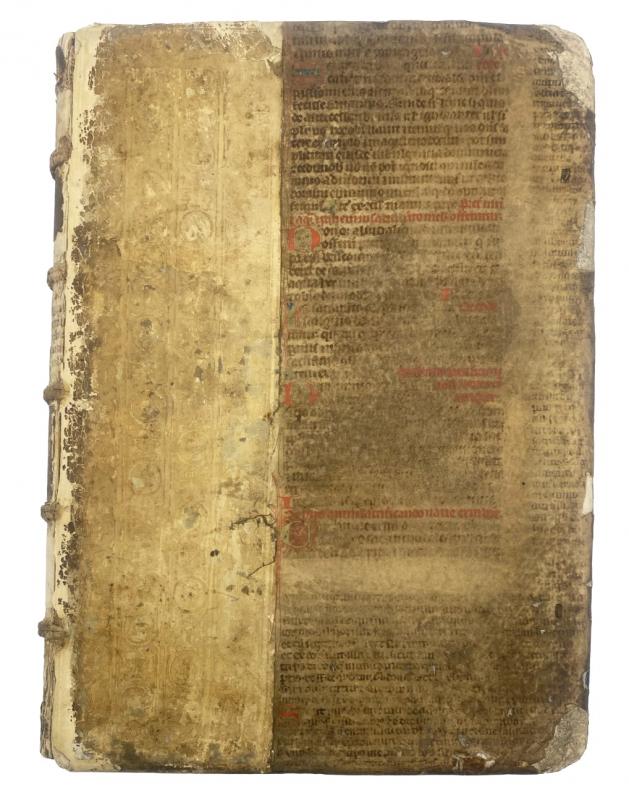
AGRICOLA, Georgius (BAUER, Georg). De re metallica libri XII - De animantibus subterraneis liber
Basel, Hieronymus Froben and Nicolaus Bischoff, 1561. Folio, pp. [xii] 502 [lxxiv]. Roman, Greek and Gothic letter. Woodcut printer's device on title and verso of last, two woodcut plates, one folding, a total of 273 large woodcut illustrations and diagrams in good clean impression, some full-page, white on black initials. Light age yellowing, a few marginal spots and splashes, clean tear without any loss in one leaf, early ms press mark to t-p and later, but not modern, to pastedown. A good, clean wide-margined copy. Formerly in contemporary 1/4 pigskin over paste-boards, the pigskin removed exposing stitching and binder's waste, cover from a ms. on vellum in red and brown ink, decorated initials, early 1400's. In folding box. SECOND EDITION of the "first systematic treatise on mining and metallurgy and one of the first technological books of modern times" (PMM), the earliest and pre-eminent early work on metallurgy and mining. It is remarkably richly illustrated with technical woodcuts of the highest quality, largely by Hans Rudolf Manuel Deutsch (after Blasius Weffring). All of them are based on Agricola's own drawings of processes and phenomena he personally observed. The work "embraces everything connected with the mining industry and metallurgical processes, including administration, prospecting, the duties of officials and companies and the manufacture of glass, sulphur and alum. The magnificent series of two hundred and seventy three large woodcut illustrations add to its value. Some of the most important sections are those on mechanical engineering and the use of water power, hauling pumps, ventilation, blowing of furnaces, transport of ores etc., showing a very elaborate technique" (PMM). It is "one of the great monuments of technology by reason of the comprehensiveness of its text and the detail and intelligibility of its numerous illustrations" (Singer, vol II, p. 27), and became "the early standard treatise" on the subject (Horblit, 2b). It is also one of the important contributions to physical geology, in particular the influence of wind and water erosion on landscape and its clear account of the order of strata exposed by mines. The work concludes with a 20 page glossary of technical terms and names in Latin and German which contains a new scientific classification of minerals based on their physical properties; the mode of occurrence and mutual relation of some 80 minerals and ores are discussed, no less than 21 of them for the first time. Written over two decades, the work illustrates Bauer's familiarity both with the technical and financial aspects of mining as well as his concern for the health of the miners. Bauer had studied medicine in Leipzig before moving to the important mining centre of Joachimstal (in latter-day Czechoslovakia) as the town physician. There, Bauer observed both by day and by night the unceasing activities of the mines, "and his interests were aroused by the metallurgical, mineralogical and chemical problems of the trade. He published several books relating to these, the above is outstanding in the field of all science and technology; it was published posthumously. Many large woodcuts present vivid pictures of men at work, machines pumping, ventilating, smelting, assaying, transportation, and hoisting equipment and methods of his time" (Dibner, Heralds of Science, 88). The work was translated into English in 1912 by Herbert Hoover, afterwards president of the United States. BM STC Ger. p.8; Adams A-350; PMM 79 (1st edn); Brunet I, 113; Horblit, One Hundred Books Famous in Science, 2 (1st); Duveen pp. 4-5; Ferguson I, p.9; Kress I, 71 (1st); Ford, Images of Science, pp. 124-5; Norman 20. L1730
Sachgebiete: Bergbau, Instrumente (Technik), Schweiz, Technik
14500,- EUR
Differenzbesteuert/Subject to margin taxation
Auf Merkliste setzen 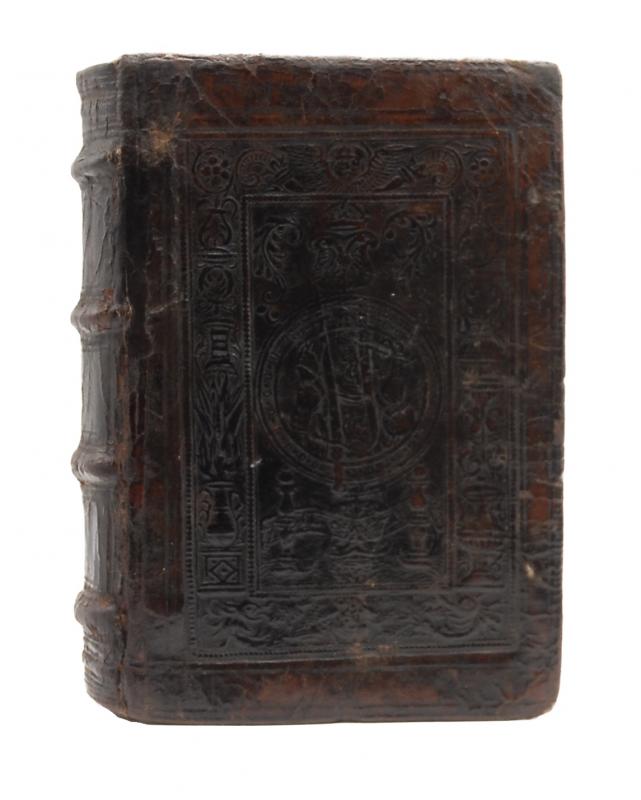
AGRIPPA, Cornelius. De incertitudine et vanitate scientiarum.
[Cologne, Eucharius Cervicornus, 1536]. 8vo. 208 unnumbered ll., A8, a-Bb8. Roman letter, little Gothic. Author s woodcut portrait to t-p, a few decorated white-on-black initials. T-p a little age yellowed, small tear from fore-edge, slight yellowing, light water stain in final gatherings, vellum slip from rubricated C15 Dutch ms. used as spine lining just visible, penultimate gathering slightly loosening at foot, small mark to lower outer blank corner of last two ll. A good, unsophisticated copy in contemporary Netherlandish calf, panel-stamped, double ruled, border of tendrils, urns, cherub at head and two interlacing wyverns at foot, centre panel with imperial arms, circular portrait of Charles V signed KO and columns of Hercules with imperial motto Plus Ultra, raised bands, few cracks to covers, edges a bit rubbed. Bookplate of Maurice Burrus and contemporary ms. inscription (signed F. Hessek?) on underlying sheet (visible with UV) on front pastedown, bibliographical notes c1800 to feps, contemporary ms. monogram (FH) to t-p, occasional contemporary annotations. An attractive, unsophisticated copy, in an unusual, contemporary Netherlandish binding, of this extremely influential philosophical work, praised by the likes of Montaigne and Descartes. Due to the controversial reputation of its author, several early editions have few recorded copies and a complex bibliographical history, i.e., from the first of 1530 (possibly a ghost ) to 1539, with most bearing neither imprint nor (frequently) a date. According to D. Clément's Bibliothèque Curieuse (1750), this edition is very similar to that printed in Cologne. The pages are unnumbered. It has no suppressed passages. There is one difference: the title is decorated with the bust of Cornelius Agrippa, absent in all preceding six editions (I, n.86). This is one of his earliest and most reliable portraits. Agrippa (1486-1535) was a major German polymath, physician, soldier (who travelled extensively in Europe) and official historian to Charles V; he was especially renowned for his occulta and ideas on the cabala (Bodin called him the greatest magician of his age), which led to clashes with the Inquisition, despite his recantation. Agrippa's ambivalence towards occultism, religion and epistemology caused a mixed reception of De incertitudine, a harsh critique of all sciences and arts, and Renaissance epistemology in general - which Agrippa subsequently defended in print. Each of the 102 chapters summarises wittily, only to berate, a discipline or art, from the elements of the trivium and quadrivium to optics, acting, painting, architecture, politics, natural philosophy, commerce, agriculture, surgery, anatomy, prostitution, veterinary medicine, law and cooking. There are fascinating sections on judicial astrology (an art bringing no certainty, which can be turned into anything, according to opinion), physiognomy (which infers nonsense from horoscopes based on physical appearance), magic (including necromancy), heraldry (by which heralds dressed in military uniform astrologise, philosophise and theologise with foolish knowledge), the inquisition (with a violent attack against the Dominicans trials of heretics from his native Cologne), and alchemy (which can be defined as an art, or sham, or persecution of nature). The conclusion is an encomium of the ass, i.e. ignorance, which is preferable to this useless knowledge. Despite the serious attacks of great minds like Bodin and Thevet, De incertitudine is a deeply ironic work, an aspect of Agrippa s work much praised, for instance, by Philip Sidney. Like the works in similar vein of Erasmus, Rabelais and many others, [it] is a literary paradox and at the same time a work of polemic (Bowen, 259), spanning the abuses of the Church and false science. The contemporary annotator of this copy, probably the F. Hassek of the concealed inscription and monogram, highlighted passages against astrology, black magic, references to Agrippa s work on occult philosophy, theories of the soul, pimps, the arts of women and cookery. He was knowledgeable as he identified a mistake, where Agrippa used Kirannides to mean the name of the author, not the title of his book. The unusual, contemporary Netherlandish binding, panel-stamped and signed by the obscure K.O., is not listed in Fogelmark s Flemish and Related Panel-Stamped Bindings or major bookbinding bibliographies. The stylised imperial escutcheon with the double-headed eagle and the columns with Charles V's motto Plus Ultra are reminiscent of BL c46b21. Only three copies recorded in the US. VD16 ZV 271; Cantamessa n.73 (mentioned); Caillet I, 87 (later eds); Durling (earlier eds); Duveen p.6 (earlier eds). Not in Brunet or Ferguson. B.C. Bowen, Cornelius Agrippa s De Vanitate: Polemic or Paradox? , Bib. d Humanisme et Ren. 34 (1972), 249-56. L3053
Sachgebiete: Wissenschaftsgeschichte, Occulta, Philosophie
5000,- EUR
Differenzbesteuert/Subject to margin taxation
Auf Merkliste setzen .JPG)
AGRIPPA, Henrich Cornilius. Militiae Equitis Aurati...[I]n Artem Brevem Raymundi Lullii, Commentaria
Solingen, Joannes Soter, 1538. 8vo. pp [284] a-r8 s6. Roman letter, occasional Italic. Woodcut initials, t.p. with printer's device of cherub within wreath, 8 woodcut diagrams of Lullian circles. Contemp. ex libris Antonius Dachselhof of Berne to Lly. Very minor damp stain and spot to t.p, woodcut circle on b5 just shaved at outer margin. A very good, clean and well-margined copy in contemporary limp vellum with 14 original blank unnumbered ll in front and 31 at end, contemp ink title to upper cover and spine, original kid ties. Second edition of Agrippa's (1486 - 1535) commentary on Raymond Lull's (1232-1316) Ars Magna or Ultimate General Art', a system of logic blending influences from Arabic mysticism, Egyptian hermeticism, and Lull's missions to Jews and Muslims. In his preface Agrippa praises Lull's art 'as easy to learn for students young and old': in fact it is based on a confusing series of paper 'machines' Lull had developed to do his reasoning for him, comprising of circles with symbols representing key topics. When rotated together in any combination they yield only theologically true' statements, such as 'Angels are Wise', and 'God is Eternal'. These so-called 'Lullian Circles' were intended as tools for debating faith with Muslims: ironically they were based from an Arabic astrological tool used to cast horoscopes known as the zairja. Agrippa breaks down each circle and its function: there are nine main subjects including God, Angels, and Man, each assigned a letter B-K. The same letters are assigned to characteristics: Goodness, Greatness, Duration, Power, Wisdom, Will, Virtue, Truth, and Glory. The relationship between these sets of terms is determined by three triangles that highlight their differences, similarities, and magnitudes of importance to one another. There is a detailed discussion of the meaning of each circle's constituent terms, including how it is possible to reduce all of philosophy to so few qualities from so many. The work concludes with the rules for using the Lullian Circle, and lists of all possible letter combinations that consider the meanings of some combinations, essentially meditating on the nature of goodness. The work ends with a final breakdown of Lull's terms into tables showing how each relate to the other. An ambitious and strange book irrespective of Agrippa's success in actually explaining Lull's system: Jonathan Swift thought it ridiculous enough to feature in Gulliver's Travels, but Borges credits him as the inventor of the 'thinking machine': what information scientists call the earliest type of computer. Rare. The only other copy traceable at auction is the Broxbourne copy, Sotheby's 1978.BM STC Gr. p. 11. Index Aureliensis I 101.866. Palau I 3333. Caillet II 6864 "Edition originale". L1411
Sachgebiete: Esoterik, Kunstgeschichte, Instrumente (Technik)
5000,- EUR
Differenzbesteuert/Subject to margin taxation
Auf Merkliste setzen 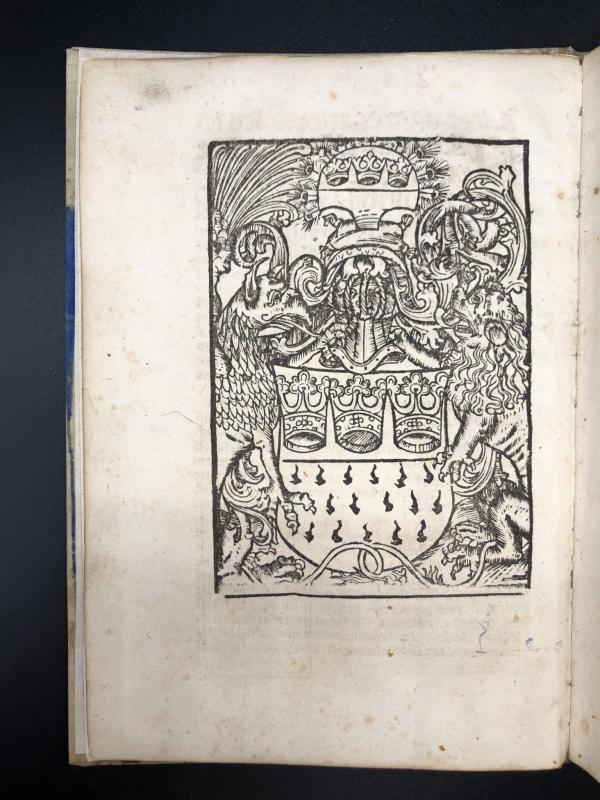
ALBERTUS MAGNUS. Liber aggregationis, seu Liber secretorum de virtutibus herbarum, lapidum et animalium. (IN C13 VELLUM MS. LEAF)
Cologne, Cornelis de Zierikzee, c.1506. Small 4to. 24 unnumbered ll., A 8 B 4 C 8 D 4 . Gothic letter. Two woodcut panels to t-p, handsome, large woodcut printer's device to verso and verso of last. T-p a little dusty, light marginal foxing or occasional slight water stain, minor marginal repair to B 4 , couple of early marginalia. A very good, well-margined copy in a C13 ms. leaf on vellum (double column, initials and line headings rubricated in red and blue), modern eps, lightly oilstained on lower cover. Handsomely bound in a C13 ms. leaf, on vellum, with Chapter XXIII of St Matthew s Gospel. A very good, well-margined copy of this very rare edition of one of the most influential medieval books of secrets. Albertus Magnus (1200-80) was a German friar, later canonised, responsible for the establishment of the curriculum studiorum of the Dominicans, including the study of Aristotle. He was also conversant in the natural sciences, philosophy and astrology. After his death, several works on the secrets of nature were attributed to him. The Liber aggregationis first reached the press in 1477 after centuries of successful ms. circulation. Its three main works are short handbooks on the natural, medical and occult properties of herbs, stones and animals: i.e., ways of preparing and administering herbs to treat abscesses or chest infections, the use of stones to create a perpetual fire or chase away visions (phantasmata), or the ways in which parts of animals could produce beneficial effects (e.g., wearing a hoopoe's eyes on one's chest could pacify friends, keeping its head in one's purse would make one immune to merchants' frauds). The fourth work, De mirabilibus mundi, is concerned with the beneficial exploitation of the wondrous properties of nature to solve everyday problems, from preventing pregnancies by making women drink ram's urine or hare's blood, to ways of capturing moles - this last of interest to the early annotator of this copy. The last work, Regimen sanitates contra pestilenciam siue epidimiam, was attributed to the bishop and physician Ranutio; it provides useful suggestions, according to the months and zodiac, to keep a healthy life and avoid epidemics, e.g., avoiding blood-letting in August and, for Pisces, avoiding gout treatment when the moon meets their sign. LC copy only recorded in the US.ISTC ia00267020; Goff Suppl. A266a; VD16 A1366; GW 657; Schuh, Albertus Magnus 62; NLM 83 (but Goff A267); BM STC Ger., p. 15 (1500 ed.); Index Aureliensis 102496 (but attributes to Cologne, H. Quentel). Ferguson, Wellcome, Osler and Houzeau-Lancaster do not list this edition. L3342
Sachgebiete: Kirchengeschichte, Esoterik, Wissenschaftsgeschichte, Mittelalter
11000,- EUR
Differenzbesteuert/Subject to margin taxation
Auf Merkliste setzen .jpg)
ALBERTUS MAGNUS, Pseudo. Secreta mulierum ab Alberto Magno composita. (WITH A UNIQUE ASTROLOGICAL MS)
[Speyer], [Conrad Hist], [about 1495-97]. 4to, 34 unnumbered leaves (last blank), + 17 manuscript leaves. Gothic letter, large woodcut depicting a school scene to t-p, a bit dusty with crude early repair to upper outer corner, light age yellowing, occasional foxing and spot to margins, insignificant waterstain to upper edges, light oil splashes to last 3 ll. not affecting reading. Manuscript averaging 28 lines, brown ink in two different gothic cursive hands (the first German, the second possibly Flemish or Dutch), first initial and underlining in red, red pen flourishing at foot of first ms. leaf, one ms. horoscope diagram. A good copy in early C19 patterned boards, vellum spine, label of Ernest Thorin (C19 bookseller in Paris) to front pastedown. A remarkable copy of this treatise on human reproduction by Pseudo Albertus Magnus, bound with a 17-page manuscript containing a astronomical text on the principles of chronological computation, apparently for astrological purposes, doubtless inspired by the printed text and an intriguing example of manuscript and print at the time of their transition. Secreta Mulierum (On women's secrets) was composed in the late 13th or early 14th century by an unknown disciple of Albertus Magnus, the most learned and prolific writer of the Middle Ages. Although scholars proposed the names of Thomas of Brabant or Henry of Saxony, the problem of authorship remains unsolved. The main text is accompanied by, and at times mixed with, a commentary, whose attribution is also debated. Relying on ancient and medieval writings, Pseudo-Albert discusses various aspects of reproduction, including the generation of the embryo, the formation and development of the fetus, the signs of conception, virginity, chastity, defects of the womb, impediments to conception and others. In the introduction, he states that his style will be partly philosophical, partly medical, just as seems to fit the material . By "philosophical" he refers to natural philosophy, or natural science, concerned with the study of the world and cosmos. Although Pseudo-Albert raises a number of medical topics nature of the menses, birth complications, gestation his knowledge of medicine is limited. On the other hand, the discussion on natural philosophy is complex and it explores in detail the relationship between human nature, reproduction and celestial bodies. Crucially, the author describes the effects of astrological influence on the developing fetus, also showing how the sphere of the fixed stars confers different virtues: Saturn gives the ability to reason, the Sun to remember, Jupiter grants generosity, Venus causes the separation of hands and feet, the Moon completes the skin. Vincent of Beauvais and Michael Scot may note some of the celestial effects, but pseudo-Albert addresses himself seriously to the problem of how they come about, and this effort forms the major thrust of his writing. Although the De secretis mulierum names women's secrets as its subject matter, if we weigh the length and the level of discourse we can almost consider this to be an astrological treatise. (Lemay) Renaissance scholars commonly practiced astrology, and the manuscript pages at the end suggest that the early owner of this volume was particularly involved. The text is a Computus Ecclesiasticus , which discusses solar and lunar cycles in relation to religious festivities and mobile feasts of the ecclesiastical calendar (Julian). In addition to basic knowledge (e.g. what a lunar cycle is), it provides precise instructions on how to calculate (computare) dates of feast days, such as dies dominicales (Sundays). Interestingly, it is arranged around metric formulas that were traditionally used to memorise calculations: here these are underlined in red, and each word corresponds to a number or provides a letter which will be used in the computations. For example, we find Sed, Quinque, Tred, Ambo, Decem, Doc, Septem, Quind, Quater, Dud, Jota, Novem, Sept VI, Quard , used to calculate the Golden number (a number from 1 to 19 which designate the year within the Metonic cycle of the moon phases). We also find: Bonus erat homo Katho, nobilis quoque Seno , which was employed to calculate the insertion of a leap day, week or year into a calendar and the second part of the manuscript is mostly concerned with this. Learning computus , the science of calculating times and dates, was fundamental for astrologers. This discipline, used in conjunction with astrolabes to predict the position of the planets (mentioned in the manuscript) and astronomical tables, was used to cast horoscopes, exactly like the one that we find at the beginning of the manuscript. The text was composed by two writers between the end of the 15th and beginning of the 16th century: in a few places, the second updates and annotates the first, including adding ab anno 1500 and 1501 to his comments. USTC 742409; ISTC ia00313900; GW 734; Bod-Inc: A-135; Klebs 26.16. This ed not in Goff, Cantamessa, Stillwell, Heirs of Hippocrates or Wellcome I. L3672
Sachgebiete: Esoterik, Genderstudies, Wissenschaftsgeschichte, Mittelalter
26000,- EUR
Differenzbesteuert/Subject to margin taxation
Auf Merkliste setzen 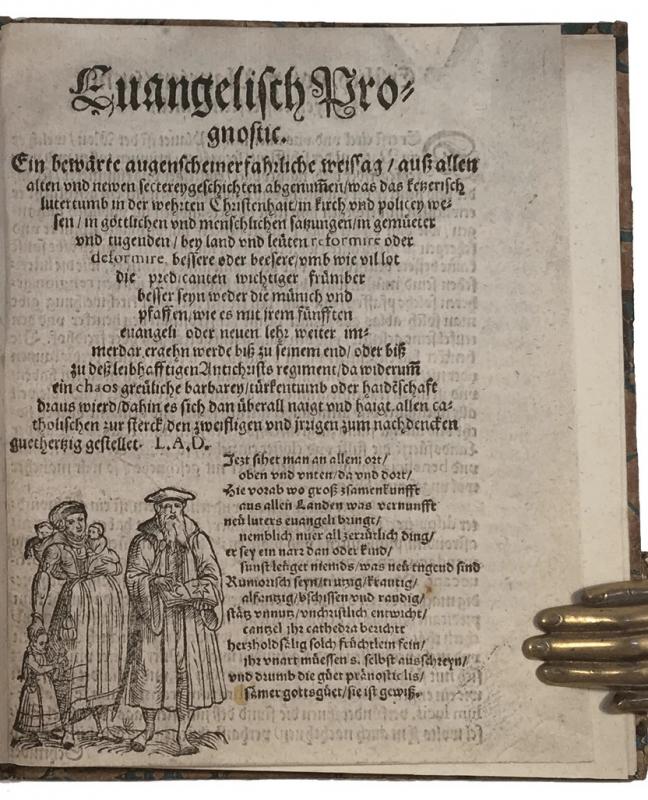
ALBRECHT, Lorenz. Evangelisch prognostic.
Munich, Adam Berg, 1589. FIRST and ONLY EDITION. 4to. ff. 8. Gothic letter. Woodcut of a man holding an almanac with his family. First and last a bit dusty, minor repair to margins and gutter of a couple of ll., small tear with no loss to gutter of third and outer margin of last, second gathering lightly browned with faint dampstaining. A very good copy in C19 floral paper over pasteboards. A remarkably clean copy of this German astrological almanac a rare survival of C16 ephemera. A former Lutheran preacher, Lorenz Albrecht (1540-1606) was the author of German and Latin religious works and re-converted to the Catholic faith in 1567. Evangelisch Prognosticon testifies to his disillusionment with the Protestant Reformation the Gospel of Luther and his intent to oppose this heresy through the popular genre of the almanac, imitating Johannes Nas s Practica Practicarum . As usual in astrological almanacs, it discusses planets, constellations, zodiacal signs and the seasons and their influx on humans with references to ancient authorities like Pliny and Manilius; but the tone is grim and planets are seen as harbingers of vices. The ominous statement by which the seat of the devil is at the centre of the earth and heresy is at the centre of the universe shows how Albrecht s almanac presented the influence of the cosmos as something that Catholics should resist through will and spiritual exercise so as not to succumb to the Protestant heresy. Only Concordia Seminary Library copy recorded in the US.USTC 349262; VD16 A1594. Cantamessa: 140 bis. Not in Houzeau-Lancaster. R.B. Barnes, Astrology and Reformation (Oxford, 2016). L2915
Sachgebiete: Kirchengeschichte, Sittengeschichte, Religion
2500,- EUR
Differenzbesteuert/Subject to margin taxation
Auf Merkliste setzen 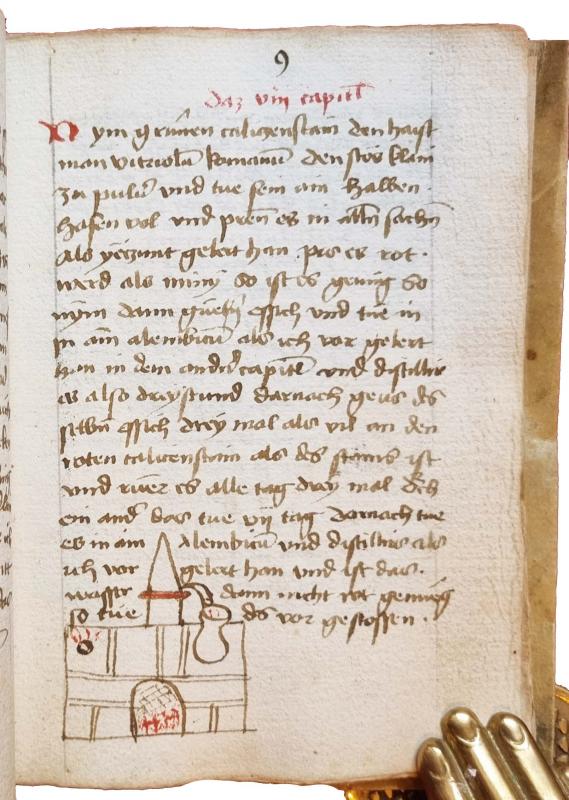
[ALCHEMY]. Wer rechten Alchomey, an exceptionally rare alchemical text in Low German with twenty-eight illustrations of early scientific equipment, together with two related works including a version of the Buch ysaac semys sun von Babilon.
[northern Germany] , [fifteenth century (probably mid century)]. Sm 4to. 157x114mm, 48 leaves, complete, collation: i-iv12, contemporary foliation at head with 1-47 in Arabic numerals followed by xlviii on last leaf, single column of 18-20 lines of a Germanic hybrida bookhand, red rubrics and simple initials, twenty-three pages with diagrams of early scientific equipment and a crowned coat-of-arms set within flames, watermark circular in part and too indistinct to help with localisation or date, a few minor spots and mostly marginal small stains, in good condition on heavy paper, in old vellum, recased. "Wer rechten Alchomey", an exceptionally rare alchemical text in Low German with twenty-eight illustrations of early scientific equipment, together with two related works including a version of the Buch ysaac semys sun von Babilon, manuscript on paper. Provenance: Written and decorated, perhaps by the author (see below), for use in practical alchemical experiments, in northern Germany (note use of spellings for the more common High German) in the middle of the fifteenth century. To this the original hand, and other later hands over the next century or so, added notes of chants and other alchemical snippets to the first leaf and blank verso of last and to the border of fol. 47r, including the phrase "Parturiunt Montes, nascetur Ridiculus mus" (a line from a fable of the first-century Latin author Phaedrus, alluding to a farcical story in which a mountain appeared to go into labour with loud groans, and a mouse emerged from its foot as an apparent miracle birth). Almost certainly owned by Emanuel Mai (1812-97), bookseller of Berlin: see his catalogue for 1854, vol. I, no. 276 (there recorded with "Blatter mit roth und schwartz gemalten Figuren" with a record of the same second text as here, correctly giving that text's Low German spellings (note that in a slight garbling of detail, Mai lists the second text as beginning on pag. 47, but it is in fact on fol. 46v, opposite the leaf numbered 47). Recently re-emerged from a private collection in the US. Text and the alchemical illustrations of the codex: When we think of alchemical manuscripts, especially those with any illustrations, the rarity of early examples means that the vast majority of those that come to mind are of the sixteenth and seventeenth century. Yet fifteenth-century Germany was a hotbed of medieval alchemy, and produced many new texts and specialists involved in early chemical experimentation. Alchemy was a fundamentally practical subject, never a formal part of the university syllabus, and was most probably learnt as a form of craft apprenticeship, and so while its practitioners often used texts in Latin, their studies existed first and foremost in vernacular languages with masters and students conversing in those over their experiments as they worked. Thus a great part of the value of the present manuscript is in its representing the cutting edge of those studies, as an apparently authentic voice of the dawn of practical alchemy. Moreover, it stands extremely early in the German tradition of such works. No alchemical work in German was catalogued by Herwig Buntz before the Buch der Heiligen Dreifaltigkeit, written between 1415 and 1419 (see his unpublished thesis: Deutsche alchimistiche Traktate des 15. und 16. Jahrhunderts, submitted to the University of Munich in 1968, and the same author's article on that work in Zeitschrift für deutsches Altertum und deutsche Literatur, 101, 1972, pp. 150-160). The present codex comprises: (i) the text of Wer rechten Alchomey (fols. 1r-35v), with the first original leaf here once with only the title of this work, followed by the main text beginning on the next leaf, and the remaining space on the first original leaf filled up by the main hand, with later alchemical notes referring to the source as a work of a "beloved Christopher" (Lieber christoff). (ii) a text digesting the work of Isaac Judeus/Isaac ibn Sulaiman al-Israili (an occultist and doctor, who served as court physician to the last Aghlabite prince, Ziyadat Allah, and the Fatimite caliph, Ubaid Allah al-Mahdi, and who died in 932/42 in Egypt: here fols. 36v-46r), this text opening "Das ist die puch das ysaac semis sun von Babilon". (iii) a short and unidentified alchemical work, opening "Lieber vett, ich pitt dich mit vleys du wild daz puech nymant" (fol. 46v-48r). All parts of this book are of exceptional rarity, and two of the three texts may well be unique. The first text here can be traced by us in only two other witnesses: (1) an unillustrated fifteenth- or sixteenth-century manuscript, now Vienna, Österreichische Nationalbibliothek MS. 3025. (Med. 222), and with a differing ending to that here, and thus perhaps with its text in a truncated form (see Tabulae codicum manu scriptorum praeter Graecos et orientales in Bibliotheca Palatina Vindobonensi, I, 1864, p. 181, no. 3025); and (2) another unillustrated copy of the text offered by Emanuel Mai as no. 275 in the same 1854 catalogue as the present manuscript, perhaps sharing an origin and provenance with the present manuscript, but evidently unseen in the last one hundred and seventy years. The tiny number of copies and their apparently restricted distribution suggests that none of these stands at any great remove from the anonymous author of the text, and the probable longer version of the text here and the inclusion of an integrated cycle of illustrations, make the present copy the most complete. It may well be the author's own copy, from which the other two were made. No other copy of this text appears to have ever been offered for sale before, and a future comparison of this witness with that in Vienna and the short readings preserved by Mai for the lost manuscript promises substantial scholarly rewards for anyone interested in this text or the German alchemical mileau that produced it. The second text here is a close variant of a work recorded in a single sixteenth-century manuscript (Munich, Bayerischen Staatsbibliothek, MS. Clm 25114), and in this form may well be unique. The third text cannot be traced elsewhere by us and may also be a sole survivor. This would accord well with the suggestion that this is the author's own copy, containing the best version of his Wer rechten Alchomey and perhaps the only surviving copies of the last two texts. The texts here principally concern the transmutation of certain metals, elements and chemical compounds (most commonly here gold and silver, with copper and sulphur also frequently mentioned, as well as "salarmoniac" [Salammoniac, or ammonium chloride crystals], borax, "white arsenic" and mercury, among others). In addition to this, the Wer rechten Alchomey contains an array of drawings of practical equipment for handling and changing the form of these elements, including kilns, heating pans, distillation equipment and vessels. Alchemical texts of this great age are of exceptional rarity on the market, and those with any form of diagrams or illustrations far more so, the last to come to the market the heavily fire-damaged Galletti Alchemical compendium, with twenty-two such diagrams accompanying the Summa perfectionis magisterii attributed to Geber, written in Germany or the Netherlands c. 1489, and sold immediately after Bloomsbury Auctions's sale of 7 December 2020 (where it was lot 44). L4014
Sachgebiete: Alchemie, Esoterik, Handschriften, Instrumente (Technik)
175000,- EUR
Differenzbesteuert/Subject to margin taxation