Bru de Ramon, Juan Bautista  Auf Merkliste setzen
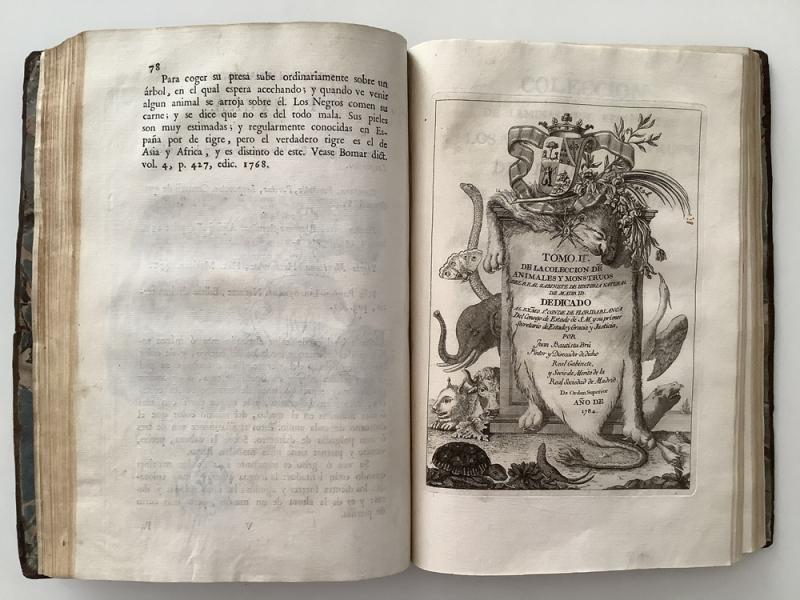
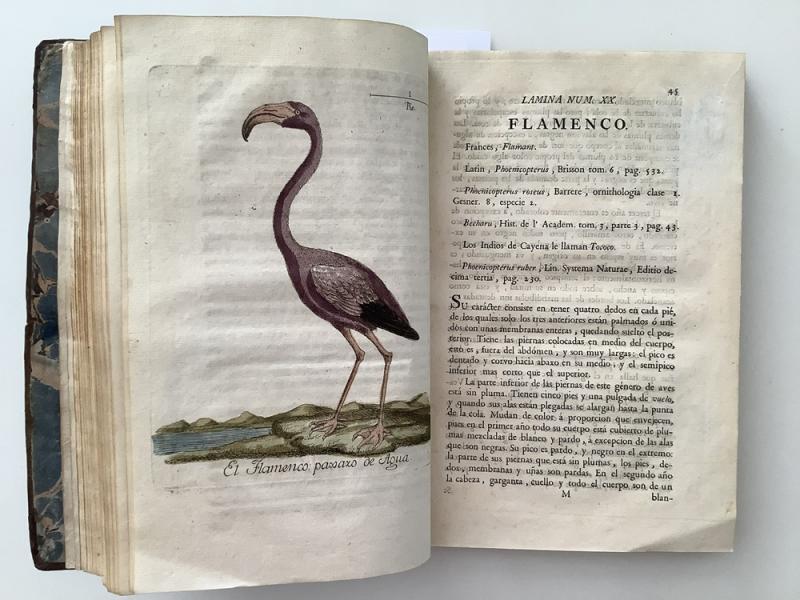
De la coleccion de animales y monstruos del Real Gabinete de historia natural de Madrid. Con una descripcion individual de cada uno. 2 parts in 1 volume. Madrid, Andres de Sotos, 1784 - 1786, 28 : 19 cm. Engraved title, 5 leaves, 78 pages; engraved title, 3 leaves, 76 pages, with togesther 71 engraved and contemporary coloured plates. Contemporary calf, title on spine, marbled end papers.
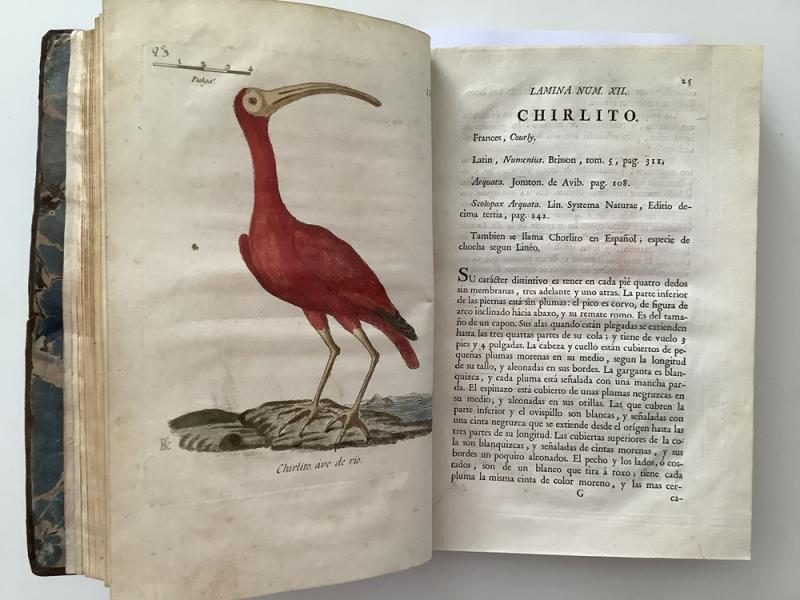
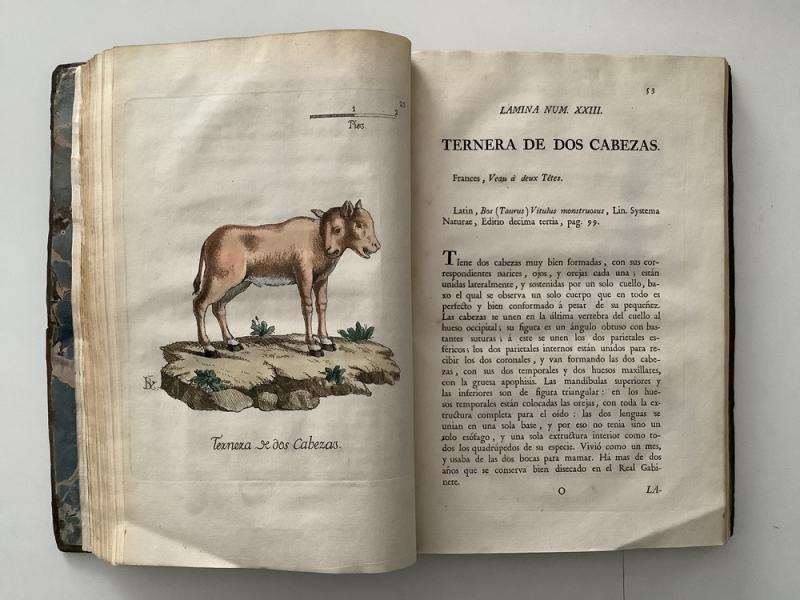
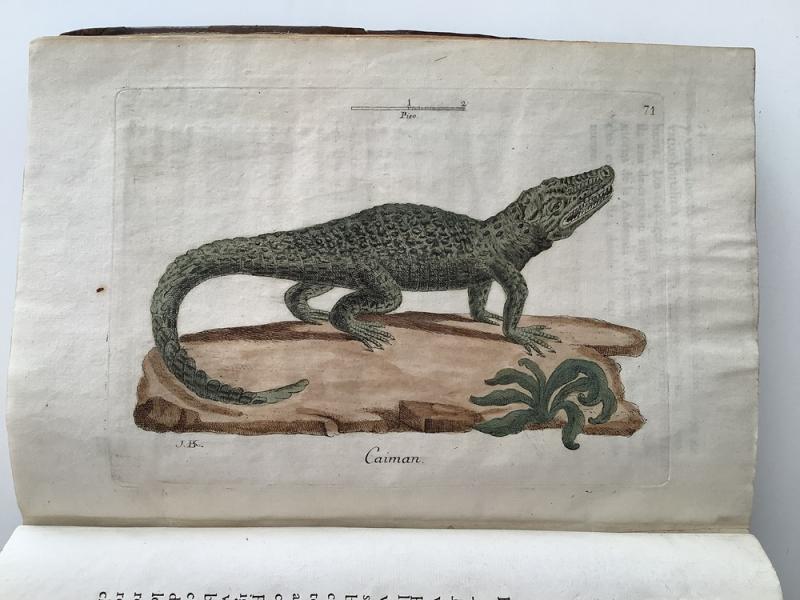
Extremely rare, first edition, with all plates with contemporary hand-colouring. According to Palau this is a rare work, and particularly so if complete. The zoologist and artist Juan Battista Bru was appointed artist and ‘dissector’ at the Royal Cabinet of Natural History in Madrid (later Museo Nacional de Ciencia), undertaking zoological dissections and scientific studies. His illustrations here are based on actual specimens in the museum, representing mammals, birds, reptiles and fish from Latin America, China, South Africa and elsewhere. The work is complete with 71 plates, as here. - Only two copies have surfaced at auction (both at Christie's London in 2004 and another copy in 2020) and Worldcat records only 6 copies (of which only one is in an American institution). Born in Valencia, Bru was appointed illustrator and “dissector” of the Royal Cabinet in Madrid in 1777. For 20 years his work was devoted to zoology, drawing animals and preparing and mounting skeletons of vertebrates. His illustrations for the present work are based on actual specimens in the museum, representing mammals, birds, reptiles, and fish from Latin America, China, South Africa, and elsewhere. - Also included are monstrous abominations of nature such as a three-legged chicken, a hare with two bodies dos-à-dos, a two-headed cow, and a calf with one eye. However, some of the depictions of normal specimens are even endowed with a freakish appearance, such as the black-tufted marmoset with its gill-like ears (plate 10) and the sucker fish (plate 61), which attaches itself to the backs of larger fish by means of suckers on its head. Others are anthropomorphized such as the smiling golden lion tamarin (plate 31), the serval cat (plate 29), the leopard (plate 47), and the lynx (plate 65). There is a distinct tension between the struggle to convey representational accuracy and the general, aesthetic intention of the illustrations. They exist as documents of natural specimens but also as images that can be experienced and studied as any work of art may be. - Bru is perhaps best known for assembling and installing the skeleton of a large animal that had been discovered in the vicinity of Buenos Aires and sent to Spain in 1788. It was called, noncommittally, a “Megatherium” (Giant Beast), and it is believed to be the first extinct mammal skeleton ever mounted. Bru wrote a description in 1793 and was preparing a monograph on the subject, with 22 engraved plates. Even before its publication, a set of proofs was sent to the Institut de France, where Cuvier wrote about the remains and published in 1796 under the title “Notice sur le squelette d'un très grand quadrupède, inconnu jusqu'à present … et déposé au Cabinet d'Histoire Naturelle de Madrid.” Cuvier's opinion was that Bru's Megatherium was a giant Ground Sloth, and like many of his opinions, it was in fact true. - Small invisible stamp on first engraved title-page removed; spine restored. - Provenance: Private Library of the Real Sociedad Económica Sevillana de Amigos del País. - Brunet I, 5645 (citing the Banks copy, extra-illustrated, with 101 plates); Nissen (ZBI 616 citing the Banks copy only); Palau 36258.
16000,- EUR
inkl. 7% USt./incl. 7% VAT
Sachgebiete: Erstausgaben, Illustrierte Bücher, Naturwissenschaften, Zoologie
Kontakt zum