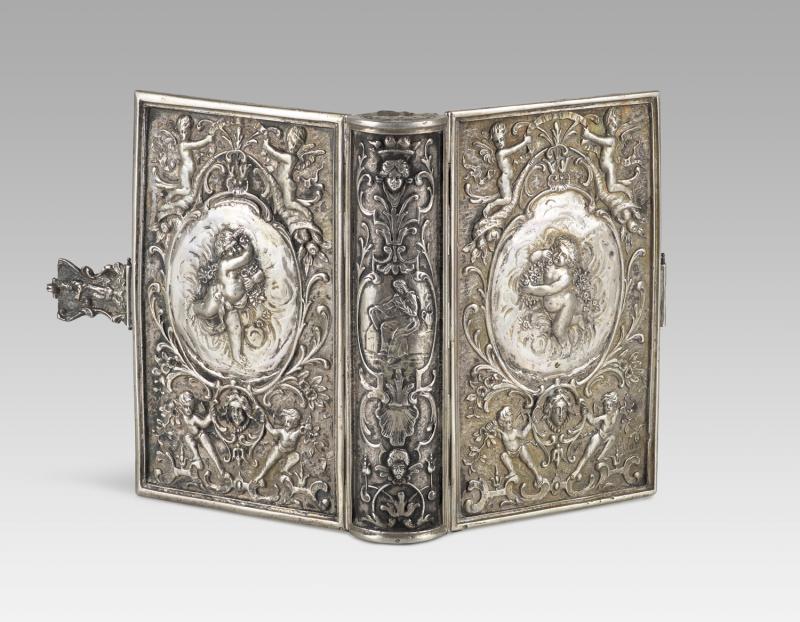
Silbereinband. Frankreich, ca. 1700–1740  Auf Merkliste setzen
Barocker Bucheinband aus getriebenem Silber, 12,8 x 18,8 cm (aufgeklappt), 245 Gramm. Je Deckel mit großem Mittelstück in Puttendarstellung, getragen und gekrönt von weiteren Putti sowie einer Porträtdarstellung Christi, umgeben von reichem floral-vegetabilem Dekor und dekorativen Akanthusranken. Der Rücken zeigt weiteres vegetabiles Rankwerk mit mittiger Heiligendarstellung, oben und unten flankiert von Puttenköpfen. Die intakte Schließe trägt eine weitere Heiligendarstellung. Gestempelt mit Fleur de Lis (nicht näher identifizierbar), verschlagener Kopfmarke sowie "G". Leichte Bereibung, partiell schwache Kratzspuren, etwas angelaufen; insgesamt sehr gut erhalten. Paris war seit dem 17. Jahrhundert das führende Zentrum der französischen Silberschmiedekunst mit europäischer Vorreiterrolle im Kunsthandwerk. Die Ornamentik aus asymmetrisch geschwungenen Voluten, naturalistischem Rankenwerk und Muschelmotiv am Rücken verweist auf die Forme Rocaille, jenen genuin französischen Stil, der um 1700 aus dem Groteskenornament und der barocken Kartuschentradition hervorging und maßgeblich durch Meissonniers "Livre d'Ornements" geprägt wurde. Stilistisch ordnet sich der Einband in die Übergangsphase von der Régence (ca. 1715–1730) zum reifen Style Louis XV (bis ca. 1760) ein, in der sich schwere Grand-Siècle-Formen zu leichteren, kurvig-organischen Rocailleformen wandelten. Das ikonographische Programm verbindet sakrale und dekorative Elemente: Die zentrale Christusdarstellung auf beiden Deckeln wird von tragenden und krönenden Puttenfiguren gerahmt, ein Bildschema, das die göttliche Figur in ein dynamisches, von Engelwesen getragenes Kompositionsgefüge einbindet, statt sie – wie in strengerer barocker Tradition – in starre architektonische Kartuschen zu fassen. Der Rücken mit Heiligendarstellung zwischen Puttenköpfen und die Schließe mit weiterer Heiligenfigur ergänzen dieses Programm zu einem in sich geschlossenen sakral-dekorativen System, in dem religiöse Motive und Rocaille-Ornamentik – Muschelwerk, Voluten, Akanthusranken – eng verschmelzen. Als bedeutendster Vertreter der Pariser Rokoko-Silberschmiedekunst gilt Thomas Germain (1673–1748), dessen Werkstatt maßgeblich zur Etablierung der Rocaille im Silberhandwerk beitrug; auch wenn der vorliegende Einband nicht aus seiner Werkstatt stammt, verdeutlicht sein Wirken den kunsthistorischen Rahmen, in dem diese Ornamentsprache in Paris zur vollen Ausprägung kam. Die Meistermarke aus Fleur de Lis, verschlagener Kopfmarke und dem Initial "G" bestätigt die französische Herkunft, lässt jedoch mangels lesbarer Jahresmarke keine exakte Datierung oder Meisterzuschreibung zu – vergleichbare Marken mit Krone, Lilie und individuellem Symbol sind etwa für den Meister Pierre Guéry aus Fontenay-le-Comte dokumentiert. Insgesamt belegt das Objekt die Kontinuität eines ikonographischen Repertoires aus Putten, Rocaillen und religiöser Bildlichkeit, das im französischen Silberschmiedehandwerk des frühen bis mittleren 18. Jahrhunderts fest verankert war. Silver Bookbinding. France, c. 1700–1740. Baroque book cover of repoussé silver, 12.8 x 18.8 cm (opened), 245 grams. Each cover with a large central medallion depicting putti, borne and crowned by further putti, together with a portrait depiction of Christ, surrounded by rich floral-vegetal decoration and ornamental acanthus scrolls. The spine displays further vegetal scrollwork with a central saint's depiction, flanked above and below by putti heads. The intact clasp bears a further depiction of a saint. Stamped with a fleur-de-lis (not further identifiable), an indistinct head mark, and the letter "G". Light rubbing, some minor scratches, slightly tarnished; overall in very good condition. Paris had been the leading centre of French silversmithing since the 17th century, assuming a pioneering role within European decorative arts. The ornamentation—asymmetrically curving volutes, naturalistic scrollwork, and the shell motif on the spine—points directly to the forme rocaille, that genuinely French style which emerged around 1700 from the structural transformation of grotesque ornament and the baroque cartouche tradition, decisively shaped by Meissonnier's "Livre d'Ornements." Stylistically, the binding belongs to the transitional phase from the Régence (c. 1715–1730) to the mature Louis XV style (up to c. 1760), during which the heavier forms of the Grand Siècle gave way to lighter, curvilinear rocaille shapes. The iconographic programme combines sacred and decorative elements: the central depiction of Christ on both covers is framed by supporting and crowning putti, a compositional scheme that embeds the divine figure within a dynamic arrangement borne by angelic beings, rather than confining it—as in stricter baroque tradition—within rigid architectural cartouches. The spine, with its saint's image flanked by putti heads, and the clasp bearing a further saintly figure, complete this programme into a self-contained sacred-decorative system in which religious motifs and rocaille ornament—shellwork, volutes, acanthus scrolls—merge closely. The most eminent representative of Parisian rococo silversmithing is considered to be Thomas Germain (1673–1748), whose workshop played a decisive role in establishing the rocaille within the silversmith's craft; although the present binding does not originate from his workshop, his oeuvre illustrates the art-historical context in which this ornamental language—shellwork, volutes, and putti motifs—reached its fullest expression in Paris. The maker's mark, comprising the fleur-de-lis, an indistinct head mark, and the initial "G," confirms a French origin, though the absence of a legible date letter precludes precise dating or attribution to a specific master; comparable marks combining crown, lily, and an individual symbol are documented, for instance, for the master Pierre Guéry of Fontenay-le-Comte. Overall, the object attests to the continuity of an iconographic repertoire of putti, rocaille, and religious imagery firmly established within French silversmithing of the early to mid-18th century.
1800,- EUR
inkl. 19% USt./incl. 19% VAT
Sachgebiete: Barock, Einbände, Silbereinbände
Kontakt zum