WEIR, JOANNE [WEYER, JOHANN]  Auf Merkliste setzen
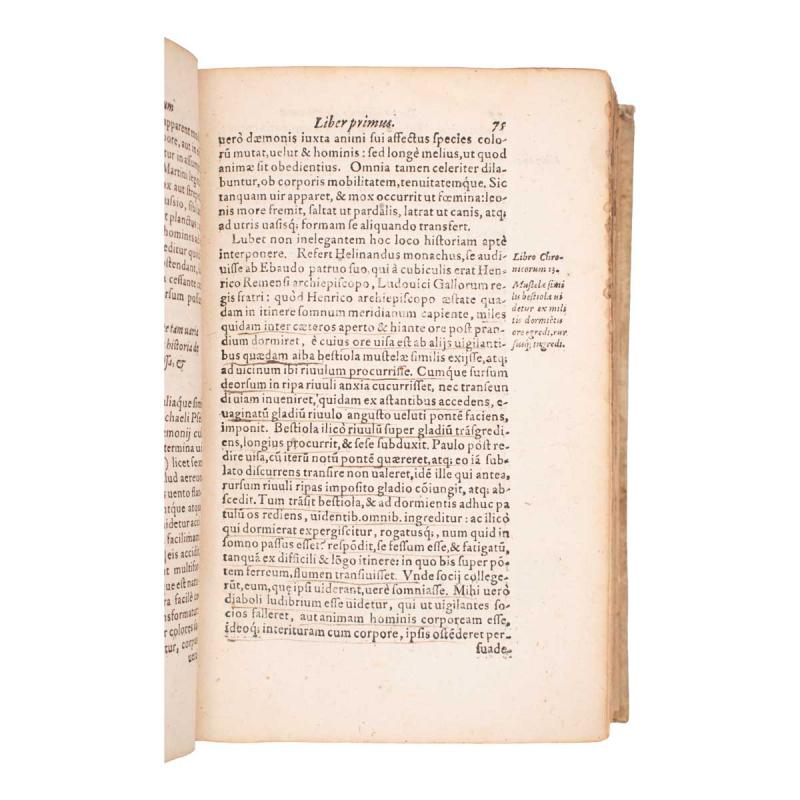
EXPANDED EDITION - INCLUDES THE INDEX OF DEMONS De Praestigiis Daemonum, Et Incantationibus ac ueneficiis, Fourth edition, [2], 3-697, [55]pp., woodcut printers device to title, early ownership mark to title, early ink marginalia and underlining, later endpapers, later vellum over boards, hinges repaired, 8vo (183 x 120mm), Basel: Oporinus, 1568. “Those who err should be brought gently home, not incarcerated with punitive ferocity.” Johann Weyer, a respected Lutheran physician at the court of William III, was one of the first to protest against the persecution of witches. He is considered "the founder of medical psychiatry" (Garrison-Morton), and a human rights defender avant la lettre. He published on rare diseases and sexual abuse. Weyer influenced contemporaries such as Michel de Montaigne and later thinkers such as Victor Hugo, Karl Marx and Sigmund Freud. After studying at the University of Paris, Weyer apprenticed under Agrippa of Nettesheim from 1530 to 1534. The poetic, mysterious and liberal-minded Agrippa was also an outspoken critic of witch persecution. Weyer sought to derogate the law concerning witchcraft prosecution, using two forms of thinking. He argued that those accused of practising witchcraft were mentally ill - suffering from “melancholia” - and the confessions they made were actually delusions of the mind. By arguing that the moral weakness in women made them easy prey to Satan’s temptations, Weyer started one of the most vigorous and enduring controversies surrounding demonology and the witch in the early modern period. Weyer powerfully argues the case for leniency to the repentant and eloquently rejects the assimilation of witchcraft to heresy. He insisted that women were neither helped nor healed by torture or burning, but that they rather needed the healing power of prayer, religious instruction, medical intervention, and meditative isolation. He bolstered this attack on realist demonology with medical authorities as well as his own clinical experience as a practising physician. Whilst he is right to insist on the relevance of medical diagnosis in many cases of witchcraft, medicine was then too primitive to suggest convincing explanations. Weyer’s most important contribution in the field of medical diagnosis may be the understanding that undernourishment was the cause of much witchcraft melancholia. Medical and juridical objections often went hand in hand. Weyer challenged demonologists on a legal terrain, attacking the prosecution's reliance on a confession, the point where demonology’s theoretical and practical endeavours converged. Weyer attempts to demolish various witch confessions, notably he publicly attacked the trials of the Wurttemberg preachers, attesting they were illegal, since the death penalties could be imposed only in cases of maleficent magic, not for mere fantasies. Weyer was careful to specify that he did not doubt the reality of witchcraft, but only its relevance to the majority of prosecutions. Weyer has become a symbol of courage and lucidity in the face of intolerance and ignorance, but he was not quite as radical as it would seem. Despite Weyer’s appeal for a greater tolerance towards alleged witches, he also wants greater severity towards male magicians, who Weyer perceived as actual practitioners of natural or demonic magic. It has been suggested that in its very conception, this work is an ideological attack on Catholic idolatry and superstition, rather than a radical stand against the cruel persecution of witches. The reaction to De Praestigiis Daemonum was formidable. Weyer had chosen to publish his book precisely at the moment when the witch-craze, after a long lull, was beginning again. That, indeed, was what had provoked him to write. But this Erasmian Platonist was no longer heard by a generation that had repudiated Erasmus. A fellow physician might hail him as a prophet of enlightenment, but his other readers thought differently. Weyer was told by his friends that his book must be destroyed or rewritten; by his enemies that he was a lunatic. Yet Johann Weyer shaped opposition to witch hunting for generations. Demonologists who wrote after him took care to demolish his arguments, and Bodin’s famous Demonomanie de sorciers includes a lengthy rebuttal of De praestigiis. Yet as they engaged with Weyer’s ideas, their own thought was shaped by his. [ADB XLII, p. 266; Garrison-Morton 4916; Robbins (1972), Encyclopedia of Witchcraft; Thorndike, L. (1941). A History of Magic and Experimental Science, pp. 515-516.; Witchcraze, Terror and Fantasy in Baroque Europe, Roper, 2004; Witches, Devils, and Doctors in the Renaissance: Johann Weyer, Mora, 1991; The Oxford Handbook of Witchcraft in Early Modern Europe and Colonial America, 2013; Ideas and Cultural Margins in Early Modern Germany, 2009; The Damned art : essays in the literature of witchcraft, 1977]
8700,- EUR
inkl. 19% USt./incl. 19% VAT
Sachgebiete: Jura, Occulta, Theologie
Kontakt zum