[Wagner] BRAZDA, JAN. Der Ring des Nibelungen. Jan Brazda. MCMLXVI. Kungliga teatern Stockholm.  Auf Merkliste setzen
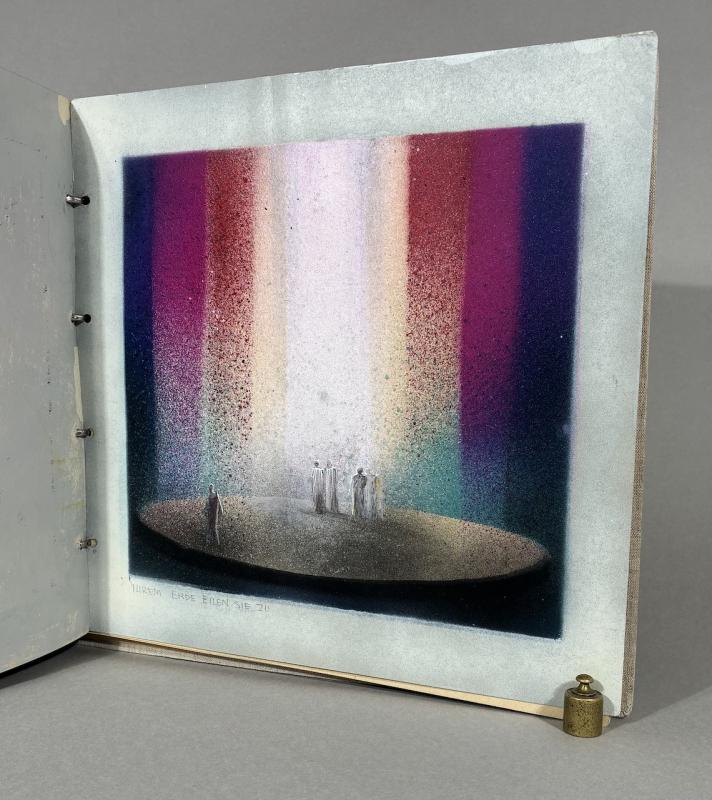
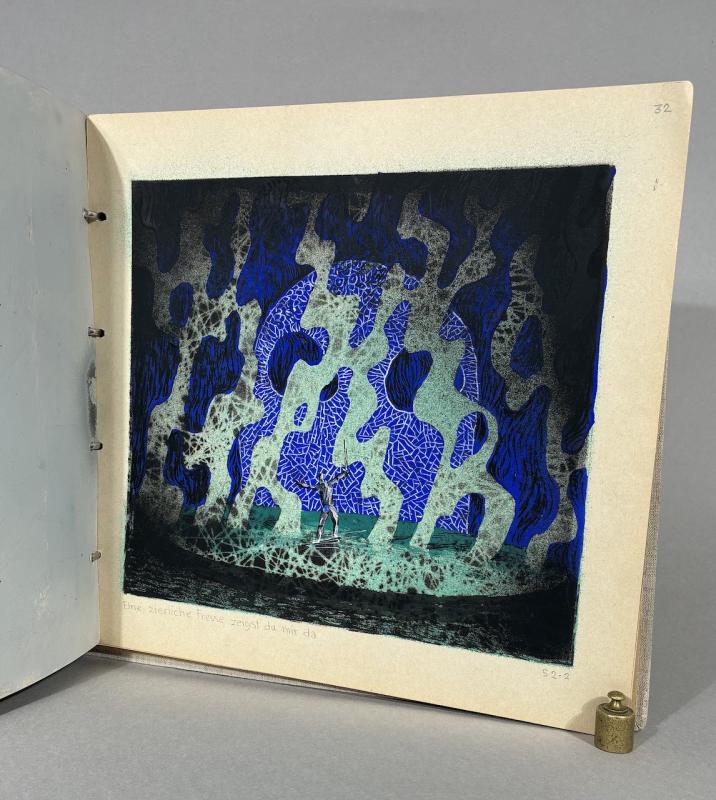
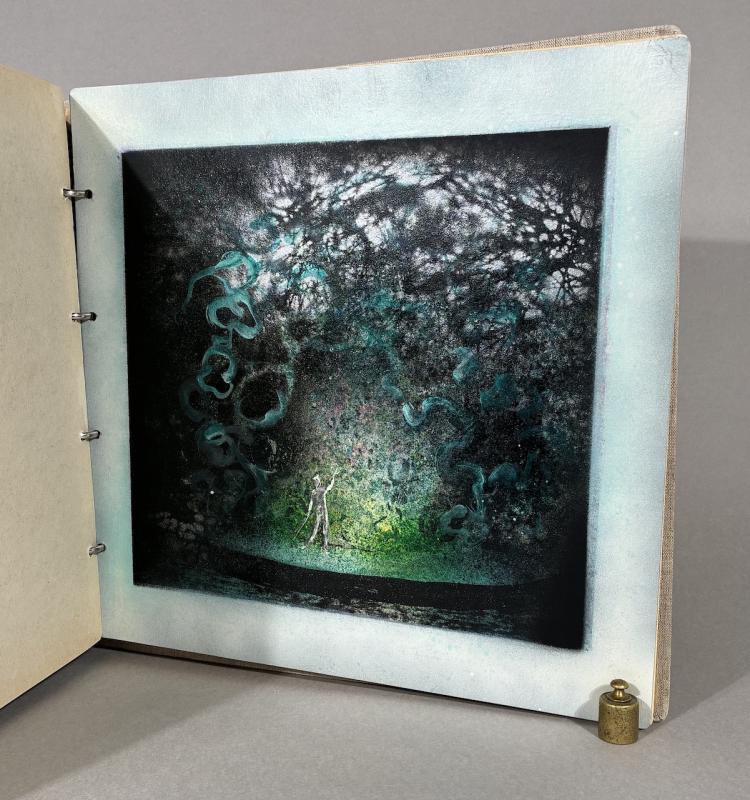
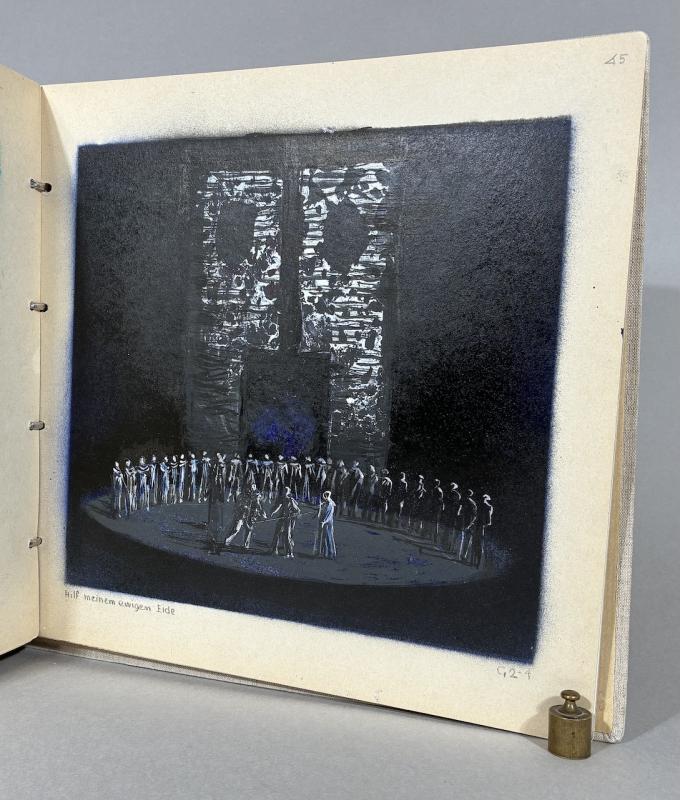
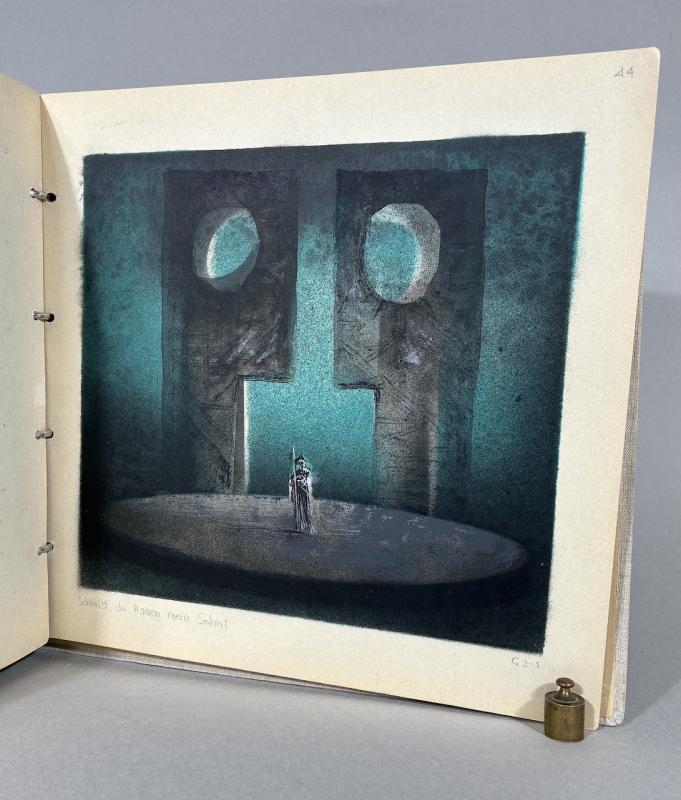
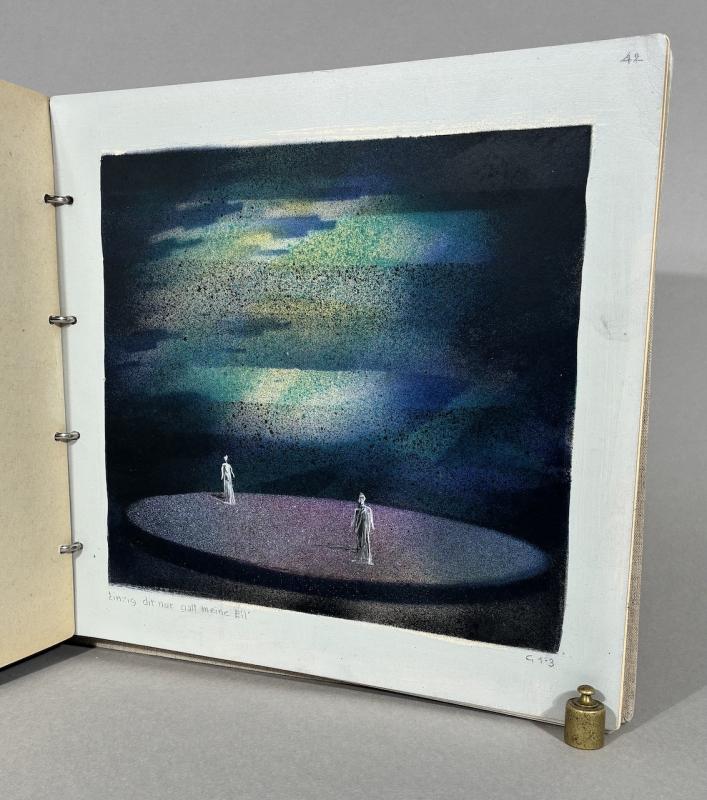
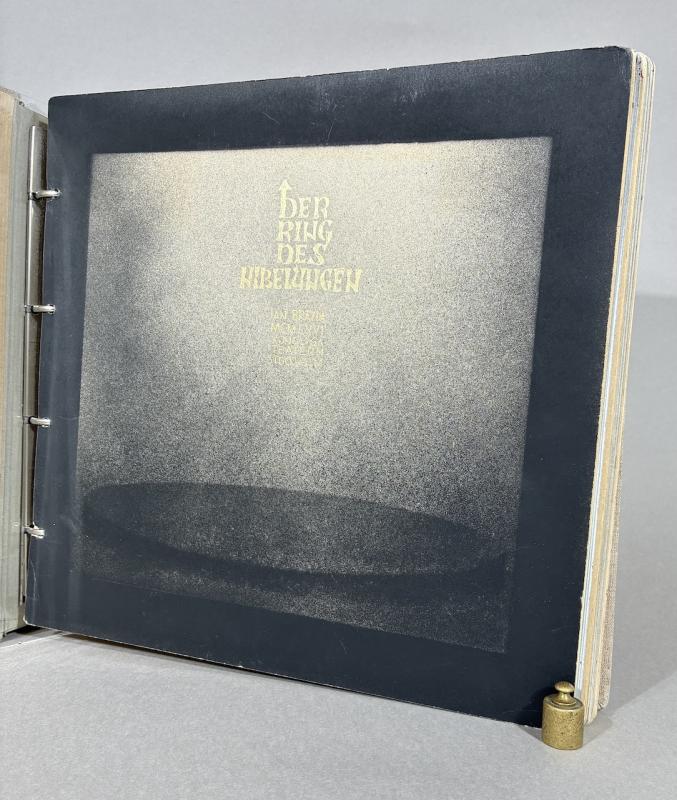
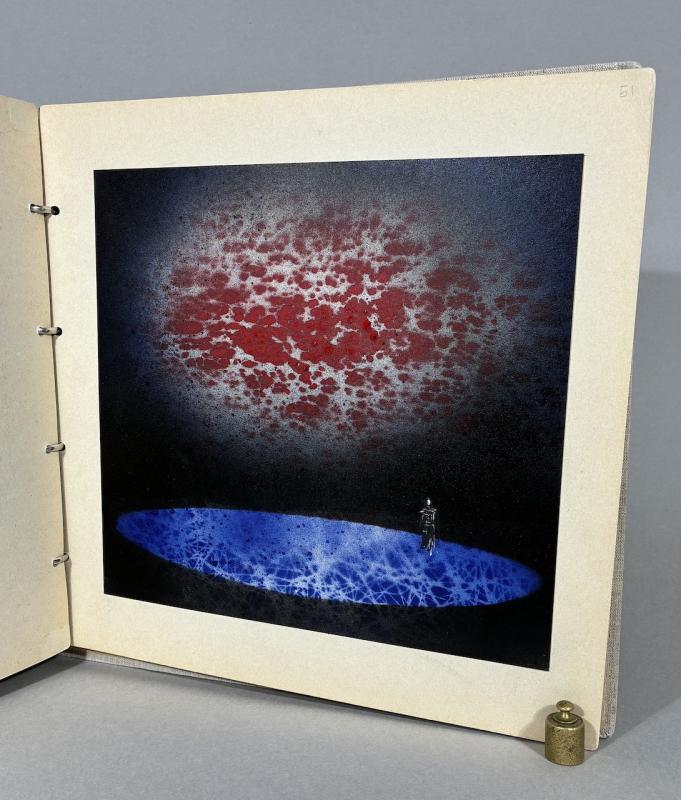
1966. Hand-painted title page & 50 mixed-media paintings. 32.5 × 33.5 cm. Housed in a contemporary cloth-covered ring binder with the title ”Ringen 1968” written in very faint pencil on the spine. Nearly all paintings have pencil captions beneath them, mostly in German but a few in Swedish. An unknown number of paintings are missing. Following the title page and the first unpaginated painting (titled ”Urtillstånd” [Primordial State]) are paintings numbered in pencil in the upper outer corner as follows: 1–4, 6–8, 10–16, 18–24, 26–28, 30–32, 35–37, 39–55 (the last titled ”Kosmos erlösning” [Redemption of the Cosmos]), followed by two unnumbered paintings. Thus, eight paintings are missing from the continuous sequence. The cloth binder is very lightly soiled. The paintings themselves are in fine condition, though the wide margins surrounding them are somewhat soiled in places, with occasional paper damage and slightly bumped corners. There is some faint offsetting of the paint onto the facing blank pages.
Original paintings by the Czech-Swedish scenographer Jan Brazda for the stage design of the Royal Theatre's (now the Royal Swedish Opera) 1968 production of Wagner's ”Der Ring des Nibelungen”. Martin Nyström writes in ”Konsten att ringa in Wagner” (”The Art of Encircling Wagner”, ”Dagens Nyheter”, 2013): "When the Stockholm Opera commissioned Folke Abenius (director) and Jan Brazda (scenographer) to stage a new ’Ring’ in 1968, it was the first uniformly conceived ’Ring’ cycle in Sweden. The production, with its musically light-based stage design and depth-psychological direction, strongly recalled the modernist, abstract aesthetic introduced in 1951 by Wagner's grandson Wieland Wagner at Bayreuth—an aesthetic which, after the war, sought to sweep away the mythologizing of the ’Ring’ that had so strongly appealed to Adolf Hitler and other leading Nazis." A contemporary review described the production as: "The most coherent Wagner staging in a long time. It is Jan Brazda's scenery that so superbly bridges what has almost always been a gulf between the fluidity of the music and the rigidity of the stage action. Using projected light against a semi-transparent scrim, Brazda creates a stage image that transforms itself through seamless dissolves. Wagner's stage directions frequently call for precisely such transitions, which would scarcely be achievable without the projection equipment at Brazda's disposal. Already in the prelude—the E-flat major triad that gradually intensifies over the course of nearly five minutes—Brazda's artistry with light comes fully into its own. Richly coloured nebulas are projected onto the scrim; they merge, separate, condense, dissolve, and continually transform." (VLT, 1968).
7200,- EUR
Differenzbesteuert/Subject to margin taxation
Kontakt zum