Auf Merkliste setzen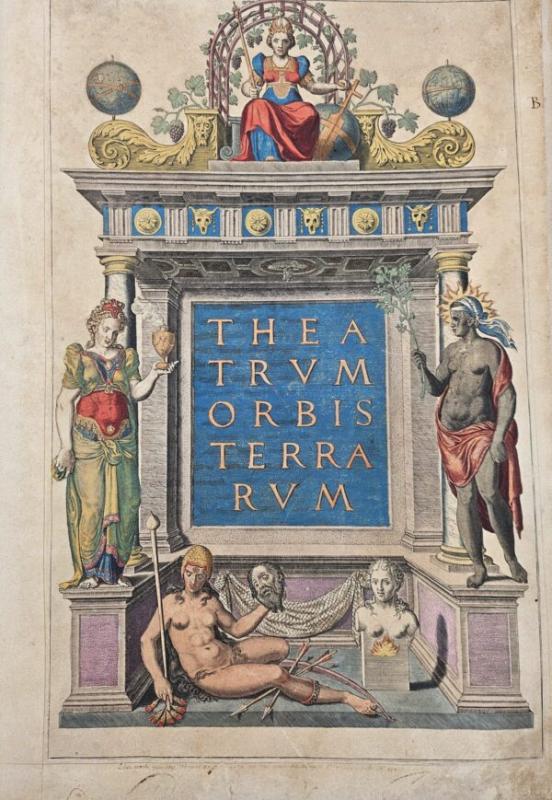
Ortelius, Abraham 1571, Antwerp, Gielis Coppens van Diest
Theatrum Orbis Terrarum. Complete copy, bound in a contemporary vellum binding, (8) 53 maps (29) Folio. Engraved architectural title with the figure of Europe at the top. With 53 contemporary hand-coloured double-page engraved maps. H. 43 x W. 30 cm. / H. 16.90 x W. 11.8 inch. Rare early edition of Ortelius’ revolutionary atlas, first published in Antwerp in 1570 (also a Latin edition). Ortelius’ atlas was revolutionary because it was the first attempt to present the geography of the world in a uniformly produced collection of maps of all known parts of the world. Ortelius designed the maps himself, basing his designs on the cartographic sources that he had at hand (and, equally revolutionary, also mentioning his sources on the maps), and once finished, had them engraved by Frans Hogenberg and Ambrosius and Ferdinand Aertsen. Finally, Gielis Coppens van Diest printed the maps, after which they could be coloured (also in a uniform style) and bound in a logical order in one volume. These atlases were a new phenomenon and proved to be very popular in Europe. Soon, editions were published in various languages of Europe in print runs of a few hundred copies each. Few maps are slightly (finger-)stained in the wide margins. Contemporary vellum binding with some scratches and stains. Overall, a remarkable copy of this famous atlas in beautiful contemporary colours. Van den Broecke estimates that of this 2nd Latin edition, approximately 275 copies were printed. Literature: Van de Krogt/ Koeman IIIA, 31:002; Adams O-335; Phillips 382; Shirley 122 (with the world map in his first plate, first state).
Sachgebiete: Amerika, Atlanten, Kartographie, Landkarten, Schifffahrt
75000,- EUR
Differenzbesteuert/Subject to margin taxation
Auf Merkliste setzen 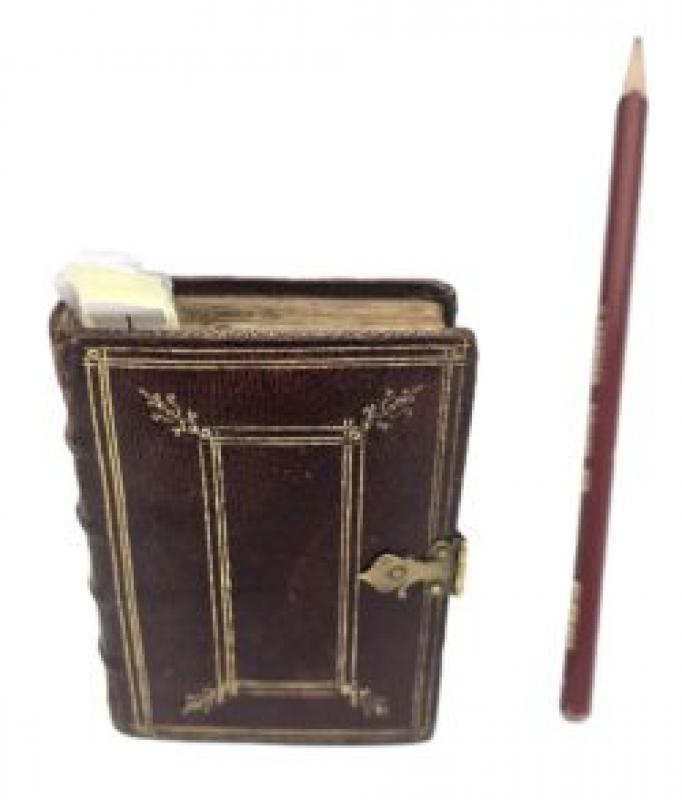
Miniature illuminated manuscript on vellum with 12 full-page and 4 small miniatures by the Parisian atelier of Maître François. 1480-1490 Paris
A tiny and complete Parisian Book of Hours with a plethora of intricate illuminations. 91 x 65mm (3.6 x 2.6in). 190 leaves on vellum, additional 4 paper leaves after (plus 3 paper endleaves at front and back) Complete, collation: 1-238, 246. Modern foliation in pencil at bottom right corners.14 lines, justified 54 x 38mm (2.1 x 1.5in), ruled in red ink, written in small dark brown lettre bâtarde, rubrics in red, penwork initials in blue with red infill or in burnished gold with dark blue infill, and flourishing extending into the margins throughout, line fillers in blue and gold. Calendar in dark brown and red. 4 small miniatures measuring four lines depicting three of the evangelists and their symbols, and the Virgin, touched in gold, some in arched frames, within three-sided panel border decorations of acanthus leaves, wildflowers, and strawberries, some in gold grounds and with black hairline penwork. 12 large miniatures in arched compartments within full borders in the same style, with additional figures of birds, insects, monsters, and a half-naked man, each including a large initial measuring 3-5 lines, blue on red with gold and white penwork, one on liquid gold grounds illuminated with berries. Some occasional light thumbing and cockling, a few smudges, and minor losses of pigment to some of the miniatures, but overall clean and vibrant. Bound in a beautiful 17th-century French red morocco binding with two triple gilt ruled frames to both boards and arabesque stamps at each corner, spine divided into five compartments, all with gilt arabesque decoration, raised bands, gilt roll tooling to board edges, brass clasp and catch in fine condition, minor cracking to one joint and some signs of wear to spine and corners, all edges gilt, marbled endpapers, bookplate to front endpaper, and additional gathering of four leaves inserted at the end, with manuscript prayer in an 18th century hand, in French and Latin. Text: Calendar ff.1-14v; blanks ff.15-16; Gospels ff.17-24v; Joys of the Virgin ff.25-28v; prayers to be said at different times of day and during mass ff.29-40v; Hours of the Virgin, use of Paris, ff.41-100v: matins f.41, lauds f.54, prime f.67, terce f.73v, sext f.78v, none f.83, vespers f.87v; compline f.95; Hours of the Cross, ff.101-108v; Hours of the Holy Spirit ff.109-114v; Seven Penitential Psalms and Litany ff.115-136v; Office of the Dead, use of Paris, ff.137-190v; additional gathering with prayer to the Virgin and the Holy Wound in French and Latin. Illumination: Twelve full-page and four small illuminations by the Parisian atelier of Maître François (fl.1460-80), tentatively identified with François Barbier père, active in Paris between 1455-72. An oeuvre of around fifty manuscripts has been reconstructed for the master through comparison to his only documented work from 1475 (La Cité de Dieu in Paris, Bib. Sainte-Geneviève, ms. 246). Painted in vibrant colours and with unusual marginalia decoration, including lozenge and square divisions within borders, which are also populated with a variety of birds, monsters, and the figure of a half-naked, drunk man. The use of gold thin strokes to highlight is liberally employed throughout the miniatures, the light tones present in the landscapes, and the porcelain-like complexions of the female figures point towards master François’ method. Variants in overall style can be observed in different miniatures within this book of hours, pointing towards a variation in the personal style of different scribes. The subjects of the large miniatures are as follows: St John on Patmos, sitting down writing with an eagle at his side f.17; Annunciation, with the Virgin facing Gabriel, the Holy Spirit flying through an open window f.41; the Nativity, Christ lying on the floor surrounded by the Virgin and Joseph in a barn f.67, Annunciation to the Shepherds, three shepherds gazing up from their flock to an angel holding a banderole ‘Gloria in excelsis Deo’ f.73v, Adoration of the Magi, two figures of the kings in addition to the family, one looking at the Star of Bethlehem f.78v, Presentation in the Temple, with the Virgin’s figure kneeling f.83; the Massacre of the Innocents f.87v; Flight into Egypt, background figures of wheat farmers and an army f.95; Crucifixion, the figure of the fainting Virgin being held by St John and Mary Magdalene, a Roman soldier holding a lance and shield and a richly dressed figure wearing a medieval cardinal’s attire, f.101; Pentecost, the Virgin and the Holy Spirit central to the composition f.109; Bathsheba bathing, King David observing in the background f.115; Death with a spear approaching a nobleman who turns away f.137. The four smaller miniatures depict Luke the Evangelist f.18v, Matthew the Apostle f.20v, Mark the Evangelist f.22v, and the Virgin with Saint Anne f.54.
Sachgebiete: Kunsthandwerk, Stundenbücher, Buchmalerei, Handschriften, Miniaturbücher
60000,- EUR
Differenzbesteuert/Subject to margin taxation
Auf Merkliste setzen 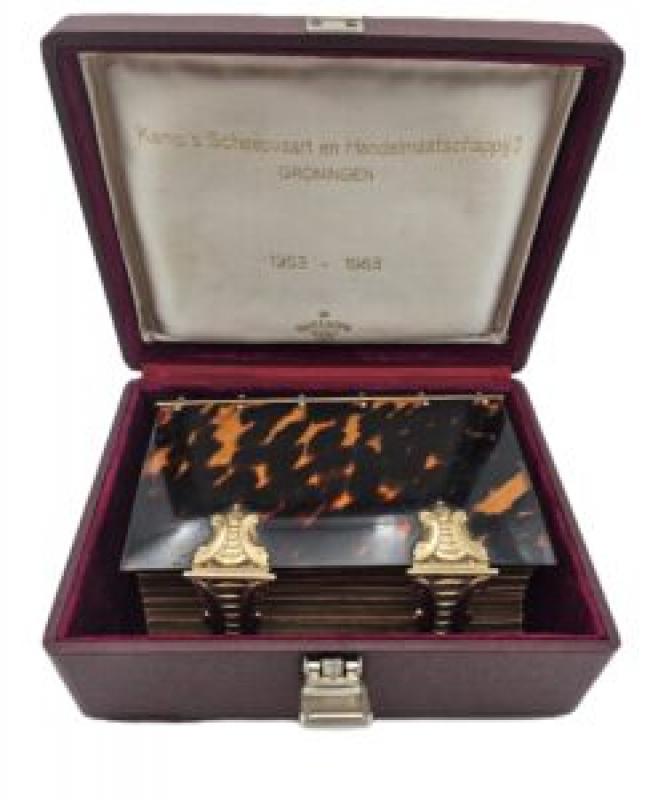
Beautiful tortoiseshell binding with 18-carat gold clasps
Binding, N.T., PSALMS / Amsterdam, Metzler & Basting 4 works in one binding, 542, 508, 364, 94 (1) p. Contemporary Tortoiseshell binding with two 18-carat gold clasps, 24 18-carat golden nails, and gilt-edged text block, 8°. H. 6 x W. 4,10 x D. 2 inches. Dutch church book containing the New Testament, 150 Psalms, evangelical hymns, followed by the Catechism and some Prayers. Attractive binding, bound in brown with fine ochre coloured flamed tortoiseshell. The use of tortoiseshell as a bookbinding material became popular in the 17th and 18th centuries and was primarily used to bind religious texts, small Bibles, prayer books, and gift books for the wealthy middle class. The material came from exotic marine turtles and was valued due to its beauty, shine, and rarity. -The name tortoiseshell can therefore be misleading because the material has nothing to do with land tortoises. Fewer than 4 percent of the luxury bindings made in the Netherlands in the 18th century were covered in materials other than leather and vellum. These bindings were regarded as richer and were more expensive. This is even more true for tortoise shells, since they were not imported in large quantities; as a result, the material remained expensive and available only to the rich.
Sachgebiete: Bibeln, Einbände
6500,- EUR
Differenzbesteuert/Subject to margin taxation
Auf Merkliste setzen 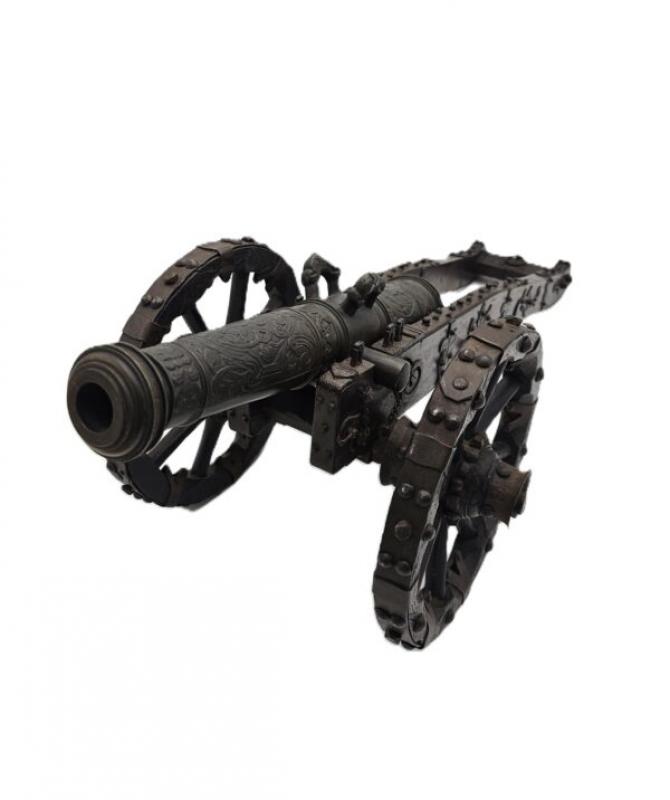
An impressive pair of North European bronze saluting cannons
19th century 68 cm. / 26,77 inch. each Both cannons have tapered barrels and cast decorations of leaves and flowers, and a pair of handles with a leaf motif; the carriages are fitted with iron fittings. Provenance: Private trust founded in aid of Private trust founded in aid of Wyenburg Castle, Echteld. Wyenburg Castle was built in 1178 by two brothers named ‘de Echtelte’. Almost a century later, the castle came into the de Wyhe family, who gave the castle its name. Later, the castle was owned by the Van Wassenaer and Van Balveren families. The castle as it stands now was built in the 16th century, although there are still sections of the castle which are medieval. In 1928, the castle was sold to Mr. B.F. Baron van Verschuer. In 1956, Baron van Verschuer gave the castle to the Gelderland Trust. A full restoration of the castle was realized between 1967 and 1973.
Sachgebiete: Antike, Art deco , Geschichte, Militaria
8500,- EUR
inkl. 19% USt./incl. 19% VAT
Auf Merkliste setzen 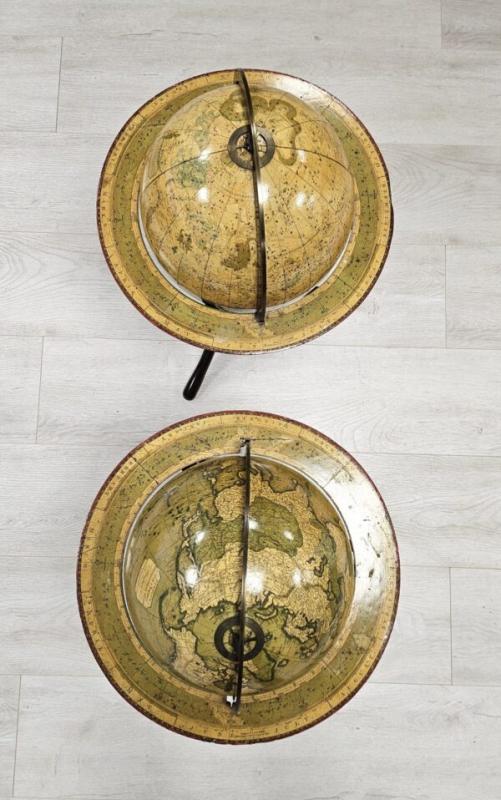
A pair of Terrestrial & Celestial library globes Newton & Son, London 1841
Diameter globes: 12 inches / 30,5 cm. Total height: 27,5 inches / 70 cm. Full titles: Newton’s New and Improved Terrestrial Globe Embracing every recent Discovery to the Present Time. Manufactured by Newton & Son, 66 Chancery Lane. London, Published Jan: 1st, 1841. Newton’s New and Improved Celestial Globe On which all the Stars Nebulae and Clusters contained in the extensive Catalogue of the late F. Woolaston F.R.S. are accurately laid down, their Right Ascensions and Declinat[ions] having been recalculated for the Year 1830, by W. Newton. Manufactured by Newton and Son, Chancery Lane. London Published Jan 1st 1841. The Terrestrial globe: This globe consists of twelve copperplate, original hand coloured varnished gores, expertly crafted onto the papier-mache globe itself. Gores are the printed panels with curved sides that taper to a point at each end, making up a surface of the globe. They are designed to give a complete three-dimensional map when cut and adhered to the globe. The paper horizon ring shows the months of the year, and the days within each month, plus stars and constellations, along with the names of the zodiac. The globe has a brass hour circle fitted above the north pole. By turning this thin, small metal circle (divided evenly into 24 segments), you can calculate the time difference between various locations on the globe. The globe also features a fully metal graduated meridian ring – a ring that arches 360 degrees around the globe and passes over the two poles. The ring is quartered in four by 90-degree quadrants and constellations. Straddling the equator circle, in the Pacific Ocean region, you will find the Analemma. The Analemma extends between the points 23.5 north and 23.5 south only, or between the Tropic of Capricorn and the Tropic of Cancer. The region between these lines is known as the tropics. The Sun’s rays do not fall vertically outside the tropics. The globe sits above a three-legged mahogany tripod, with a turned base and delightful and elegant tapered feet. The title of the globe is found in the North Pacific Ocean. The globe has an attractive patina because of its age, and is in full original hand colour. Some regions of the world are coloured in a muted green, but for the most part an off-white colour is seen. Some political and country borders are delineated by a thin pale red line. The United States is divided into East and West via the Mississippi River. Mexico extends northwards into Texas, New Mexico and California. Many native American Indian tribal lands are mentioned: Snake Indians, Chepawans, StrongBow (Canada), Fall Indians, Assimboins, Hare Indians (Canada). Old place names are evident in Canada and the United States – many betray the Spanish presence in Mexico at the time; New Norfolk, New Albion, New Navarre, New Madrid, New Leon, New Biscay, to name a few. Condition: The wooden horizon ring has a papered surface, has one restored, diagonal cut, and split. There is some notable surface loss to gores just to the west of Peru in South America, and in the South Pacific Ocean – near to the Analemma. There is black vertical scarring to parts of what would be California and British Columbia in Western Canada. The Celestial globe: The paper horizon ring shows the months of the year, and the days within each month, plus stars and constellations, along with the names of the zodiac. The globe has a brass hour circle fitted above the north pole. By turning this thin, small metal circle (divided evenly into 24 segments), you can calculate the time difference between various locations on the globe. The globe also features a fully metal graduated meridian ring – a ring that arches 360 degrees around the globe and passes over the two poles. The ring is quartered in four by 90-degree quadrants and constellations. This globe also sits on an identical three-legged mahogany tripod, with a turned base and has the delightful and elegant tapered feet. This globe also has an attractive pale patina because of its age. The globe is beautifully varnished, and in general uncoloured, but on closer inspection, you can detect some original applied colour. The title of the globe is to be found just above the Tropic of Cancer, close by a scale of the magnitude of stars. Celestial globes show the apparent positions of the stars in the sky. They omit the Sun, Moon, and planets because the positions of these bodies vary relative to those of the stars, but the ecliptic, along which the Sun moves, is indicated. Condition: The globe is in remarkably good condition, with very few flaws or blemishes. There is one distinct diagonal split or crack to the horizon ring, at December. There is some minor discolouration to the top of the gores that are under the brass hour circle at the North Pole. Seen and displayed as a pair of matching table globes, these are very handsome indeed. Beautifully made and produced by one of the premier globe makers of the 19th-century in England. They would be a fine addition to any academic institution, or make a welcome addition to any home or library into which they were placed.
Sachgebiete: Art deco , Globen, Kartographie
19500,- EUR
Differenzbesteuert/Subject to margin taxation
Auf Merkliste setzen 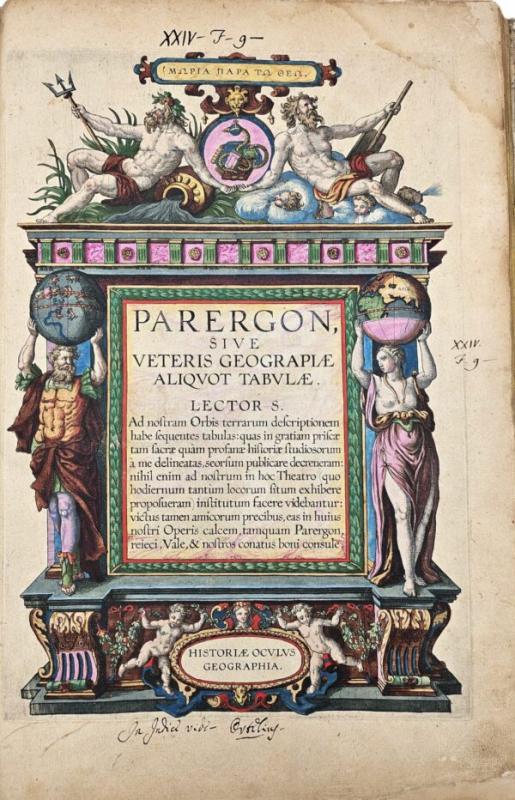
Ortelius, Abraham An attractive copy of this monumental work with all maps contemporary hand-coloured.
Antwerp, Jan Baptist Vrients. 1603 Parergon sive veteris geographiae aliquot Tabulae […]. Engraved title, 33 maps of the Ancient World, 2 plates with costumes and 3 views (“Tempe”, “Daphne” and “Escorial”). H. 43 x W. 30 cm. / H. 16.90 x W. 11.8 inch. A fine and complete copy of the Parergon by Abraham Ortelius (1527-1598), published in Antwerp in 1603. This celebrated companion to the Theatrum Orbis Terrarum represents one of the earliest and most influential works of historical cartography. The volume contains a full suite of maps illustrating the ancient world, including the Roman Empire, classical Greece, and Biblical regions. All maps are original, contemporary, hand coloured, exceptionally well-preserved, and vibrant throughout. The engraved title page is richly decorated with allegorical figures and classical motifs. Latin text on verso. A highly decorative and scholarly work, reflecting the humanist interest in antiquity and geography. Light age toning and occasional marginal wear are consistent with age. Overall, a very attractive copy.
Sachgebiete: Atlanten, Kartographie
37500,- EUR
Differenzbesteuert/Subject to margin taxation
Auf Merkliste setzen 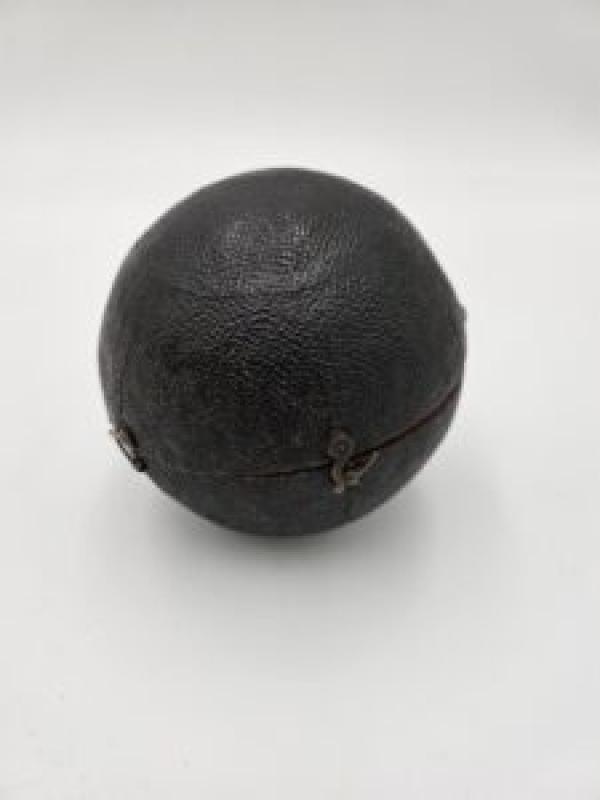
A small miniature terrestrial pocket globe by J. Addison
London, No. 116 Regent St., 1825 A superb small miniature terrestrial globe produced by John Addison & Co. at their premises in Regent Street in 1816. The globe is beautifully housed and enclosed within its original black fish skin case, complete with original hook, clasp, and hinge. The interior of the fish skin case is a striking scarlet colour. The case will close. The globe has its original metal pinions. This globe is in good condition. It has a lovely ‘aged’ feel and patina that can only be achieved by time. The globe is seen in original hand colour, with greens, reds, and off-white. There is cracking to the original lacquered gores, a few minor marks and abrasions – entirely normal and consistent with a globe of this age. Some gores have suffered a slight loss, some loss and discolouration to the gores culminating at the South Pole. The fish skin case is in good condition, and has the normal crazed cracking in its interior; at the extremities of the case have the usual signs of general rubbing and wear. Historically, globes are among the most ancient scientific instruments known to man. They can be dated back over two millennia and are still manufactured to this day. The earliest tradition of globe making is mainly concerned with celestial globes – man has always been fascinated and drawn to the heavens above Celestial globes have always enjoyed a precedent of terrestrial globes. Doubts about the feasibility of a terrestrial globe were firmly expressed by the Greek geographer Strabo, who wrote that such a globe would only make sense if its diameter were approximately 10 feet, presumably because only then could it furnish sufficient geographical detail! The great second-century Egyptian mathematician, astronomer, astrologer, and geographer, Claudius Ptolemy, also considered the large size of a globe to be somewhat of an obstacle and noted a further shortcoming of a terrestrial globe – that one could not view the whole world on it in a single glance. As a result, terrestrial globes were not as popular until much later. The eighteenth and nineteenth centuries are recognized as the high points of English globe making, and this globe illustrates this fact admirably. Many English globes were exported to the continent and throughout the world, many finding their way into famous scientific institutions, libraries, and the stately homes of gentlemen and aristocrats. T he real beauty of globes is that they can be considered to be “all things to all men”; to some they are useful and practical educational tools, (3D maps perhaps); to some others as beautiful and useful scientific instruments; and to more, they may be seen purely as decorative, beautiful pieces of furniture; to be envied and enjoyed, but more importantly, and above all, to be admired by all.
Sachgebiete: Globen, Kartographie
9500,- EUR
Differenzbesteuert/Subject to margin taxation
Auf Merkliste setzen 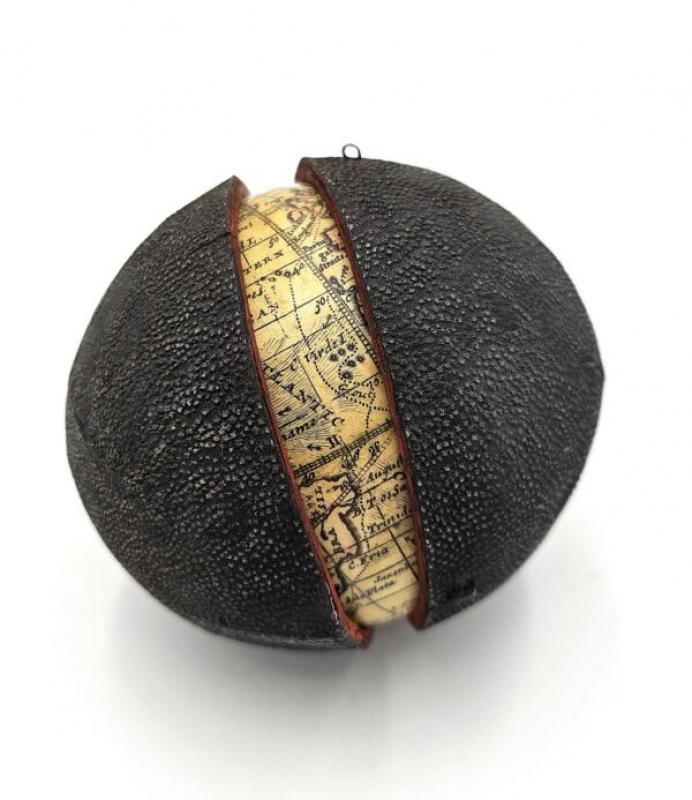
N.N. London (1775). A Correct Globe with y(e) New Constelations of Dr. Halley &c.
Rare pocket globe with a diameter of 2.75 inches. / 7 cm. held in the publisher’s shagreen case. The globe consists of 12 hand-coloured engraved gores and 2 polar caps, the top and bottom of the case each lined with 12 hand-coloured engraved half gores and a polar cap depicting the celestial hemisphere. The design after Moll’s 1710 pocket globe, updated with the latest discoveries, such as California depicted correctly as a peninsula and Cook’s discoveries made visual in the adaptation of Australia and New Zealand. Also shows the tracks of Cook’s first voyage (incorrectly marked 1760 instead of 1770). Attractive contemporary colouring. The globe was formerly attributed to globe maker George Adams, London, 1773, but its actual maker remains anonymous. The globe is in fine condition. The case with the globe inside can’t close. The metal clasps from the case are missing. Some wear and cracks on the outside of the case.
Sachgebiete: Globen, Kartographie
9500,- EUR
Differenzbesteuert/Subject to margin taxation
Auf Merkliste setzen 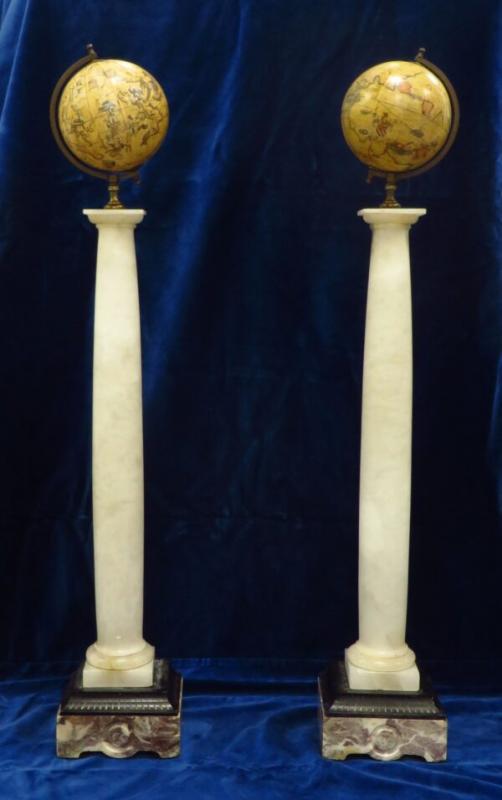
N.N. 19th century. A pair of decorative globes on alabaster and marble column stands.
The 4.25 inch. (10 cm.) spheres applied with twelve printed gores and polar calottes pivoted via the poles within brass half-meridian rings, each mounted on top of alabaster columns with molded capitals, notable entasis to the shafts and Tuscan-style bases, the plinths with gilt fluted black marble cavetto top moldings and roundel-centered skirts incorporating shaped aprons. Each 70cm (27.5 inch.) high, 12.5cm (5 inch.) wide, 11cm (4.5 inch.) deep. The terrestrial and the celestial globe are a reduction, printed after the 1541 original by the early Flemish cartographer Gerardus Mercator (1512-94) for Nicholas Perrenot (possibly of de Granville, Prime Minister to Emperor Charles V).
Sachgebiete: Antike, Art deco , Globen, Kartographie
12500,- EUR
Differenzbesteuert/Subject to margin taxation
Auf Merkliste setzen 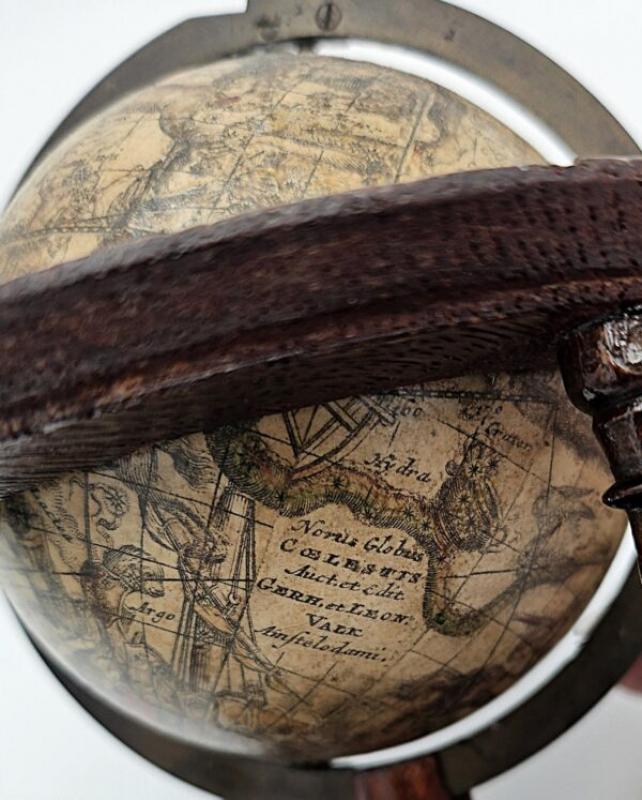
A scarce and beautiful miniature celestial globe produced in Amsterdam during the first quarter of the 18th century. Amsterdam, Gerard & Leonard Valk, 1715-1728
Novus Globus / COELESTIS / Auct. Et Edit. / GERH. Et LEONH. VALK / Amstelodami. Diameter globe: 3 inches / 7.6 cm. – Total height: 5,91 inches / 15 cm. A scarce and beautiful miniature celestial globe produced in Amsterdam by Gerard and Leonard Valk during the first quarter of the eighteenth century. A celestial globe is a mounted sphere, displaying the stars and zodiacs. This globe consists of twelve copper plates, original hand-coloured varnished, clipped elliptical gores, and two celestial calottes – all expertly crafted onto the papier-mache globe itself. Gores are the printed panels with curved sides that taper to a point at each end, making up a surface of the globe. They are designed to give a complete three-dimensional map when cut and adhered to the globe. The globe sits on four lovely, turned wooden mahogany stands, with rectangular cross stretchers all meeting at a central point beneath the globe. The globe has delightful bun feet. The celestial calottes are on the ecliptic poles. The globe has a brass meridian ring and hour dial with a hand-coloured printed paper ring on the wooden horizon ring, showing degrees and the days of the houses of the Zodiac. The title is (without a cartouche) situated between Hydra and Argo. Only the stars of the first five magnitudes are given; the chart is placed between Phoenix and Cetus. Highlights include: Stars: Individual stars are marked, often using different-sized dots to indicate their magnitude (brightness). Constellations: Figures representing the constellations (such as Orion, Ursa Major, Pegasus) are typically drawn and labelled, often based on the traditional 48 Ptolemaic constellations from Greek and Roman astronomy. The colouring on this miniature globe is certainly contemporary if not original. All the engraving is rendered to the highest standard. The globe is presented in excellent condition. There are a few minor dents and blemishes due to restoration, just below the Bear (Ursa Major) constellation. The horizon ring shows signs of slight wear. Gerard Valk, along with his son Leonard, was the only significant publisher of globes in the Netherlands during much of the 18th century, and enjoyed a near monopoly in the first half of the 1700s. Gerard Valk was apprenticed in London during the 1670s; however, he returned to Amsterdam during the late 1680s and quickly established his own business. In the early days, he often worked in collaboration with his brother-in-law, Petrus Schenk. Valk was tutored in the art of globemaking by Pieter Smit. Valk’s globes soon met with widespread acclaim, and he swiftly produced several globes with 3,6,9,12,15, 18, and 24” diameters. In 1711, Gerard’s son, Leonar,d joined the business and became a partner, and gained full control of the business after the death of his father in 1726. After Leonard’s own death in 1746, globe production continued under Maria Valk (nee Schenk), wife of Leonard, and daughter of Petrus. The miniature or pocket globe was a British invention, introduced to the world by Joseph Moxon in 1673 when he produced a 3” globe. To own a pocket globe is to have the whole world in miniature. Pocket globes were never to be taken very seriously; they never served any practical purpose. Their size makes accurate calculations impossible, and they tend to lack the rings and dials for the most common manipulations. No, they were seen more as a status symbol, or a lovely decorative, artistic artefact to reside on a gentleman’s desk or small table. There is a school of thought that some of the cheaper pocket globes may have aided children’s education. Today, they reflect a lost and never-to-be-forgotten bygone age of exploration and discovery. The heyday or peak time for the pocket globe was the late 18th century. A unique opportunity to acquire and own a most desirable celestial pocket globe, in very good condition, produced by one of the very finest globemakers in Europe.
Sachgebiete: Globen, Kartographie
35000,- EUR
Differenzbesteuert/Subject to margin taxation