 Auf Merkliste setzen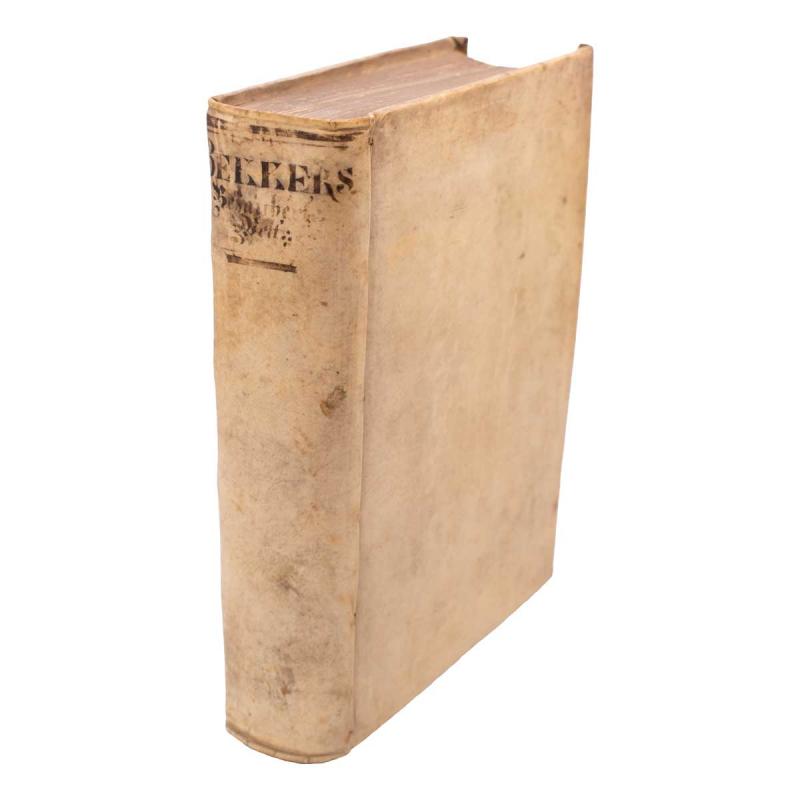
BEKKER, BALTHASAR
THE MOST IMPORTANT WORK OF THE TIME COMBATING BELIEF IN GHOSTS, WITCHCRAFT, AND SORCERY Die bezauberte Welt: Oder eine grundliche Untersuchung des allgemeinen Aberglaubens. Aus dem Hollandischen (ubers. von J. Lange) First German Edition, 4 parts in 1 vol., 39, [1], 136, 270, [2], 195, [3], 308, [4]pp., 1 woodcut plate, small woodcut portrait to title, text in German Black, woodcut initials and tail-pieces, contemporary vellum over boards, yapped edges, manuscript title to spine, sprinkled edges, 4to (230 x 170mm)“Amsterdam, D. van Dahlen” (i.e. probably Hamberg), 1693. Balthasar Bekker (1634-98) was a Dutch pastor and Cartesian rationalist who wrote what was in many ways the seventeenth century’s most fundamental and influential critique of demonology and witchcraft belief, Die bezauberte Welt or The Enchanted World. He was the last of the Dutch thinkers, from Weyer to Grevius, who kept Holland free from the abuses of the witch hunters. The liberal climate thus engendered had made Holland the only country where Reginald Scot had been translated. He first attracted attention in 1683 after publishing his Inquiry into Comets to show they were not portents of evil. In 1691, first in Dutch, then in 1693 in German, he published Die bezauberte Welt, where he attacked the entire demonological system as a lack of confident faith in the goodness and wisdom of God. Putting his critical reason to work in the areas of scriptural interpretation, formal theology, natural history, and natural philosophy, and offering alternative explanations of generally accepted witchcraft incidents, Bekker was one of a handful of seventeenth-century thinkers preparing the conceptual and intellectual path for a complete renunciation of the demonological beliefs that had stood the tragic test of time for centuries. Since the belief in the influence of spirits had crept into Christianity from paganism, said Bekker, there was no reason to credit the pact between the witch and the Devil, the core of the theory. In fact, Bekker added, the theory of witchcraft was invented by the papacy “to warm the fires of purgatory and to fill the pockets of the clergy,” who burned witches to confiscate their property and to pay the salaries of the inquisitors. Bekker’s work was both widely admired and criticized in its time; within two months of its first Dutch publication the work had sold four thousand copies in the Netherlands alone. However, it cost Bekker his position as a Calvinist minister. Refusing to recant, on August 21, 1692, Bekker was expelled by the Reformed Dutch church, but the Amsterdam magistrates prevented a public burning of his book and continued to pay his magisterial stipend. He was still outside the Church at his death in 1698. Many writers engaged in a war of words, attacking and defending Bekker’s views, especially his denial of demoniacal possession. Bekker himself refused to participate in the debate, but in 1692 defended himself in die Friesche Godgelehrheid. After his death, rumours circulated that he had changed his views, but this suggestion was repudiated by his son, Jan Hendrik Bekker. The engraving shows the so-called "Oldenburg Horn," widely known through its reuse in "Des Knaben Wunderhorn." [ VD 17 3:303184Q. Bircher B 13458. Coumont B 40.7. - Without distinguishing variants: Crowe 43. Hayn/Gotendorf III, 177. Graesse, BMP, 62. FdF 1270. Jouin 857. Caillet 915;Witchcraft in Europe, 1100-1700 / Alan Charles Kors. 1972; The Encyclopedia of witchcraft & Demonology/ Rossel Hope Robbins/ 1984]
Sachgebiete: Occulta
2335,- EUR
inkl. 19% USt./incl. 19% VAT
Auf Merkliste setzen 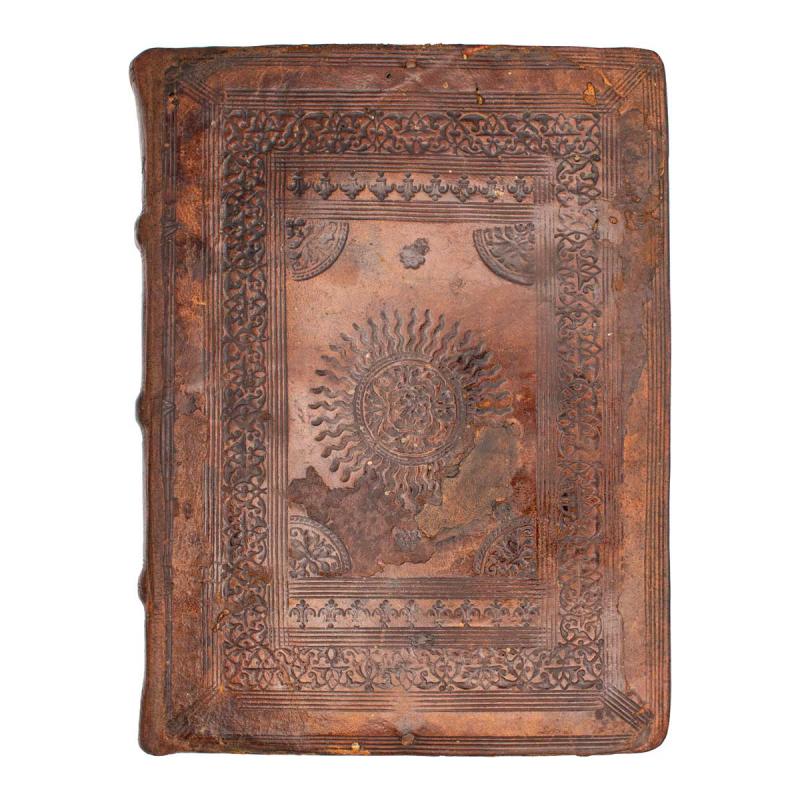
[PAPAL BULL - CONJURING, WITCHCRAFT] POPE BONIFACE VIII (1235-1303), et al
Sextus decretalium liber... in concilio Lugdunesi editus [and:] Clementis quinti constitutions in concilio vienensi edite... [and:] Extravagantes viginti Joannis vigesimisecundi... [and:] Extravagates coes Additio ultra priorem impressione... [and:] Constitutiones do domini Eugenii IIII. Pontificis marimi de unione Grecorum Armeno… cclxxxviii, cxx, lxiiii, lxiiii, xi pp., printed throughout in red and black, numerous woodcut text illustrations and diagrams, text in double columns, title foredge expertly restored without loss to text, early ink marginalia throughout, final two parts with light marginal dampstaining and occasional marginal worming, contemporary caf, boards blindstamped with elaborate design, rebacked, 4to, [Venice: Luceantonii de Guinta, 1514] Issued in five parts, this collection of canon law is actually an omnibus of civil laws, researched and written primarily by jurists of the time. Beautifully printed by Giunta, the woodcuts depict church life as well as civil life. This collection of canon law norms includes Boniface VIII's Sacrosanctae bull from 1298, which integrated the Liber Extra with the newer canonical norms from 1234. It was issued during a period of intense conflict between the Papacy and European monarchs. Pope Boniface VIII (r. 1294–1303) was a controversial figure due to his involvement in foreign affairs. He became a personal enemy of the poet Dante due to his interference in Florentine politics (ultimately resulting in the poet’s exile). Boniface was the target of allegations regarding witchcraft and sorcery, largely propelled by his political enemies, particularly King Philip IV of France. Accusations suggested he kept a familiar demon, practiced magic, and was a "good friend of the Devil". These charges were, in part, a political weapon to discredit him and a reflection of 14th-century anxieties, with claims that he was a sorcerer, a diviner, and an enchanter who used illicit arts. The third work, Extravagantes viginti Joannis vigesimisecundi (Twenty Extravagants of Pope John XXII) is a specific collection of twenty papal constitutions (decretals) issued by Pope John XXII (1316–1334) that were not included in the official Clementines (constitutions of Pope Clement V) and were therefore considered to be "wandering" or "outside" (extravagantes) the Corpus Juris Canonici. On the verso of fol. 137 is a woodcut depicting an itinerant conjuror performing tricks to an audience, with a caption warning that clerics should not engage with such undignified persons, as conjurors are jokers, fools, and buffoons.
Sachgebiete: Jura, Occulta, Theologie
5250,- EUR
inkl. 19% USt./incl. 19% VAT
Auf Merkliste setzen 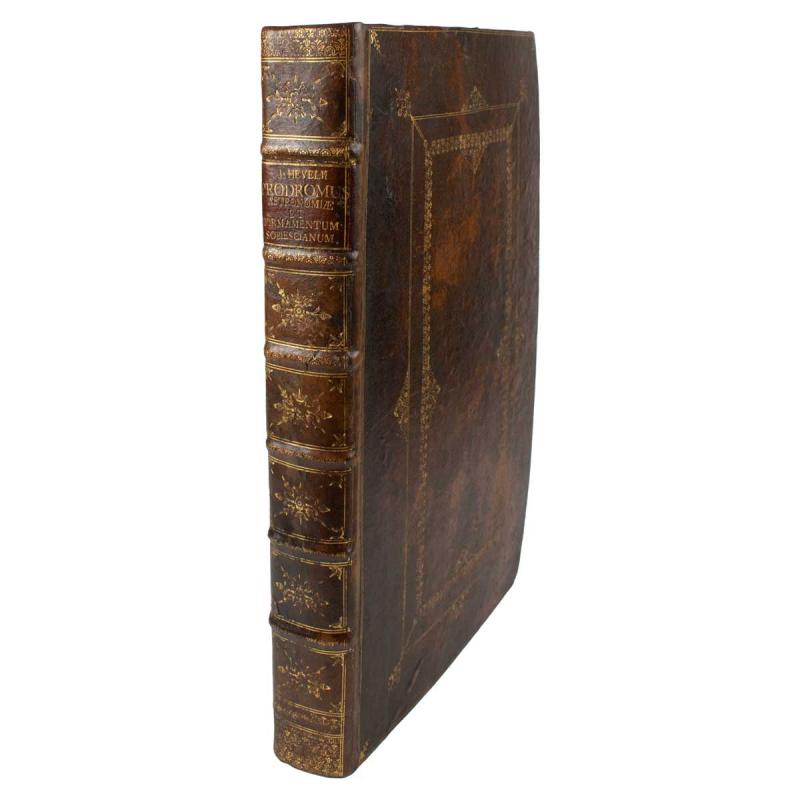
HEVELIUS, JOHANNES.
Prodromus Astronomiae, exhibens fundamenta, quae tam ad novum plane & correctiorem stellarum fixarum catalogum construendum. Danzig, Johann Zacharias Stoll, 1690. Folio [39.2 x 22.9 cm], double page engraved frontispiece displaying an Observatory with a scene of a meeting of Hevelius and other astronomers including Ptolemy, Tycho Brahe, Riccioli, and others, (10) ff. (including general half-title and title), engraved portrait of Hevelius 142 pp, single-page engraved plate A* bound opposite p. 96 as usual, engraved headpiece and initial, woodcut headpieces,tailpieces and initials,with the double-page engraved title to the Firmamentum, Contemporary polished calf gilt. [Bound with:] ____. Catalogus stellarum fixarum ex observationibus multorum annorum. Danzig, Johann Zacharias Stoll, 1687. 143-350 pp., (1) f. [And with:] ____. Firmamentum Sobiescianum, sive Uranographia, totum coelum stellatum. Danzig, Johann Zacharias Stoll, 1690. (1) f. title, 21 pp., (1) p. circular engraved vignette, with engraved headpiece vignette, (2) oversized folding plates of planispheres & 54 double-page engraved plates of the constellations in excellent fresh impressions, One chart has some colour on one of the celestial figures. Rare first edition of Hevelius’ star atlas, along with the Introduction (Prodromus) and the catalogue of stars, together as issued: a fundamental text in the history of astronomy and a spectacular illustrated book. The Firmamentum Sobiescianum is considered the most detailed and influential celestial atlas of its time, both in the formation of subsequent atlases and in the production of celestial globes: “Contemporary globes, such as those by G. C. Einmart, and Gerhard and Leonhard Valk, often acknowledge Hevelius as their source. Later constellation outlines and draftsmanship also owed much to the Uranographia” (North, DSB VI.364). The star atlas contains 73 constellations, of which 12 are introduced here by Hevelius himself. His discoveries include the Scutum Sobiescianum (the shield of Sobieski, i.e., the shield with which King Jan III of Poland defended Europe against the Turks, and which Hevelius so named to acknowledge the latter’s financial support); the “Lynx”, a grouping of very faint stars named because one needed the sharp eyes of this animal in order to see them; and the “Sextans”, which he called after one of the many astronomical instruments he designed. These names as well as several others coined by Hevelius are still used by astronomers today. The 57 star maps were drawn by the Polish artist Andreas Stech and engraved by Charles de la Haye, though on the basis of his known involvement in making the plates for other works, North has suggested that Hevelius had a hand in these as well. The publication history for these works is somewhat unclear, as is typical with posthumous publications: Hevelius died in January of 1687, and the work was seen through the press by his widow. Two dates are associated with the Firmamentum: 1687, which appears on the handsome engraved title, and 1690, which appears on the printed title page. The title page of the Catalogus Stellarum is also dated 1687. The printed title page of the Prodromos, however, is dated 1690. This disparity in dates has led some to hypothesize that the star atlas and the Catalogue may have been issued separately for limited distribution in 1687. See the Brigham Young Catalogue, #18, which cites the Harvard copy in its defence: that copy has a frontispiece and plates but does not possess the printed title page nor text leaves. This theory is corroborated by a letter written two months after Hevelius’s death by his assistant Christoph Colbe, indicating that the star atlas was already printed, but publication was delayed until after the Catalogus went to press. It is plausible that all three titles circulated separately as early as 1687. By 1690, however, they were joined (reference is made to “the book”). Most often the three parts circulate together. * Johannes Hevelius and his Catalogue of Stars, 55-58; J.D. North in DSB VI.360-64; Kenney, p. 83; Warner, The Sky Explored, p. 113, n. 8.
Sachgebiete: Astronomie, Atlanten, Kartographie
87500,- EUR
inkl. 19% USt./incl. 19% VAT
Auf Merkliste setzen 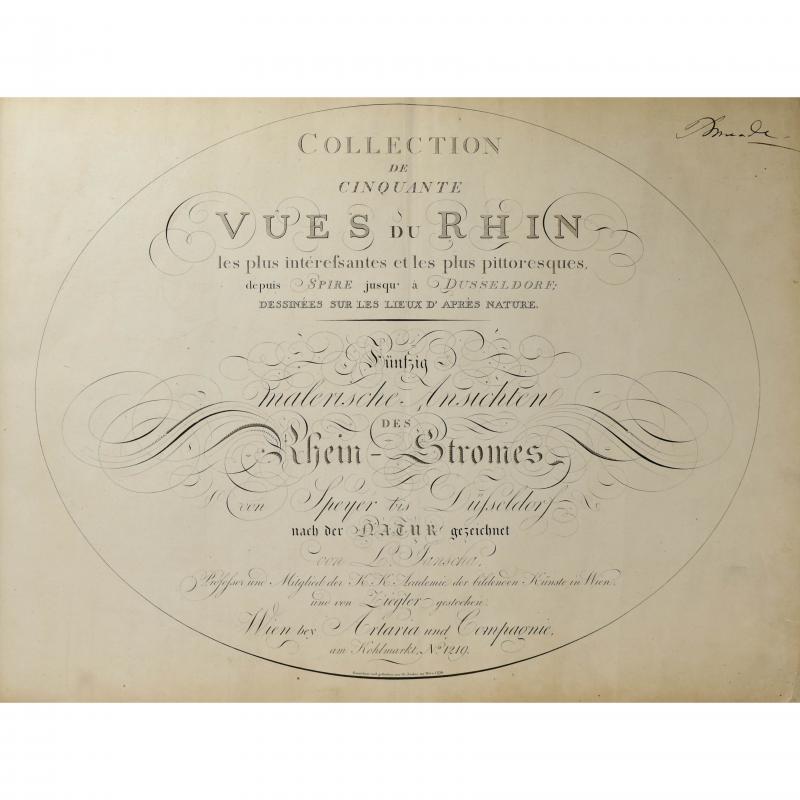
JANSCHA, LAURENZ & ZIEGLER, JOHANN.
Collection de Cinquante Vues du Rhin. depuis Spire jusqu'à Dusseldorf Dessinees sur lieux d'apres Natur 1798. Fünftzig malerische Ansichten des Rhein-Stromes von Speyer bis Düsseldorf nach der Natur gezeichnet. Vienna, Ataria & Co., 1798. Large Folio, (420 x 550mm), attractive binding of full red morocco gilt, engraved title and 50 finely fully hand-coloured, etched and aquatint plates within wash borders, text in German and French. A MAGNIFICENT SERIES OF FINELY HAND-COLOURED VIEWS OF THE RHINE, including the major cities, castles and sights along the river at Speyer, Mannheim, Worms, Mainz, Bingen, Koblenz, Bonn, Andernach, Gottesberg, Poppelsdord, Cologne and Dusseldorf, and elsewhere. FIRST EDITION This has now become a rare and splendid work and is rightly considered to be the most beautiful collection of Rhine Views ever published. (Schmitt 114). "The Viennese landscape painter Laurenz Janscha (1749-1812) and the draftsman and engraver Johann Ziegler (1750-1812) created a rococo-style work of Viennese Views probably under instruction from Maximilian Franz, son of the Austrian Empress Maria Theresa " One of the most beautiful of all German colour plate books, and undoubtedly the mostmagnificent series of views of the Rhine. One of the earliest of the spectacular colour-plate books on the journeys of rivers. Although this vogue can be said to have started with Gilpin's book on the River Wye, the first of the great books was probably Boydell's Thames (1794). The present work appeared shortly after that book and pre-dates the river journey books by Ackermann. In the Romantic tradition of book illustration, it shows the great castles and ruins of the middle-ages in the most picturesque settings (Haberland, Illustr. Rheinbücher 24).
Sachgebiete: Deutschland, Papier/Buntpapier
50850,- EUR
inkl. 19% USt./incl. 19% VAT
Auf Merkliste setzen 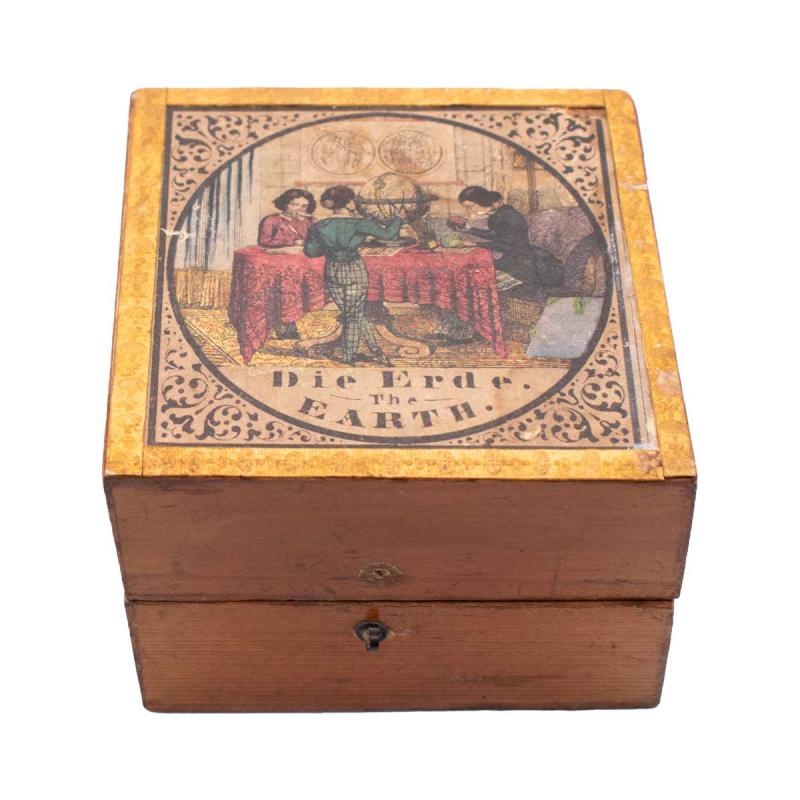
KLINGER, J.G.
[POCKET GLOBE] Die Erde/The Earth A 2inch (57mm) diameter miniature globe, 12 handcoloured copper-engraved gores laid on a solid sphere with two brass axis pins, fitting into notches in a horizon ring serving as a shelf in wooden box, box with engraved paper cover depicting 2 children and an adult around a table studying globes titled "Die Erde. The Earth," lid of box unattached, published by J.G. Klinger, Nuremberg, c.1850. A charming mid-nineteenth century German pocket globe published in English. The globe rests on metal pinions at either pole in a full horizon band with engraved paper calendar and zodiac, fitted and spinning in a lidded wooden box for display, transport and storage. The equatorial is graduated in degrees. The ecliptic is shown but not graduated. The Antarctic is called " Icy Sea " with coastline shown for Wilkes Land; Australia is called New Holland; Tasmania (V. Diemans L.) is drawn as an island. Johann Georg Klinger began producing globes in 1790 in Nuremberg. Klinger produced small globes in various sizes and cases for the continental and English market. They are often found in cylindrical paperboard cases, or sometimes in hinged wooden boxes such as this example. Dekker Globes at Greenwich GLB0239.
Sachgebiete: Kartographie, Deutschland, Globen
5250,- EUR
inkl. 19% USt./incl. 19% VAT
Auf Merkliste setzen 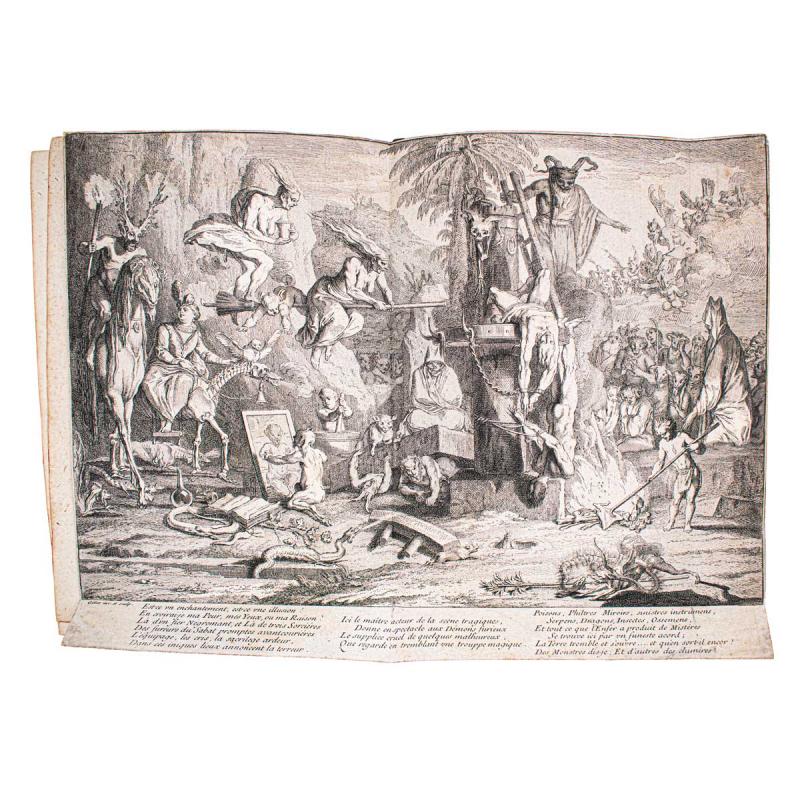
LANCRE, PIERRE DE
Tableau De L’Inconstance des Mauvais Anges et Demons. Ou Il Est Amplement Traieté de la Sorcellerie & Sorciers. FIRST EDITION, [28], 568, 2 engraved folding plates inserted, woodcut printers device, head and tailpieces, inhabited initials, marginal annotations in an old hand, marbled endpapers, full mottled calf, spine gilt, a.e.r., 4to, Paris, Jean Berjon, 1612 “... the last author on this subject who possessed judicial authority and himself carried out violent repression” - Julio Caro Baroja First Edition of the first, and most influential, of de Lancre’s work on demonology. Born in 1553, de Lancre studied in Toulouse and Turin. In 1583 he joined the Bordeaux parliament as a magistrate. De Lancre was one of the immensely learned lawyers who, towards the last third of the sixteenth century, gave a destructive twist to the witchcraft debate. He was entirely convinced of women’s inclination toward witchcraft and their universal threat to the individual, the community, and the state. He felt especially convinced that such practices threatened the political and economic stability in the French border regions, especially since the French religious wars had made it imperative to secure French territories. In 1609 King Henry IV of France appointed him head of a commission to investigate the activities of witches in the Labourt, the Basque region of France. According to de Lancre, most of these people engaged in active satanic associations and practices. During the course of a visit that lasted just four months, de Lancre, by his own account led investigations against forty-six suspected witches, among them twelve priests, and thirty-five informants. At least two dozen suspects were executed. This judicial operation had significant repercussions on both sides of the border with Spain. Accused witches fleeing south triggered the final witch-hunt undertaken by the Spanish Inquisition, ending in a major auto-da-fé in 1610. De Lancre’s frequent comments on the antisocial and antinationalist behaviours of the Basque people make it clear that the witch prosecutions had not only religious but political motives as well. These prosecutions clearly formed part of the French move toward the absolutist state. The rampage was finally stopped by de Lancre’s own colleagues, the judges of the Parlement of Bordeaux. In Spain, the episode soon led the Inquisition to stop executing witches altogether. In France, similar scepticism provoked de Lancre to publish ‘Tableau De L’Inconstance des Mauvais Anges et Demons’. A report on his extraordinary stay in the Basque country, de Lancre based the ‘Tableau’ on the original trial records. Since these records were destroyed in the eighteenth century, de Lancre’s report is the only surviving account of the proceedings of the trials. ‘Tableau’ is divided into six books, which deal with the more important problems which confronted him during his investigation. First he establishes the inconstant nature of demons, their number, and their special appeal to women. Books II and III enlarge the sabbath; de Lancre then returns to themes already suggested at the beginning: the ability of demons to change their shape, either in fact or through illusion. Book V enumerates the cures a man might adopt to counteract the wiles of the Devil. De Lancre concludes his work with an important discourse on priests and witchcraft, a learned rebuttal of the Canon Episcopi which leads him to stress the need to exact the severest punishment for crimes of witchcraft. Pierre de Lancre, is perhaps the greatest expert on the witch’s sabbath, constructing one of the most vivid descriptions based on the trials and testimonies in the Basque. Few demonologists blended learned and popular beliefs as effectively as he did. He described children being presented with toads in velvet suits, to be guarded while their parents amused themselves with the unspeakable pleasures of the sabbath feast. De Lancre believed that the witches’ sabbath was ongoing but only visible to the witches themselves. His ‘Tableu’ had celebrated authority in action against witches. De Lancre produced a report that went beyond the established parameters on witchcraft indictments and warnings. The reasons for this departure are two fold; his account is clearly more politically motivated than comparable works of the period. De Lancre is writing for his colleagues to convince them of the need to exercise control. He firmly believed witches to be a threat to the body politic, offering a detailed argument as to why secular magistrates and the government had to move with firmness and vigour against the menace witches posed. De Lancre dedicated his work to Chancellor Sillery, who set in motion the banishment of magicians, devils and sorcerers. Additionally, his vigorously argued legal tract can be read as an ethnological exploration of the Lambourt region and its Basque inhabitants. His descriptions of the religious, demonological, and judicial aspects of the witchcraft phenomena have much in common with contemporary reports of travel to the New World. Two eighteenth-century plates have been inserted into this work. The first work is by Jean Crespy, for Laurent Bordelon’s ‘L'Histoire des Imaginations Extravagantes de Monsieur Oufle’ (1735). This satirical work tells the story of a Mr. Oufle who reads so much about ghosts, witches, devils that he begins to have all sorts of strange visions. Mr. Oufle is shown here bottom left observing the bizarre sabbath scene accompanied by a jester. The devil worshipers are banqueting on babies and performing somersaults before the devil who is seated at centre. The work captures all the stereotypes of a witches sabbat including crones riding broomsticks, cauldron magic, dancing and dining with demons. The second engraving is by Claude Gillot, from a pair of engravings titled “Les Sabbats” (1722) depicting a witches’ sabbath. In the centre a stag-horned shaman presides over the torture of two men tied to a spinning device. On the left two masculinised crones ride on a broomstick with a small child. An elegant woman mounted on the skeleton of a horse, accompanied by a stag-horned man on a lion-faced horse. In the background hordes of animal-faced demons gather to watch the night's proceedings. [USTC:6011140; Witchcraft and Catholic Theology, Baroja; Defining Dominion, Williams, 1995; The Damned Art, 2012; The Oxford Handbook of Witchcraft in Early Modern Europe and Colonial America, 2013]
Sachgebiete: Volkskunde, Frankreich, Jura, Occulta
14600,- EUR
inkl. 19% USt./incl. 19% VAT
Auf Merkliste setzen 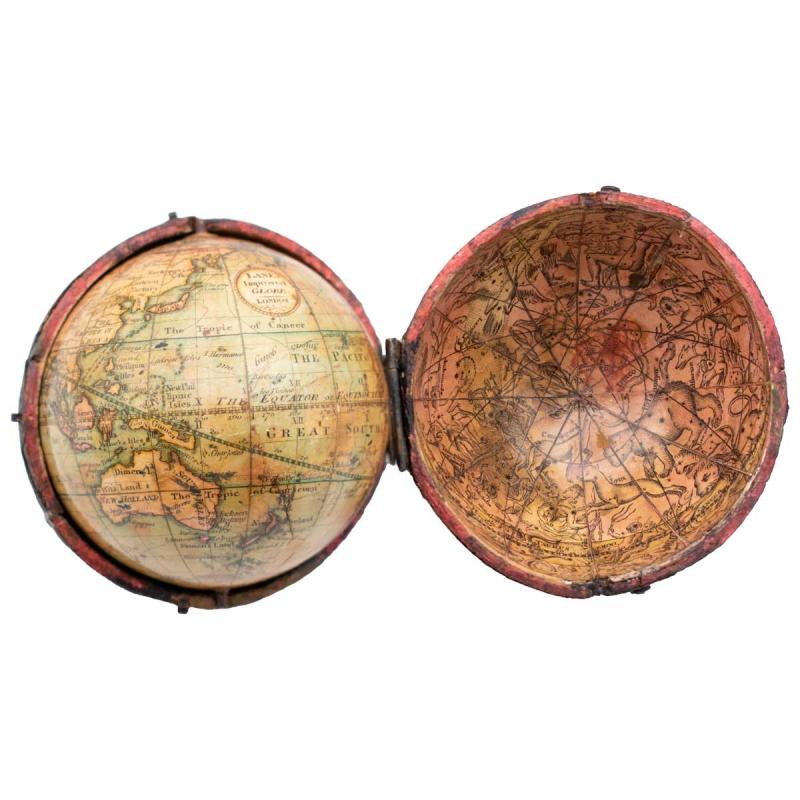
LANE, NICOLAS
[POCKET GLOBE] Lane’s Improved Globe Terrestrial pocket globe, 70mm, 12 hand-coloured engraved gores, axis pins at poles, title in cartouche, a few areas of abrasion to the surface of the globe, contained in original imitation fishskin-covered case, metal clasps, case interior lined with celestial gores, partially hand-coloured and varnished, case slightly cracked, two halves joined with brass hinge and three brass hook-and-eye closures, London, c.1833 This pocket globe shows the tracks of several voyages including those of Anson and Cook’s second voyage. The location of the ‘Antipodes to London’ are marked, as well as the monsoon in the Indian Sea. The Great Wall of China is depicted and labelled ‘The Chinese Wall’. California is shown as a peninsula and Australia and New Zealand are drawn according to the Dutch discoveries. The case shows an engraved celestial chart of the Northern Sky on one side and the Southern Sky on the other. The celestial projection is geocentric but the constellations are seen from the back. The stars are represented by different symbols but there is no magnitude table. The Milky Way is labelled. The 48 Ptolemaic constellations and four of the non-Ptolemaic constellations are drawn. Four of the southern constellations are also drawn, as well as those of Plancius and all those of Hevelius [cf. Van der Krogt Lae 5 and 6]
Sachgebiete: Kartographie, Globen
10500,- EUR
inkl. 19% USt./incl. 19% VAT
Auf Merkliste setzen 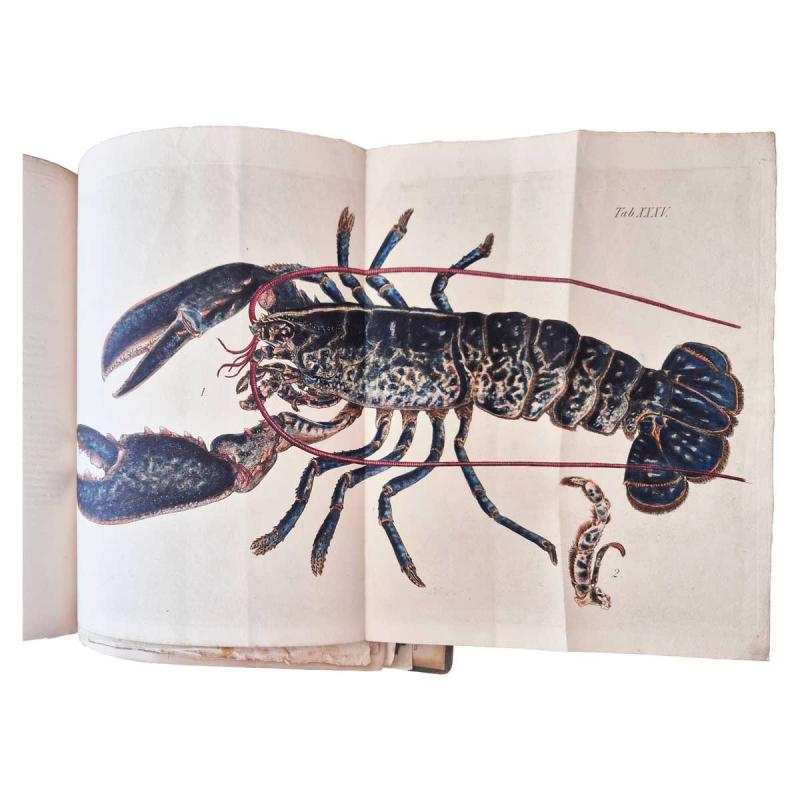
LEACH, WILLIAM ELFORD
Malacostraca Podophthalmata Britanniæ; or, Descriptions of such British species of the Linnean Genus Cancer as have their eyes elevated on footstalks. Illustrated with figures of all the species, by James Sowerby [and] Continued and Completed, with a New Generic and Specific Index to the Whole, and Seven New Plates, By George Brettingham Sowerby. First edition, folio (30.5 x 24 cm); later half blue morocco, marbled sides, with54 hand-coloured plates of which 4 are folding, original blue wrappers of each part bound in at the rear, a little light toning and spotting to the contents, a few repairs to edges of text etc, a complete uncut copy of this rare work. A complete set of 'one of the most beautiful publications devoted to Crustacea' (Biodiversity Heritage Library), with the original wrappers for each part bound in. Though trained in medicine, William Elford Leach (1791-1836) never worked as a physician, but instead joined the British Museum as a naturalist. 'Although Leach's interests ranged over many groups of animals, he soon developed a passion for entomology and malacology. He was an enthusiastic collector of British insects who greatly enriched the entomological collections at the British Museum, and whose knowledge of the Crustacea was regarded as superior to that of any other naturalist of his time' (Oxford Dictionary of National Biography). The artist James Sowerby (1787-1871) was both a naturalist and the leading natural history artist of the period and, 'although responsible for the description of many taxa, his main contribution to natural history had been "the portraits of natural objects he has left behind him. delineated faithfully from. acquaintance with their form and structure" (W. Sowerby, cited in Simpkins, 393), "which no pencil or burin, but those of a scientific artist could possibly accomplish"' (Buckland, cited in the Oxford Dictionary of National Biography).
Sachgebiete: Papier/Buntpapier, Naturwissenschaften, Ozeanologie
5800,- EUR
inkl. 19% USt./incl. 19% VAT
Auf Merkliste setzen 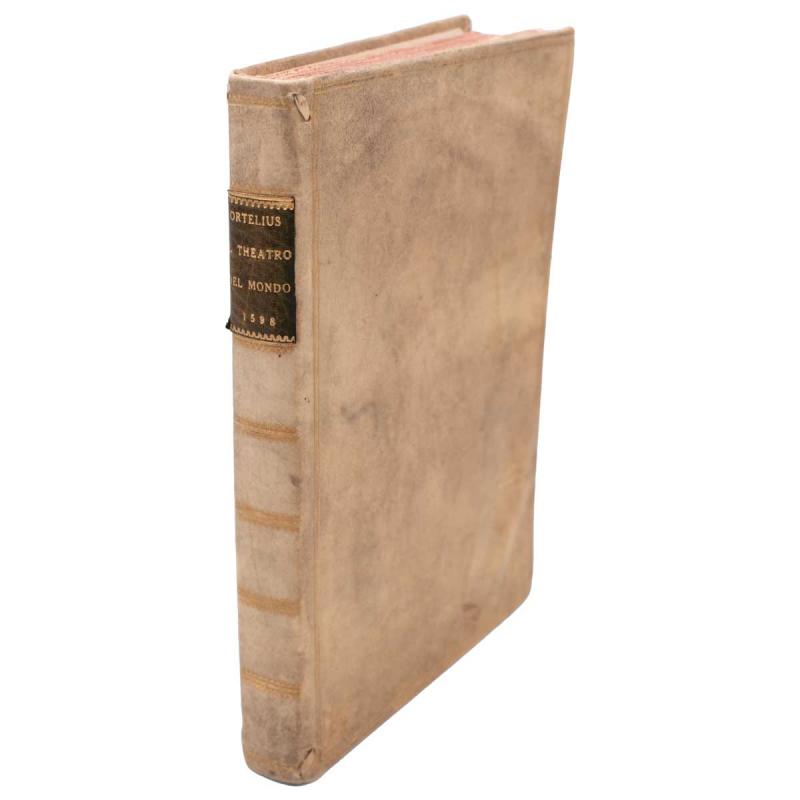
ORTELIUS, ABRAHAM
Il theatro del mondo nelquale distintamente si dimonstrano in tavole tutte le provincie, regni e paesi ... ridotto dalla forma grande in questa piccola… Brescia: Compagnia Bresciana, 1598, 4to (190 x 132mm). Printer's device on title, without blanc 06, woodcut headpieces and initials, 109 engraved maps in the text,a restored minor tear on title without any loss, later full vellum, double gilt fillet on covers, gilt decorations, Morocco title on spine. Earliest edition of the Epitome of Ortelius and of the translation by Filippo Pigafetta (1533-1604), to appear in Italy. The charming maps, copied from the first Galle editions of the Epitome, are printed on the upper part of the recto pages, with text on the lower part and on verso. ‘The main difference from the originals is that the names of the regions were engraved at the bottom, outside the frame.’ Koeman III Ort 69; Van der Krogt 33A:01; Sabin 57702 (date misprinted 1589.
Sachgebiete: Atlanten, Kartographie, Vermessungswesen , Landkarten, Reisen/Reiseliteratur
10000,- EUR
inkl. 19% USt./incl. 19% VAT
Auf Merkliste setzen 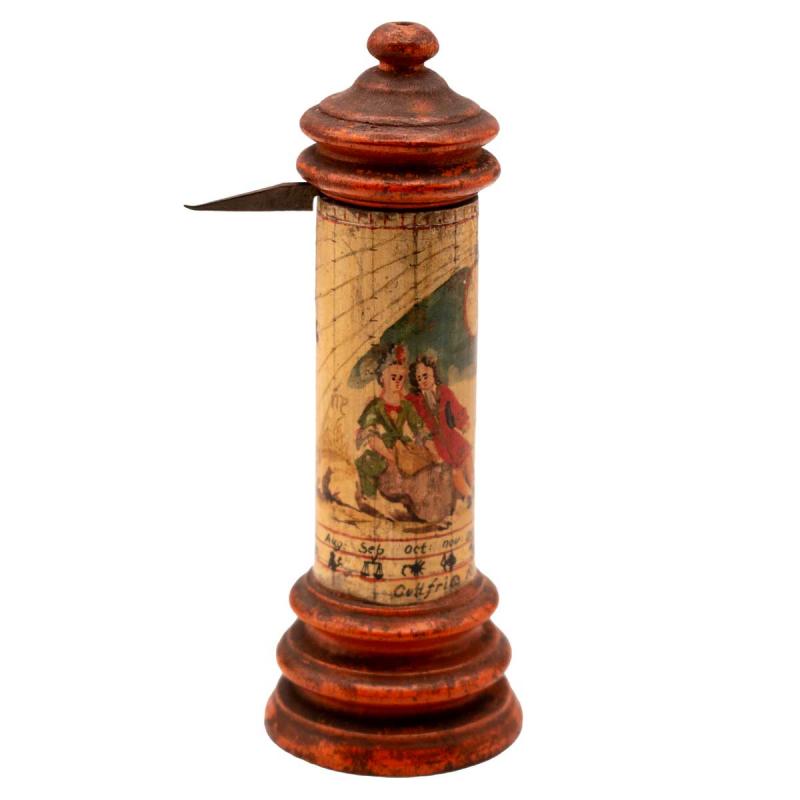
REIFF, GOTTFRIED
FINELY DECORATED CYLINDER DIAL Painted Wood Pillar Dial Turned wood pillar with removable top for story the hinged brass gnomon, painted with a rural landscape with a seated couple in 18th century dress, hour lines from V-XII and 1-7, lower edge with calendar scale and zodiac signs, signed in manuscript ‘Gottfried Reiff fec Nurib’, 125 x 40 x 40mm, Nuremberg, mid-18th century. This vertical cylindrical sundial, also known as a travelling dial, pillar dial, or more commonly, the Shepherd’s dial, was one of the most widely used dials in the world. It comprises a wooden cylinder covered by a varnished paper. A central cylindrical hole holds the cylindrical capital that carries the gnomon, which folds away. Vertical declination lines, numbered according to date, run along the bottom of the dial. The hour-lines are drawn across the declination parallels from right to left with bold lines for the hours and dotted lines for the half-hours. Provenance: Harriet Wynter Ltd. 1995
Sachgebiete: Land- und Forstwirtschaft, Instrumente (Technik), Reisen/Reiseliteratur
6500,- EUR
inkl. 19% USt./incl. 19% VAT
Auf Merkliste setzen 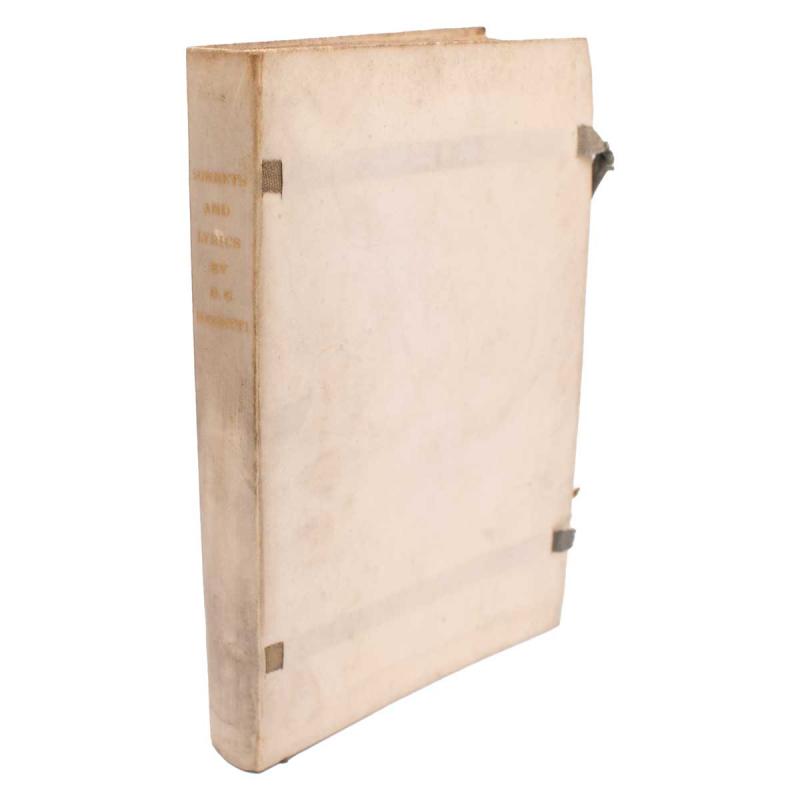
ROSSETTI, DANTE GABRIEL
Sonnets and Lyrical Poems, limited to 316 copies, this copy one of 310 on paper, printed in red and black in Golden type, elaborated wood-engraved border and initials designed by William Morris, mostly unopened, very faint spotting to endpapers, original limp vellum, silk ties, light spotting as usual , 8vo,Kelmscott Press, 1894 [Peterson A20a]
Sachgebiete: Handwerk, Kunsthandwerk, Pressendrucke, Großbritannien
6900,- EUR
inkl. 19% USt./incl. 19% VAT
Auf Merkliste setzen 
SADASUKE, IMAIZUMI
[Kojitsu Sosho] Yosha zuko fuzu kojo kojitsu sosho/ Figures and studies of palanquins and cars Tokyo: Yoshikawa Hanshichi, 1900 2 vols., 24pp.; 36pp., double page title, otherwise comprised of 29 brilliant double page woodblock illustrations and diagrams of traditional palanquins and carriages, some discolouration from old reinforcements at the fold of some plates (appear to be Japanese washi paper, but discoloured with acidic paste), accordion books, original boards, folio, a good set, complete in 2 volumes. Part of Kojitsu Sosho, a series of Japanese books published in the Meiji period (1868-1912) that documented ancient customs and objects, edited by Shinto scholar Imaizumi Sadasuke. Sadasuke believed that Meiji period academics were excessively focused on Western thoughts and ideas, so wrote many books on Japanese traditional culture and customs to counteract this trend. He became director of the Institute of Japanese Classics Research, the central government organisation for the training of Shinto priests, in 1918. His series offered detailed, illustrated volumes on various subjects such as ceremonial clothing, textile patterns, samurai armour, etc. The colour woodblock prints are brilliantly preserved.
Sachgebiete: Papier/Buntpapier, Japan, Japanische Holzschnitte, Reisen/Reiseliteratur
3000,- EUR
inkl. 19% USt./incl. 19% VAT
Auf Merkliste setzen 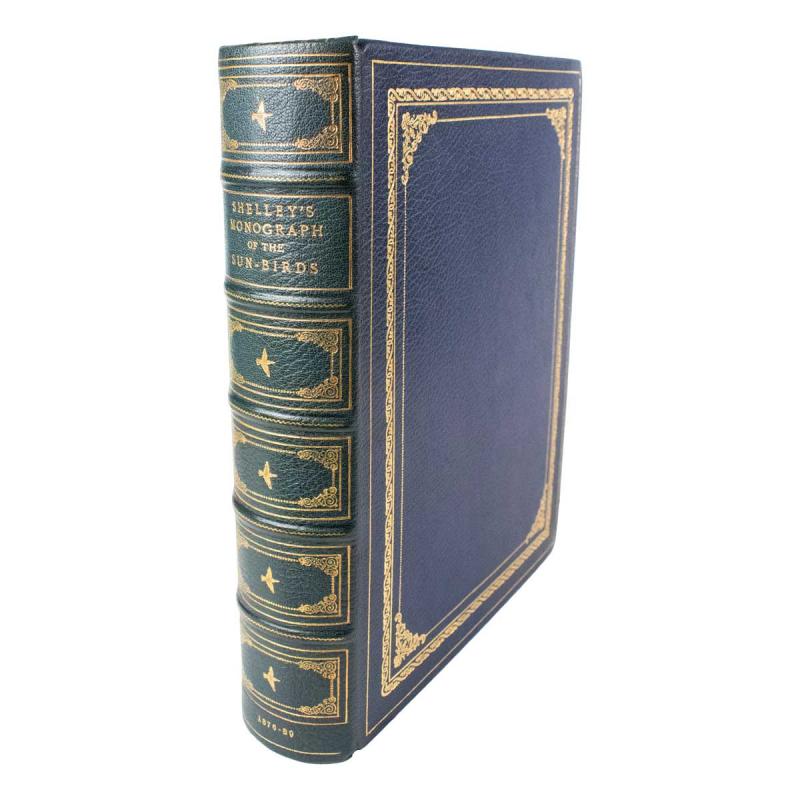
SHELLEY, G.E.
PRESENTATION COPY OF SHELLEY’S SUN-BIRDS A Monograph of the Nectariniidae, or Family of Sun-Birds. London, published by the author, 1876-1880. 4to (318 x 247mm). With 121 hand-coloured lithographed plates by Keulemans. Later Full Blue Morocco Gilt, Original Wrappers Bound In. PRESENTATION COPY FROM THE AUTHOR TO GERALD WALLER Inscribed Gerald Waller, from the Author 4/10/80" A very attractive clean copy of one of the most beautifully illustrated works by J.G. Keulemans. "An excellent monograph of an interesting family of birds, with descriptions in Latin and English, critical notes, and discussions of habits, etc., from accounts by many different observers. A total of 138 species of the group arerecognized..."(Zimmer II, 588). "Keulemans paid particular attention to colour and structure of feathering and his ability to transmit clear, accurate impressions of various plumages was held in much esteem. Overall, his skills for accurate representations are attributable to his detailed study of birds. He was a keen naturalist and to judge from the narratives of his observations, a field ornithologist of note. These attributes often stood him in good stead, as when his specialized knowledge of a particular species made it unnecessary for the author to check anatomical authenticity. As Shelley points out in the Preface to his Sun Birds: 'The illustrations, which form such an important portion of my Monograph, have been executed by Mr Keulemans, whose name is sufficient guarantee for the accuracy of the details and for high artistic skill. The latter is rendered perhaps more striking from his being acquainted with this family of birds in their native haunts; and his notes upon the Sun-birds inhabiting Prince Island have been incorporated in my work'" (Keulemans & Coldewey, 'Feathers to Brush. The Victorian bird artist John Gerard Keulemans' p. 42. The feathering is highlighted in places by the application of gum arabic. Without notes for binders slip. Usually missing. Provenance: Gerald Waller, from the Author 4/10/80" Nissen IVB, 873; Zimmer II, 588
Sachgebiete: Naturwissenschaften, Ornithologie, Zoologie
14600,- EUR
inkl. 19% USt./incl. 19% VAT
Auf Merkliste setzen 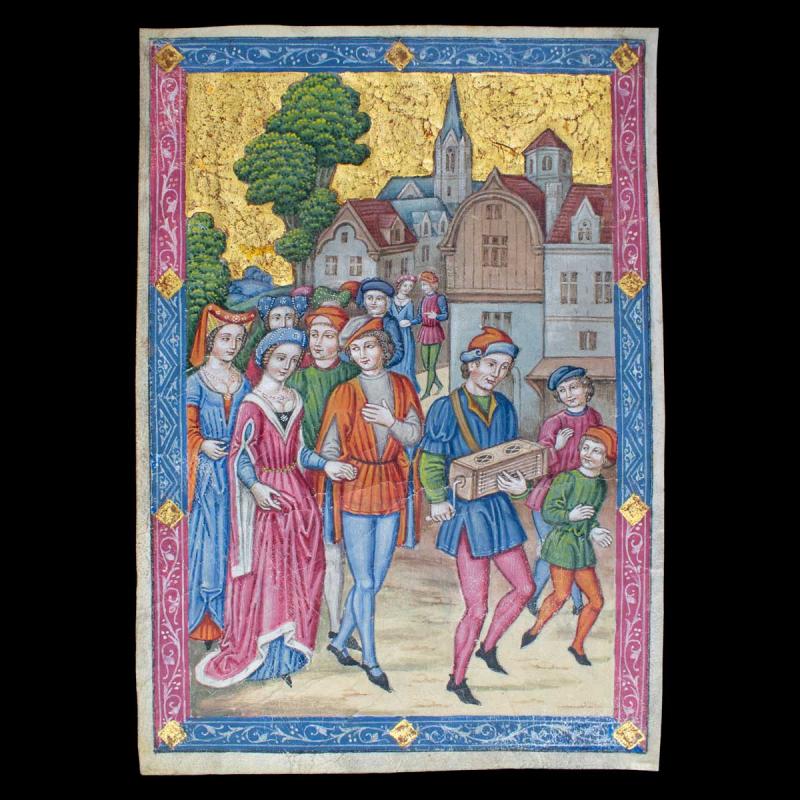
THE SPANISH FORGER
A Musician with a Music Box Leading a Noble Couple Perhaps Just Wed with an Ladies Attendant and Following of Nobles. Grand House in Background. Illuminated Miniature France, circa 1900. Sheet size 23.5 x 16.5 cm. Miniature in coloured overpainting with gold, framed in a coloured Blue & Pink Border, Gold Sky, white-highlighted border with gold lozenges. Verso square musical notes on four red lines with Latin text and a fleur-de-lis initial. Mounted. A beautiful and characteristic miniature by the so-called Spanish Forger , one of the greatest imitators of medieval book art in modern times. The artist, whose identity remains unknown, probably lived in France around 1900. For his high-quality miniatures, he mostly used parchment from old manuscripts. Another characteristic is the sweetly cheerful expression of the depicted faces, which is atypical for the serious and pious expression of medieval paintings. "The Spanish Forger was one of the most skillful, successful, and prolific forgers of all time. Until recently, his numerous panels, manuscripts, and single leaves were appreciated and admired as genuine fifteenth- and sixteenth-century works. Now they are increasingly sold and collected as forgeries " (Voelkle, p. 9).
Sachgebiete: Buchmalerei
14000,- EUR
inkl. 19% USt./incl. 19% VAT
Auf Merkliste setzen 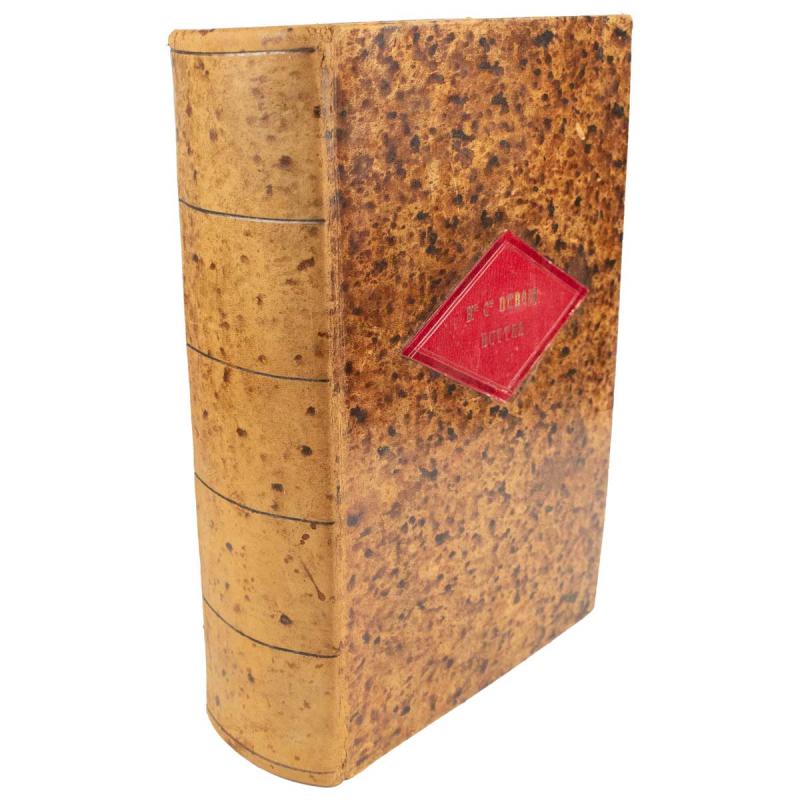
VOLCKMANN, GEORG ANTON.
BOTANICAL MANUSCRIPT WITH 245 WATERCOLOURS OF WILD AND GARDEN FLOWERS OF SILESIA Sciagraphia et Icones Plantarum Indigenarum, maxime vero Exoticas jum turissimo labore collectarum à vivis depicta additis synonymis et locus natalibus singulari industria et penicillo … A Very Fine Herbarium and Botanical Folio with 245 Full Page Watercolours with Manuscript Descriptive Text Leaf to Each Drawing. Finely executed and carefully coloured drawings with manuscript captions and descriptive manuscript text leaf to each watercolour. Extensive manuscript with 245 Watercolours of Garden Flowers; Wild Flowers and Plants of Silesia. Legnica/ Silesia circa 1690/1700 , Folio (320 x 220 mm). with Manuscript title, 254 Latin descriptions all but 10 on separate leaves, mostly interleaved, 245 watercolours on 245 leaves, Later calf with gilt printed morocco label on cover: “Hr Ct Dubois. Buttes”, Title page a little stained and mounted at time of binding, overall in excellent condition. The 245 full-page watercolours executed in gouache and opaque colours are titled in ink with latin names Extensive, yet unrecorded botanical manuscript on the Silesian wild and garden flora by the well - known Silesian physician and naturalist Georg Anton Volckmann (1664 - 1721), who is still known today as the author of the geological work ‘Silesia Subterranea’, printed in 1720, which includes elaborate sketches of fossils including Carboniferous plants from the Lower Silesia region. Georg Anton Volckmann was the son of the botanist Israel Volkmann (1636 - 1706), whose fundamental collection ‘Phytologia magna’ he continued. The series on the Silesian wild and garden flora, comprising a total of 10 volumes was written between 1666 and 1716, but never printed; the manuscripts are now in the Saxon State and University Library (SLUB) Dresden: Mscr.Dresd.B116-125. The renowned Liegnitz physician Dr. Israel Volckmann and subsequently his son Dr. Georg Anton Volckmann wrote the manuscript in their own hands and illustrated the work with plant depictions, sometimes accompanied by insects, after nature in watercolours and opaque colours. The names commonly used in older botanical literature and the medicinal uses of the plants are recorded on the reverse of the nearly 3.600 leaves. The work was intended for publication but would have been too expensive because of the many copper plates required. This manuscript might be a condensed or shorter version of these 10 vols. also intended to be published which however never happened. Georg Anton Volckmann was born in Liegnitz/ Legnica in 1663, studied medicine (where is unknown; only his stay in Padua is known) and settled as a doctor in Legnica/Silesia around 1687. His father was the doctor Israel Volckmann, born on 6 December 1636 in Nikolstadtnear Legnica, where his father was a priest from 1630-1633, attended the town school in Legnica, then the Elisabeth gymnasium in Wroclaw, studied medicine and philosophy in Leipzig from 1655 to 1659 and, after a stay in Italy, settled as a doctor in Legnica in 1660 or 1661, his mother was Ursula Marianne née Schultheß. His father introduced Georg Anton to botany at an early stage and, from 1687 onwards, entrusted him with the continuation of his ‘Phytologia magna’ (vol. I, 1666/68; II, 1668/70; III, 1670; IV, 1671/77; V, 1678/85), a large manuscript work with his own plant drawings, which his son enlarged by a further five volumes (VI, 1678/85). 5 volumes (VI, 1686/89; VII, 1689/91; VIII, 1692/97; IX, 1698/1703; X, 1704/18). Georg Anton’s drawings are more artistic, his locations more varied than those of his father, who died in Legnica on 5 February 1706. This magnificent work came with G. A. Volckmann’s collection to Dresden, first to the Zwingers collection of vegetation, later to the State Library. G. A. Volckmann explored Silesia on numerous journeys; he recorded his mineralogical, geological and prehistoric observations in ‘Silesia subterranea’ (Leipzig 1720). He also produced a handwritten ‘Historia Conchyliorum’ and an ‘Ornithologia’ (before 1712, now lost) as well as a collection of Silesian town coats of arms drawn by him. He analysed the water of the Hedwigsbrunnen fountain discovered in the Grüntal valley near Legnica; in 1716, together with Maximilian Preuß, Gottfried David Mayer and Gottfried Ernst Wilhelm, he described the health springs in Skarsine. He undertook excavations at Töpferberg in 1697/98 and 1707, at Simsdorf near Legnica in 1712 and at Großendorf near Steinau in 1716. Volckmann died on 21 March 1721 Reference: H. Neumann, ‚Liegnitzer Naturforscher’ in Mitt. d. Gesch. u. Altertums Ver. Liegnitz, Heft 8, 1920/21, Liegnitz 1922, p. 246-262); Heinrich Robert Göppert, Über ältereschlesische Pflanzenkunde als Beitrag zur vaterländischen Kulturgeschichte, Schles. Provinzialbl., 96, pp. 1–27. Provenance: Maybe looted property in the Napoleonic Wars, as an ownership note of a French officer ‘à l’ Etat major du 5 corps d’ armée à Breslau, le 12 may 1808 is on the title. Later added ownership note “à Ami Dubois”, dated July 1836; since then privately owned in Switzerland.
Sachgebiete: Papier/Buntpapier, Botanik, Handschriften, Naturwissenschaften
58500,- EUR
inkl. 19% USt./incl. 19% VAT
Auf Merkliste setzen 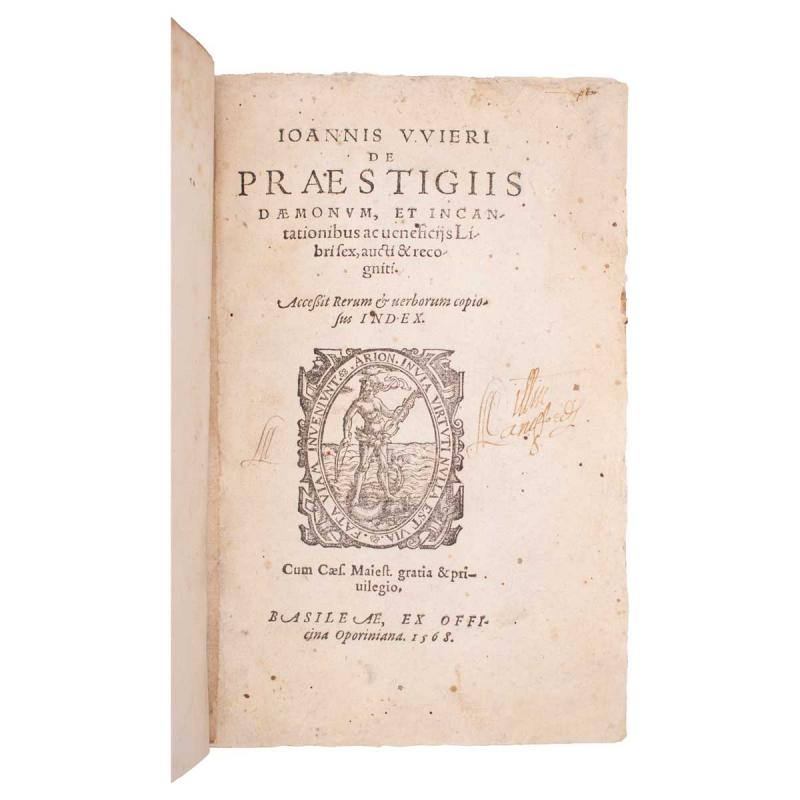
WEIR, JOANNE [WEYER, JOHANN]
EXPANDED EDITION - INCLUDES THE INDEX OF DEMONS De Praestigiis Daemonum, Et Incantationibus ac ueneficiis, Fourth edition, [2], 3-697, [55]pp., woodcut printers device to title, early ownership mark to title, early ink marginalia and underlining, later endpapers, later vellum over boards, hinges repaired, 8vo (183 x 120mm), Basel: Oporinus, 1568. “Those who err should be brought gently home, not incarcerated with punitive ferocity.” Johann Weyer, a respected Lutheran physician at the court of William III, was one of the first to protest against the persecution of witches. He is considered "the founder of medical psychiatry" (Garrison-Morton), and a human rights defender avant la lettre. He published on rare diseases and sexual abuse. Weyer influenced contemporaries such as Michel de Montaigne and later thinkers such as Victor Hugo, Karl Marx and Sigmund Freud. After studying at the University of Paris, Weyer apprenticed under Agrippa of Nettesheim from 1530 to 1534. The poetic, mysterious and liberal-minded Agrippa was also an outspoken critic of witch persecution. Weyer sought to derogate the law concerning witchcraft prosecution, using two forms of thinking. He argued that those accused of practising witchcraft were mentally ill - suffering from “melancholia” - and the confessions they made were actually delusions of the mind. By arguing that the moral weakness in women made them easy prey to Satan’s temptations, Weyer started one of the most vigorous and enduring controversies surrounding demonology and the witch in the early modern period. Weyer powerfully argues the case for leniency to the repentant and eloquently rejects the assimilation of witchcraft to heresy. He insisted that women were neither helped nor healed by torture or burning, but that they rather needed the healing power of prayer, religious instruction, medical intervention, and meditative isolation. He bolstered this attack on realist demonology with medical authorities as well as his own clinical experience as a practising physician. Whilst he is right to insist on the relevance of medical diagnosis in many cases of witchcraft, medicine was then too primitive to suggest convincing explanations. Weyer’s most important contribution in the field of medical diagnosis may be the understanding that undernourishment was the cause of much witchcraft melancholia. Medical and juridical objections often went hand in hand. Weyer challenged demonologists on a legal terrain, attacking the prosecution's reliance on a confession, the point where demonology’s theoretical and practical endeavours converged. Weyer attempts to demolish various witch confessions, notably he publicly attacked the trials of the Wurttemberg preachers, attesting they were illegal, since the death penalties could be imposed only in cases of maleficent magic, not for mere fantasies. Weyer was careful to specify that he did not doubt the reality of witchcraft, but only its relevance to the majority of prosecutions. Weyer has become a symbol of courage and lucidity in the face of intolerance and ignorance, but he was not quite as radical as it would seem. Despite Weyer’s appeal for a greater tolerance towards alleged witches, he also wants greater severity towards male magicians, who Weyer perceived as actual practitioners of natural or demonic magic. It has been suggested that in its very conception, this work is an ideological attack on Catholic idolatry and superstition, rather than a radical stand against the cruel persecution of witches. The reaction to De Praestigiis Daemonum was formidable. Weyer had chosen to publish his book precisely at the moment when the witch-craze, after a long lull, was beginning again. That, indeed, was what had provoked him to write. But this Erasmian Platonist was no longer heard by a generation that had repudiated Erasmus. A fellow physician might hail him as a prophet of enlightenment, but his other readers thought differently. Weyer was told by his friends that his book must be destroyed or rewritten; by his enemies that he was a lunatic. Yet Johann Weyer shaped opposition to witch hunting for generations. Demonologists who wrote after him took care to demolish his arguments, and Bodin’s famous Demonomanie de sorciers includes a lengthy rebuttal of De praestigiis. Yet as they engaged with Weyer’s ideas, their own thought was shaped by his. [ADB XLII, p. 266; Garrison-Morton 4916; Robbins (1972), Encyclopedia of Witchcraft; Thorndike, L. (1941). A History of Magic and Experimental Science, pp. 515-516.; Witchcraze, Terror and Fantasy in Baroque Europe, Roper, 2004; Witches, Devils, and Doctors in the Renaissance: Johann Weyer, Mora, 1991; The Oxford Handbook of Witchcraft in Early Modern Europe and Colonial America, 2013; Ideas and Cultural Margins in Early Modern Germany, 2009; The Damned art : essays in the literature of witchcraft, 1977]
Sachgebiete: Jura, Occulta, Theologie
8700,- EUR
inkl. 19% USt./incl. 19% VAT