 Auf Merkliste setzen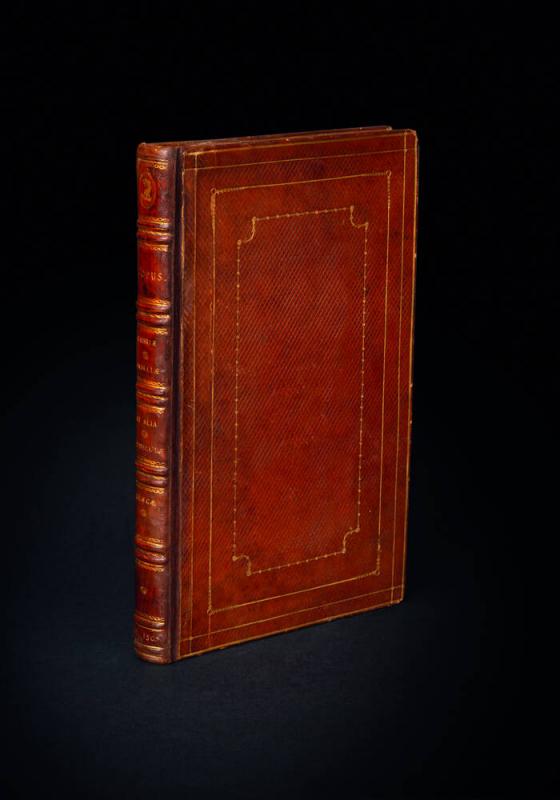
AESOP. Vita & fabellae Aesopi cum interpretatione Latina.
Venice: Aldus Manutius, October 1505. Folio (281 x 178mm). 142 [i.e. 140] p., 172 col., [68] p.; text of Aesop and Gabrias in Greek and Latin, the others in Greek. Aldine anchor on title and verso of final leaf. Late XVIII century diced russia with gilt crest of Sir Richard Colt Hoare on spine, gilt tooling on covers and gilt edges. Neat marginal repair to wormhole in last three leaves, occasional light spotting and soiling, extremities lightly rubbed, spine neatly restored, overall a very fine copy from the libraries of Sir Richard Colt Hoare (1758-1838; his crest on spine, Stourhead sale 1883, lot 164); W.R. Jeudwine (bookplate; sale Bloomsbury 18 September 1984, lot 30); Helmut Friedlaender (ex libris); sale Christie's, 24 November 1993, lot 92; Livio Ambrogio (bookplate). First and only Aldine edition of Aesop Fables, both in Greek and Latin, in an heterogeneous compilation including two fable collections (one in prose, attributed to Aesop, one in verse, attributed to Gabrias, i.e., Babrius), a biography of Aesop by the Byzantine scholar Maximus Planudes, some short treatises on the interpretation of myths and the genre of the fabula, and a collection of proverbs. "This edition may be considered among the rarer and more beautiful productions of the Aldine press" (Frognall Dibdin). Aesop' Fables are here increased in number in comparison to the editio princeps and are provided with a new Latin translation by Aldus, which enjoyed great fortune in the decades following its appearance. A special mention should be given also to two of the seven works being published here for the first time, the poetic fables erroneously attributed to Gabrias and Horapollo's Hieroglyphica, the only systematic essay on the interpretation of Aegyptian hieroglyphics to survive in its entirety from Classical Antiquity. In producing this edition, Aldus was confronted with the problem of putting together the Greek text and the Latin translation and with the resulting problem of the numeration of pages and leaves. The Greek text is thus enumerated from page 17 to page 142 (with the only exception of pages 129–130), while the Latin translation presents no numbering at all and pages 142–173 are present a enumerated in columns. Aldus was not, apparently, interested in editing Aesop Fables as an indipendent text; rather, the edition was intended as an anthology of poetic forms considered useful for grammar school exercise. In particular, by connecting the animal fables with tales on myths and anthropomorphic gods, he provided his reader with a refined linguistic and thematic inventory, susceptible to undergoing a reuse in the field of rhetoric. "Aldus' edition of Aesop is essentially a collection of 'fabulae' (in the rhetorical definition of implausible narratives) and their interpretations; it closely corresponds to the forms recommended by Quintilian for the grammar school, especially in that it begins with the fables and ends with the proverbs" (W.P. Weaver, Untutored Lines. The Making of the English Epyllion, Edinburgh 2012, p. 50).
Sachgebiete: Alte Drucke 16. Jahrhundert , Einbände, Altphilologie, Fabeln, Griechenland
35000,- EUR
Differenzbesteuert/Subject to margin taxation
Auf Merkliste setzen 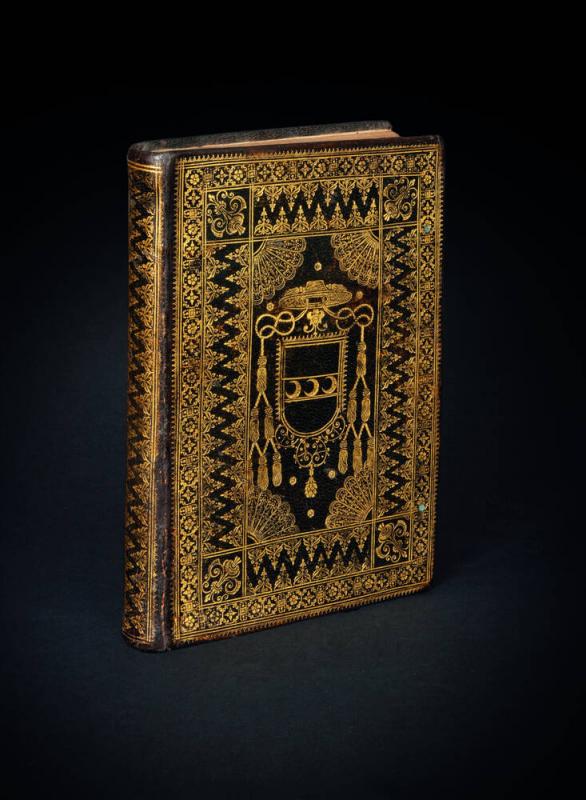
BARBERINI, Maffeo. [POPE URBAN VIII].. Poemata. Poesie toscane.
Rome: ex typographia reverendae camerae Apostolicae, 1637. Quarto (211×145mm), two works bound together. I: [10] leaves, 231; [1 errata] pages. II: [7] leaves; 106 pages, [1] errata leaf. Title-pages with engraved arms of Pope Urban VIII. Engraved headpieces and tailpieces throughout. Contemporary Roman black morocco binding by the Andreoli bindery: two concentric borders separated by double fillets, the outer border with roll of stylised flowers and leafy branches and the broader, internal border with alternating triangular tools and with arabesque tools in the corners; alternating triangular tools on spine; central panel with four fan corner-pieces and the arms of Leone Strozzi (1637–1703), Bishop of Pistoia and Prato and, from 1700, Archbishop of Florence. In a modern box. Early annotations on endpapers, few spots. A very good copy from the library of Francesco Riccardi del Vernaccia (1794–1863), chamberlain of the Grand Duke of Tuscany Ferdinand III (ex-libris). Two rare collections of poetry by Pope Urban VIII, born Maffeo Barberini (1568–1644). The first collected edition of Barberini's poems was printed in Paris in 1621. Despite him being elected pope in 1623, "it took till 1631 before the first Roman edition appeared, with the Vatican Press. […] In the same year, a smaller, and therefore supposedly cheaper but yet identical version was published by the press attached to the Apostolic Chamber; this, of course, was the press that usually catered to the people of Rome and of the Papal States and therefore could be instrumental in distributing the book to those teachers who expressed an interest in using it in their classes." (Rietbergen, p. 113) "In a papal brief titled Poesis probis et piis ornata documentis primaevo decori restituenda, that would precede the text of all subsequent Roman editions, he […] maintained […] that poetry should be restored to its pristine quality, turning its back on pagan themes and images and instead inciting to Christian virtues. Still, sometimes it might be necessary to use classical elements to direct the reader to biblical texts and their messages, or to moral examples. […] Not only was the official Roman edition constantly re-issued, it also was constantly enlarged, as the Pope's poetic vein continued to flow. Indeed, almost each new edition contained additional, mostly Latin poems […]. From 1635 onwards, the Roman editions of Urban's Latin poems mostly were followed by editions of his Italian verses as well […]. The purpose of the poems now published was manifestly didactic, since most are provided with explanatory captions. All Urban's favourite themes recur: the moral education of the members of his family—various Latin poems for the Pope's brothers and nephews […]—the cult of poverty, expressed in a sonnet [II, 69] on St. Francis, and the prayer- like meditations." (ibid., pp. 114, 115) "As the years went by, the number of printed editions of the papal poems increased. Obviously, the two main presses of Rome, that of the Vatican and of the Apostolic Chamber, re-issued their editions, quite probably on express papal orders but also because a genuine demand for them must have sprung up all over the Roman Catholic world." (ibid., p. 118) "Maffeo Barberini was born on April 5, 1568 as the youngest of the six sons of Antonio Barberini and Camilla Barbadori, who were citizens of Florence. Young Maffeo was first sent to school with the Florentine Jesuits and then, in 1584, moved to Rome to live under the tutelage of his uncle Francesco. In Rome, too, he was schooled in the humanistic curriculum of the Jesuits, in their famous Collegio Romano. Despite his obvious cultural interests, the career mapped out for a young man of his social background demanded that he go on to university to study for a law degree. This he did, at Pisa, where he spent several years. Though he wanted to marry, nothing came of the match arranged for him by his mother. Therefore he returned to Rome in 1588, to seek a career in the Church. With the initial aid of his uncle he soon succeeded, gaining one position after the other and thus moving upwards in the hierarchy of the Curia. The life he had started in 1588 found its culmination in 1623, with his election to the papacy.” (ibid., pp. 97–98) Urban VIII was the longest-reigning pope of the XVII century, ruling until his death in July 1644. His papacy was marked by the Galileo affair, with the Florentine scientist being condemned by the Roman Inquisition in 1632, as well as his patronage of major Baroque artists such as Gian Lorenzo Bernini, Francesco Borromini and Pietro da Cortona. It is interesting to note that "poetry may well have been Maffeo Barberini's first and most important inclination." (ibid., p. 96) "Maffeo Barberini […] was a poet before he could even think to aspire after the papacy. As pope, he continued to be a poet. Rather than, only, expressing a personal aesthetic in his poetry, he used it as the powerful means it was precisely to propagate his deepest convictions and feelings." (ibid., p. 136). "Maffeo's poetic compositions […] can and should be read as a running commentary on many of the issues he had to confront, on many of the actions he did take; they even seem to suggest a unity of thought that may help to give meaning to a number of his deeds and, moreover, point to a surprising consistency and continuity in his policy." (ibid., p. 97)
Sachgebiete: Barock, Einbände, Kirchengeschichte, Italien, Religionsgeschichte
7000,- EUR
Differenzbesteuert/Subject to margin taxation
Auf Merkliste setzen 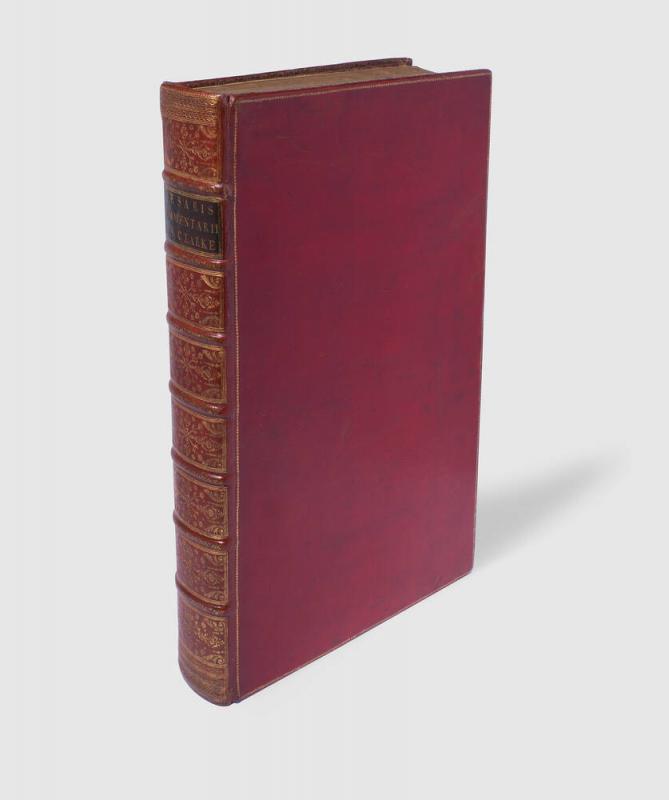
CAESAR, Gaius Julius. [The Commentaries.]
London: Jacob Tonson, 1712. Folio (465 x 288mm). 87 engraved plates, comprising: engraved double-page additional title, 61 double-page plates, many by C. Huijberts after Mantegna, including a famous image of a bison, 25 full-page plates including a folding portrait of the Duke of Marlborough by George Vertue (1684-1756); numerous engraved headpieces and vignettes in the text, initials. Faint even browning throughout but a very fine copy in contemporary red morocco, spine richly gilt in 8 compartments, dark-green morocco gilt lettering-piece in second, the others with foliate tools and volute cornerpieces, marbled endpapers, gilt turn-ins and edges. Provenance: 'L' (small circular stamp dated 1910 on rear free endpaper). First edition.‘The most sumptuous classical work which this country has produced' (Lowndes) bound in contemporary red morocco with 87 attractive engravings by various artists, including the famous image of a bison that is sometimes missing or damaged. The Tonson's Caesar received contemporary praise from Joseph Addison as ‘a Work that does honour to the English Press', having ‘passed thro' the Hands of one of the most accurate, learned and judicious Writers this Age has produced. The Beauty of the Paper, of the Character, and of the several Cuts with which this noble Work is illustrated, makes it the finest Book that I have ever seen; and is a true Instance of the English Genius' (The Spectator no. 367, May 1712). The work is annotated by Samuel Clarke (1675-1729), a major English philosopher, especially renowned for his theories on the existence of God and the immortality of the soul. He also corresponded with Leibnitz and in 1706 translated Newton's Optiks into latin. Among his philological works is also an edition of the first 12 books of the Iliad. For the present edition, he chose Caesar's accounts of his campaigns in Gaul and Britain (58-50BC) and of his participation in the Roman Civil War (49-48BC) along with the remaining works on his military campaigns in Alexandria and Asia, Africa, and the Iberian peninsula. The volume is ‘dedicated to John Churchill, 1st Duke of Marlborough, the victorious English general at the Battle of Blenheim (1704) and instrumental to the military successes of the Grand Alliance more generally, this monumental volume establishes by a secular typology that Marlborough is the new Julius Caesar of Europe. Strange as that may seem from the long view of history, Samuel Clarke's cloying dedication to the Duke as the “noblest, wisest, and strongest” of men (“Nobilissimo, Sapientissimo, & Fortissimo”) says as much from its opening paragraph, describing the ancient commander as “outdone only by YOU [Marlborough] in glory and success, and in every part of the character of a consummate general” (“TUA solius armorum gloria & felicitate & laude omni superatum”).10 Understandably, then, Marlborough's portrait (by George Vertue after Godfrey Kneller), complete with a cartouche proclaiming him “Illustrissimus, Potentissimus, et Excellentissimus,” occupies pride of place as the frontispiece of the volume.' (Michael F. Suarez, Hard Cases: Confronting Bibliographical Difficulty in Eighteenth-Century Texts. pbsa 111:1 (2017): 1–30 © 2017 Bibliographical Society of America.)
Sachgebiete: Antike, Einbände, Chroniken, Altphilologie, Völkerkunde/Ethnographie
20000,- EUR
Differenzbesteuert/Subject to margin taxation
Auf Merkliste setzen 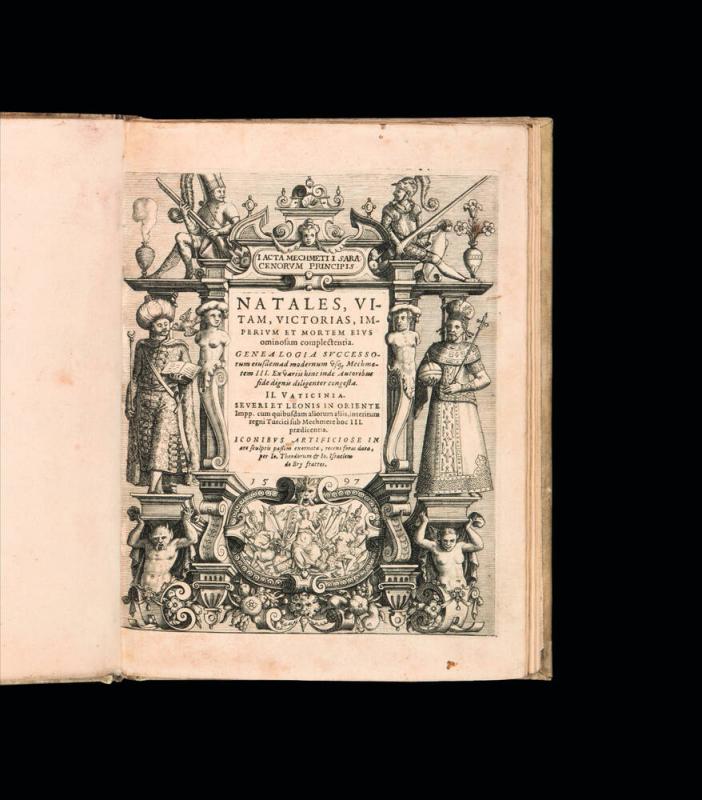
[DE BRY, Johann Theodor & Johann Israel]. I. Acta Mechmeti I Saracenorum principis
[Frankfurt]: per Io. Theodorum & Io. Israelem de Bry fratres, 1597. Quarto (199×146mm), 2 parts in one volume. I: [4] leaves, pages 1–58, [1] leaf; II: pages 59–96, [3] leaves. Engraved title-page within architectural border, the Prophet Muhammad and a Byzantine emperor at the sides. Twenty- six engravings, various historiated initials and typographical ornaments throughout. Contemporary stiff vellum binding, remounted. Rather browned, especially in quires D and N, some minor spotting and foxing, else a very good copy. First edition of "the first printed Western book to illustrate the life of the Prophet Muhammad" (Ilg, p. 241). The book's editors, the brothers Johann Theodor and Johann Israel de Bry, worked in Frankfurt and are best known for their illustrated editions of travel accounts from Asia and the Americas. Although the author of this volume is anonymous, they are most likely to be identified as Jean-Jacques Boissard, a scholar and humanist who frequently collaborated with the de Bry printing house until his death in 1602. Boissard had previously written a collection of biographies of Ottoman sultans, printed in 1596, and it seems apparent that the Acta Mechmeti could be a complement to this earlier work. Boissard also provided the drawings on which the engravings for his editions were based; therefore, it is probable that the twenty-six illustrations in this volume were also based on his drawings. The first part of the book contains not only a biography of Muhammad, but also a presentation of the basic principles of Islam, a brief history of the Arabic caliphates up to the year 1300, a summary of the customs of the Armenians and the Georgians, and finally a history of the Ottoman sultans from 1300 to 1595. The second part of the book is a collection of prophecies about the decline of the Ottoman Empire that were popularly attributed to the Byzantine emperor Leo VI. "The nine engravings that accompany the life of Muhammad — the only section of the Acts to receive illustrations — give the textual arguments a dramatic turn: the engravings always represent the most spectacular, climactic moment of each of the narrated episodes. Muhammad is, for example, caught groping his mistress or tumbling down due to an epileptic fit. Certainly, these engravings illustrate only the most salient points of the Christian criticism of Muhammad and of his doctrines. Hence, his ignoble family origin, his lecherous behavior, and the fact that he was a trickster who cheated people by fabricating false miracles were highlighted. However, the illustrator did not give Muhammad the aspect of a demoniac, deformed, or harmed creature, as frequently had been the case in Western art. Instead, the characters who appear in these engravings have been treated in a matter-of- fact way: the illustrator considered the costume figures published in 1567 by the French royal geographer Nicolas de Nicolay in his travel report from the Ottoman Empire (Navigations et peregrinations orientales) as the best available approximations of the true appearance of the historic Muhammad and his contemporaries. The young Muhammad is therefore — due to a misunderstanding of the prototypal image — dressed in the hood and cloak of de Nicolay's Turkish girl" (ibid., p. 252). "The decision to represent Muhammad and his contemporaries as if they were sixteenth-century Ottomans may seem anachronistic today. The sixteenth-century reader of the Acts, however, must have had a quite different point of view. During the first half of the century, the image of the Turk had become instrumental in the polemics between the Protestant and Catholic denominations. Innumerable Reformation broadsheets had depicted a Turk as personification of heresy and false doctrine next to either the pope or a Lutheran preacher. By conferring to his Muhammad the appearance of an Ottoman, the illustrator of the Acts used this established iconographic tradition to characterize Muhammad even more effectively as a pseudo- prophet. Further, the curious "ottomanization" of Muhammad was a result of the opinion, expressed not only in the Acts, that Muhammad was succeeded as "rex" by a series of Saracen rulers and finally by the Ottoman sultans. The Ottomans were therefore widely considered to be Muhammad's heirs, Islam became the "Turkish religion" and the content of the Qur'an the "Turkish law" (Ilg, p. 258). The second part of the volume contains the Vaticinium Severi et Leonis imperatorum ("The Prophecy of the Emperors Leo and Severus"). It is a prophetic forgery that was attributed to Leo VI the Wise, emperor of Byzantium from 886 to 912, and to the Roman emperor Antoninus Severus, better known as Caracalla (211–217). It consists of sixteen poems, each paired with an allegorical illustration and followed by an explanation, which foretell the imminent fall of the Ottoman rule. The Oracles of Leo the Wise were widely read throughout the late Middle Ages and early modern period, and they were routinely reinterpreted in light of the current political context. Their first printed edition appeared in Brescia in 1596, containing Latin and Italian text; the present edition reprints the Latin text of this first edition and almost exactly replicates its sixteen engravings.
Sachgebiete: Alte Drucke 16. Jahrhundert , Arabistik, Deutschland, Islam, Religionsgeschichte
11000,- EUR
Differenzbesteuert/Subject to margin taxation
Auf Merkliste setzen 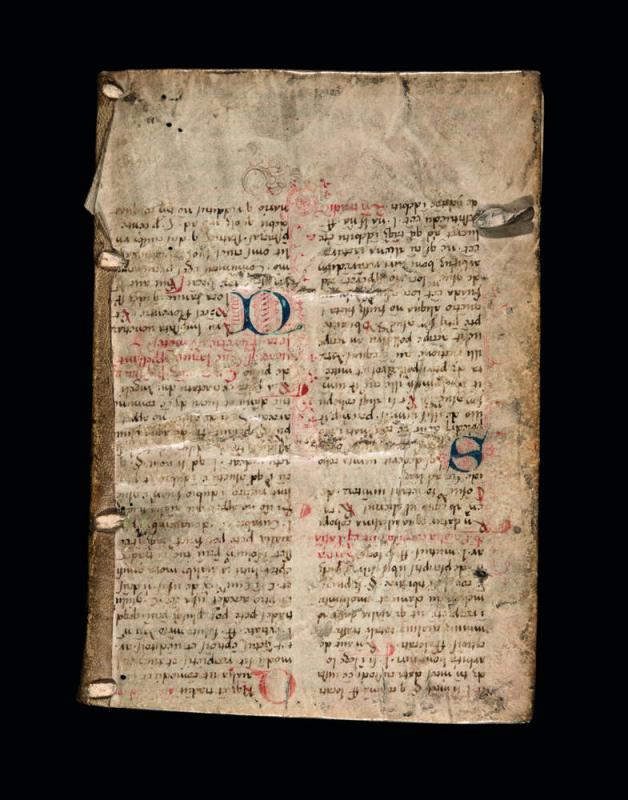
ST. FRANCIS OF ASSISI. Fiorecti di Sancto Francesco.
Florence: [Bartolommeo di Libri] for L.R., 26 May 1489. Quarto (175 x 122 mm.), [128] leaves, the first leaf, blank except for the title, is an old facsimile on ancient paper; Gothic type 3:114G, 27 lines per page with L.R. device at the end. A few spots, short upper margin, but a very fine copy bound with a contemporary vellum manuscript page, spine renewed, manuscript title on spine, from the library of the famous British explorer Apsley Cherry Garrard (1886-1959). Modern half morocco box. Exceedingly rare edition of Saint Francis's Fioretti. “Little Flowers of Francis of Assisi is the name given to a classic collection of popular legends about the life of St. Francis of Assisi and his early companions as they appeared to the Italian people at the beginning of the fourteenth century. Such a work, […], can hardly be said to have one author; it is the product rather of gradual growth and must, […], remain in a certain sense anonymous, because it is national. There has been some doubt as to whether the Fioretti were written in Italian in the first instance, […], or were translated from a Latin original […]. The latter seems altogether more probable, and modern critics generally believe that a larger Latin collection of legends, which has come down to us under the name of the Actus B. Francisci et Sociorum Ejus, represents an approximation to the text now lost of the original Floretum, of which the Fioretti is a translation. A striking difference is noticeable between the earlier chapters of the Fioretti, which refer to St. Francis and his companions, and the later ones which deal with the friars in the province of the March of Ancona. The first half of the collection is, no doubt, merely a new form given to traditions that go back to the early days of the order; the other is believed to be substantially the work of a certain Fra Ugolino da Monte Giorgio of the noble family of Brunforte, who, at the time of his death in 1348, was provincial of the Friars Minor in the March. Living as he did a century after the death of St. Francis, Ugolino was dependent on hearsay for much of his information; part of it he is said to have learned from Fra Giacomo da Massa who had been well known and esteemed by the companions of the saint, and who had lived on terms of intimacy with Fra Leone, his confessor and secretary. Whatever may have been the sources from which Ugolino derived his materials, the fifty-three chapters which constitute the Latin work in question seem to have been written before 1328. The four appendixes on the Stigmata of St. Francis, the life of Fra Ginepro, and the life and the sayings of the Fra Egidio, which occupy nearly one half of the printed text of the Fioretti, as we now have it, form no part of the original collection and were probably added by later compilers. Unfortunately the name of the fourteenth-century Franciscan friar who translated into Italian fifty-three of the seventy-six chapters found in the Actus B. Francisci and in translating immortalized them as the Fioretti, remains unknown. The attribution of this work to Giovanni di San Lorenzo rests wholly upon conjecture. It has been surmised that the translator was a Florentine. However this may be, the vernacular version is written in the most limpid Tuscan and is reckoned among the masterpieces of Italian literature. The Fioretti have been described as “the most exquisite expression of the religious life of the Middle Ages.” That perhaps which gives these legends such a peculiar charm, is what may be called their atmosphere; they breathe all the delicious fragrance of the early Franciscan spirit. Nowhere can there be found a more childlike faith, a livelier sense of the supernatural, or a simpler literalness in the following Christ than in the pages of the Fioretti, which more than any other work transport us to the scenes amid which St. Francis and his first followers live, and enable us to see them as they saw themselves. These legends, moreover, bear precious witness to the vitality and enthusiasm with which the memory of the life and teaching of the Poverello was preserved […]. In Italy the Fioretti have always enjoyed an extraordinary popularity; indeed, this liber aureus is said to have been more widely read there than any book, not excepting even the Bible or the Divine Comedy. Certain it is that the Fioretti have exercised an immense influence forming in the popular conception of St. Francis and his companions. The earliest known manuscript of the Fioretti, now preserved at Berlin , is dated 1390; the work was first printed at Vicenza in 1476.” (Catholic Encyclopedia on-line) After that first appearance, the Fioretti were reprinted other eleven times during the fifteenth-century; all these editions, including ours which is the first printed in Florence, are extremely rare and most of the surviving copies are imperfect.
Sachgebiete: Einbände, Humanismus, Inkunabeln, Italien, Religionsgeschichte
39000,- EUR
Differenzbesteuert/Subject to margin taxation
Auf Merkliste setzen 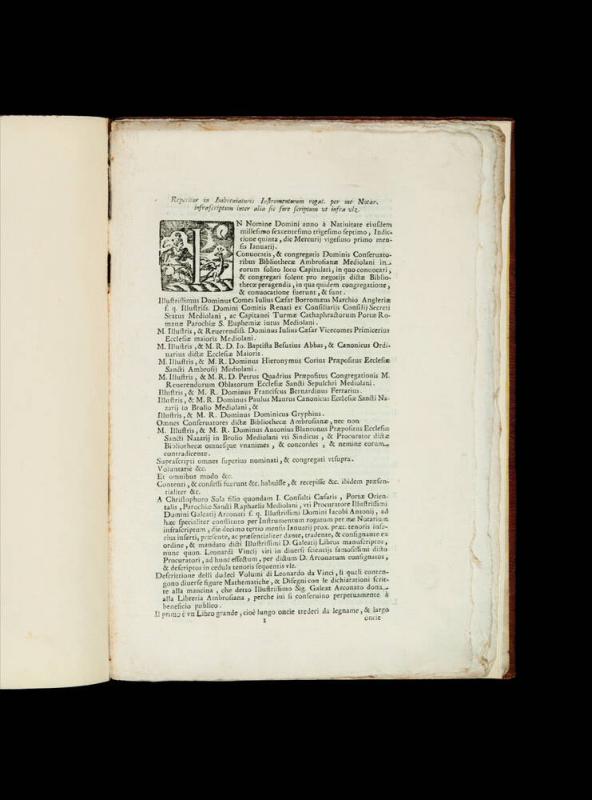
[LEONARDO DA VINCI]. [Istrumento della donazione di dodici volumi di Leonardo da Vinci fatta alla Biblioteca Ambrosiana di Milano da Galeazzo Arconati a mezzo del suo procuratore Cristoforo Sola in data 21 gennaio 1637].
N.p. [Milan?]: n.d. [first quarter of the XVIII century]. Quarto (310×211mm). [6] leaves, the last blank. Historiated woodcut initial on the first page. A fine copy with wide margins and untrimmed edges bound in nineteenth-century brown morocco. Very rare printed edition of two notarial deeds concerning the donation of Leonardo da Vinci's manuscripts to the Biblioteca Ambrosiana of Milan. The documents include a description of all twelve notebooks, featuring the first ever mention of Leonardo's Codex Atlanticus, and a transcription of the plaque placed inside the Biblioteca Ambrosiana, to commemorate the donor, Galeazzo Arconati. Only nine copies of the four known issues are present in public libraries, which only one in the US (Washington, National Gallery of Art Library). According to Gustavo Uzielli, first to discover and publish the text of the Instrumento, in 1884, the present copy is a third edition, likely dating from the time of Giuseppe Antonio Arconati Visconti (1698–1763), a great-grandson of Galeazzo. Based on paper quality, we also believe that it dates to the early XVIII century. When Leonardo died in Amboise in 1519, his friend and pupil Francesco Melzi inherited all the notes and drawings his teacher had produced throughout his entire life. Melzi took them to his villa in Vaprio d'Adda, near Milan, where at his death in 1570 they passed to his son, Orazio Melzi. Orazio took so little interest in his inheritance that he even allowed several manuscripts to be stolen by the family's tutor. After the manuscripts were recovered, Pompeo Leoni (1537–1608), a sculptor at the Spanish court, purchased the entire collection and took it to Madrid. It was there that Leoni compiled the Codex Atlanticus by arbitrarily mounting 1,750 fragments of Leonardo's notebooks onto a large book (65×44cm), "making no attempt to classify them according to their content or date" (Pedretti, pp. 7–8). Leoni's heirs then dispersed Leonardo's manuscripts in different directions: some remained in Madrid, some were sent to England (now the British Museum's Codex Arundel and the drawings in Windsor Castle), and some, including the Codex Atlanticus, were sold to Count Galeazzo Arconati (1580–1649). Arconati, patron of the arts and an art collector, was also the cousin of Cardinal Federico Borromeo, founder of the Biblioteca Ambrosiana. Our document maintains that the king of England offered Arconati 1,000 golden coins for the Codex Atlanticus, but he refused the offer and instead donated it, along with all the other manuscripts, to the Ambrosiana, one of Italy's earliest public libraries. The first deed was drafted on 13 January 1637, and the second one, with the same provisions, was drafted a week later on 21 January, the day of the public donation ceremony. These were originally intended for the attendees of the ceremony. The twelve volumes remained in Milan until 1796, when Napoleon ordered they to be brought to Paris. The Codex Atlanticus only was returned to the Ambrosiana after the Congress of Vienna in 1815, while the rest of the collection has remained in the Institut de France ever since.
Sachgebiete: Geschichte, Italien, Renaissance
16000,- EUR
Differenzbesteuert/Subject to margin taxation
Auf Merkliste setzen 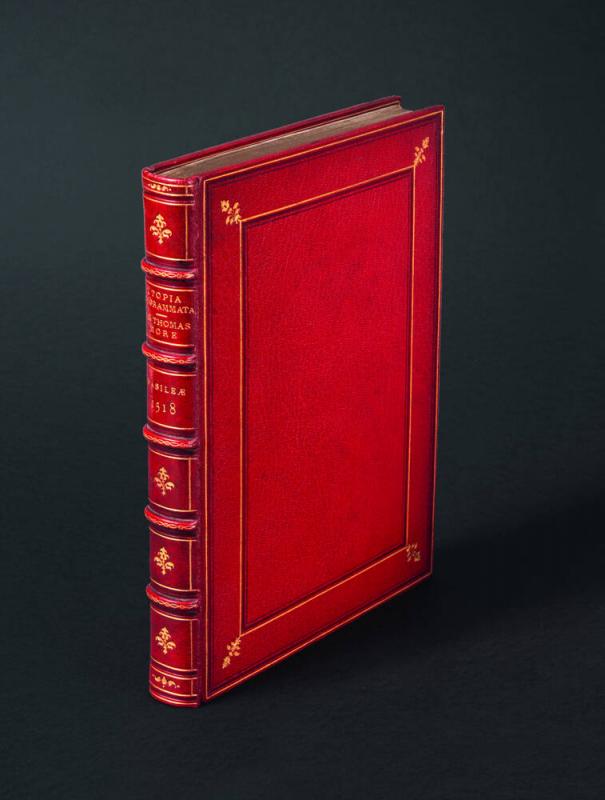
MORE, Sir Thomas; DESIDERIUS ERASMUS. MORE, Sir Thomas. De optimo reip. statu deque nova insula Utopia ... Epigrammata [with:] DESIDERIUS ERASMUS. Epigrammata.
Basel: Johann Froben, March 1518 Quarto (213 x 155 mm.), three parts in one volume. Roman, Greek and 'Utopian' types. Woodcut historiated border to title of each part and to preface, the first by Ambrosius Holbein, the others by Hans Holbein, full- page woodcut of Utopia and half-page woodcut of Clement, Hythlodaye, More and Gillies, by Ambrosius Holbein, a different woodcut printer's device at end of each part, woodcut historiated initials by A. and H. Holbein. A very fine copy in nineteenth century red crushed morocco by Francis Bedford, spine gilt in compartments with gilt title, gilt edges; from the library of Cardiff Castle (ex libris) and Livio Ambrogio (ex libris). The important third edition of Utopia with the author's revisions, including the first edition of More's Epigrammata, not present in the first 1516 Louvain publication by Peter Gillies and the following Parisian reprint by Gourmont in 1517. This early edition of More's Epigrammata includes verses that were removed from following printings, particularly those pertaining to Germain de Brie (c. 1490-1538). This is the first edition printed by Johann Froben, which was followed by an identical issue in November/December of the same year. Froben's editions have been described as ‘'the most complete and most correct published in [More's] lifetime'' (Fairfax Murray, p. 494). This revised impression was arranged by Erasmus and it also contains his own Epigrammata, originally printed in Paris in 1506 in conjunction with the fourth edition of his Adagia. The title page is contained within a woodcut border showing Lucretia and Sextus Tarquinius, with additional separate title pages for each of the three works, as well as printers' devices. These works are often found separate, however it is rare to find them together as published. Utopia's architectural border is populated by Cherubs and signed by Hans Holbein. More's Epigrammata is set within a border also signed by Hans Holbein, the lower part occupied by scenes of the life of Gaius Mucius Cordus. The border for Erasmus' Epigrammata depicts St. John the Baptist and Salome. Utopia opens with a full-page woodcut map of the island, executed by Ambrose Holbein, depicting Raphael Hythlodaeus on the bottom left corner pointing towards it while speaking to More and Gillis. The opposite leaf contains the Utopian alphabet and several verses. An additional woodcut vignette is included at the beginning of the first section, showing Clement, More, Hythlodaeus, and Gillies. More's Utopia is presented as a imaginary dialogue between the author and the fictitious traveller Raphael Hythlodaeus, allegedly part of Amerigo Vespucci's crew. The first part is reserved for Hythlodaeus' critiques of European societies, particularly their greed, corruption, and inequality, blaming private property, harsh punishments, and class oppression. Conversely, the second part describes the island of Utopia that houses a society organized around communal property and rational governance. Utopians work only six hours a day, share resources, are not bound by materialism and practice religious tolerance. Their simple laws and elected leadership ensure fairness, while war and overpopulation are avoided, and slavery serves as punishment for criminals and prisoners of war. While on the surface Utopia appears idyllic, the work is infused with irony, leaving the reader to question whether such a society is attainable or a critique of human nature. "Utopia is not, as often imagined, More's ideal state: it exemplifies only the virtues of wisdom, fortitude, temperance and justice. It reflects the moral poverty of the states which More knew […] But an ideal state is what it has come to mean […] Utopia has become a fairy-tale. More, who was knighted in 1521, was later Speaker of the House of Commons, High Steward of Cambridge University, and Lord Chancellor. In 1535 he was executed for high treason. He is a saint to the Catholic, and a predecessor of Marx to the Communist. His manifesto is and will be required reading for both, and for all shades of opinion between.'' (PMM p.28).
Sachgebiete: Einbände, Humanismus, Niederlande , Renaissance , Schweiz
50000,- EUR
Differenzbesteuert/Subject to margin taxation
Auf Merkliste setzen 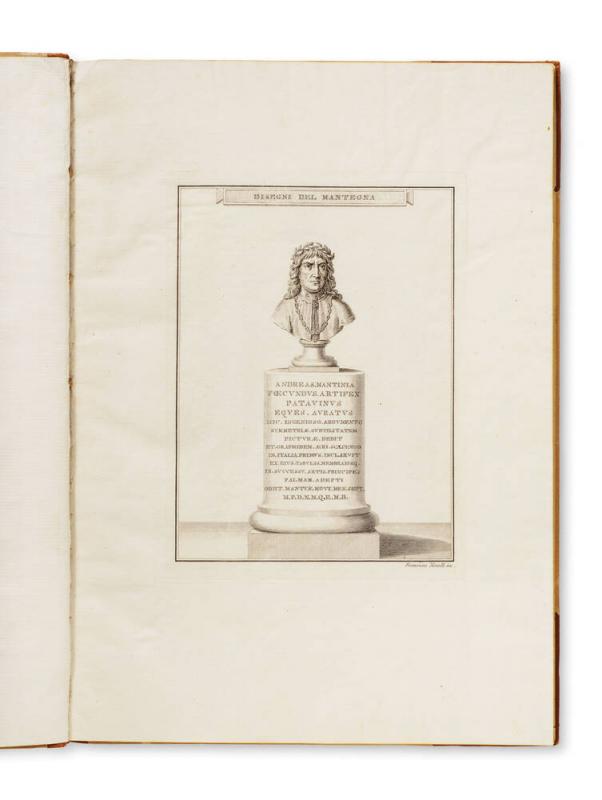
NOVELLI, Francesco. Disegni del Mantegna.
Venice: 1796-1799 circa. Folio (386 x 277 mm.), engraved title-page with the bust of Mantegna on a pedestral, engraved dedication printed on two leaves anf fourty-four engraved plates. Contemporary half calf, gilt spine in compartments with red morocco lettering-piece. Spine very lightly rubbed, overall very fine. ‘A rare suite of prints reproducing drawings of putti playing of fighting, all'antica heads, and studies of the Virgin and Child, once attributed to Andrea Mantegna, now recognized as works of Marco Zoppo (1432/3-1478). The prints are dedicated by the printmaker Francesco Novelli to Giambattista de Rubeis, and all but the last two reproduce drawings executed in pen and ink and wash on vellum in an album that De Rubeis had given to the printmaker's father, the Venetian painter Pietro Antonio Novelli. The album passed subsequently through the hands of Samuel Woodburn, Sir Alexander Barker, Baron Mayer de Rothschild, to Archibald Philip Primrose, fifth Earl of Rosebery (1847-1929), who in 1920 presented it to the British Museum. The function of the album has been much debated, with some reading ita s apattern book, others as an adjunct to a literary text – perhaps Petrarch's De viris illustribus – or as a luxury picture book commissioned by a patron in Venice or Padua; its date, too, is uncertain, with arguments ranging from the mid-1460s. The elusive meaning of some of the drawings and discret homosexual imagery in others “suggest a commission where the patron had a hand in providing some of the subject matter, the significance of which may have been understood only by a small circle of friends” (Chapman, Padua in the 1450s: Marco Zoppo and his contemporaries, exhibition catalogue by Hugo Chapman, British Museum, Departments of Prints and Drawings, London 1998, pp.38, 40) […] In the dedicatory letter, Novelli recounts the discovery of the album in 1765 in Padua by Giambattista de Rubeis (1743-1819), a painter and a dilettante from Udine. He tells us that various experts of Padua, recognizing ita s an important work of art derived from Squarcione, decided that the drawings must be by his most illustrious pupil, Mantegna, basing this attribution on a resenblance, in their opinion, to the so-called Tarocchi del Mantegna. In the letter, Novelli attemps to support the attribution, by finding affinities with the Triumphs of Caesar and other authentic works of Mantegna. The album consists of twenty-six vellum leaves, of which twenty-four are drawn on both sides and two are blank on one side, so the total number of drawings is fifty. Novelli's plan was to engrave all fifty drawings and issue his prints serialy, in group of eight, to subrcribers. […] In a letter of December 1796 to Abate Mauro Boni, Novelli writes that he had become apprehnsive about publishing prints of two drawings, because he considered them licentious, and thus likely to lose his subscribers, as incorrect in drawing. We learn from another letter that Francesco Novelli had acquired from Abate Pietro Bini, sometime before 27 May 1796, a double-sided drawing (on paper) showing eight studies of the Virgin and Child in a variety of pose. Novelli belived this sheet to be also by Mantegna – despite receiving from the Venetian connosseur Giovanni Maria Sasso the correct attribution to Zoppo – and he etched both sides as substitute for two rami licenziosi recording the different provenance directly on the plates: Il disegno fu regalato all'incisore dall'Egregio Pittore Sigr. Abre. Pietro Bini. […] The project was brought to a close in 1799, […]. In an undated Avviso [in our copy pasted onto the front pastedawn], Novelli explained that the work would terminate with forty-four prints, however the two prints of the Virgin anc Child (each with four studies) would be counted as eight, thereby fulfilling his promise to supply 50 disegni originali di Andrea Mantegna. The majority of surviving copies are comprised of forty-seven or forty-eight prints: the title-print (often supplied in two versions, one with and the other without lettering); two leaves of engraved dedication and forty-four numbered plates.' (Robin Halwas)
Sachgebiete: Kupferstich, Handzeichnungen, Illustrierte Bücher, Renaissance
9000,- EUR
Differenzbesteuert/Subject to margin taxation
Auf Merkliste setzen 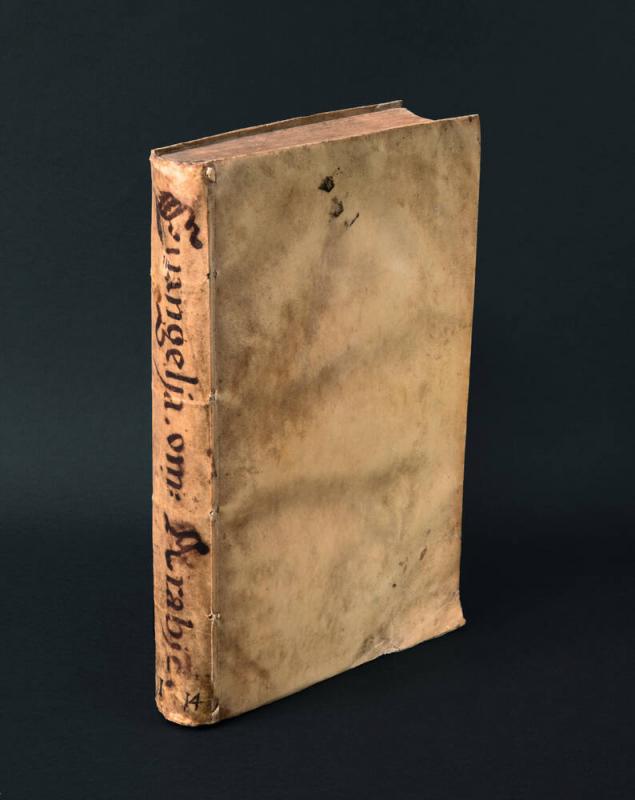
[BIBLIA ARABICA]. Evangelium Iesu Christi quemadmodum scripsit Mar Mattheus unus ex duodecim discipulis eius.
Rome: Typographia Medicea, 1591. Folio (329 x 217 mm.), 9 - 462 pages, as issued without title and preliminaries. “Double-rule border on each page of text. One hundred forty-nine woodcuts, by repetition of sixty-seven blocks, approximately 100 x 125 mm. Fourteen of these blocks are signed with the monograms of Antonio Tempesta as designer and Leonardo Parasole as cutter, and four other blocks have Parasole's signature alone. An early attribution of the “LP” monogram to Luca Penni is incorrect. […] The Arabic types are those designed by Robert Granjon for Domenico Basa, and Granjon was employed by the Typographia as type designer in the last years of his life.” (Mortimer). Occasional light spotting, some browning; a good copy in contemporary limp vellum with manuscript title on spine. First printing of the Gospels in the interlinear Arabic and Latin version, printed by the Typographia Medicea at the same time of the publication of the Gospels in Arabic only. The Arabic text, printed in Robert Granjon's famous large font, regarded as the earliest satisfactory Arabic type, is based on the Alexandrian Vulgate and is edited by Giovanni Battista Raimondi; the Latin version is by Leonardo Sionita. The book begins at page 9 without a title-page or any preliminary matters: “the reason for the apparent omission of pages of preliminaries is explained by Schnurrer quoting Bandini (C.F. de Schnurrer, Biblioteca Arabica, Amsterdam, 1968); G.B. Raimondi hoped to dedicate the volume to some great person, but failed to do so. In casting off the pagination, therefore, pp. 5-8 were omitted. The book was printed in Rome, but the unsold sheets went to Florence sometime about 1610, and any copy sold after that was sold in Florence. In the reissue of 1619 the gap in the pagination was seized upon and Schnurrer says that it has a leaf with dedication to Cardinal Madruzzi and a portrait together with the leaf "Typographus lectori" separately printed, without the colophon and with a different ornament. In all this makes four leaves, i.e. [8] pages. However it is clear that copies were made up on a very ad hoc basis. The sheets were again reissued in 1774.” (Sotheby's The Library of the Earls of Macclesfield Part VII: Bibles 1477-1739. 2006) This is the second book issued by the Typographia Medicea established in 1584 by Cardinal Ferdinando de' Medici, later gran duke of Tuscany from 1587, supported by Pope Gregory XIII and directed by the Orientalist and mathematician Giovanni Battista Raimondi (1536?-1614). The ultimate purpose of the Typographia Medicea was, in the Pope's mind, the printing of sacred and religious texts in Oriental languages that were to be disseminated throughout the Mediterranean and the Near East. Antonio Tempesta (1555 - 1630), Italian painter and engraver of the early Baroque era, was the author of the illustrations of both editions of the Gospel in Arabic printed by the Typoraphia Medicea.
Sachgebiete: Alte Drucke 16. Jahrhundert , Arabistik, Bibeln, Typographie, Holzschnitt
11000,- EUR
Differenzbesteuert/Subject to margin taxation
Auf Merkliste setzen 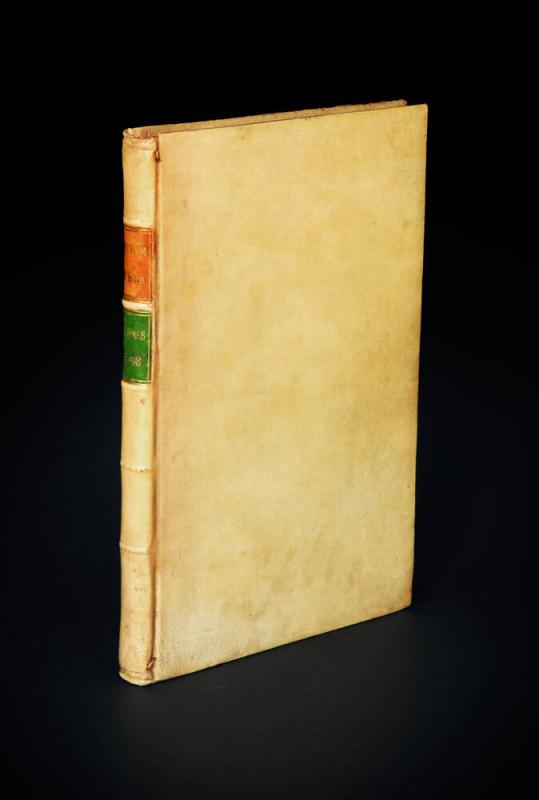
ARCHIMEDES. Archimedis opera non nulla à Federico Commandino urbinate nuper in latinum conversa, et commentariis illustrata.
Venice: apud Paulum Manutium Aldi f., 1558. Folio (300×203mm), 2 parts in one volume with separate titles. I: [4], 55, [1] leaves; II: [1], 63, [1] leaves. Printer's device on title-page and last leaf of both parts. Numerous diagrams in text. Light marginal spotting, a manuscript monogram on title-page, overall a very fine copy in XVIII century stiff vellum, spine in compartments with two morocco lettering pieces, title lettered in manuscript on lower edge. First edition of Federico Commandino's translation of Archimedes. This edition not only marked a pivotal moment in the rediscovery of Archimedes, whose writings were almost entirely forgotten during the Middle Ages, but also contributed to the development of mathematical studies in the XVI and XVII centuries, directly influencing Galileo and Kepler. Federico Commandino (1509–1575) studied Latin and Greek in Urbino, then moved to Padua in 1534 to study philosophy, medicine and mathematics. In the 1550s, he came under the patronage of the young Cardinal Ranuccio Farnese, who appointed him as court physician and mathematician. While in Rome with Cardinal Farnese, Commandino met Cardinal Marcello Cervini, the head librarian of the Vatican Library and future Pope Marcellus II. Cervini had a keen interest in Greek mathematics and had already conceived the idea of printing important Greek and Latin mathematical writings based on the manuscripts of the Vatican Library and other Italian libraries. Thanks to Farnese's encouragement and Cervini's requests, Commandino could devote the rest of his life to his greatest passion: restoring and producing Latin editions of classical Greek mathematical texts. In this role, Commandino had access to important manuscripts in Italian libraries and was in contact with the most prominent humanists of his time. The most notable works he edited and published were those of Archimedes, Ptolemy, Apollonius, Euclid and Pappus. "Archimedes, the greatest mathematician and engineer of antiquity, studied at Alexandria and lived most of his life at Syracuse. He was killed at the capture of Syracuse by the Romans under Marcellus in 212 by a Roman soldier whom he rebuked for trampling on a diagram he had drawn in the sand. [He] was above all a great mathematician, developing further many ideas of Eudoxus and Euclid. […] Archimedes — together with Newton and Gauss — is generally regarded as one of the greatest mathematicians the world has ever known, and if his influence had not been overshadowed at first by Aristotle, Euclid and Plato, the progress to modern mathematics might have been much faster. As it was, his influence began to take full effect only after the publication of [the] first printed edition which enabled Descartes, Galileo and Newton in particular to build on what he had begun" (PMM). Although the first appearance of any of Archimedes's works in print dates back only to 1503, the editio princeps of the Greek texts of seven of his works was not published until 1544 by Thomas Gechauff Venatorius, in Basel. However, Commandino found this edition entirely unsatisfactory: despite the translation, commentary and diagrams, many of the Archimedean demonstrations still remained obscure. Commandino's main motivations for translating Archimedes's books again from scratch were his desire to fully understand the mathematics they conveyed, and his wish to provide commentary that would clarify points less clear in the Basel edition. He began working on this new translation when, during a visit to Venice in 1553, he borrowed a Greek manuscript containing the writings of Archimedes with Eutocius's commentary from the Biblioteca Marciana. This manuscript was itself a copy of an older one dating back to the IX or X century, and it originally came from Cardinal Bessarion's library. In 1558, his new edition of five Archimedean writings was printed in Venice, containing five treatises: De Circuli dimensio, De lineis spiralibus, Quadratura paraboles, De conoidibus et sphaeroidibus, De numero arenae. These are followed, in the second part of the volume, by Commandino's commentary. Commandino's Archimedis opera non nulla is a significant achievement of mathematical humanism for its mathematical commentary and philological explanations, and served as an invaluable reference both for the subsequent editions of Archimedes's works as well as for XVI- and XVII-century mathematicians. Galileo Galilei owned a copy as it was the only available guide to understanding De lineis spiralibus, from which he drew inspiration for his observations on uniform motion published in Discorsi e dimostrazioni matematiche intorno a due nuove scienze (1638). In his Astronomia nova (1609), Johannes Kepler used Commandino's commentary on De conoidibus et sphaeroidibus to demonstrate the elliptical orbit of Mars. Kepler also explicitly referenced this edition in Ad Vitellionem Paralipomena (1604), quoting Commandino's commentary on De numero arenae. These references testify to the importance of Commandino's Archimedis for the rebirth of mathematical studies in Italy and abroad.
Sachgebiete: Alte Drucke 16. Jahrhundert , Altphilologie, Wissenschaftsgeschichte, Mathematik, Renaissance
15000,- EUR
Differenzbesteuert/Subject to margin taxation
Auf Merkliste setzen 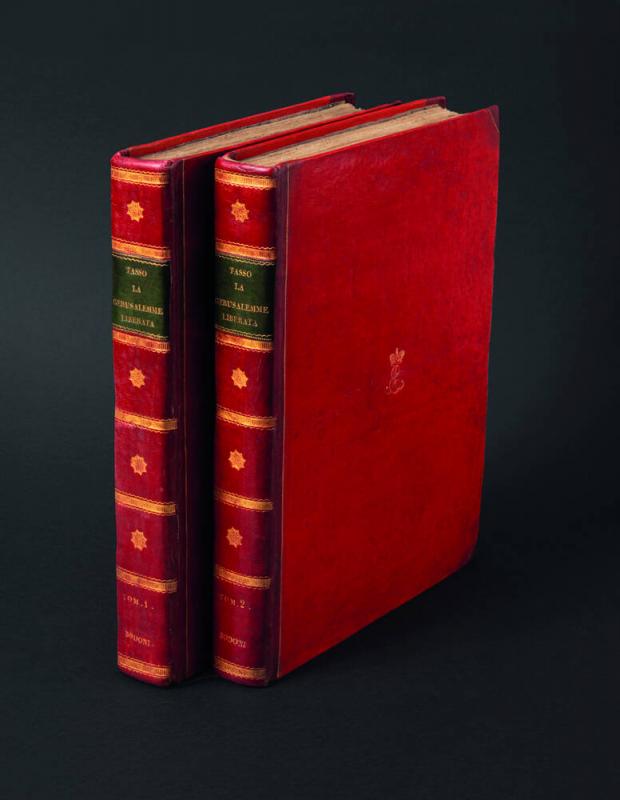
TASSO, Torquato. La Gerusalemme liberata.
Parma: nel Regal Palazzo co' tipi Bodoniani, 1794. Quarto (310 x 230 mm.), two volumes: [20], 331, [1] pages; [4], 337, [3] pages. In both volumes instead of first blank page there is a printed page declaring that “quest'edizione appartiene alla biblioteca particolare di S.A.I. Eugenio Napoleone di Francia vice-re d'Italia”. A very fine untrimmed copy bound in half red morocco, covers with gilt supralibros of Eugene Napoleon of France and his wife Augusta of Bayern, flat spines with gilt decoration green morocco lettering pieces. A very fine copy with an important provenance of Tasso's masterpiece. The Bodoni edition of La Gerusalemme liberata, is dedicated to the King of Spain Carlos IV de Borbon, who had gratified Bodoni with an annual pension and the title of Tipografo di Sua Maestà, and edited by Pier Antonio Serassi (1721 – 1791) who revised the text upon the editions printed in 1581 and 1584, and on some autograph notes by Tasso in his personal collection. “Sometime in the early 1790s, Bodoni conceived the idea of printing by subscription uniform editions of the four Italian poets Tasso, Dante, Petrarch and Ariosto. He detailed his plans in a prospectus circulated in 1793 (printed in English and Italian): 'Two Editions of each [author's work] will come out at the same time… Of the First in grand Folio, on a superfine, chosen paper and polish'd, there will be only fifty copies struck off… Of the same Edition in common Folio, on fine royal paper and polish'd, one hundred & fifty Copies will be printed… Of the second Edition in grand Quarto, on superfine chosen paper and polish'd, there will be 100 Copies… And of this Edition in common Quarto, on fine royal paper, polish'd, there will be two hundred Copies… And each Copy, if the subscriber chuses [sic] shall have a page of frontis¬piece with his name, surname and additions, which will be a lasting proof of the original propriety of the Book'. The first text to be printed was the Gerusalemme liberata. On 22 July 1794, Bodoni informed a correspondent that the work was well-underway (ho quattro torchi occupati attualmente nella stampa della Gerusalemme liberata) and that it would appear in September in cinque diverse forme, tutte eleganti e nitidissime. In fact, four (not five) editions were produced, and the quantities printed were not as specified in the 1793 prospectus. The earliest bibliographers of the Bodoni press, Francesco Fusi and Giuseppe De Lama, writing in 1814 and 1816 respectively, maintain that the four editions were printed in this order: (1) in two volumes, with three cantos printed on each page, foglio grande (page height 470 mm, or smaller), on laid paper with PB watermark (carta reale fina, detta di Napoli), 130 copies printed (100 copies reserved for subscribers or so-called ‘Associati', and 30 for sale to others); (2) in three volumes, with two cantos printed per page, foglio mezzano (page height 450 mm, or smaller), on wove paper (velina), 100 copies printed; (3) in two volumes, foglio piccolo (page height circa 390 mm), on wove paper (di Londra); (4) in two volumes, quarto (page height circa 300 mm), on laid paper (reale fina detta di Napoli). Bodoni's ambitious project to print luxurious editions of the Italian poets was ultimately a commercial disappointment: the next work to appear in the series, Dante's Divina comedia, was published in 1795–1796, also in four editions (Brooks nos. 588, 653–654; Giani p. 53); Petrarch's Rime, published in 1799, appeared however in two editions only (Brooks nos. 733–734; Giani p. 61); and Ariosto never proceeded to press.” (Robin Halwas)
Sachgebiete: Einbände, Italien, Literatur bis ca. 1900, Napoleon, Typographie
8000,- EUR
Differenzbesteuert/Subject to margin taxation
Auf Merkliste setzen 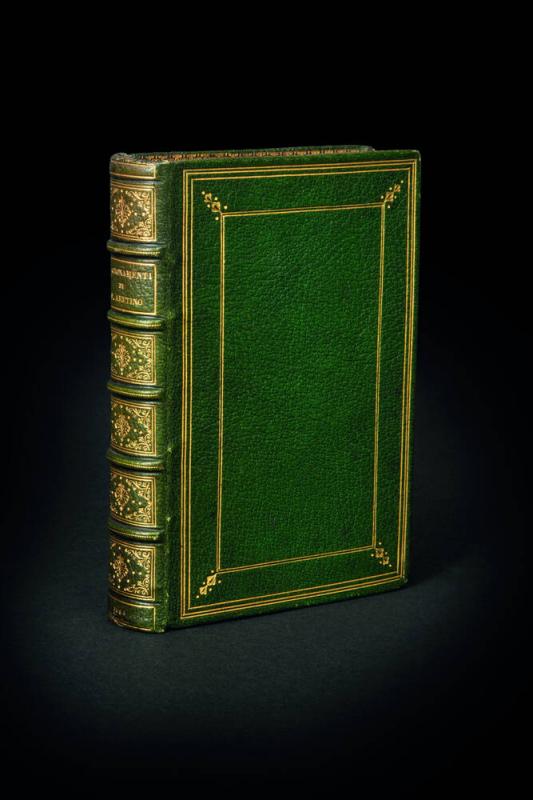
ARETINO, Pietro; CARO, Annibale. La prima [seconda] parte de ragionamenti. Commento di ser Agresto da Ficaruolo, sopra la prima ficata del padre Siceo. Con la diceria de nasi.
Bengodi: 21 October 1584 [1649 or 1651]. Octavo (148×105mm), 3 parts in one volume. I: [5] leaves, 198 pages; II: [3] leaves, 339 [i.e. 340] pages; III: 118 pages. Several historiated initials and a small engraving on FF3v. Late nineteenth-century French green morocco binding, covers with double panel of gilt lines, spine in compartments decorated and lettered in gilt; gilt edges, marbled endpapers. Armorial ex- libris on front paste-down. A few spots; overall a good copy. A rare, clandestine edition of Pietro Aretino (1492–1556), the major Renaissance author of erotic literature. A humanist, playwright and poet, he was active between the Roman court, Mantua and Venice, earning a reputation among his contemporaries for his bold satirical and polemical works directed towards the powers at the time. His scandalous and almost pornographic Ragionamenti was first printed in Venice in 1534–36 and was soon censored, as were all of Aretino's other writings, but it later circulated through the surreptitious London editions printed by John Wolfe in the 1580s, as well as their close continental reprints. Since the 1580s, Wolfe had become known for printing several editions of "popular and well-known Italian works which could not be reprinted by Italian printers (as they normally would have been) because of their appearance in the newly-established Roman Catholic Index Librorum Prohibitorum" (Woodfield, p. 8). The publication of works by Niccolò Machiavelli and Pietro Aretino, for example, was prohibited in Italy and any other Catholic country, yet there was a continuous demand for these books, which was likely even stimulated by the papal ban itself. Wolfe had already gained experience in the printing of Italian books while working in Florence in the 1570s and thus was able to cater to both the foreign market and English readers interested in Italian literature. His first venture was Aretino's La prima parte de Ragionamenti, in late 1584. The present edition is among the continental reprints that appeared following the great success of Wolfe's activity, when publishers seemed to be able to circumvent the effects of the Index Librorum Prohibitorum. Woodfield describes it as follows: "It was printed on the Continent as a double volume, almost certainly in 1651. At the bottom of N8v there is printed the motto: "MediCata RelaboR." The letters which are in larger capitals seem to be a fashion of indicating the date MDCLI, which is probably the year when this edition was printed." It is also described as a close reprint of another early seventeenth-century continental, likely from Amsterdam, edition, which was itself a reprint of a late sixteenth-century London edition. In EDIT16, however, it is reported that this edition should date to 1649. The Ragionamenti parodies Pietro Bembo's Asolani and the Platonic dialogue genre more broadly, a popular literary form in the early XVI century. It is divided into two parts. In the first part, two elderly prostitutes, Nanna and Antonia, discuss whether Nanna's daughter, the young Pippa, should live as a nun, a wife or a prostitute, ultimately agreeing that a career as a prostitute is the safest and most honest option. In the second part, Nanna teaches Pippa the skills and secrets of the perfect prostitute and warns her of the dangers of the trade, particularly betrayals by men. It is followed by the Ragionamento del frate Zoppino a Ludovico puttaniere, con la genealogia di tutte le cortigiane romane, a lively satire of Roman society of the time, the Commento di ser Agresto and the Diceria de nasi. Although these last two works are here attributed to Aretino, they were probably written by Annibale Caro (1507–1566), the author of the famous translation of Virgil's Aeneid.
Sachgebiete: Einbände, Erotica, Humanismus, Italien
3000,- EUR
Differenzbesteuert/Subject to margin taxation
Auf Merkliste setzen 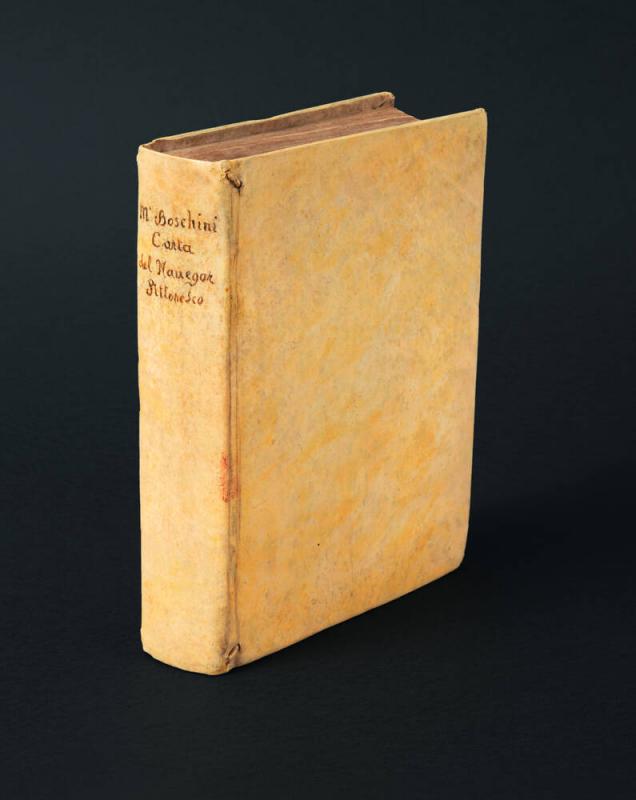
BOSCHINI, Marco. La carta del nauegar pitoresco dialogo tra vn senator venetian deletante, e vn professor de pitura, soto nome d'ecelenza, e de compare.
Venice: per il Baba, 1660. Quarto (193 x 142 mm.), [24], 680 (i.e. 682), [10] pages, illustrated with an engraved allegorical frontispiece, an engraved portrait, and 25 full-page engravings. Old signature on title page, a few spots but a very good copy in contemporary stiff vellum with manuscript title on spine from the library of the famous British art historian Kenneth Clark (ex libris). Rare first edition of the most influential works on Italian art of the seventeenth century. “The Carta del navegar pitoresco is a poem of five thousand three hundred and seventy quatrains in the Venetian language, divided into eight cantos that correspond to the eight parts of the compass rose. Each "Wind" is preceded by a summary, whose author, according to Anna Pallucchini, (A. Pallucchini, in M. B., La Carta del navegar pitoresco, Venezia-Roma 1966) would be a friend of Boschini, the Paduan painter Dario Varotari. The protagonist of the poem is a Venetian senator (probably Giovanni Nani) to whom a "Professor of painting" - Boschini himself - teaches how to recognize and evaluate the technique of painting and how to distinguish the style of the various authors. In front of the works of art, which the two protagonists of the didactic poem encounter on their path, a discussion is intertwined in which the artistic superiority of Venice over Florence is continually demonstrated. Boschini compares Venetian painting with music, rather than with poetry; fully adhering to the sensual character of baroque art, he evokes olfactory suggestions and even gastronomic comparisons. To the plasticity of the Tuscans' drawings and chiaroscuro he contrasts the life and excitement of Venetian colour; to the officialism of Vasari he prefers dialogue and improvisations that sometimes have the vivacity of news reporting. As a good Venetian he tends to use everyday language, proposes comparisons and adopts terms that any academic would have rejected. To remain faithful to his commitment as a populariser and ardent propagandist of Venetian art he must resort to every means to attract the interest of his readers; to be more effective and "Venetian" and to free himself from any Tuscan complex, he resorts to the use of the dialect of his beloved city, and of the richness of this language, indeed, he weaves the highest praise. The continuous passing from one place to another, the calm conversation of the two protagonists through the streets of Venice, correspond to the exuberant and colorful animation of the city. But however witty and lively, it must be said that the poem, from a literary point of view, does not correspond at all to the genius of the critical intuitions of Boschini, who for many of the greatest Venetian and Veneto artists has come to propose illuminating interpretations and so precise as to form in our memory a whole with the work of art they illustrate.” (transaled from DBI) Marco Boschini (1613-1678) was a Venetian painter, engraver and art dealer. “Boschini's main "client" was Cardinal Leopoldo de' Medici who, following Galileo's principles, intended to organically assemble a collection where all the schools were present and each artist was represented by a self-portrait, some drawings and a painting that well documented his style. Alongside Baldinucci, in charge of the Tuscan school and Malvasia for the Bolognese one, Boschini was entrusted with the task of completing the documentation relating to the Venetian school.” (translated from DBI)
Sachgebiete: Bibliographie , Kunstgeschichte, Illustrierte Bücher, Italien
7000,- EUR
Differenzbesteuert/Subject to margin taxation