 Auf Merkliste setzen
[SAINT-DENIS, Antoine de (fl. mid 16th cent.)]. Les Comptes du Monde adventureux par A.D.S.D. Paris, Estienne Groulleau [for Jean Longis and Vincent Sertenas booksellers], [8 July] 1555.
8vo (169x104 mm). [11], 245, [1] leaves. Collation: ã8 ē4 A-Hh8. Lacking the blank leaves ē4, Hh7 and Hh8. Groulleau’s device on title page. Woodcut initials. Colophon on l. Hh5r, Privilège du Roi on ll. Hh5v-6v. Roman and italic types. 19th-century gilt hazelnut calf, spine in compartments with lettering piece, gilt edges, marbled endleaves, blue silk bookmark (part of the spine and hinges skillfully repaired). On the front flyleaf bookplate with the monogram “AMB”, on the title page barely readable ownership entry “Le marquis De P[…]” and library stamp “Ex bibliotheca J. Richard M.D.” (repeated on l. A1r). Contemporary manuscript notes on ll. Q2r and Q6r in a French hand. Worm tracks repaired on the lower blank margin of most of the volume only occasionally minimally affecting the text, title page slightly soiled, some occasional light browning, all in all a good copy. Extremely rare first edition of this collection of fifty-four moralizing stories, often rather coarse and spicy, nevertheless dedicated “Aux sages et vertueuses Dames de France”. The work is traditionally attributed to Antoine de Saint-Denis, a priest from the diocese of Mans, who seems to have been in close relationship with Marguerite de Navarre. “Par ses tendances come par sa forme littéraire, ce recueil appartient bien au petit cercle des contes de la reine de Navarre, et la personalité d’Antoine de Saint-Denis [curé de Champfleury] s’y encadre sans difficulté […] Il faut reconnaître que, en effet, si Marguerite d’Angoulême étendit largement sa protection sur le monde entier des lettres et des arts, elle se fit tout près d’elle un cenacle choisi de poëtes et de conteurs, et que sa personalité fut, pour ceux-ci, una cause vivante démulation autant qu’un centre d’attraction […] Par ces points de contact fréquents entre le livre de la reine de Navarre et le recueil de Comptes du monde adventureux se trouve corroborée l’opinion que j’ai déjà émise au sujet de la priorité des ces Comptes, priorité d’allieurs publiquement affirmée par les amis de l’auteur au moment de l’impression du recueil in 1555, et qui ne souleva de la part des contemporaines aucune réclamation” (F. Frank, Notice, in: “Les comptes du monde adventureux”, Paris, 1878, pp. XIV, XXIV and CXXVII; see also V.-L. Saulnier, Martin Pontus et Marguerite de Navarre, la Réforme lyonaise et les sources de l’Héptameron, in: “Bibliothèque d’Humanisme et Renaissance”, XXI, 1959, pp. 577-594). At the beginning of each story the author gives his short general moral lesson and at the end he addresses specifically to women to tell them what lesson they have to draw from the story. As in Boccaccio’s Decameron, the stories are told within a narrative frame, which is in itself a short story. The author is traveling from Provence to Savoy through the Dauphiné. Along the way he meets a gentleman who is accompanying his recovering wife to a thermal center. He joins them and their group, and during the journey - on horseback, during and after meals - they tell each others short stories to entertain themselves. Investigations about the sources of the stories were made by G.-A. Pérouse in his Nouvelles françaises du 16me siècle (Genève, 1977, pp. 139-155). Thus the main source of the stories is Masuccio Salernitano (c. 1410-1475), as at least thirty stories are drawn from him. Some single stories are adaptations from the Pecorone of Giovanni Fiorentino (fl. mid 14th cent.), from Heinrich Bebel (1472-1518), from Matteo Bandello (1485-1561) (cf. V.-L. Saulnier, Sur une nouvelle de Bandello et l’un des Comptes du Monde adventureux, in: “Bibliothèque d’Humanisme et Renaissance”, XXIII, 1961, pp. 347-350), from Le petit Jehan de Saintré by Antoine de La Sale (c. 1388-1461) (cf. G.-A. Pérouse, Les Comptes du Monde adventureux et le roman de Jehan de Saintré, in: “Bibliothèque d’Humanisme et Renaissance”, XXX, 1968, pp. 457-469), and from the Cent Nouvelles nouvelles (c. 1450s). The remaining stories, however, are original and “constituent un ensemble de récits inspirés par des anecdotes françaises et contamporaines, dont la note est très distincte de celle que rend le reste du recueil; ce sont des nouvelles, au sens propre du terme” (Pérouse, op. cit., p. 144). “[…] A.D.S.D. est écrivain et, de plus d’une manière, y fait preuve d’originalité. Tout d’abord, ses ‘histoires’ sont loin d’être tout “traduites”; et, lorsque traduction il y a, celle-ci est rarement simple traduction. Mais notre auteur se distingue encore par son recours à un récit liminaire (alors que les collections commerciales en sont depourvues, on l’a constaté), ou par le fait que ses emprunts s’addressent à la ‘deuxième génération’ des modèles italiens, enfin et surtout par sa constante volonté d’enseigner […] Tout cela étant, les Comptes du Monde adventureux ont bien une place entre Taillemont et Tahureau. Mais ils sont aussi liés de près à l’Heptameron […] Malgré la date tardive de leur publication, au bord des années de crise, les Comptes du Monde adventureux se rattachent assurément, pour une part, à la grande époque du genre. Les quinze récits realists qui s’y détachent ont leur place à côté des Nouvelles Récreations et surtout de l’Heptaméron: narrations ‘ancrées’ dans la réalité sociale quotidienne de ce côté-ci des Alpes, et exprimant ces réalités françaises dans des intrigues souvent fort reussies, ce sont proprement des ‘nouvelles’ au sens que nous avons voulu dégager au début de cette étude – éléments épars d’un authentique ‘Decameron françois’ ”(Pèrouse, op. cit., pp. 140 and 154). “La répartition des délits et du personnel criminel entre histoires comiques et histoires tragiques dans l’Heptaméron et Les Comptes du monde adventureux délivre un premier enseignement: les crimes les plus graves sont associés aux histoires tragiques tandis que les crimes bénins sont majoritaires dans les histoires comiques – ce qui n’exclut néanmoins pas la présence de délits majeurs. Dans ces deux recueils, les histoires tragiques accordent une place prépondérante aux crimes les plus graves tels que le meurtre, le viol ou encore l’adultère – ce dernier délit étant lui-même considéré comme le plus criminogène de tous, dans la mesure où il entraîne dans son sillage une multiplication des crimes les plus graves, de l’homicide au crime de lèse-majesté […] [D]ans la trente-quatrième histoire des Comptes du monde adventureux, l’adultère monnayé d’une dame avec un étudiant mène le mari trompé à assassiner son épouse et dans la cinquantième histoire, l’adultère d’une dame avec un écuyer la conduit à commettre un homicide, celui d’un enfant innocent. De manière générale, les pulsions sexuelles et les malheurs liés à l’amour et au désir sont au cœur des histoires tragiques où désir et violence sont étroitement associés […] (dans Les Comptes du monde adventureux, sur onze histoires criminelles trois tragiques, un mariage clandestin, cinq relations sexuelles illicites et quatre adultères peuvent être comptabilisés): l’amour est mortifère et malheureux dans la peinture tragique […] Cependant, contrairement à ce qui se passe dans l’Heptaméron, les histoires comiques réservent dans Les Comptes du monde adventureux une place importante aux délits mineurs, vols, duperies et autres bons tours, dont les victimes provoquent le rire, et non la compassion. Ce personnel criminel professionnel est représentatif de la perspective facétieuse et satirique, tandis qu’il est le plus souvent absent des histoires tragiques ou y apparaît au second plan. La satire des milieux marchands et artisans, dans la tradition des fabliaux, est présente dans la onzième histoire où un couturier voleur se fait meunier et apprend à être un peu larron pour éviter d’être réduit à la mendicité ; les moines malhonnêtes sont mis en scène dans la dixneuvième histoire et dans la vingt-deuxième, alors que les membres du clergé apparaissent au contraire comme des proies faciles pour les voleurs du fait même de leur cupidité et de leur soif d’argent dans les trente-troisième et quarante-sixième histoires. Ces figures criminelles sont héritières de la tradition satirique et se caractérisent par la ruse, la finesse, la duplicité dont elles font preuve pour mystifier leurs victimes. La vingt-quatrième histoire est très représentative, puisque le menu larcin accompli par les protagonistes est assimilé à une plaisanterie, une raillerie permettant de rire aux dépens d’un personnage respecté, un docteur ès lois de la ville de Boulogne: l’identité de la victime, un notable, représentant de la justice ou membre du clergé, contribue beaucoup à faire ressortir le sel des bons tours accomplis par des personnages mi-voleurs mi-plaisantins” (E. Ziercher, Représentations du sujet criminel, entre facétie et pathétique, in: “Juges et criminels dans la narration brève du XVIe siècle, J.-C. Arnould, ed., 2010, pp. 2-3 and 8; see also W.K. Pietrzak, Le Tragique dans les nouvelles exemplaires en France au XVIe siècle, Lódź, 2006, ad indicem; and L. Dion, Histoires de mariage. Le mariage dans la fiction narrative française (1515-1559), Paris, 2017, ad indicem). The present edition was shared between four Parisian publishers: Estienne Groulleau, Jean Longis, Robert Le Mangnier and Vincent Sertenas, and is extant with three variant title pages bearing the name of one or the other publishers. The work was very successful and was reprinted seven times until the end of the century. The 1582 edition contains an addition of five “discours modernes et facetieux”, that do not appear in the latest known 16th-century edition printed in 1595. The first modern edition is the one edited and commented by F. Frank cited above, that was reprinted at Geneva in 1969 (cf. Pérouse, op. cit., p. 502). BMSTC French Books, 127; Cioranesco, 6795; Melzi, I, 236; Barbier, I, 658.
4800,- EUR
Differenzbesteuert/Subject to margin taxation
Auf Merkliste setzen 
GALLI BIBIENA, Antonio (1697-1774). Disegni del nuovo teatro de quattro cavalieri eretto in Pavia l’anno MDCCLXXIII opera del Cav. Antonio Galli Bibiena. N.pl. [Pavia], n.pr., n.d. [c. 1773].
Folio (412x287 mm). Engraved architectural title page by Giovanni Ramis after Paolo Mescoli, dedicaton leaf to the Archduke Ferdinand of Austria, [1] leaf of text, and [3] double-page plates engraved by Giovanni Ramis after Paolo Mescoli and Antonio Martorini, showing the plan, the façade and a section of the theater. Contemporary colored wrappers (spine repaired, worn and faded). A very good copy printed on thick paper. Extremely rare first edition, probably printed after 24 May 1773, date indicated in the text for the inauguration of the theater. Begun in 1771 by the famous architect Antonio Galli Bibiena, son of Ferdinando, and completed two years later, the Teatro dei Quattro Cavalieri, now known as Teatro Fraschini, is one of the most important monuments in the city of Pavia and the last of a series of theatres built by Bibiena in Italy, including the Comunale in Bologna, the Teatro Rossini in Lugo di Romagna and the Teatro Scientifico in Mantua. The façade of the building on Strada Nuova shows the affirmation of the neoclassical style, while the interior, with its symmetrical division of the rectangular plan, destined to the stage on one side and the audience on the other, was designed so that the protagonist would be exactly in the centre of the hall. The theatre was inaugurated in 1773 with J. Mjsliweczek’s Il Demetrio in the presence of Archduke Ferdinand of Austria, to whom the opera is dedicated. The four knights who financed its construction, Count Francesco Gambarana Beccaria, Marquis Pio Bellisomi, Marquis Luigi Bellingeri Provera and Count Giuseppe de Giorgi Vistarino, wanted to oppose the monopoly of theatrical performances held by G. Omodei, owner of the only theatre in Pavia until then. “The Teatro dei Quattro Cavalieri, now known as the Fraschini, is destined to play a fundamental role in the corpus that will be critically defined around the name of Antonio, at least as important as that of the Comunale in Bologna (1756-1763) and the Scientifico in Mantua (1767-1769). In fact, it is reasonable to assume, and a reading of the monument confirms this, that in the Pavia project the previous experiences in Bologna and Mantua led to a rethinking and to new, albeit partial, acquisitions in the formulation of the theatrical organism. The main source for the commission, the original icnography of the building and the timing of its realisation is the folio publication entitled Disegni del nuovo teatro de quattro cavalieri eretto in Pavia l'anno MDCCLXXIII opera del Cav. Antonio Galli Bibiena, published by the coowners patrician cavalieri at an unspecified date, but probably on the occasion of the theatre’s inauguration, and dedicated to Archduke Ferdinand of Austria. In the introduction to the three plates - plan, section and prospectus of the theatre - that make up the volume, it is stated that ‘ebbe principio il nuovo Teatro nella Regia Città di Pavia l'anno 1771, coll’essersi sul fine del mese di luglio formata una società di quattro Cavalieri Patricj, e Decurioni della città stessa cioè: il Conte Francesco Gambarana Beccaria, il Marchese Pio Bellisomi..., il Marchese Luigi Bellingeri Provera..., ed il Conte Giuseppe de Giorgi di Vistarino’ (‘The new theatre in the royal city of Pavia began in 1771 with the formation, at the end of July, of a company of four patrician knights and decurions of the city itself, namely: Count Francesco Gambarana Beccaria, Marquis Pio Bellisomi..., Marquis Luigi Bellingeri Provera... and Count Giuseppe de Giorgi di Vistarino’). It is clear that this was a private company that brought together some of the leading representatives of the local ruling class for an initiative in the public interest, in line with the enlightened directives of the central power. The nature of the company and its private funding were very much in line with 18th-century practice, which was full of similar examples; we need only think of the Comunale in Bologna, the Filarmonico in Verona, the Aliberti in Rome. In this particular case, the construction of a theatre was intended to avoid a precarious situation. Confined to the salons of patrician houses in the 17th century, the theatrical life of the city found an opening at the beginning of the 18th century with the construction of a theatre open to the public. It was a poorly equipped hall owned by the Homodei family, who ran it according to dubious criteria inspired by a misunderstood caste pride. The intention of the four knights was therefore to provide the city with a stable structure more suited to its needs […] The choice of the architect was probably determined by two factors: Bibiena’s fame as a theatre engineer, apparently untainted by the controversy that had surrounded the Bolognese commission, and his qualification as Architect of the Imperial Court of Vienna, a particularly prestigious title in a city of strict Austrian observance. In October 1777, the demolition of the existing houses in the chosen area began and the foundations of the building were laid. The inauguration took place on 24 May 1773 with the opera ‘Il Demetrio’, text by Pietro Metastasio, music by Giuseppe Mjsliweczek, scene changes by Antonio Bibiena himself. According to the first local historians, the architect personally supervised the work […] Following the principles laid down by the architect during the controversy over the construction of the Comunale in Bologna, the Teatro di Pavia was also built entirely in brick and stone, materials that contemporary theorists had a very negative view of, considering them to be unacoustic par excellence. In the Teatro dei Quattro Cavalieri, Antonio Bibiena used other means to ensure the success of the acoustics. The ceiling, the structure of which was later rebuilt, and the pit under the stalls probably played a prominent role in this undertaking. Antonio Galli Bibiena’s role in 18th-century theatre architecture was gradually defined. The bell-shaped plan, typical of the entire Bibiena tradition, became here the object of geometric formulation and was concretized in stable wall structures” (cf. L. Giordano, Il teatro dei quattro cavalieri e la presenza di Antonio Galli Bibiena a Pavia, in: “Bollettino d’arte”, 60, series 5., fasc. 1-2, Jan.-Jun. 1975, pp. 88-93). Antonio Luigi, one of the sons of the famous architect Ferdinando Galli Bibiena, was born in Parma in 1697. After his early studies in Bologna, he began his career as an architect, set designer and painter with his father. His most active period was in Vienna, where he was employed annually as a set designer for court shows. Around 1740 he accepted the invitation and protection of Imre Esterházy, Bishop of Veszprém and later Archbishop of Esztergom, who employed him in Bratislava in both civil and religious works. After the death of Cardinal Esterházy (1745), he returned to Vienna, where he was appointed “First Imperial Architect” in 1748. He permanently returned to Italy in 1751. The experience he had gained in over 30 years at the Viennese court and his exceptional skills as a theatre architect won him a prominent position in Italy, where he first worked on the reconstruction of the Teatro dei Rinnovati in Siena (1751-53), then on the reconstruction of the small theatres in Colle di Val d’Elsa and Pistoia (1754-55), and finally on the scenography and decoration of the Teatro della Pergola in Florence (1755). He returned to Bologna in 1756 to complete the new public theatre, inaugurated on 14 May 1763. He then designed stage sets for theatres in Milan (1751-53), Parma (1753, 1761, 1763), Reggio Emilia (1759) and Bologna. He was also responsible for the design of the Teatro di Lugo, the Teatro Scientifico in Mantua (1767-69) and the Teatro dei Quattro Cavalieri in Pavia (1771-77). His late activity was divided between Emilia and Lombardy. Antonio Luigi died in Milan on 28 January 1774 (cf. A. Coccioli Matroviti, Galli Bibiena, in: “Dizionario Biografico degli Italiani”, vol. 51, Rome, 1998, s.v.). Italian Union Catalogue, IT\ICCU\PUVE\004090; Cicognara, 752.
3900,- EUR
Differenzbesteuert/Subject to margin taxation
Auf Merkliste setzen 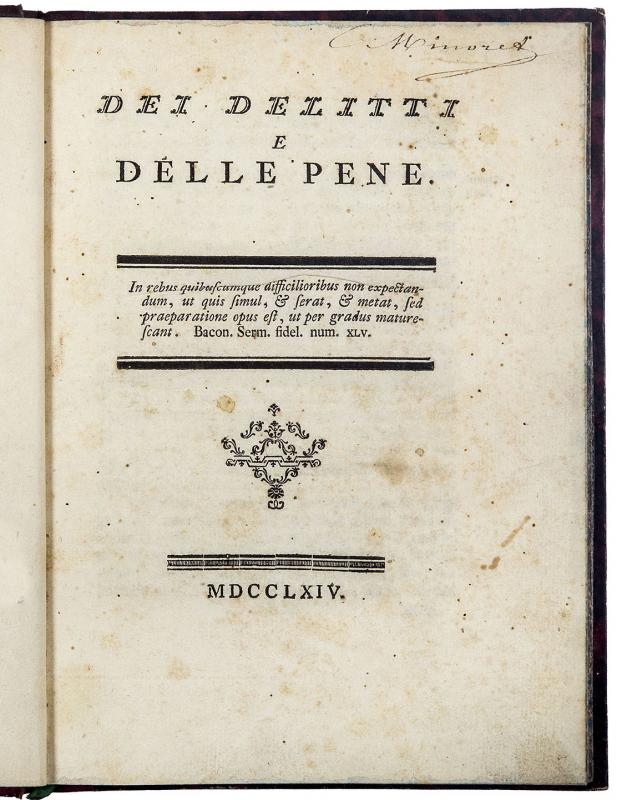
[BECCARIA, Cesare (1738-1794)]. Dei delitti e delle pene. N.pl., n.pr., n.d. [Livorno, Marco Coltellini], [July] 1764.
4to (203x145 mm). 104, [2] pp. Collation: A-N4 χ1. 19th-century French half morocco, spine with four raised bands and gilt title, marbled endleaves and marbled edges. Between the front flyleaves is a loose paper strip written in an elegant 19th-century hand which contains a few verses against torture taken from Voltaire’s Ode à la verité. On the title page is the ownership entry “C. Minoret”. Title page a bit soiled, uniformly slightly browned, some scattered foxing, all in all a good, wide-margined copy. First edition (in one of the rare copies with the errata leaf containing twenty-one corrections, printed as a separate sheet) of one of the most important works of the Italian Enlightenment. A manifesto on legal reform, and one of the best interpretations of the ideas circulating around France in the second half of the eighteenth century. The young Milanese nobleman Cesare Beccaria Bonesana composed this work between March 1763 and January 1764, while he was an active member of the intellectual circle known as the Accademia dei pugni, founded in Milan in 1762 by the brothers Alessandro and Pietro Verri, and Beccaria himself, among others. The central theme of the work is the reform of criminal justice, in a context in which punishment was still both brutal and arbitrary. Beccaria advocates an egalitarian justice system and traces a new metric for punishment and laws rooted in the concept of public happiness. “One of the most influential books in the whole history of criminology [...] Beccaria maintained that the gravity of the crime should be measured by its injury to society and that the penalties should be related to this. The prevention of the crime he held to be of greater importance than its punishment [...] his ideas have now become so commonplace that it is difficult to appreciate their revolutionary impact at the time” (PMM). The work enjoyed wide and immediate success, and its influence was enormous. Voltaire, d’Alembert, Helvétius, Holbach, Hume, and Hegel all counted among its enthusiastic readers; Beccaria’s ideas also inspired justice reforms introduced by Grand Duke Leopold of Tuscany, Emperor Joseph II, and Catherine II of Russia, and its influence on constitutionalism broadly, especially the Declarations des droits de l’homme of 1789, is likewise evident. The Dei delitti e delle pene was published in Livorno (Tuscany) – then one of the most advanced cities in Italy – on 12 April 1764, anonymous and without indication of place, for fear of repercussions owing to its strong egalitarianism. The printer Coltellini had already published, in 1763, the Meditazioni sulla felicità by Pietro Verri, Beccaria’s closest friend. The ‘innovative’ feature of the reform proposed by Beccaria was, however, perceived by the Roman censorship, and in 1766 Dei delitti e delle pene was included in the Index of Forbidden Books. A good sign, as Beccaria admonishes: if a government needs censorship, it comes from the weakness of its constitution. The work was translated into English in 1767, and On Crimes and Punishments “significantly shaped the views of American revolutionaries and lawmakers. The first four U.S. Presidents – George Washington, John Adams, Thomas Jefferson and James Madison – were inspired by Beccaria’s treatise and, in some cases, read it in the original Italian. On Crimes and Punishments helped to catalyze the American Revolution, and Beccaria’s anti-death penalty views materially shaped American thought on capital punishment, torture and cruelty” (J. D. Bessler, The Italian Enlightenment and the American Revolution, p. 1). Gamba, no. 2147; Parenti, p. 67; Melzi, I, p. 281; Printing and the Mind of Man, no. 209; L. Firpo Le edizioni italiane dei delitti e delle pene, Milano, 1984, no. 1; Einaudi, no. 3362; B. E. Harcourt, Beccaria’s ‘On Crimes and Punishments’: A Mirror on the History of the Foundations of Modern Criminal Law, Chicago, 2013; M. Palumbo & E. Sidoli (eds.), The Books that Made Europe, Bruxelles, 2106, pp. 248-249.
18000,- EUR
Differenzbesteuert/Subject to margin taxation
Auf Merkliste setzen 
BERNI, Francesco (1610-1673)]. Il torneo a piedi, e l’invenzione, ed allegoria, colla quale il Signor Borso Bonacossi comparì a mantenerlo: e l’Alcina maga favola pescatoria [...] Ferrara, Gioseffo Gironi & Francesco Gherardi, 1631.
4to (198x140 mm). [16], 107, [1] pp. and [6] etched folding plates attributed to Alfonso Chenda (1607-1640). Collation: a-b4 A-M4 N6. 18th-century half vellum, inked title on spine, panels covered by light blue floral paper, red sprinkled edges (slightly worn and rubbed). Private stamp to the title-page verso. Worm track to the lower outer corner of the first ten leaves, which then becomes just a small hole, never affecting the text, other work track to the outer margin of the final leaves with no loss of text, two small holes on l. C2 one of which slightly affects the text, some foxing and staining, more strongly towards the end, all in all a good, genuine copy. Extremely rare first and only edition of the account by Francesco Berni (1610-1673, disguised under the academic name of “Aggirato”) of the first festival held in Ferrara after the War of the Mantua Succession (1628-1631), to celebrate the wedding of Giovanni Francesco Sacchetti (1595-1656) and Beatrice Estense Tassoni (1611-1633), in the presence of the Duke of Mantua, Charles de Nevers -to whom the volume is dedicated- and Cardinal Giulio Sacchetti. The book describes a tournament organised by Borso Bonacossi at Carnival time and accompanied by recited texts (one of which is signed by Ottavio Magnanini), as well as poems, stage designs, and machinery (pp. 6-86). It also contains the Alcina maga, a “favola pescatoria” by Sebastiano Martini (pp. 87-96), a wedding ode by Francesco Berni recited that same evening (Il Tebro, overo la Pittura loquace del pittor muto, pp. 99-107), two sonnets, by Alfonso Fiornovelli and Ippolito Visdomini, and a Latin poem by I. Visdomini. The plates depict the allegorical and historical re-enactments that were performed, including two scenes from the Alcina maga. Sartori, 23349; Italian Union Catalogue, IT\ICCU\MODE\034506; Michel & Michel, I, pp. 152-153; Watanabe, 418; Cicognara, 1438.
12000,- EUR
Differenzbesteuert/Subject to margin taxation
Auf Merkliste setzen 
GRAZIANI, Girolamo (1604-1675). Il Cromuele tragedia del Co: Girolamo Gratiani Segretario, e Consigliere di Stato del Serenissimo Signor Duca di Modona. Bologna, Manolessi, 1671.
4to (190x138 mm). Engraved frontispiece, [14], 160, [2: errata] pp. and [5] engraved folding plates. Collation: [+]4(-+2) ++4 A-V4 χ². Lacking the final (blank?) leaf. Woodcut arms of the dedicatee, King Louis XIV, on the title page. Woodcut initials, head- and tail-pieces. Later boards, red sprinkled edges (joints repaired, slightly rubbed and soiled). Upper outer corner of the half title repaired, lower margin of the title page trimmed with loss of a line of text, some foxing, marginal tears to some of the plates skilfully repaired, tiny portion of a plate missing, all in all a good copy. Rare first illustrated edition, also printed in the same here without illustrations in Modena by Soliani and reprinted in Bologna by Manolessi in 1673, of this five-act tragedy by Count Girolamo Graziani, a man of letters from Modena who served as secretary and advisor to the Duke of Modena. The play, conceived in the 1660s during Laura Martinozzi’s regency in Modena, depicts the dramatic events of the English Civil War, pitting the tyrant Oliver Cromwell against the martyr Charles I. Inspired by the typically seventeenth-century tendency to rewrite recent historical events for political purposes, the play paints a hagiographic portrait of the English monarch, whose blood comes to take on a strong symbolic and almost Christ-like significance following his death sentence (cf. P. Di Nepi, Girolamo Graziani e la politica come arte: “Cromuele”, in: “F.M. Annali dell’Istituto di Filologia Moderna dell’Università di Roma”, 2-1979, Rome, 1981, pagg. 113-24). From the very beginning, the tragedy presents itself as a Baroque device in the service of defending the monarchy, through a pseudo-historical - yet theatrical - reconstruction of the events of 1649. It is true that the tragedy makes use of specific historical references, but - as is usually the case in seventeenth-century theater - these are condensed into a single night, that of January 30, 1649 (cf. S. Miglierina, Il sangue di Carlo: apologia e licenza teatrale nel Cromvele di Girolamo Graziani, in: “Krypton”, vol. 1, 2013, p. 47). The first mention of the tragedy’s composition appears in the preface to Girolamo Graziani’s Varie Poesie e Prose (1662). Beginning in 1666, the composition of the Cromuele was accompanied by an extensive correspondence with Jean Chapelain, with whom Graziani - who was on the payroll of Colbert on behalf of the Sun King - corresponded regularly (cf. R. Galli Pellegrini, La Tragédie Italienne à l’école du classicisme Français: le rôle de Chapelain dans la genèse du “Cromuele” de Graziani, in: “Quaderni del Dipartimento di Lingue e Letterature Straniere Moderne, Università di Genova”, 2-1987, pp. 35-57). There is no mention of a performance of Il Cromuele in the preface to the second edition of 1673, nor is there any trace of it in the extensive documentation on theatrical performances in the Este States preserved in the State Archives of Modena. The likely reason for the play’s failure to be staged was the dynastic marriage that took place in 1673 (just two years after the 1671 publication) between Maria Beatrice d’Este and Giacomo Stuart, who had been widowed in the very year of Il Cromuele’s publication by Anna Hyde - the woman with whom he appears to be in love in the tragedy. This was an inconvenient presence for Graziani, who, as secretary of state, had looked after the Este family’s interests in that marriage (cf. M. Fasce, Introduzione e note alle edizioni de Il Cromuele, in: “Storie Inglesi, l’Inghilterra vista dall’Italia tra storia e romanzo XVIII sec.”, C. Carminati-S. Villani, Pisa, 2011, pp. 297-330). Girolamo Graziani, who earned a degree in law and humanities in Bologna, served as an advisor and secretary to the princes, that is, to the sons of Alfonso III of Modena. After several legal disputes, he traveled in 1648 on a diplomatic mission to Paris, where he witnessed the Fronde, before returning to Modena in 1649, where he continued his diplomatic and literary career. Graziani was in Paris, at the French court, at the time of the execution of the King of England, and this suggests that he was a direct witness of the scandal that the event could have caused at the court of the nephew of the murdered king. Graziani decided to recount those events in a dramatized version twenty-two years after Charles’s death, thirteen after Cromwell’s, and eleven after the restoration of the monarchy in England (cf. F. Tarzia, Graziani, Girolamo, in: “Dizionario Biografico degli Italiani”, vol. 58, Rome, 2002, s.v.). Italian Union Catalogue, IT\ICCU\CFIE\004848; Clubb, 483; Brunet, II, 1719.
5500,- EUR
Differenzbesteuert/Subject to margin taxation
Auf Merkliste setzen 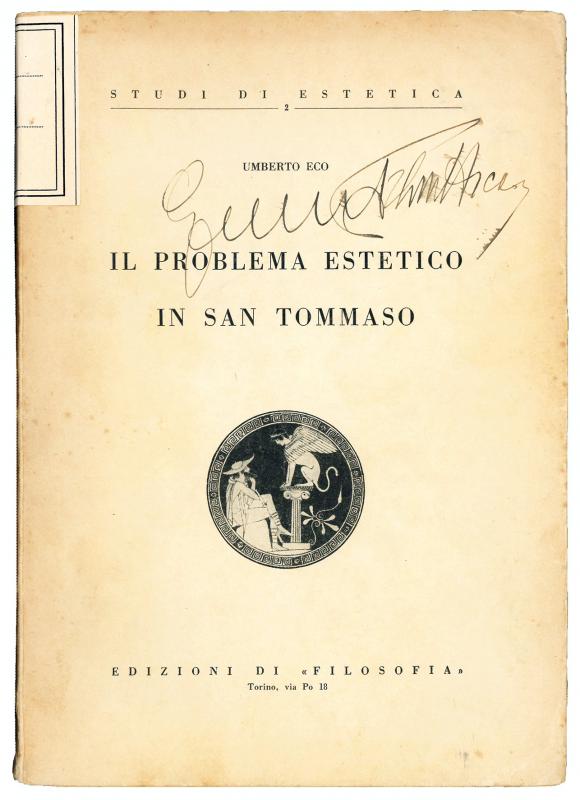
ECO, Umberto (1932-2016). Il problema estetico in San Tommaso. Turin, Edizioni di “Filosofia” (Cuneo, Stabilimento tipografico editoriale “Saste”), 10 August 1956.
4to (250x176 mm). 157, [3] pages. Original publisher’s wrappers. A good copy, uncut and mostly unopened, leaves slightly uniformly browned. Provenance: Giuseppe Flores d’Arcais, considered the founder of the school of personalized pedagogy (his large signature on the front cover and the label of his library on the spine). First edition of the first book by the famous Italian semiotician and novelist Umberto Eco. Il problema estetico in San Tommaso consists of an enlargement of Eco’s thesis developed with the historian and philosopher Luigi Pareyson (1918-1981) on the theme of the complex and original aesthetic theories advanced by the influential medieval thinker Thomas Aquinas (1225-1274). Umberto Eco, a native of Alexandria, graduated in 1954 from the University of Turin with a thesis on St. Thomas Aquinas. After teaching at the Faculty of Letters of the University of Milan, at the Faculty of Architecture in Florence and at the Polytechnic of Milan, in 1975 he was appointed professor of semiotics at the University of Bologna. Eco was awarded many honorary titles by universities from all over the world. Since 1989 he was the president of the International Center for Semiotic and Cognitive Studies and since 1994 of the International Association for Semiotic Studies. Contributor to many Italian newspapers and magazines such as “Il Corriere della Sera”, “La Repubblica” and “L’Espresso”, in his long career and vast bibliography he dealt in particular with aesthetics, artistic avant-garde, linguistics, and mass communication. After the extraordinary success of his debut novel Il nome della rosa (1980), Eco published other works of fiction, among which Foucault’s Pendulum (1988), The Island of the Day Before (1994), Baudolino (2000), and The Prague Cemetery (2010) (cf. P.E. Bondanella, The Cambridge Companion to Umberto Eco, Cambridge, 2013; S.G. Beardsworth & R.E. Auxier, eds., The philosophy of Umberto Eco, Chicago, 2017). Giuseppe Flores d’Arcais (1908-2004) was among the pioneers in the teaching of the history of entertainment and audiovisuals. Graduating from Padua with a degree in musical aesthetics in 1929, Flores d’Arcais, who joined Fascism as a young man, was not only a professor of pedagogy but also of didactics, aesthetics, philosophy, history of theater, of which he held one of the first chairs in Italy (1959-1972), and method and didactics of audiovisual arts until his retirement (1983). He greatly contributed to giving didactic dignity to the disciplines of entertainment, radio communication and cinema, to whose interaction he dedicated his first course “The Problem of Relations between Cinema and Theater”. He gave equal space to the history of theater and cinema, supplementing courses on Luigi Pirandello and the birth of filmaking with sections devoted to the European cinema between 1930 and 1960 or Neorealism. He was a full member of the Accademia Patavina di Scienze, Lettere ed Arti, and a corresponding member of the Istituto Veneto. In addition to his many pedagogical writings, mention should also be made of Il film nella scuola (1963) and Note per una estetica del cinema (in: “Rivista del cinematografo”, 1, 1953, pp. 6-10) (cf. A.M. Bernardinis, Scritti di Giuseppe Flores D’Arcais, in: “Studi in onore di Giuseppe Flores d’Arcais”, Padua, 1985, pp. XXXVII-LXXVII). Considering that Eco and Flores d’Arcais knew each other well and copies of later Eco’s pubblications bearing Eco’s dedication to him are known, it is possible that Eco himself gave this copy to Flores d’Arcais, but did not dedicate it to him as at the time the latter was already a reknown professor while Eco had graduated from university only a few years earlier. L. Gambetti-F. Vezzosi, La letteratura italiana del Novecento. Repertorio delle prime edizioni, Genoa, 1997, p. 188.
2800,- EUR
Differenzbesteuert/Subject to margin taxation
Auf Merkliste setzen 
CORVUS, Andreas (Andrea Corvo della Mirandola, 1470-1514). Ein schönes Büchlin der kunst Chiroma[n]tia deß wolgelerte[n] Magistri Andree corui vo[n] Mira[n]dula. Colophon: Strassburg, Johann Grüninger, 1514.
8vo (147x100 mm). [104] leaves. Collation: A-N8. Colophon on l. N8r. Woodcut decorated initials. With overall 168 woodcut illustrations in text including the one on the title page. The woodblocks cover approximately two-thirds of the page. The title woodcut (l. A1r), showing a closed fist surrounded by a floral pattern on a black background, is repeated on l. N7r. At the end of the theoretical section, the illustrated part of the treatise begins on l. C4v with a full-page illustration of a hand, in which the five basic lines, the mountains, and the fingers are named in captions within the image. This is followed on ll. C5r-N7v by 166 woodcuts on a black background depicting hands with various lines and symbols, surrounded by floral patterns. The illustration on l. D4v is the only one not printed on a black background. Next to each woodcut is one or two decorative borders. Below the woodcuts is the letterpress text providing an interpretation of the hand. Right and left hands are shown alternately: on ll. M7v-N4r, two right hands are followed by two left hands. Contemporary half calf over wooden boards, later rebacked, original metal clasp preserved, hardly readable manuscript notes in German and Greek on the front panel. Some light foxing. A very good, genuine copy. Incredibly rare first edition in German, first issue, of which only one copy is recorded at the Bayerische Staatsbibliothek of Munich. A second issue, significantly reset and with the addition of two leaves in quire L, was published by Grüninger in 1515 (cf. VD16, C-5543 and J. Benzing, Bibliographie Strasbourgeoise, Baden-Baden, 1981, no. 424). Of the second issue, only two copies are recorded, one at Bibliothèque nationale et universitaire of Strasbourg and the other at the University of Amsterdam (cf. OCLC, 491221309 and 1262642211). G. Sabbatini (Bio-bibliografia chiromantica, Reggio Emilia, 1946, no. 102) mentions a copy of the 1515 issue sold by the Antiquariat J. Halle of Munich in 1934, but doesn’t seem to be aware of the existence of the 1514 issue. In 1514 Grüninger also issued a Latin edition of this text, of which only one copy is know in Bamberg (cf. VD16, ZV-33904). Finally, he published Corvo’s treatise again in 1524 together with Cocles’ Physiognomie. A French edition of the original Latin text and another edition of the text in the French translation by Jehan de Verdellay, both undated, are usually ascribed to the Lyon presses of Jean Pivard or Jean de Vingle, and variably dated between 1500 and 1515. The Lyon Latin edition, in which the hands are also shown against black backgrounds decorated with floral motifs, may not be the first overall of this text, but is considered to have probably served as a model for Grüninger editions. Debated it is also whether the 1513 Venetian edition by Agostino de Zannis may be the first or, as stated by Th. Musper (Das Original des Titelholzschnittes von Andreas Corvos ‘Chiromantia’, in: “Gutenberg-Jahrbuch”, 1944/49, pp. 126-127), the undated Niccolò & Domenico dal Gesù Venice edition was printed before (cf. ISTC, ic00942500; Edit 16, CNCE14018). The Dal Gesù brothers also printed in 1519 the first edition in Italian of the text. The work is dedicated by the author, of whose life very little is known, to Gianfrancesco II Gonzaga (1466-1519), Marquess of Mantua. Corvo’s seems to be the second printed book in German on palmistry after J. Hartlieb’s Buch von der Hand (Augsburg, ca. 1488-1490). Andrea Corvo was born in Carpi around the middle of the 15th century and settled in Mirandola, probably in 1470 when Antonio de’ Corvi da Carpi, possibly his brother-in-law, was appointed provost of the city. Nothing else is known about Corvo’s education or activities, except that he practised palmistry for many years. Neither the place nor the date of his death are known. He is renowned for the present work on palmistry, which establishes him as one of the earliest writers on the subject in Europe. This also suggests that many later writers drew on his work, which puts the accusations made by Bartolomeo della Rocca (also known as Bartholomaeus Cocles), a famous Bolognese astrologer of the time, into perspective. In his Anastasis (1504), Cocles often plays on the name Corvo (‘Raven’) to undermine his originality and accuses him of drawing on other authors without citing them. Cocles himself acknowledges Corvo’s excellence in the practice of palmistry, but states that he is weak and of no value in theory. Moreover, many editions of Corvo’s Chiromantia were printed under Cocles’s name. This generated misunderstanding and cast doubt on the existence of Corvo, who some believed to be a pseudonym for Cocles; others argued that Corvo used the pseudonym Cocles, but this is unlikely given that, as mentioned, Cocles speaks of Corvo in unfriendly terms. Another famous palm reader, Patrizio Tricasso, also criticised him harshly, but controversies between palm readers and astrologers were well known to be frequent. Corvo’s book was placed on the Index by the Church, alongside the works of Cocles, Tricasso, Giovanni da Indagine and Pietro d’Abano. On the other hand, Corvo was defended by Campanella in his Atheismus triumphatus because, in his opinion, palmists merely observe the signs of God in nature, and therefore only fall into sin if they claim to extend those signs to effects with which they have nothing to do. Also Agrippa of Nettesheim ranks Corvo among the most important palmists of his time, while Taisnier says that he excels above all in the graphic demonstration of palm reading. Corvo’s palmistry was specifically practiced for use in medicine and surgery (cf. De Ferrari, Andrea Corvo, in: “Dizionario Biografico degli Italiani”, vol. 29, Rome, 1983, s.v.). H.C. Agrippa di Nettesheim, De incertitudine et vanitate omnium scientiarum et artium liber, [1527], p. 83; J. Taisnier, Opus mathematicum, Cologne, 1562, I, p. 7 and II, pp. 26; C. Gesner, Bibliotheca instituta et collecta, Zürig, 1583, p. 42; T. Campanella, Atheismus triumphatus, Paris, 1636, p. 266; J.J. Manget, Bibliotheca scriptorum medicorum, Geneva, 1731, I, p. 121; G. Tiraboschi, Biblioteca modenese, Modena, 1782-1786, II, p. 191 and VI, p. 98; V. Lancetti, Pseudonomia, Milan, 1836, I, p. 66 and II, p. 359; J.G.T. Graesse, Bibliotheca magica et pneumatica, Leipzig, 1843, pp. 100 and 107; Nouvelle biographie générale, XI, Paris, 1855, col. 17; F. Ceretti, Biografie mirandolesi, in: “Memorie storiche della città e dell’antico ducato della Mirandola”, Mirandola, 1901, I, pp. 189-92; L. Thorndike, A history of magic and experimental science, New York, 1941, V, pp. 55ff., 64ff., 586ff.; VI, pp. 147, 163, 177, and 510; Th. Musper, Das Original des Titelholzschnittes von Andreas Corvo’s ‘Chiromantia’, in: “Gutenberg-Jahrbuch”, 1944/49, pp. 126-127; G. Sabattini, Bio-bibliografia chiromantica, Reggio Emilia, 1946, pp. 25-29; P. Gerlach, Bibliographie von Texten zur Physiognomik, 400 v. Chr.-1999, online. VD16, C-5542; USTC, 646484; Index Aureliensis, 145.698.
19500,- EUR
Differenzbesteuert/Subject to margin taxation
Auf Merkliste setzen 
HULAK, Mykola Ivanovich (1821-1899). Opyt geomtrii o chetyrekh izmereniakh. Geometriia sinteticheskaia (“An Essay on the Geometry of Four Dimensions. Synthetic Geometry”). Tiflis (Tbilisi), Tipographia S.G. Melikova, 1877.
8vo (250x165 mm). [6], 150, [4] pp. and one large folding plate with geometrical figures. Editor’s printed wrappers (worn, marginal paper loss, spine broken and roughly repaired). Some quires loose. A genuine copy preserved in a cloth box. Incredibly rare first and only edition of this pioneristic work on four-dimensional geometry. Mykola Ivanovich Hulak (or Nikolai Ivanovich Gulak or Goulak) was born in Warsaw in 1821 into a noble, but poor family from the Zolotonish district of the Poltava province. He spent his childhood and youth in the village of Mykolaivka, in the Kherson region. After graduating from the local gymnasium, he studied law at the University of Tartu in Estonia, graduating in 1844. From 1845 he served the Kiev governor-general as a translator and archaeographer. Hulak played an active part in the founding of the Cyril and Methodius Brotherhood (cf. P.S. Goncharuk, The harbinger of friendship and cooperation of peoples: to the 180th anniversary of the birth of Cyril and Methodius M.I. Hulak, Kyiv, 2002). He belonged to the radical wing of the organization, which defended national-democratic ideals and the idea of a peasant revolution. He advocated the elimination of autocracy and serfdom, the abolition of estates, universal education, and the unification of Slavic people. In January 1847 he moved to St. Petersburg, where he was arrested in March for his political activism. During interrogation, he refused to testify or name any of the brotherhood’s members. He spent three years in the Shlisselburg Fortress, after which he was exiled to Perm. It was only 12 years later that he returned to Ukraine and began teaching. He taught geography and mathematics at the Russian-language lyceum in Odessa (1859-1861), history at the Kushnikov Women’s Institute in Kerch (1861-1862), mathematics at the Stavropol gymnasium (1862-1863), physics and cosmography at the Kutaisi Gymnasium (1863-1867), and mathematics, physics, Latin and Greek at the Tiflis Gymnasium (1867-1886). After retiring, he moved to the Azerbaijani city of Yelizavetpol (later Kirovabad, today Ganja), where he died. A street in that city is named after him. Hulak had been interested in mathematics even before the Brotherhood was founded. While in prison, he studied the subject and later carried out research primarily related to non-Euclidean geometries and four-dimensional space. In 1859, he published “Studies on Transcendental Equations” in Odessa, and in 1877, he published the present work in Tbilisi (cf. M. Briefly & O. Antonyuk, Mikola Gulak as a mathematician: Monograph, Lutsk, 2004). In particolar, Hulak’s second book aroused great interest. He published it with a dedication “To the memory of Lobachevsky”. He considered Lobachevsky’s discoveries in non-Euclidean geometry to be of revolutionary importance. The introduction to the book is titled “A Conversation about Space”. Written in the form of a dialogue between the author and his friend “V”, it contains an exchange of thoughts about the theories of Nicolaus Copernicus and Nikolai Lobachevsky. The book, one of the first ever published in this field, deals with synthetic geometry and explores the properties of figures in a four-dimensional space. Hulak invented neologisms for the new concepts he was explaining (such as ‘sphero-sphere’, ‘plano-planes’, ‘prismo-prisms’, ‘pyro-pyramides’, so forth), and was one of the first to systematically treat four-dimensional geometry in a synthetic way, anticipating by decades some of the best-known developments in the West (even though his works remained little known outside certain circles). Hulak also wrote a continuation to the “Attempt at Four-Dimensional Geometry” entitled “Analytical Geometry with Four Dimensions and with Spherical Tetrahedronometry”, but this work remained unpublished. The original manuscript ended up in the collection of Professor I.K. Andronov (cf. I.K. Omelchenko, Gulak, Mykola Ivanovich, in: “Great Ukrainian Encyclopedia”, online; G. Bevz, Mykola Hulak, in: “Mathematics at School”, 2011, no. 9, pp. 46-47). Hulak (pp. 25-26) claims that he had reached his conclusions in 1876, completely independently of Carl Friedrich Zöllner’s Prinzipien einer elektrodynamischer Theorie der Materie (‘Principles of an Electrodynamic Theory of Matter’, 1876): ‘Such a coincidence of my thoughts with those of a renowned scientist can only bring me joy because it confirms that we are both addressing a genuinely advanced issue that aligns with modern science’. During the Soviet era, Hulak was completely forgotten. It is only in recent years that he and his work have been rediscovered. He himself was quite an impressive figure. He was the first Ukrainian orientalist. He spoke Ukrainian, Russian, German, French, Latin, Greek and several Oriental languages (cf. Z.K. Aliyeva, Intelligentsia in linguistic studies and Georgian-Azerbaijani-Ukrainian relations, in: “Scientific notes of the Nizhyn State University named after Mykola Gogol. Series: Philological Sciences”, 2013, 4, pp. 302-308). Roman Ivanychuk’s 1984 historical novel, “The Fourth Dimension”, is dedicated to Hulak and his passion for mathematics. In the afterword to the novel, Ivanychuk writes: “Mykola Ivanovich Hulak was the most active organiser of the Cyril and Methodius Brotherhood. He was an outstanding mathematician, lawyer, literary scholar, orientalist, translator and philosopher with encyclopaedic knowledge. He was also a political scientist who knew twenty languages perfectly”. “Interestingly, [the renowned Russian polymath and religious philosopher Pavel] Florensky understood it [the concept of the fourth dimension] not only as time, but also as ‘depth’ -a peculiar quasi-metaphysical depth of reality that should not be confused with depth in a usual, three-dimensional sense, and especially not with perspectival depth. This rather uncommon notion came from a book called An Essay on the Geometry of Four Dimensions. Synthetic Geometry (“Opyt geometrii o chetyrekh izmereniyah. Geometriya sinteticheskaya”, 1877) by a Ukrainian scholar and educator named Nikolai Goulak (alternatively spelled as Mykola Hulak), whose biography Florensky considered writing during his university years. In the introduction, echoing Johann Carl Friedrich Zöllner’s reflections on the non-Euclidian character of cosmic space, Goulak suggested that space in the universe may be most accurately described through Bernhard Riemann’s elliptic geometry and conceived of as a closed ‘sphero-sphere’ (sharo-shar) with constant positive curvature. ‘And having once assumed that our space has constant positive curvature, in all its points, we thus allow the existence of the fourth dimension-depth’, which is ‘imperceptible by our sensory organs, but nevertheless as real as length, width, and height’ (Goulak 1877, 13-14). The following exchange between the author (‘I’) and his fictional interlocutor (‘V’) is particularly instructive: ‘V. All this is wonderful, but I can’t understand what exactly this fourth dimension-depthis, and why isn’t it perceptible by our sensory organs? After all, you said yourself that the direction of depth is as real as the directions of length, width, and height […] I. Indeed, and I even claim that the depth axis is mutually perpendicular to the other axes and makes 90-degree angles with them. V. Well, here’s the point O in space: I will pass through it, in fact or in imagination, three mutually perpendicular axes: length, width, and height, and you pass through this point, mentally, the fourth axis of depth. I. With pleasure. First of all, notice that the depth axis has, like the other three axes, two opposite directions: a positive direction and a negative direction. Consequently, this axis will pass through the point O, and at this point -but only at this one point- will cross our space […] Departing from the point O in the positive direction of the depth axis, we will leave our space and deepen into the sphero-sphere, for which Riemannian space serves as the outer edge. Take a good look at the ex-pression: deepen. So, the direction of the fourth axis lies not to the right or left, not above or below, not at the front or behind the point O, but straight inside it. Following the positive direction of the depth axis, we will finally reach the center of the universe […] (Goulak 1877, 20-21). Further on, to account for the inability of the human senses to perceive this mysterious ‘axis of depth’, Goulak employed a popular explanatory device -the analogy with imaginary sentient inhabitants of two-dimensional space who would have no idea of a higher dimension. ‘Similarly, in our material world of three dimensions, we see and perceive not the very essence of external objects, but only their three-dimensional projection, just as in a picture we see their projection in two dimensions’ (Goulak 1877, 21). In support of this argument, he cited several acclaimed sources, such as Plato’s Republic, Goethe’s Faust, and Louis Claude de Saint-Martin’s Of Errors and Truth (Des erreurs et de la vérité, 1775). But the most important text (referenced even on the cover of the book), where the word ‘depth’ seems to have originated, was a verse from Apostle Paul’s epistle to the Ephesians (3:18). In his article on ‘The Meaning of Idealism’ (Smysl idealisma, 1915), Florensky acknowledged Goulak as the first person to notice this verse (in the geometrical context) and cited it along with several previous ones: ‘I bow my knees before the Father of our Lord Jesus Christ... May He grant you, -writes St. Apostle to the Ephesians,-... to be strengthened with His Spirit in the inner man, and may Christ dwell in your hearts through faith, so that you, being rooted and grounded in love, could comprehend with all the saints what is the breadth and length and depth and height’. Florensky could recall this passage (which directly connects the concept of the ‘inner man’ to four dimensions), and the obscure book on ‘synthetic geometry’ along with it, thanks to the work of Pyotr Ouspensky, the main Russian theorist of the fourth dimension and promoter of Charles Howard Hinton’s ideas. In the conclusion to his Tertium Organum (1911), discussing the words of St. Paul, ‘startling by reason of their mathematical exactness’, Ouspensky remarked that they not merely connect sanctity to knowledge, but imply ‘that sanctity gives a new understanding of space’. Florensky borrowed this idea and, in a way, turned it against Ouspensky: criticizing ‘the methods of distillation of new capabilities’, devised by Hinton and popularized by his Russian counterpart, as ‘unnatural’ and ‘violent’ to the ‘spiritual organism’, he described the fourth dimension as ‘the depth of the world, which can be perceived only by a righteous soul’. This four-dimensional depth, therefore, served as a kind of alternative to the habitual three-dimensional one, which Hermann von Helmholtz had shown to be a psychological phenomenon produced by the so-called ‘unconscious inference’. For Florensky, the latter seems to have represented a by-product of the fallen human mind that lost the capacity to see the world in its original and supertemporal unity. Identifying Goulak’s axis of depth with the axis of time, he explained that, being seen properly, ‘any reality is stretched in the direction of time no less than it is stretched in each of the three directions of space’, which means that it has a certain ‘time depth’ and ‘constitutes some kind of formation of the four-dimensional geometry, i.e. not a body, but a super-body, or, in N.[I.] Goulak’s terminology, body-body [telo-tela]’: ‘Now, any reality extends in four dimensions and is isolated in an image of four dimensions. And time, the fourth coordinate of this image, is organized in it as its own [internal] time […] This time is not an external time, which is the time of lifeless things devoid of strong individuality. And that is why the time of a given image cannot be measured by the time of other images […]: it is necessary either to enter into the proper time of a given image and consider it as a self-contained unity or to ascend by contemplation to an image [of a higher order] that concretely encompasses this image and others […] Then this new image, in relation to those particular images, will act as their common space, with its own special time, i.e. the four-dimensional space, and they, these particular images, in relation to the common image, will be the objects within it, connected between themselves by power and energy interaction’ ” (P. Yushin, The Cover of the Journal Makovets and Pavel Florensky’s World Picture, in: “In anderen Zeiten/In Other Times. Zeitdiskurse im Wandel/Changing Discourses of Time across Human History”, B. Hohenwald, N. Illner & J. Renn, eds., Berlin, 2022, pp. 170-174). We were not able to trace a copy of this book in any public library worldwide.
18000,- EUR
Differenzbesteuert/Subject to margin taxation
Auf Merkliste setzen 
CONTILE, Luca (1505-1574). Ragionamento di Luca Contile sopra la proprietà delle imprese con le particolari de gli Academici Affidati et con le interpretationi et croniche. Pavia, Girolamo Bartoli, 1574.
Folio (349x230 mm). [6], 1-43, [1], 44-161 [recte 162], [1] leaves. Collation: *6 A-Z4 Aa-Pp4 Qq4(-Qq4) Rr8. The final quire was added later, so the previously final leaf Qq4 was excised, and its content (register, errata, and table) was reprinted on the recto and verso of leaves Rr1 and Rr8, respectively. A few other leaves were sometimes cancelled, in this copy leaves S1-2, Aa4, Bb3, Cc1, Hh4 and Mm4 appear to be cancels. Roman type, 54 lines plus headline. Engraved title page, woodcut initials, woodcut printer’s device above colophon on l. Rr8r. Leaf Rr8v is a blank. With 116 engraved illustrations in the text, the first of which is full page and unnumbered, and depicts the device of Philip II of Spain, to whom the work is dedicated; the remaining half-page illustrations show the devices of the Accademia degli Affidati and its members. The illustrations are set within elaborate and elegant borders and bear both the motto and the academic name of the owner of the emblem. Contemporary vellum, modern buckram drop-backed box (traces of ties, binding crinkled and somewhat worn, spine slightly torn with old repairs at ends, front hinge repaired). Old manuscript note at the foot of the text on l. 82r, another note on l. 86r. Title-page somewhat soiled, gutter of the title-page reinforced, occasional staining throughout, a few quires slightly browned, occasional offsetting, repaired tear in Cc1, a few small round wormholes towards end. A very good, tall copy with some deckle edges. Provenance: W.D. Worthington, bookplate; Kerr & Richardson, Glasgow, bookseller’s label at end; T. Kimball Brooker (Bibliotheca Brookeriana, VIII, lot 95). Original edition of this lavishly printed emblem book divided into two parts. The first part (ll. 1-43), after briefly discussing medals and hieroglyphics, deals with devices from a theoretical point of view by raising specific questions. The author, who demonstrates to be well aware of his predecessors’ writings on the subject (citing, among others, Paradin, Giovio, Domenichi, Ruscelli, Ammirato, and Arnigio), distinguishes between crests, coat-of-arms, hieroglyphics, emblems, and devices, seeking to define how the latter differ from the former: the device, which in his opinion is “componimento di figura e di motto rappresentando vertuoso e magnanimo disegno” (‘a composition of figure and motto representing a virtuous and magnanimous design’), is only suitable for virtuous characters and not for “li tinti d’infamia et i professori dell’arti meccaniche, eccettuati gl’ingegneri che stanno a’ servigi de’ principi, i pittori eccellenti e gli statuarii famosi” (‘those tainted with infamy and those practicing mechanical arts, except for engineers who are in the service of princes, excellent painters, and famous sculptors’). The second part, on the other hand, is a veritable tribute to the members of the Accademia degli Affidati, whose devices are extensively commented on and enriched with numerous biographical details. The devices include that of Contile himself (l. 83), in which he provides valuable information about his life, and that of San Carlo Borromeo (l. 86). Towards the end of April 1574, the printing of Contile’s Ragionamento was finally completed, and on August 23, he sent a copy of the newly printed book to the Duke of Parma, informing him that the edition had been ready for four months and, complaining about the quality of the printing, he was hoping for a second edition, which, however, never appeared. The publication had also been delayed by discussions arose among the members of the Accademia degli Affidati regarding its authorship, with some wanting the Ragionamento to be printed in the name of the Accademia, and others wanting it to be published solely under the name of its compiler; the latter party prevailed. Contile’s treatise is considered the most accomplished, and certainly the most useful for the history of the genre. Furthermore, the second part is quite significant as a collection of biographical and genealogical information on the various members of the academy, almost all of which was diligently obtained by Contile through direct or indirect communication with the members themselves or their associates. And so the Ragionamento, as well as being a theoretical and practical book on the genre of devices, can also be considered as a sort of directory to the members of the Pavia academy, with information that we often cannot obtain elsewhere (cf. Abd-el-Kader Salza, Luca Contile. Uomo di lettere e di negozi del secolo XVI, Florence, 1903 (repr. Rome, 2007), pp. 234-239). The Accademia degli Affidati, founded in 1562 on the initiative of Giacomo Berretta, who was its first Prince, and of Counts Galeazzo Beccaria and Ottaviano Langosco, “is undoubtedly a source of pride for the city of Pavia and an irrefutable proof of the favor accorded to scholars of science and literature” (M. Maylender, Storia delle Accademie d’Italia, Bologna, 1926, I, pp. 76-77). The members of the academy used to meet first at the university building, then at the monastery of S. Pietro in Ciel d’Oro in Cittadella, and finally, for many years, they wandered from house to house. Luca Contile, born in Cetona (Val di Chiana), studied at Siena and Bologna, where he attended the lessons of Ludovico Boccadiferro. Afterwards he entered the service of cardinal Agostino Trivulzio at Rome, where he got acquainted among others with Annibal Caro, Francesco Maria Molza, and Gandolfo Porrino. In 1541 he accompanied the cardinal to Lucca for the entry of Emperor Charles V. A year later he moved to Milan to offer his services to Alfonso d'Avalos, marquis of Vasto. At his court Contile became familiar with Pietro Aretino, Paolo Giovio, Girolamo Muzio, and Giulio Camillo. In the summer of 1545 he travelled with his patron through Germany. When Alfonso died in 1546, his widow Maria d'Aragona moved the court to Naples and Contile followed her to Ischia. But, as soon as 1548, he was again in Milan at the service of Ferrante Gonzaga and his wife Isabella di Capua. For them he undertook several missions to Poland and southern Italy. Between 1552 and 1557 Contile served as secretary to Cristoforo Madruzzo, Cardinal of Trent. After a brief employment at Ottavio Farnese’s court, in 1558 he entered the service of Sforza Pallavicino and moved to Venice, where he met Francesco Patrizi, Girolamo Ruscelli, and Ludovico Dolce. After a short period of unemployment he finally found in 1562 a stable place in Pavia, where he spent the rest of life taking part in the literary activity of the Accademia degli Affidati under the nickname of ‘Il Guidato’. He died there in 1574. Contile was a very versatile writer and the author of comedies (Pescara, Cesarea, Trinozia), eclogues (Agia, Nice), poems (Rime, 1560), devotional dialogues (Dialoghi spirituali, 1543), and letters (Delle lettere, 1564) (cf. Abd-el-Kader Salza, Op. cit., pp. 1-102; see also R. Gigliucci, ed., Luca Contile da Cetona all’Europa, Atti del seminario di studi, Cetona 20-21 ottobre 2007, Manziana, 2009, passim). Edit 16, CNCE13187; Adams, C-2588; Mortimer, I, 136; M. Praz, Studies in seventeenth-century imagery, Rome, 1975, p. 307; J. Landwehr, French, Italian, Spanish and Portuguese books of devices and emblems, 1534-1827: a bibliography, Utrecht, 1976, 233; A.G. Cavagna, Libri e tipografi a Pavia nel Cinquecento, Milan, 1981, 407; Biblioteca Nazionale Braidense, Le edizioni del XVI secolo, I Le edizioni lombarde, Milan, 1981, 508.
4800,- EUR
Differenzbesteuert/Subject to margin taxation
Auf Merkliste setzen 
ROLLENHAGEN, Georg (1542-1609). Froschmeuseler. Der Frösch und Meuse wunderbare Hoffhaltunge / Der fröhlichen auch zur Weyßheit / und Regimenten erzogenen Jugend / zur anmutigen aber ser nützlichen Leer / […] Magdeburg, Andreas Gehne, 1596.
8vo (160x92 mm). [400] leaves. Collation: A-Ddd8. The final leaf is a blank. Title printed in red and black with a vignette in the center partly and 16 small woodcuts in the text (two repeated, one full page). Contemporary flexible vellum (slightly soiled and rubbed). Donation note on the front pastedown dated 13 June 1596, manuscript monogram on the title page. Slightly browned and foxed, more heavily at places, small corner tear to title page, all in all a good, genuine copy. Extremely rare first edition of this didactic-humoristic animal epic, a most singular and remarkable work of German literature between the sixteenth-century and the Baroque period. The work is dedicated to the learned Heinrich Rantzau (1526-1599), then the king of Denmark’s representative in the duchies of Schleswig and Holstein. As Rollenhagen points to on several occasions, the work was written for the learned male youth: “Und ihr junge lustige Knaben / Die lust zu ehrbar kurtzweil haben.” (leaf C4v), and summarizes his intention: “Damit im schertz die gute Leer / Bey der Jugend schaff desto mehr ”(leaf C4v) (cf. O. Brunken, Georg Rollenhagens ‘Froschmeuseler’ – ein späthumanistisches dikaktisches Tierepos für die Jugend des gebildeten ‘Mittelstandes’, in: “Schiefertafel”, 5, 1982, pp. 46-73). In 1566, when Rollenhagen still was a student at Wittenberg, he had heard Veit Ortel’s lecture on the pseudo-Homeric Batrachomyomachia and made a first attempt at a German version. Nearly thirty years later his magnum opus was accomplished and bore little resemblance to the Greek original (who has 305 lines, whereas the Froschmeuseler has over 20,000). The work is divided into three books, the first of which deal with the individual in the society, the second the ideal constitution of a state and the relationship between state and church (here is included a sharp polemic against popery), and the third deals with international relationships, especially war and peace (cf. R. Richter, Georg Rollenhagens Froschmeuseler: Ein rhetorisches Meisterstück, Bern, 1975, p. 61). Rollenhagen did not intend his work to be simply an allegorical polemic. He also conceived it to be an antidote to and a weapon against the Volksbücher as the “weytbrümbter Eulenspiegel / oder auch andere Schandbücher / der Pfaff von Kalenberg / Ratziporus, Rollwagen / etc.” (leaf A8r). He wanted to tell the truth to the world, laughingly, since the world did not seem to care for truth seriously written. The immense pile of fable, proverb, tale, and anecdote woven into the plot proper is shown by the sources he enumerated, which go from the Reinecke Fuchs and Fischart’s Flöh Hatz to the Indian Panchatantra (Büch der bÿspel der alten wÿsen, Urach, ca. 1480). The Froschmeuseler was an immediate success, was reprinted many times (1596, 1600, 1608, 1615, 1616, 1618, 1621, 1627, 1637, and 1683) and knew several adaptations and abridged versions. It satisfied, seemingly, a yearning by the German-reading people for a long, comprehensive, poetic work which gave aesthetic pleasure and was also didactic. Rollenhagen was one of the first of the literati to employ the German Language in such a work and produced a true expression of the German national character, an ingenuous expression of the fatherland as is found in Johann Fischart, Burkhard Waldis, and a very few others in the sixteenth century. However, the historic contribution of the Froschmeuseler is that Rollenhagen related his comic poem to the world affairs and the political struggles of his time. The Froschmeuseler is not only an instructive work on morals, virtue, or religion, but also an anticipation of the political didacticism of the German Baroque in the seventeenth century. Georg Rollenhagen was born in Bernau near Berlin. Despite the adversities of a sickly youth and the early loss of his father, he was able to obtain a brilliant scholarly and literary career. He attended school at Prenzlau, Mansfeld, and Magdeburg. From 1560 to 1563 he studied at the University of Wittenberg, and then was appointed rector of the Johannisschule in Halberstadt. He returned to Wittenberg to earn a master’s degree in philosophy in 1567, and in the same year became prorector of the ‘Gymnasium’ in Madgeburg. There he spent the rest of his life. Under his direction the Magdeburg ‘Gymnasium’ became the foremost ‘Gelehrtenschule’ in Germany. Rollenhagen’s literary production goes far beyond the Froschmeuseler, so he produced several dramas, Abraham (1569), Tobias (1576), and Vom reichen Manne und armen Lazaro (1590), German translations of some of Terence’s comedies (1592), two short rhymed chronicles Der Hinckende Both (1589) and Der Post Reutter (1590), a collection of fables, Alte Newe Zeitung von der Welt Lauff (1592), and a sermon on the Ascesion (1592) (cf. E. Sobel, Georg Rollenhagen, Sixteenth Century Playwright, Pedagogue, and Pulicist, in: “Publications of the Modern Language Association of America”, 70, 1955, pp. 762-780). VD 16, R-2964; T. Brüggemann & O. Brunken, Handbuch zur Kinder- und Jugendliteratur. Von 1570 bis 1750, Stuttgart, 1991, cols. 843-874 and 1744-1746, no. 722; G. Dünnhaupt, Personalbibliographien zu den Drucken des Barock, Stuttgart, 1991, V, no. 13.1.
5000,- EUR
Differenzbesteuert/Subject to margin taxation
Auf Merkliste setzen 
CROCE, Giulio Cesare (1550-1609). Descrittione del nobil palazzo, posto nel contà di Bologna. Detto Tusculano, del molto Illustre, et Reverendiss. Monsignore, il Sig. Gio. Battista Campeggi, Vescovo di Maiorica. Bologna, Giovanni Rossi, 1582.
4to (202x136 mm). 80 pp. Collation: †4 A-I4. Campeggi’s woodcut arms on the title page. Woodcut historiated and decorative initials. Roman and italic types. 19th-century quarter calf with lettering piece on spine (slightly worn). Some minor foxing and staining, marginl hole repaired to the last two leaves not affecting the text, a good copy. Extremely rare first and only edition of this poem, divided into three parts and consisting of two hundred and fourteen octaves, which provides a detailed description of the interior and exterior of the beautiful palace purchased by Giovanni Battista Campeggi, Bishop of Majorca, in 1567. Known as Tusculano, the palace was located four miles north of Bologna on the Saliceto (today Corticella) plain and became a gathering place for eminent learned and noble figures. The detailed account of the rooms (including the kitchen, the pantry and the cellar), frescoes, paintings, furnishings, silverware, drapery, leathers and crockery vividly depict the palace, which no longer exists today, while arousing curiosity and awe. As such, the poem is an excellent example of Croce’s poetics, which frequently finds inspiration in the enumeration of objects. The book opens with a dedicatory epistle to Giacomo Campeggi, primicerius of the Cathedral of Bologna, dated 21 December 1582, and a sonnet addressed to readers, in which the author admits that he is not very familiar with the Tuscan language. The edition bears the Campeggi coat of arms on the title page and is adorned with woodcut ornaments and initials at the beginning of each section. Also the choice of the 4to format (larger than Croce’s usual 8vo pamphlets) denotes the work’s illustrious destination. Croce felt most at ease in the piazzas, streets and taverns, rather than the palaces of the lords, although he always sought to be welcomed there. And when, quite occasionally, he happened to enter the luxurious villa of G.B. Campeggi, it seemed to him that he was entering an incredible, prodigious place that was completely foreign to his experience. He was so stunned and amazed that he felt compelled to describe every minute detail, from the frescoes and crockery to the furniture, books, draperies and linens. He could not tear himself away from it, lingering in his description for over two hundred octaves, a considerable lenght even for someone as generous as he was when it came to inventories of all kinds. Giulio Cesare Croce was a self-taught poet and storyteller who, due to his ability to bridge the gap between the cultured and popular worlds and between oral and written culture, occupies a unique position in the Italian literary scene. Born in San Giovanni in Persiceto near Bologna in 1550 to a family of blacksmiths, he received an irregular education and was supported by the Fantuzzi family of Medicina. He divided his time between blacksmithing and storytelling in Bologna until, in 1575, he devoted himself entirely to storytelling. He travelled from market to market, staying in the homes of the wealthy, but despite his popularity, he remained poor. He also spent some time in Venice, where he performed for local dignitaries. Appreciated by the renowned Modenese musician Orazio Vecchi for his talent as a versifier, Croce collaborated with him on the celebrated Amfiparnaso (1597), widely considered to be the first Italian “melodramma giocoso”. He died in Bologna in 1609. More than four hundred works are attributed to Croce, most of which were published in modest, poorly printed booklets. Written in Italian or Bolognese dialect, in prose or verse, his pamphlets contain lively descriptions of the lives of the poor, as well as jokes, humorous stories, proverbs and accounts of popular festivals and calamities. Edit 16, CNCE14310; USTC, 824852; O. Guerrini, La vita e le opere di Giulio Cesare Croce, Bologna, 1879, no. 81; Le stagioni di un saltimbanco, Bologna, 2009, p. 39; Una città in piazza, Bologna, 2000, pp. 151-152, no. 13; L. Frati, Opere della bibliografia bolognese, Bologna, 1888, p. 1035, no. 8106; P. Camporesi, Il palazzo e il cantimbanco, Milan, 2023, pp. 51-52; L. Strappini, Croce, Giulio Cesare, in: “Dizionario Biografico degli Italiani”, vol. 31, Rome, 1985, s.v.
5000,- EUR
Differenzbesteuert/Subject to margin taxation
Auf Merkliste setzen 
VERGERIO, Pier Paolo (1498-1565). Actiones duae secretarii pontificii: quarum altera disputat, an Paulus Papa IIII debeat cogitare de instaurando Concilio Tridentino. [Basel, Johann Oporinus], 1556.
8vo (168x118 mm). 189, [3 blank] pp. Collation: a-m8. The last leaf is a blank. Contemporary vellum, spine subsequently reinforced (soiled, rubbed and worn, lacking the ties). Manuscript note on the title page partially inked out, two marginal notes in a contemporary or slightly later hand on ll. a2v and a3v. Title page soiled, small round worm hole affecting the first four leaves, some light foxing and staining throughout, all in all a good, genuine copy. Rare first edition of this satire on the council policy of Pope Paul IV, considered by Vergerio one of his most important contributions to this subject (cf. A. Hauser, Pietro Paolo Vergerios protestantische Zeit, Diss., Tübingen, 1980, p. 167), so relevant that he had reprinted it during his stay in Poland a year later (Königsberg, January 1557) with a dedicatory letter to Jan Lutomirski, castellan of Brzeziny (cf. L. Hein, Piero Paolo Vergerio und sein Auftreten in Preussen und Polen-Litauen, in: “Kyrios. Vierteljahreschrift für Kirchen- und Geistesgeschichte Osteuropas”, 5, 1965, p. 165). “Wie stark die Frage nach dem Verhältnis von Papst, Konzil und Religionsfrieden die deutsche Öffentlichkeit beschäftigte, zeigt auf protestantischer Seite die damals erschienen Schrift Vergerios ‘Actiones duae secretarii pontificii’. Diese Satire auf die päpstliche Konzilspolitik gehört literarisch gesehen zum besten, was Vergerio je schrieb. Er lässt den ‘Actiones’ einen Sekretär Pauls IV. auftreten, der dem Papst an zwei aufeinanderfolgenden Tagen Vortrag über die Konzilfrage und Deutschland hält. Vergerio hat das Manuskript dieser Schrift vor der Publikation von den französischen Gesandten in der Schweiz durchsehen lassen, mit denen er von Württemberg aus in ständiger Verbindung stand. Er konnte sich bei der Abfassung wohl auch auf unmittelbare Berichte aus Rom stützen. Seine dortigen Vertrauensmänner darf man am ehesten in der Umgebung des Kardinals du Bellay suchen […] Aber die Aporie von Konzil und Religionsfrieden, die er mit sarkastischer Feder darstellte, traf zu. Mit vorwegnehmender Schärfe zeigte er die Endgültigkeit, die dem Weg des deutschen Protestantismus von dem Reichsabschied des Jahre 1548 zu jenem von 1555 innewohnte. Er zeigte, wie diese Entscheidung über den deutschen Raum hinaus jeder Wiedereröffnung des Trienter Konzils einen veränderten und reduzierten Charakter geben wird” (‘The extent to which the question of the relationship between the Pope, the Council and religious peace preoccupied the German public can be seen on the Protestant side in Vergerio’s Actiones duae secretarii pontificii, which was published at the time. From a literary point of view, this satire on papal politics is one of the best Vergerio ever wrote. The Actiones features a secretary of Paul IV who lectures the pope on two consecutive days about the Council and Germany. Before publication, Vergerio had the manuscript of this work reviewed by the French envoys in Switzerland, with whom he was in constant contact from Württemberg. It is also likely that he was able to rely on direct reports from Rome. His informants there are probably to be found in the circle of Cardinal du Bellay […] But the impasse of the Council and the religious peace, which he depicted with a sarcastic pen, was true. With anticipatory acuity, he showed the finality inherent in the path of German Protestantism from the imperial decree of 1548 to that of 1555. He showed how this decision would give a changed and reduced character to any reopening of the Council of Trent outside of the German sphere’) (H. Lutz, Christianitas afflicta. Europa, das Reich und die päpstliche Politik im Niedergang der Hegemonie Kaiser Karls V., 1552-1556, Göttingen, 1964, pp. 469-470). Pier Paolo Vergerio was born in Capodistria, a few miles south of Trieste on the Istrian peninsula, which then was subject to the republic of Venice. He was the son of a local notable and the descendant of the renowned humanist Pier Paolo Vergerio the Elder. He obtained a solid education in his hometown before enrolling at the University of Padua, where he earned a degree in civil law in 1524. He cultivated humanist pursuits in the local circles and his first work, the dialogue De republica Veneta (1526), in which Pietro Bembo and Niccolò Leonico Tommeo are the interlocutors, provides evidence of his literary talent. Sponsored by his brother Aurelio, Vergerio entered papal service in 1532. Clement VII immediately put him to work as a diplomat, sending him first to Venice to promote a league against the Turks and then to central Europe as nuncio to Emperor Charles V’s brother Ferdinand. Here Vergerio received his first exposure to current political and religious problems. His initial reaction to the Reformation was visceral repugnance and alarm about the imminent threat of this penetrating Italy. Early in 1535, Paul III summoned him to Rome and gave him a new mandate: to assess support in central Europe for the convocation of an ecumenical council on which the Emperor was insisting. Vergerio crisscrossed the empire, visiting numerous Catholic and some Protestant principalities and cities. Most of those on whom he called, among them Luther (encountered unexpectedly at Wittenberg in November 1535), professed enthusiasm about the proposed council. But he gradually realized that for Paul III the project was merely a political ploy. He returned rather disillusioned to Italy in 1536, but confident that he would be appropriately rewarded for his services. But his nomination in May to the bishopric of Capodistria (Koper), a see with meager revenues further eroded by a pension payable to a papal favourite, disappointed him. Seeking a protector who could get his pension lifted, he accepted hospitality from various Italian princes and prelates, visited the courts of Francis I and Marguerite d’Angoulême, and attended the Worms-Regensburg colloquy (1540-1541). During these travels he also encountered the major exponents of the ‘spirituali’ (e.g. Pietro Carnesecchi, Bernardino Ochino, Reginald Pole, Marcantonio Flaminio, Renée of France and Vittoria Colonna), all of whom were proponents of renewal within the church inspired by the concept of justification by faith alone through grace. In summer 1541 he settled in his bishopric of Capodistria, taking the holy orders and beginning to implement his new convictions about reform. His vigorous efforts to root out abuses in the church aroused strong opposition. Soon suspicion was awakened such that on December 13, 1544, a denunciation of Vergerio was lodged with the Venetian Inquisition. Although, after due examination, Vergerio was released, Cardinal Marcello Cervini, later Pope Marcellus II, took advantage of the fact that Vergerio was not yet formally absolved to prevent his participation in the council for which he had labored so many years. He then began a publishing activity which turned more and more against the Roman Catholic Church. In connection with the painful case of Francesco Spiera (a lawyer, who had been forced to abjure and who died on December 27, 1549), Vergerio directed a sharp reply to the bishop of Padua. Instead of responding to a second summons by the Nuncio Giovanni Della Casa (who had initially opened the procedure against Vergerio) to appear before the tribunal in Venice, on May 1, 1549, he left Italy forever. The experiences at Spiera’s sickbed had brought Vergerio to a decision. The twelve treatises which he produced at Basel in 1550 supply information regarding his position. Meanwhile, a second trial had been conducted in Venice in absentia and was confirmed at Rome on July 3, 1549. Vergerio was convicted of heresy in 34 points, deposed from his episcopal dignity, and made subject to arrest (cf. A. Santosuosso, Religion ‘more Veneto’ and the Trial of Pier Paolo Vergerio, in: “Peter Martyr and the Italian Reform”, J.C. McLelland, ed., Waterloo ON, 180, pp. 43-61). His ‘apostasy’, the first by a bishop, evoked great excitement on both sides of the Alps. At that time, however, he was in the Swiss Grisons, and became active in a brisk round of polemics. His themes were the papacy, its origin and policy; the jubilees; saint and relic worship, and the like. Vergerio continued in the Grisons till 1553, when he heeded a call from Duke Christophe of Württemberg to write and travel on behalf of Evangelical doctrine. While he never again set foot in Italy, in 1556 he made his way to Poland, and conferred with Duke Albrecht of Prussia. He was in Poland in 1559 with the twofold purpose of meeting the moves of the Nuncio Luigi Lippomano, and of working against Johannes a Lasco. He sought permission to take part in the religious conference at Poissy in 1560, but he was not allowed to appear at the Council of Trent as the duke’s delegate. During all these years he continued his polemical authorship and worked toward the publication of his Opera, though only the first volume appeared (1563). He died at Tübingen in 1565 (cf. R.A. Pierce, Pier Paolo Vergerio the Propagandist, Rome, 2003, pp. 7-12). VD 16, V-634; USTC, 608697; J.M. De Bujanda, R. Davignon & E. Stanek, eds., Index de Rome: 1557, 1559, 1564: les premiers index romains et l’index du Concile de Trente, Sherbrooke, 1990, p. 360, no. 40; A. Hauser, op. cit., no. 120; F. Hubert, Vergerios publizistische Thätigkeit nebst einer bibliographischen Übersicht, Göttingen, 1893, p. 299, no. 108/2; H. Jedin, Geschichte des Konzils von Trient, Freiburg/Br.,1974, IV, p. 292.
2800,- EUR
Differenzbesteuert/Subject to margin taxation
Auf Merkliste setzen 
IONA, Giovanni Battista, tr. (1588-1688). Arbaʻa avne haǧ-ǧilionim mehat-tora ha-ḥadaša ašer neʻettaqu melišon romi lelišon ʻivri [hebraice] Quatuor Evangelia Novi Testamenti ex Latino in Hebraicum sermonem versa. Rome, De Propaganda Fide, 1668.
Folio (350x235 mm). [28], 395, [1 blank] pp. Collation: [π]4 ++-+++4 ++++2 A-Bbb4 Ccc6. Parallel text in Hebrew and Latin arranged in two columns. Half title, title within a typographic frame with the woodcut device of the Congretatio de Propaganda fide in the center. With four large woodcut vignettes at the beginning of each Gospel showing the Evangelists with their symbols, taken from the Arabic Gospels printed in Rome in 1590-‘91 by the Typographia Medicea. Woodcut initials and ornaments. Contemporary grey cardboards, inked title on spine (endleaves renewed). Some marginal worm tracks partly skillfully repaired, lower inner corner of the first quire repaired not affecting the text, some scattered browning due to the paper, all in all a very good, genuine copy. Uncut with deckle edges. First edition of the Gospels in the Hebrew translation from the Vulgate by the converted Jew Giovanni Battista Iona, who completed his version before 1639. The preliminary matter includes a dedication to Pope Clement IX, a twenty-two-page introduction printed in parallel columns in Latin and Hebrew, and the approbations. Jehudas Jona was born in a Jewish Sephardic family in Safed in 1588 and renamed Giovanni Battista in Warsaw in 1625. After travelling around various cultural centres in Europe, he settled in Rome, where he lectured at La Sapienza University from 1649 to 1664, and subsequently at the Collegio dei Neofiti until his death in 1668. Among his students was Giulio Bartolocci. Like other teachers of the discipline, he was also a Hebrew scriptor in the Vatican and an interpreter of other Eastern languages. In addition to teaching, he was intensely involved in apologetics. We know of his Hebrew and Latin sermons on the true Messiah and the descent of the Holy Spirit, as well as his translations of Bellarmine’s catechism, the Gospels and St Thomas’s Summa contra Gentiles. He died before completing the Hebrew version of the Acts of the Apostles, as well as various dialogues and polemical pamphlets against the Jews, which he left as manuscripts (cf. G. Rita, Le discipline umanistiche da Sisto V a Clemente XII (1587-1740), in: “Storia della Facoltà di Lettere e Filosofia de ‘La Sapienza’”, L. Capo-M.R. Di Simone, eds., Rome, 2000, p. 280). “Three main points may be adduced from [the introduction]. First, one particular reason for which Iona wished to read the Gospels in Hebrew was his belief – a widespread one – that the Gospel of Matthew was originally written in Hebrew. Iona was therefore hoping to find this original version of Matthew or, at least, an approximation to it. Second, the Hebrew versions of the Gospel of Matthew that Iona actually found – the translation included in Shem-Tov ibn Shaprut’s fourteenthcentury polemical treatise ʾEben Bōḥan (The Touch Stone) and the translation published in Paris in 1555 by Jean du Tillet and Jean Mercier – disappointed him greatly, since he deemed that they were written in poor Hebrew, or in what he calls ‘stammered language’ […] Iona believed that the rendering of the Gospel into ‘bad’ Hebrew was a polemical technique used by the authors of these translations in order to make the Gospel ‘despicable’ to Jews […] Third, Iona hoped that his own translation was written in such ‘pure’ Hebrew that may enable it to be perceived as being ‘like the rest of the Holy Scriptures’, that is, as being similar to the books of the Hebrew Bible […] Iona hopes that the reading of his translation will be convincing to some Jews and therefore bring about their conversion. It may be noted that Iona’s translation is one of the earliest Hebrew translations of the New Testament in which such a missionary aim is mentioned. Only in the eighteenth and nineteenth century did the mission to the Jews become a main motivation for producing Hebrew translations of the New Testament […] Regarding the Hebrew used by Iona in the translation, it may first be observed that it has some clear ‘biblicizing’ features […] Last but not least, it is not rare to find in Iona’s translation renderings of undeniable quality, that is, cases in which Iona manages to find a translation that both faithfully renders the meaning of the Latin expression or phrase and is idiomatic in Hebrew and resonates with Jewish culture” (E. Shuali, Giovanni Battista Iona’s Hebrew translation of the four Gospels, in: “Journal of Jewish Studies”, 2023, 74.2, pp. 408-428). In 1626, Urban VIII established the Polyglot Printing House of the Congregation for the Propagation of the Faith with the aim of producing publications for missionary work. The press soon amassed a considerable amount of typographical material (23 alphabets), which was augmented by oriental characters donated by the Vatican and Medici printing houses. The creation of new typefaces was entrusted to the punchcutter S. Paolini. The press mainly printed religious books, grammars and lexicons. Italian Union Catalogue, IT\ICCU\CFIE\007075; T.H. Darlow & H.F. Moule, Historical Catalogue of the Printed Editions of Holy Scripture in the British and Foreign Bible Society, London, 1911, vol. II/2, p. 716, no. 5136.
1800,- EUR
Differenzbesteuert/Subject to margin taxation
Auf Merkliste setzen 
JEWS AND GYPSIES-OSNABRÜCK. Unsere, Von Gottes Gnaden Ernst Augusts, Herzogs zu Yorck und Albanien, [...] Verordnung, Wegen Abhaltung der Zigeuner, fremden Bettler, Bettel-Juden und anderer dergleich dergleichen Landstreicher. Osnabrück, G. Kissling, 1720
4to (185x148 mm). Pp. [8]. Unbound. Uniformly browned. Exteremly rare original edition of the ordinances, promulgated by Ernest Augustus of Brunswick-Lüneburg (1674-1728), concerning the administration of justice, policing and private law, with particular reference to Gypsies, foreign beggars, Jewish beggars and other vagabonds. More specifically, the decree prohibits gypsies, beggars and begging Jews (“Bettel-Juden”) to enter territories under the rule of Ernstest Augustus II, Prince-Bishop of Osnabrück. Inhabitants of his territories are forbidden to accommodate any of these vagrant groups, violations will be punished and denunciations rewarded. Children of such groups under ten year of age will be removed from their families and raised by Christian foster parents. Male gypsies will be branded with a hot iron and driven out of the country, re-entry will be punished by hanging. Other beggars (including Jews) found inside the country will be expelled and threatened with corporal punishment should they return. Prince Ernest Augustus was the youngest son of Elector Ernest Augustus and Sophia of Hanover, and the younger brother of King George I of Great Britain. He served as a military commander and later as the Protestant Prince-Bishop of Osnabrück from 1715 until his death, receiving the British title Duke of York and Albany in 1716. OCLC, 257873054 (1 copy at Göttingen).
900,- EUR
Differenzbesteuert/Subject to margin taxation
Auf Merkliste setzen 
HAFIZ HIZIR ILYAS (ca. 1801-1864). Tarih-i Enderun. Istanbul, Matbaa-i Amire, 1276 [i.e. 1859-1860].
8vo (239x158 mm). 34 (index) pp., [1 blank] leaf, 503 pp. Ink stamp of Matbaa-i Amire on p. [1]. Title on table of contents: Vakayi-yi letaif-i enderun. Title from colophon: Letaif-i vakayi-yi enderuniye. Ottoman Turkish in Arabic script. Contemporary Turkish wallet-style leather binding, gilt tughra (Ottoman sultan’s calligraphic monogram) within a double gilt frame on the panels, gilt ornaments and frame on the overlapping extension, marbled endleaves (slightly worn and rubbed, spine repaired in the middle). Few leaves slightly loosened, some occasional marginal staining, a few leaves slightly browned, marginal tear to a leaf, overall a very good, genuine copy in a gift binding. First edition. Vekâyi-i Letâ’if-i Enderûniyye, commonly referred to as Târîh-i Enderûn, is the only known work of Hafız Hızır İlyas. It is a primary source on Ottoman palace life, detailing events, honours and ceremonies from the time at the Enderun, the imperial Ottoman palace school and court, with a particular focus on the reign of Mahmud II. The text vividly describes court ceremonies and social gatherings, as well as the complex relationships among palace officials. It also contains personal reflections on family dynamics, rivalries, and the ambitions of individuals within the Ottoman court. As a rare literary and historical bridge to the late period of Ottoman divan literature, the work offers insights into the lives and works of notable poets and scholars of the time. OCLC, 19173408; Özege, M.S. Eski harflerle, 11616.
2400,- EUR
Differenzbesteuert/Subject to margin taxation
Auf Merkliste setzen 
GIOVIO, Paolo (1483-1552). Pauli Iovii Novocomensis libellus de legatione Basilii magni principis Moschoviae ad Clemente[m]. VII. Pont. Max. [...] Colophon: Rome, Francesco Minizio Calvo, 1525.
4to (208x145 mm). [20] leaves. Collation: A-E4. Title page within an elaborate woodcut border featuring the printer’s device at the bottom. Colophon on l. E3v. Roman and italic types. Contemporary cardboards “alla rustica” with parchment reinforcements on the spine (worn, losses to spine, slightly soiled). Some light marginal staining and foxing, overall a good, genuine copy with wide margins. Provenance. On the title page ownership entry “Aureliae Gabiae”. Aurelia Gabbia Abbagara (1546-1609), a female scholar and printer renowned in early seventeenth century Rome for her extraordinary linguistic and mathematical skills, was related to the Armenian Abgar family. In 1593 Aurelia appears in the recordings of the notary Giovanni Prisco Giovenali on the occasion of the sale of a typography in her possession to Giovanni Stefano Scorza, for the sum of 500 scudi. According to the document, Aurelia worked as a “stampatrix” in via del Crocifisso and she was the widow of the “quondam March’Antonio Abbagaro”. A tombstone with a portrait and a commemorative Latin inscription dedicated to her is located inside the church of Santa Maria Egiziaca (the Temple of Portunus) in Rome (cf. C. Santus, New Documents on the Armenian Presence and Printing Activity in Early Modern Rome: Marco Antonio Abagaro (Sult‘anšah), Bartolomeo Abagaro and the “Typographia Gabiana”, in: “Revue des Études Arméniennes”, 2022, pp. 195-223). Her father was Giovan Battista Gabia (d. 1590). Born in Verona in the early 16th century, he was professor of Greek at the University of Rome from around 1553 until 1582. Alongside teaching, he was also active as a translator and editor of Greek and Hebrew texts (cf. E. Del Gallo, Gabia, Giovan Battista, in: “Dizionario Biografico degli Italiani”, vol. 51, 1998, s.v.). Rare first edition, dedicated by the author to the Archbishop of Cosenza, Giovanni Ruffo de Theodoli (d. 1527), of the first Western account of Russia. The work was reprinted by Froben in Basel in 1527. It was then translated twice into Italian: the first translation was printed by Imperatore in Venice in 1545, the second appeared in the second volume of Giovanni Battista Ramusio’s Navigationi e Viaggi (1559). It was also included in the collection Novus orbis regionum (1532) and Rerum moscovitarum auctores varii published in 1600. On title-page verso are three poems by Girolamo Delio degli Alessandri, Giano Vitale, and Pietro Corsi. On l. E3r is a poem by Benedetto Lampridio (1478-1540). In Vitale’s poem and on l. A2v there are references to a map of Moschovia, that is today known in only two copies. “The first printed map carrying name ‘Moschovia’ in its title was compiled in Rome in 1525 by Paolo Giovio (1483-1552). He announced it in Libellus de legatione Basilii magni (Rome, 1525), a book he published based on his conversations with Dimitri Gerasimov, an envoy to Pope Clement VII from Grand Duke Vassily III of Moscow. The map’s importance transcends Muscovy, extending to the other medieval Rusian states: the Grand Duchy of Lithuania and Novgorod Republic, the lands of the sedentary and nomadic successors of the Mongol Empire (Tartaria), as well as the modern states of Ukraine, Lithuania, Poland, Belarus, and the Russian Federation. For a long time, only several manuscript renditions of the 1525 map were known issued in 1550s by the Venetian mapmaker Battista Agnese, while the printed version was presumed lost. An article in Imago Mundi Vol.72:1 (2020) reported the discovery of an original imprint of the 1525 map back in 2006 at Biblioteca Marciana in Venice. In fact, this was the second known imprint of the map. The first one was sold on December 7, 1993, by Sotheby’s in London and subsequently made its way to the Russian State Archive of Ancient Acts (RGADA) in Moscow (D.A. Khotimsky, The two surviving copies of the 1525 Moscovia map by Paolo Giovio: A comparative study, in: “Conflict & Cartography. The 29th International Conference on the History of Cartography”, Bucharest, 2022). Dmitry Gerasimov, ambassador of Grand Duke Vasily III Ivanovich, arrived in Rome in June 1525. During his two-month stay, he was entertained and interviewed by Paolo Giovio on behalf of Clement VII. The Libellus is therefore the result of those conversations and was published for the occasion as a true “instant book.” In the history of relations between the Russian world and Western Europe, the years in which this mission took place represent a joint effort to bring the Principality of Muscovy and the Holy See closer together - no longer merely from an anti-Turkish perspective, but now also from an anti-Protestant standpoint, in line with the policy pursued since 1518 by Emperor Maximilian I, who sponsored the dispatch of ambassadors Sigmund von Herberstein (1516) and Francesco Da Collo (1518-1519) and supported the peace agreement between the Prince of Muscovy and the King of Poland. These were situations and events that had been unfolding for over a decade and had already aroused Giovio’s interest as early as 1514, when he devoted a section of the first book he wrote for the Historiae to the Russo-Polish War, a topic he later briefly revisited in the historical-political conclusion of the Libellus, dedicated to the major political and military events of the reign of Basil III. It can therefore be said that the reason for the Muscovite ambassador’s visit to Rome was, in essence and primarily, linked to current political events. The Libellus, which originated as a diplomatic account, subsequently gained popularity as a geographical text thanks to its inclusion, as mentioned above, in famous travel anthologies of the time (I. Melani, “Venire a unirsi con esso noi nelle cose della fede”. Un vescovo, un papa, un ambasciatore e “un re di nome non finto”. La Moscovia di Paolo Giovio e la sua tradizione ramusiana, in: “Paradigmi dello sguardo. Percezioni, descrizioni, costruzioni e ricostruzioni della Moscovia tra Medioevo ed Età moderna (Uomini, Merci, Culture)”, Viterbo, 2011, pp. 109-130). Paolo Giovio was born in Como. Because of his father’s early death, Paolo was brought up by his brother, Benedetto, himself a writer of distinction, of whom he speaks with admiration and affectionate gratitude. He took his degree in medicine at Pavia and at first yielded to his brother's kindly insistence that he should justify the expense of his training by practicing that profession, although he was already secretly bent on a literary career. Benedetto’s historical works on Como and the Swiss had excited his rivalry and such scholars as Pomponazzi, whom he heard at Padua, and Lodovico Celio and Giasone Maino at Pavia and Milan had increased his enthusiasm for letters. When, therefore, an outbreak of the plague drove him to Rome (probably about 1516), he found himself free to follow his inclination and he devoted himself to the writing of history. His ready tongue and pen quickly won the favor of Leo X, who thought (or at least said) that his History of His Own Times was second only to Livy. Leo gave him the rank of cavaliere with a pension. Hadrian VI made him canon of the cathedral of Como, remarking that it was a point in his favor that he was no poet. All the Medici were his friends, “by far the surest and strongest safeguards of my life and studies”. He was the constant companion of Clement VII with rooms in the Vatican and when that unhappy pontiff fled for his life during the sack of Rome, it was Giovio who flung his own purple cloak over the Pope’s too conspicuous white robes. His devotion was rewarded the next year by the bishopric of Nocera. Later, in 1530, we find him accompanying Cardinal Ippolito de’ Medici to Bologna for the coronation of Charles V and in 1533 to Marseilles for the marriage of Catherine de’ Medici. The Roman Academy had welcomed him with enthusiasm and scholars had honored him with the dedications of their works. Until the fall of Rome his fortunes had prospered. In that catastrophe he lost many of his possessions including some of his manuscripts and retired for a time to the island of Ischia to bewail his calamities. His reputation, too, had begun to wane. The acclaim with which his writings had been received was gradually tempered by the suspicion that his talents were at the service of the highest bidder. Some of the talk was probably, as he would have us believe, the result of ignorance and envy, but his extravagant eulogy of the infamous Alessandro de’ Medici and his careless frankness as to his own attitude toward the subjects of his biographies certainly support the charges. Still he continued to find supporters. For twenty years he enjoyed the favor of Pompeo Colonna and among others to whom he owed benefits and encouragement were the Marquis of Pescara and his wife Vittoria Colonna, Ippolito d’Este, Isabella d’Este, the Marquis of Vasto, Giberti, and Ottavio Farnese. With the accession of Paul III, however, he fell out of favor at the Vatican. Unsuccessful in his efforts to induce the Pope to make him bishop of Como and disappointed in his hopes of a cardinal’s hat, he finally retired to Como and then to Florence, where he died on December 11, 1552. He was buried in San Lorenzo and his statue still guards the stairs that lead to the Laurentian library. Probably the occupation that gave Giovio most pleasure in his later years was the building and furnishing of the villa on Lake Como, where he collected the portraits of famous men, princes, soldiers, prelates, and scholars. Some of the portraits were originals, some were copied from statues, busts, or paintings. They are now scattered and only a few remain in the possession of his family. The copies made by order of Cosimo I may be seen in the Uffizi. Though Giovio left instructions in his will that not so much as a nail should be removed, Boldoni in his Larius (1617) laments the almost complete ruin of the villa. Whatever may be thought of his sincerity, as a writer Giovio commands our interest. If he is far from being Livy's equal, he shares with his greater countryman the “pictured page”. His work and letters are full of vivid descriptions, many of them those of an eye-witness, e.g. the horrors of the sack of Rome, the passionate scenes on the election of Hadrian VI, the plundering of his native Como by the troops of Pescara (cf. T.C. Price Zimmermann, Paolo Giovio, Princeton, 1995, passim; and B. Agosti, Paolo Giovio. Uno storico lombardo nella cultura artistica del Cinquecento, Florence, 2008, passim). Edit 16, CNCE21144; Adams, G-633; USTC, 833141.
7500,- EUR
Differenzbesteuert/Subject to margin taxation
Auf Merkliste setzen 
PHILANDRIER, Guillaume (1505-1565). […] In decem libros M. Vitruvii Pollionis De architectura annotationes […] Colophon: Rome, [Antonio Blado for] Giovanni Andrea Dossena, 1544.
8vo (155x99 mm). [16], 369, [39] pp. Collation: a8 A-Z8 &8 AA8 BB4. Large printer’s device on the title page and 65 woodcut illustrations in text. Colophon on last leaf verso. Woodcut initials. Italic, Greek, and Roman type. Contemporary flexible vellum with overlapping edges and inked title on spine (traces of ties). Small hole on l. H1 with some loss of text, quire T slightly browned, otherwise a very good, extremely genuine copy in its first binding. Provenance. Ownership entry on the title page “Joan. Bap.ta Gabii”. Giovan Battista Gabia, born in Verona in the early 16th century, was a professor of Greek at the University of Rome from around 1553 until 1582. Alongside teaching, he was also active as a translator and editor of Greek and Hebrew texts. In 1583, he published in Rome a translation of the Gregorian calendar into Greek. He probably died around 1590 (cf. E. Del Gallo, Gabia, Giovan Battista, in: “Dizionario Biografico degli Italiani”, vol. 51, 1998, s.v.). Scarce first edition, dedicated to the King of France Francis I, of Philandrier commentary on Vitruvius, that was reprinted in Paris in 1545 and later issued accompanying Vitruvius’s actual text in Strasbourg in 1550 in 16mo and in De Tournes’ enlarged 4to format in Lyons in 1552. The edition opens with a note to the scholars (“studiosis”), a six-page long list of quoted authors, and a short life of Vitruvius based on the autobiographical references that can be found in his own work. As secretary to Cardinal Georges D’Armagnac, Philandrier lived in Rome for a few years, becoming a member of the famous Accademia della Virtù, which, founded by Claudio Tolomei in 1538 under the protection of Cardinal Ippolito de’ Medici, had been established for the main purpose of studying and commenting on the work of Vitruvius (see M. Maylender, Storia delle accademie d’Italia, Bologna, 1926-‘30, V, pp. 478-480). The academy, whose members included Marcello Cervini (the future Pope Marcellus II), Jacopo Barozzi called Il Vignola, Alessandro Manzuoli, Luca Contile, Annibal Caro, Marco Antonio Flaminio, and Francesco Maria Molza, to name but a few, met twice a week at the residence of Archbishop Francesco Colonna; during the meetings Vitrivius’ De Architectura was read and discussed in order to publish a comprehensive annotated edition of the work. The activity and goals of the Accademia della Virtù are outlined by Tolomei in a very interesting letter to Count Agostino Landi, dated 14 November 1542 (cf. D. Wiebenson, ed., Architectural Theory and Practice from Alberti to Ledoux, Chicago, IL, 1982, pp. 1-13). It was precisely during his stay in Rome that Philander (known in Italian as Filandro and in Latin as Philander) produced his Annotationes, which remained the only published outcome of the ambitious project of the Accademia della Virtù (cf. F. Lemerle, Philandrier et le texte de Vitruve, in: “Mélanges de l’École française de Rome, Italie et Méditerranée”, 106, no. 2, 1994, pp. 517-529). “Philander’s commentary is composed of sections of the text followed by practical explanations and definitions, each passage heavily reinforced with scholarly and classical examples […] Philander’s work is at once a learned study and a practical manual of architecture, incorporating the methods of both the humanists and architects […] It is the first synthesis of academic and practical interpretations of Vitruvius’ treatise to appear in published form. The contribution of Philander and of the Accademia delle Virtù to mid-sixteenth-century architectural theory is of the greatest importance […] Philander’s notes would be cited almost without exception by every Vitruvius commentator and translator, from the date of its first appearance until the nineteenth century” (D. Wiebenson, ed., The Mark J. Millard Architectural Collection, I: French books, New York, 1993, no. 165 for the 1552 edition). Guillaume Philandrier, a native of Châtillon-sur-Seine, was a pupil of Jean Perelle. As secretary to Georges d’Armagnac, French ambassador first to Venice, then to Rome, he visited Italy and got to know influential artists of the time, most notably Sebastiano Serlio, who taught him architecture. At an unspecified date between 1544 and 1549 he returned to France, to Rodez, where, having taken the ecclesiastical habit, he was appointed canon of the cathedral and archdeacon. He died in Toulouse in February 1563, while visiting Georges d’Armagnac, who had meanwhile become bishop of that city. His annotations to Vitruvius had a considerable influence on later commentaries such as that of Barbaro and became a reference text especially on the four orders, to which Philandrier added a fifth, the Varronian order (cf. M. Carpo, L’architettura dell’età della stampa. Oralità, scrittura, libro stampato e riproduzione meccanica dell’immagine nella storia delle teorie architettoniche, Milan, 1998, pp. 64-71). Edit 16, CNCE34749; Cicognara, Catalogo ragionato dei libri d’arte e d’antichità posseduti dal Conte Cicognara, Pisa, 1821, no. 708; L.H. Fowler, The Fowler Architectural Collection of the Johns Hopkins University, Baltimore, 1961, no. 402; Schlosser Magnino, p. 263; Schweiger, II, 1265; BMSTC Italian, 1465-1600, p. 510.
2800,- EUR
Differenzbesteuert/Subject to margin taxation
Auf Merkliste setzen 
FRANCK, Sebastian (1499-1542/43). Sprüchwörter Gemeiner Tütscher nation, erstlich durch Sebastian Francken gesammlet, nüwlich aber in kommliche ordnung gestellt und gebessert. Zurich, Eustachius Froschauer, [1545].
Two parts in one volume, 8vo (153x100 mm). [8], ccxlvii, [1 blank]; [4], cxcii leaves. Collation: *8 a-z8 A-H8; †4 aa-zz8 Aa8. Leaf H8 is a blank. Contemporary blind-tooled pigskin over wooden boards dated 1558 and signed with the initials “A.K.” (repeated in manuscript at the bottom of the title page), two clasps preserved (slightly soiled, spine rubbed). Stamp of “Menno P.W. de Limburg” on the front pastedown and flyleaf. A superb copy with some contemporary annotations and underlining in brown ink. Second edition (the first was printed in Frankfurt by C. Egenolff in 1541) of this fundamental and incredibly successful collection of seven thousand proverbs, recast in Swiss German by the printer, newly arranged by subject by Konrad Pellikan (1478-1556) and provided with an index for each part. Some of the German proverbs are accompanied by Latin equivalents. This second edition is the only one, along with the first, to include Franck’s name in the title; all subsequent editions omit him. “Une édition publiée à Zurich, vers 1545, porte également au titre le nom de Seb. Franck, mais elle offre un travail particulier de l’éditeur, car les Proverbes y sont distribués par ordre alphabétique et s’y trouvent énoncés dans le dialecte allemand particulier à la Suisse […] J’ai déjà dit quelques mots de cette édition qui donne les Proverbes de Franck distribués par ordre alphabétique et exprimés dans le dialecte allemand usité en Suisse. Elle est fort rare, et présente, dans sa spécialité, un intérêt qui lui est propre” (P.-A. Gratet-Duplessis, Bibliographie parémiologique, Paris, 1847, pp. 326 and 328). “Die folkloristisch bedeutende Sprichwörtersammlung Sebastian Francks, die erstmals 1541 bei Egenolf zu Frankfurt erschienen war, gab Froschauer 1545 in durch Konrad Pellikan ausgearbeiteter Neuordnung heraus (Rud. 318). Als Drucker und Verleger zeichnet Christophs Bruder Eustachius, der dem umfangreichen Oktavbande eine Vorrede vorausschickte” (P. Leemann-Van Elck, Die Offizin Froschauer, Zurich-Leipzig, 1940, p. 92). The proverbs are taken from folklore, contemporary speech, classical languages and the dialects of north-western Europe. Fables and stories of common folk and powerful people complete the entries. Generations of writers have plundered the collection for ideas and phrases. In the Proverbs Franck conveys practical rules of life and wisdom for the common reader. At the same time, he places his theological program in a traditional cultural context by translating Jewish, ancient and national language collections of proverbs into German. “Sebastian Franck (Eleutherius) was born at Donauwörth, in Swabia, studied in Ingolstadt and Heidelberg, and took holy orders in the diocese of Augsburg. In 1527 he served as a Lutheran pastor near Nürnberg, but one year later he joined the Anabaptist community in the imperial city. This association did not last long either, and in 1529 Franck moved to Strasbourg, where he tried to settle down as a writer and private scholar. He maintained personal contacts with such radical religious thinkers as Kaspar Schwenckfeld, Hans Denck, Johannes Bünderlin, Johannes Cam-panus, and perhaps also with Michael Servetus, who came to Strasbourg in 1531 to debate with Capito and Bucer. Denck and Bünderlin seem to have exerted a decisive influence upon Franck, who became more and more critical of all ecclesiastical institutions and adopted a fully spiritualist position. After having been expelled from Strasbourg in 1531 he spent some time at Esslingen, where he tried to make a living as a soap-boiler. In 1532 he moved to Ulm, where he set up a printing shop. His writings provoked the wrath of the Lutheran preachers, and on the initiative of Martin Frecht he was eventually banished again in 1539. After further wanderings he settled in Basel in 1541. He acquired citizenship and again started his printing business, but after little more than a year he died. Franck’s literary activity began in 1527-8 with a German translation of Andreas Althamer’s Diallage against Hans Denck (Nürnberg 1528) and with the tract Von dem grewlichen Laster der Trunckenheit (Augsburg 1528). The Paradoxa (Ulm: J. Varnier 1534), the Guldin Arch (Augsburg: H. Steiner 1538), and the Verbütschiert ... Buch (1539) are the main reflections of his spiritualism. His historical thought can be studied in the Türkenchronik (Nürnberg 1529) and in the Germaniae Chronicon (Frankfurt: C. Egenolff 1538) but above all in the Chronica, Zeytbuch und Geschichtbybell (Strasbourg: B. Beck 1531; Ulm]. Varnier 1536). Among his other writings are the cosmographic Weltbuch (1533), a Latin paraphrase of the Theologia Deutsch, and the Kriegsbüchlein des Frides (Augsburg: H. Steiner 1539), which became important as a landmark in the history of pacifist thought. A number of Franck’s minor writings were published in Dutch editions only. Sebastian Franck was one of the great religious individualists of his age; he was a lonely and isolated advocate of peace and an imperturbable critic of religious persecution, because he believed that God alone recognizes the true heretics. After many disappointing experiences with the Roman church, Lutheranism, and Anabaptism he dissociated himself from all religious parties; he had no followers and did not found his own religious movement. His life was a vagrant journey from one city to another because his attempts to settle down were thwarted almost everywhere. Franck respected Erasmus very highly and often quoted from the humanist’s writings. His skepticism of dogmatic formalism and his pacifist ideas clearly show marks of Erasmus’ influence. In 1534 Franck wrote a German translation of the Moria. Erasmus, on the other hand, did not show much appreciation for Franck’s work. Franck’s expulsion from Strasbourg in 1531 was in fact due to a complaint which Erasmus had submitted to the city government because the author of the Geschichtoybell had listed him among the great and unjustly persecuted heretics of Christendom” (H.R. Guggisberg, Sebastian Franck, in: “Contemporaries of Erasmus”, Toronto-Buffalo-London, 1986, II, pp. 53-54). K. Kaczerowsky, Sebastian Franck Bibliographie, Wiesbaden, 1976, A-161; M. Vischer, Bibliographie der zürcher Druckschriften, Baden-Baden, 1991, C-1146; Gratet-Duplessis, Op. cit., no. 542, pp. 327-328; VD 16, F-2123.
3800,- EUR
Differenzbesteuert/Subject to margin taxation
Auf Merkliste setzen 
RASCH, Johann (ca. 1540-1612). Von Erdbiden, Etliche Tractat, alte und newe, hocherleuchter und bewärter Scibenten: inn welchem klärlich angezeigt, was dieselbigen jeder Zeit gutes oder böses mitgebracht: [...] München, Adam Berg, [1582].
4to (198x152 mm). [24] leaves. Collation: A-F4. Large woodcut vignette of an earth-quake on the title page. Woodcut decorative initials and tailpieces. Modern marbled cardboards. Very light browning and occasional marginal foxing, but a good, crispy copy. Very rare first edition. Apart a didactic poem by an anonymous author on the earthquake in Bavaria of 1511, this seems to be the first general treatise on this subject in German. The work opens with a long letter by Rasch to the printer Adam Berg, dated Vienna January 6, 1582, in which he writes about the difficulties to compose a book on earthquakes and holds theoretical speculations worthless. He tells about the earth-shock who took place at Vienna in July 1581, which however did not cause such great harm as the terrible earthquake that happened in southern Germany in 1348, which was still remembered by Rasch’s contemporaries in form of a poem. Rasch explains the causes of earthquakes with cavernous spaces in the depth of the earth filled with fire, air or water, whose fortuitous contact gives rise to every manner of destructive action, which, he rightly declares, are most destructive in the epicenter of the earthquake. He ends his letter praising Berg’s editorial skills and hints to some of his own future publications. There follows a German translation of a tract on the same subject by Friedrich Nausea, bishop of Vienna, and his account of an earthquake happened at Mainz in 1528; a treatise by the Italian humanist Filippo Beroaldo; and an anonymous tract, of which Konrad von Megenberg’s Buch der Natur served as a model. At the end is a libel by one Magister Albertus from Strasbourg, who sees the causes of earthquakes in the infamous actions of the Jews (cf. S. Günther, Münchener Erdbeben- und Prodigienlitteratur in älterer Zeit, in: “Jahrbuch für Münchener Geschichte”, 4, 1890, pp. 240-244). Johann Rasch was born around 1540 in Pöchlarn on the Danube in Lower Austria. As a child he was a choirboy at the Benedictine monastery grammar school. From there he went to the University of Wittenberg. He was repulsed by the constant quarrelling that prevailed there and decided to leave Wittenberg after only a short stay to live as a cleric in Mondsee Abbey from 1561 to 1563. However, he left this place soon after and enrolled at the University of Vienna in 1565, where he studied astronomy and mathematics under Bartholomaeus Reisacher. After graduating, he went to Munich, where he met the printer Adam Berg, but was unable to make a living there and returned to Vienna in 1570 as organist at the Schottenkirche. In 1576 he became a Catholic bookseller in Vienna. Rasch probably became a Viennese citizen around 1580. He is last recorded as a taxpayer in the tax register of the city of Vienna in 1611, which suggests that he probably died in 1612. In historical research, Rasch is primarily recognised as a musician. In the early 1570s he had several of his compositions printed by Adam Berg in Munich. In addition to music, between 1579 and 1597 Rasch published in several places such as St. Gallen, Rorschach, Graz, Vienna and Munich astronomical-astrological, calendrical, prognostic, economic, historical, theological, ethical and poetic-literary pamphlets, as well as a book on wine, which is his most important economic work. As a Catholic calendar maker, he defended the calendar reform of Pope Gregory XIII (cf. M. Schilling, Rasch, Johann, in: “Frühe Neuzeit in Deutschland 1520‒1620. Literaturwissenschaftliches Verfasserlexikon”, Berlin-New York-Boston, 2016, V, cols. 191-197). VD16, ZV-11372; P. Hohenemser, Flugschriften-Sammlung Gustav Freytag, Frankfurt/M, 1925, p. 32, no. 446; K. Schottenloher, Bibliographie zur deutschen Geschichte im Zeitalter der Glaubensspaltung 1517-1585, Stuttgart, 1957, IV, p. 193, no. 367-49c.
3600,- EUR
Differenzbesteuert/Subject to margin taxation
Auf Merkliste setzen 
AMMANNATI, Bartolomeo (1511-1592). Lettera di messer Bartolomeo Ammannati architetto, e scultor fiorentino. A gli honoratissimi Accademici del disegno. Florence, Bartolomeo Sermartelli, 1582.
4to (208x154 mm). [8] leaves. Collation: A-B4. Italic type. Woodcut printer’s device on title page, woodcut initial. Modern carta rustica. Small stain around a repaired tiny hole going through each leaf. Bookplate of Giannalisa Feltrinelli (see sale Christie’s London, 2 June 1998, lot 1091). Rare first edition (it was reprinted in Florence in 1687) of Ammanati’s famous letter to the Accademia del Disegno, the artist’s guild at Florence, in which he denounced the display of nude sculpture, including his own colossal figure of Hercules in Padua and the Neptune fountain in the Piazza della Signoria in Florence. One of the leading Mannerist sculptors and architects in Florence, Ammannati worked for Cosimo de’ Medici on his programme of public works, remodelling Palazzo Pitti and the Boboli gardens, and building the Ponte Santa Trinita and the Neptune fountain in the Piazza della Signoria. Under the influence of the Counter-Reformation, however, at the end of his life Ammannati reconsidered his artistic expression and his art became more religious in tone. The present letter expressed his remorse at depicting nude bodies in his previous art, despite the importance of the shape of the body in his earlier work. As an example of virtuous sculpture from his last period, Ammannati cites in the letter the tomb of Giovanni Boncompagni, commissioned by Gregory XIII in 1572 for the cemetery of Pisa, which depicts Christ between Peace and Justice. Although Ammannati doesn’t mention it directly in the letter, this radical change may have been due to his advancing age and his new collaboration as patron and architect for the Jesuits, for whom he designed and financed the renovation of the church and college of San Giovannino. It was probably around 1572, thanks to the influence of his wife Laura Battiferri, that Ammannati began to be more involved in the activities of the Society of Jesus in Florence (cf. V. Kirkham, Creative Partners: The Marriage of Laura Battiferra and Bartolomeo Ammannati, in “Renaissance Quarterly”, LV, 2, 2002, pp. 498-558). “When the first Jesuits arrived in Florence in 1551, they hoped to set up a community for twelve members of their order with the support of the Duchess Eleonora di Toledo. During the first few years, the Florentine Jesuits experienced many setbacks, and finding a permanent residence was one of their main concerns. For several years, they were forced to occupy a number of unsuitable, rented houses. They probably expressed their troubles to Eleonora, because in 1554 her husband, Duke Cosimo I de’Medici, donated the medieval church and the rectory of San Giovannino to them. The location was almost perfect: a central position, easily reached by students from all over town. However, the medieval building was too small and in a state of disrepair […] In Florence, due to the absence of a devoted and wealthy patron, no improvement of the accommodation of the Jesuit community was forthcoming. Almost fifteen years after establishing their foundation in Florence, the Jesuits still faced an insecure future. In 1566 a committee of supportive and prominent citizens was founded to find a solution, and it is likely that Ammannati soon became involved with their work […] Indeed, Ammannati’s assistance proved to be of great value. His close involvement with the construction of the new complex was exceptional; Ammannati not only proposed to make the designs, he and his wife also offered to take care of a substantial part of the expenses. The couple had agreed to pay for the construction of the college as early as 1577, although Ammannati hoped to persuade Giacomo Salviati, the cousin of Francesco de’ Medici, to be the main patron of the church. It seems that Salviati pulled back, making Ammannati responsible for bearing the cost of both the church and school. The best proof of Ammannati’s and Battiferri’s generosity was the decision of the childless couple in 1581 to make the Jesuit community in Florence their heir. His sympathy with the Jesuits was in keeping with his religious awakening at the end of his life. In 1582, when Ammannati was seventy-one, he wrote a well-known letter to all the artists in Florence expressing remorse for the character of his artistic oeuvre and warning his colleagues to refrain from making unchaste images. He repented for creating the sensual ignudi for the Neptune fountain on Piazza della Signoria in Florence, saying that it was improper to erect these kinds of images in a public place, where the statues could evoke impure thoughts. This change in thinking might have sprung from the prospect of his death, for Ammannati was old and probably in bad health, but it seems that his contact with the Jesuits was in part responsible […] Following the decision to enlarge the existing site, Bartolomeo Ammannati planned a new building. In 1579 the construction of the new nave of the church began, and already in 1581 the church was consecrated after the first three bays were built. However, after this successful start, the acquisition of new land largely failed, compelling Ammannati to adjust his design. In 1590 he produced a carefully made plan, which is now preserved in the Archivio di Stato in Rome (ASR) […] The complex of San Giovannino is adapted to its specific situation. Ammannati had to create a design that complied with the new ideological and functional demands of the Jesuits while taking into account the grave spatial and financial limitations. The final design of 1590 demonstrated his flexibility and acute observation, which were architectural skills championed in Antonio Possevino’s encyclopedia, the Bibliotheca selecta (1593). Possevino consulted Valeriano and Ammannati for his chapter on architecture, which is wellknown for its dismissal of blind adherence to Vitruvius’s De architectura […] The Florentine Jesuits were particularly proud of overcoming the problems they encountered in building their church. In 1581, when San Giovannino was consecrated, the annual report remarked with enthusiasm that the people considered it almost a miracle that, in spite of many setbacks, the church was built so swiftly that it seemed to have appeared suddenly. The admiration of San Giovannino is apparent in its influence on seventeenth- and eighteenth-century churches in Florence and Tuscany. Several churches were inspired by Ammannati’s system of alternating chapels and confessionals in niches […] But although Ammannati did not have the stature of a Farnese or a Borromeo, and although his support for the Jesuits did not spring from political aspirations, he had one thing in common with those grander patrons. He, too, wanted to demonstrate his stature, and the prospect of burial in the church is likely to have pleased him. Ammannati and Laura Battiferri were granted this unusual privilege in recognition of their zeal for the Jesuit cause, because without their ongoing efforts the new complex would never have been accomplished. The couple were even permitted to decorate the chapel of Saint Bartholomew with an altarpiece. The altarpiece that Ammannati commissioned from Alessandro Allori is still visible in the second chapel on the left, and it is said that the couple are depicted on the lower right. Clearly, Ammannati could not have wished for a better expression of his prestige, to be buried in front of the chapel of Saint Bartholomew in a church he designed and financed. He was highly satisfied with his achievement, as he wrote to the Accademia del Disegno in 1582, boasting that, through his contribution, the very beautiful San Giovannino (la bellissima Chiesa di S. Giovannino) was being erected. Even though their sepulcher must have originally been no more than a humble stone with an inscription, it drew prestige from the lack of other private tombs. In that sense Ammannati’s intentions were not so far removed from those of Farnese at Il Gesù. San Giovannino would be his mortuary monument” (M. Hurx, Bartolomeo Ammannati and the College of San Giovannino in Florence: Adapting Architecture to Jesuit Needs, in: “Journal of the Society of Architectural Historians”, vol. 68, no. 3, September 2009, pp. 339-341 and 351-354). “Lo stesso Bartolomeo Ammannati, accademico della prima ora, amico di Vasari e Borghini, considerò la scomparsa degli amici il momento opportuno di scrivere, nel 1582, una ‘lettera agli Accademici del Disegno’. In quello scritto, dato alle stampe, rivendicava a sé un metodo didattico, diretta espressione di una discussione accademica, capace di far comprendere ai giovani artisti il vero metodo di fare l’arte. L’obiettivo dell’Ammannati era però un altro. Sempre più vicino alle pratiche della pietà della Compagnia di Gesù, da poco instaurata anche a Firenze, l’architetto esprimeva il suo pubblico confiteor pregando tutti i membri dell’Accademia affinché non raffigurassero nudità ‘coprendo quelle parti che si deono ricoprire e che vedere non si possono se non con vergogna, e che ragione et arte ricoprir c’insegna, è grandissimo e gravissimo errore’. Il messaggio, rivolto proprio a quegli allievi del disegno, era tra le più insidiose mistificazioni scritte nel periodo. L’Ammannati, infatti, nel testo loda spesso il magistero michelangiolesco, al quale è perfino dedicato l’epitaffio finale, ma al contempo, con un’abile espediente retorico, sublima le pulsioni estetiche ed artistiche del Buonarroti in un’aurea di eterea castità e vergogna: ‘i buoni cristiani sempre facevano le buone e belle figure’. Ecco che, ribaltando le prospettive, persino una presunta frase attribuita al divino artista diveniva, nelle mani di sapienti pedagoghi, strumento di potere e di pressione sull’animo delle giovani generazioni. Del resto lo stesso Ammannati, il 28 aprile del 1583, fece dono all’Accademia di un torso michelangiolesco non finito, un modello ricevuto dallo stesso Granduca e identificato oggi con l’eponimo di Dio Fluviale, previsto da Michelangelo come ornamento di una tomba dei duchi di casa Medici ai lati dei sarcofagi di San Lorenzo. L’episodio, apparentemente in contraddizione, rappresentando il modello una divinità nuda - ma non evidentemente sessuata - si può inquadrare perfettamente nella concezione accademica dell’Ammannati per cui occorreva studiare, copiare, ispirarsi (anche secondo le indicazioni del De pictura di Leon Battista Alberti), ma con discernimento. Nella piccola collezione dell’Accademia si aggiungeva così, alla copia in gesso del Cristo della Minerva di Michelangelo di cui, oltre che per la didattica, si disponeva largamente per l’uso liturgico interno all’accolita, il ‘modello di terra cruda grande in sur una basa di lengio’ che rimarrà preziosa reliquia, per almeno due secoli, di un padre a cui mai fu permesso di fare da padrone” (E. Sartoni, Arte e potere. Il mito di Michelangelo padre e “fondatore” dell’Accademia del Disegno, in: “L’immortalità di un mito. L’eredità di Michelangelo nelle arti e negli insegnamenti accademici a Firenze dal Cinquecento alla contemporaneità”, S. Bellesi & F. Petrucci, eds, Florence, 2014, pp. 47-48). Bartolomeo Ammannati was a prominent sculptor and architect of the Italian Mannerist period. He began as a pupil of Baccio Bandinelli before working under Jacopo Sansovino and Giovanni Angelo Montorsoli. In the 1530s and 1540s, Ammannati collaborated on Sansovino’s project for the Biblioteca Marciana in Venice and Montorsoli’s tomb for the poet Jacopo Sannazaro in Naples. Between 1544 and 1548, he worked as a sculptor and architect in Padua for the humanist and antiquarian Marco Mantua Benavides. Ammannati’s tomb for Benavides in the Church of the Eremitani illustrates his take on Michelangelo’s unfinished wall tombs in the Medici Chapel. In 1550, Ammannati married Laura Battiferra, an accomplished poet and a prominent figure in the devotional culture of Counter-Reformation Italy. He traveled to Rome where he undertook important commissions related to the papal family, including tombs for the Del Monte in S. Pietro in Montorio and portions of Julius III’s Villa Giulia, on which he collaborated with Giorgio Vasari and Jacopo Vignola. In 1555, Ammannati returned to Florence to serve under Duke Cosimo I de’ Medici. His works during this period exemplify Mannerism at its height, from the bronzes of the Neptune Fountain to the courtyard of the Palazzo Pitti. As architect and engineer, he was also responsible for the Ponte Santa Trinità and the Column of Justice. In his later years, Ammannati took on architectural projects outside of Florence and he grew increasingly dedicated to the Jesuit order. He and Laura left their possessions to the Jesuits and helped with the reconstruction of the church of S. Giovannino in Florence, funding a chapel where they were buried (cf. Ch. Avery, Ammanati [Ammannati], Bartolomeo [Bartolommeo], in: “Grove Art Online” J. Rodenbeck, ed., New York, 2003). Edit 16, CNCE1542; Gamba, 1192; Schlosser-Magnino, pp. 373-375; USTC, 809077.
5800,- EUR
Differenzbesteuert/Subject to margin taxation