 Auf Merkliste setzen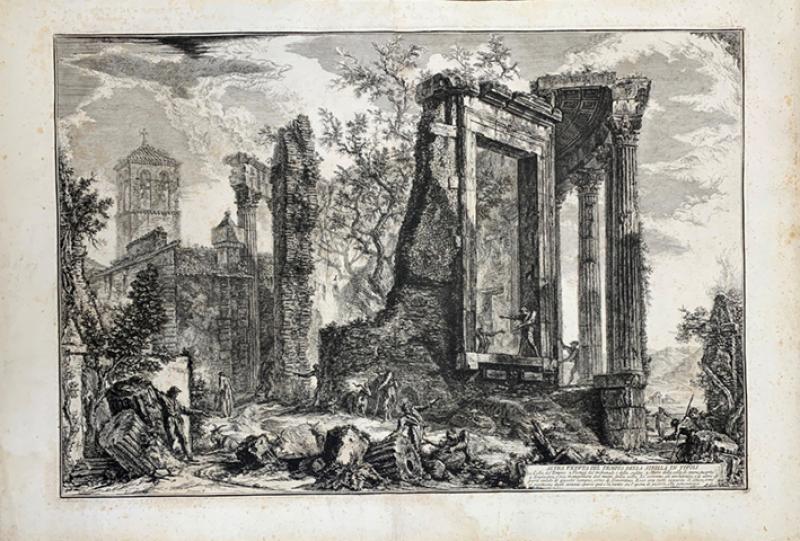
GIOVANNI BATTISTA PIRANESI (Mogliano 1720 – 1778 Rome)
Another view of the Temple of the Sibyl at Tivoli (1761) Giovanni Battista Piranesi’s etching Altra Veduta del Tempio della Sibilla in Tivoli was created in 1761 as part of the series Vedute di Roma. It depicts the ancient circular temple in Tivoli, which is today most commonly referred to as the Temple of Vesta. The low perspective, strong light-dark contrasts, and dense hatching make the ruins appear particularly monumental. Tiny figures further emphasize the overwhelming scale of the architecture. Piranesi, born in Mogliano Veneto in 1720 and died in Rome in 1778, was an artist, architect, archaeologist, and publisher. His views of ancient structures combine precise observation with dramatic composition. Several historical prints of this etching exist today and are held in major museum collections in Washington, New York, and London, among other places.
Sachgebiete: Altertum, Architektur, Graphik, Italien, Ortsansichten
4200,- EUR
inkl. 7% USt./incl. 7% VAT
Auf Merkliste setzen 
GIOVANNI BATTISTA PIRANESI (Mogliano 1720 – 1778 Rome)
View of visible remains of the Baths of Diocletian at S. Maria degli Angel (1774) Giovanni Battista Piranesi's etching Terme Diocleziano was produced as part of his celebrated series Vedute di Roma. It depicts the monumental ruins of the Baths of Diocletian, the largest public bath complex of ancient Rome. Through a dramatic perspective, dense cross-hatching, and striking contrasts of light and shadow, Piranesi emphasizes the grandeur and decay of the ancient architecture. Small figures animate the scene while underscoring the immense scale of the ruins. Piranesi, born in Mogliano Veneto in 1720 and deceased in Rome in 1778, was an artist, architect, archaeologist, and publisher. His views of ancient monuments combine meticulous architectural observation with a powerful sense of theatricality. Numerous impressions of this etching survive and are today preserved in major museum collections around the world.
Sachgebiete: Altertum, Architektur, Graphik, Italien, Ortsansichten
4200,- EUR
inkl. 7% USt./incl. 7% VAT
Auf Merkliste setzen 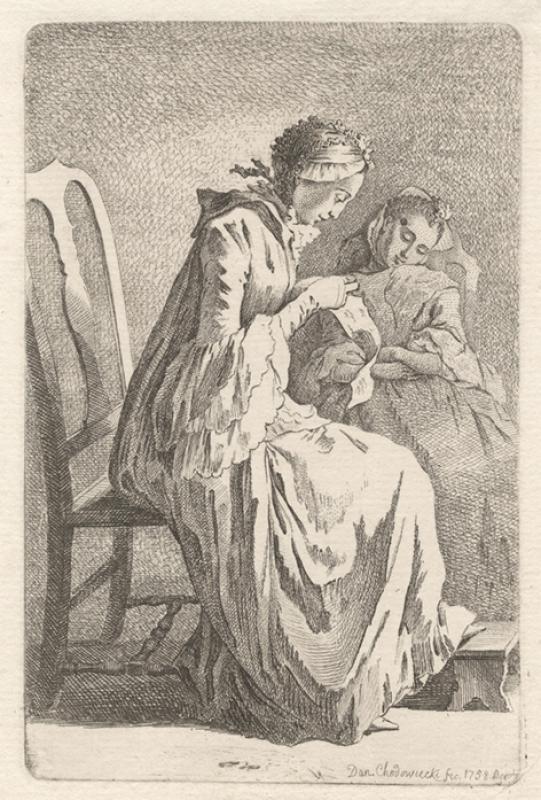
DANIEL NIKOLAUS CHODOWIECKI (1726 Danzig – 1801 Berlin)
The two ladies seated. Miss Quantin and the wife of the artist. (1758) Chodowiecki’s many thousands of drawings and miniature engravings made him the greatest reporter of his time in Germany. He drew incessantly wherever he was, on the street, at receptions and balls, usually in such a way that the people portrayed did not notice. Chodowiecki created unique depictions of the customs and everyday life of his time and was subsequently commissioned to illustrate the works of many poets of his time. He was highly valued by his contemporaries. Johann Caspar Lavater described him as “the best and most sensitive illustrator I know.” Chodowiecki produced over 100 copperplate engravings for his “Physiognomic Fragments for the Promotion of Knowledge of Human Nature and Human Love,” published in 1774.
Sachgebiete: Deutschland, Graphik, Kunstgeschichte, Porträts, Rokoko
1300,- EUR
inkl. 7% USt./incl. 7% VAT
Auf Merkliste setzen 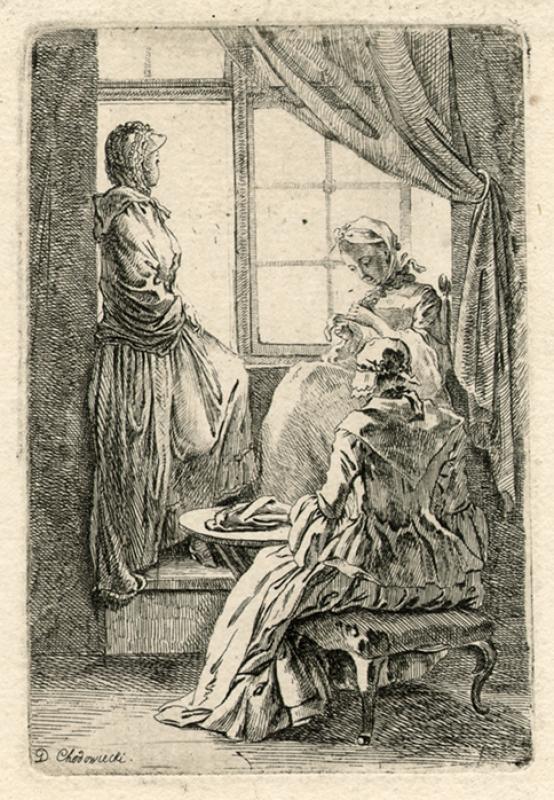
DANIEL NIKOLAUS CHODOWIECKI (Danzig 1726 – 1801 Berlin)
Three ladies by the window. (1764) The engraving “Three Ladies at the Window” shows a finely observed interior scene from 18th-century bourgeois life. Two elegantly dressed women are in a room by an open window. One lady is sitting on an upholstered chair, busy with needlework, while the other is sitting on the windowsill, looking outside. The depiction thrives on the careful rendering of the fabrics, furniture, and room details, especially the heavy curtains and window recess. With minimal means, Chodowiecki succeeds in capturing a calm, intimate everyday situation that simultaneously hints at curiosity and social observation.
Sachgebiete: Deutschland, Graphik, Kunstgeschichte, Porträts, Rokoko
1600,- EUR
inkl. 7% USt./incl. 7% VAT
Auf Merkliste setzen 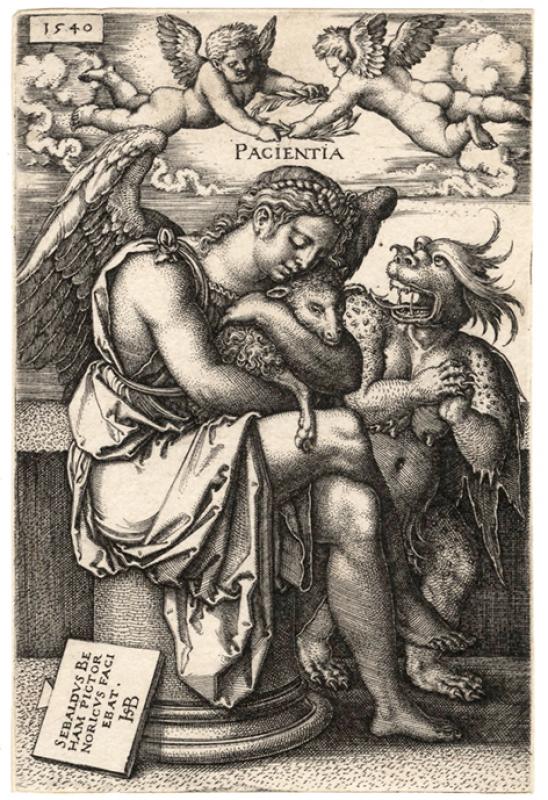
HANS SEBALD BEHAM (Nürnberg 1500 – 1550 Frankfurt)
Pacientia. (Patience) Around 1520, the small format became for decades fashionable in the north. On the one hand, the small format was certainly based on the Italian niello prints, which were very popular in the early 16th century. On the other hand, the small formats were in line with the custom of the time of gluing collectable prints into books. Small, very detailed engravings with unusual motifs but familiar formulas were very popular. From the late 1530s Sebalds style of engraving became more focused on the creation of clear designs on very small scale. At the same time, he developed a more sensuous approach to his subject-matter. This is exemplified in Patience produced in 1539. Sebald was never ashamed to use other artist's ideas. During 1539 Beham made several independent engravings of allegorical figures. They are always set in the near foreground with a few attributes surrounding them. Brilliant, detailed and nuanced early impression with the platemark visible. In excellent condition.
Sachgebiete: Deutschland, Graphik, Kunstgeschichte, Kupferstich, Renaissance
9000,- EUR
inkl. 7% USt./incl. 7% VAT
Auf Merkliste setzen 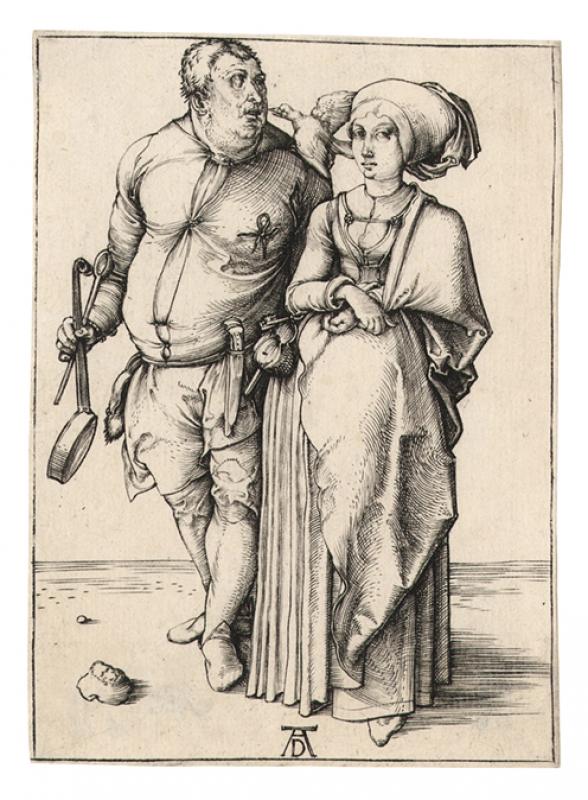
ALBRECHT DÜRER (1471 Nürnberg 1528)
The Cook and his Wife. (1496) In this print, an unshaven, overweight man is depicted wearings grungy clothes and holdings a frying pan and cooking spoon in his hand. With his untidy appearance, he stands in stark contrast to his companion, who can be recognized as a Nuremberg woman by her clothing. She wears a hood, a bag and a key, the characteristic attributes of a housewife. In addition, she also carries a spoon, which can be seen as an element connecting the figures. The bird with beating wings that has settled on the man’s shoulder is difficult to interpret. The sheet has been titled “The Cook and his Wife” since the 18th century. Nevertheless, there were several other attempts to explain the sheet. It was only in 1907 that K. Lange suggested the story from “Der Ritter von Thurn”, which was published in Basel in 1493 and to which Albrecht Durer also contributed some illustrations. “Die Atzel (Elster), die vom Aal schwätzt” is the story of a husband who keeps an eel in a tub to eat occasionally. His wife, however, beats him to it and prepares the fish for herself and her lover. The magpie betrayed the woman to her husband and in return, the man plucked the feathers on it's head. The story goes that whenever the magpie saw a bald head it cried: “You have gossiped about the eel” This story must have been very well known because Durer illustrated it without explanatory text. Superb and early impression before all wiping marks and scratches as described by Meder for early states.
Sachgebiete: Deutschland, Graphik, Kunstgeschichte, Kupferstich, Renaissance
30000,- EUR
inkl. 7% USt./incl. 7% VAT
Auf Merkliste setzen 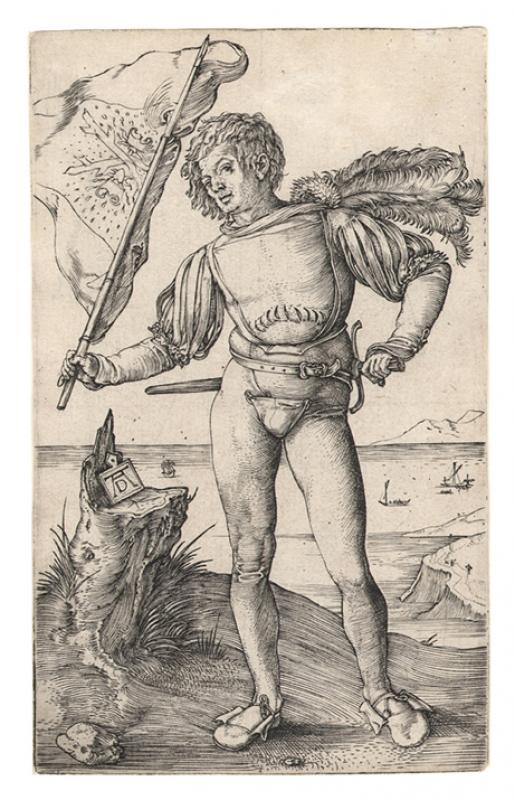
ALBRECHT DÜRER (1471 Nürnberg 1528)
The Standard Bearer (1501/02) This engraving by Durer is probably one of the earliest depictions of an isolated standard-bearer, a pictorial motif that was of great importance in the golden age of lansquenets in the second half of the 16th century. In the military hierarchy, the standard-bearer occupied a prominent position and only the strongest and bravest were chosen for this honour of carrying and defending the banner. In this engraving the dazzlingly dressed heroic figure stands on a hill. Before the low horizon, the wide sea stretches far into the distance. With a sweeping movement of his right arm, the standard-bearer waves the flag with the insignia of the Order of the Golden Fleece, the emblem of Maximilian’s imperial rule. His left hand holds the pommel of his sword as a sign of his fortitude and steadfastness. Very fine and clear Meder a-impression. With fine margins around the border line.
Sachgebiete: Deutschland, Graphik, Kunstgeschichte, Kupferstich, Renaissance
33000,- EUR
inkl. 7% USt./incl. 7% VAT
Auf Merkliste setzen 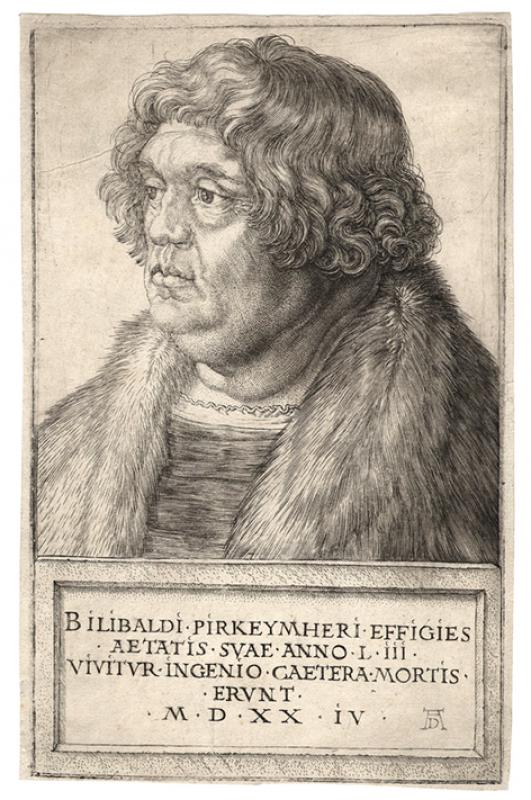
ALBRECHT DÜRER (1471 Nürnberg 1528)
Portrait of Willibald Pirckheimer. (1524) Pirckheimer (1470–1530), a patrician and the leading humanist of Nuremberg, was Durer’s closest friend. He studied seven years in Italy and undoubtedly played a part in Durer’s decision to travel to Venice in 1494. Pirckheimer translated writings by Xenophon, Lucian Plutarch and Plato from Greek into Latin and German. With his knowledge of the ancient languages as well as of Modern Italian, he made literary sources available to the artist which he could not have read for himself, most notably the recent publications from Italy by theorists such as Vitruvius and Alberti. The two friends kept a continuous correspondence during his second Italian trip. Ten letters Durer wrote to Pirckheimer in 1506 still survive. It was Pirckheimer who composed Durer’s moving epitaph on the bronze plaque of Durer’s tomb. “Quicquid Alberi Dureri mortale fuit, sub hoc conditur tumulo” – “Whatever was mortal of Albrecht Durer is covered by his tomb”. The portrait drawing, which must have preceded the engraving, no longer exists, although two profile studies of Pirckheimer that Durer made in 1503 are still preserved in Nuremberg and Berlin.
Sachgebiete: Deutschland, Graphik, Kunstgeschichte, Kupferstich, Renaissance
26000,- EUR
inkl. 7% USt./incl. 7% VAT
Auf Merkliste setzen 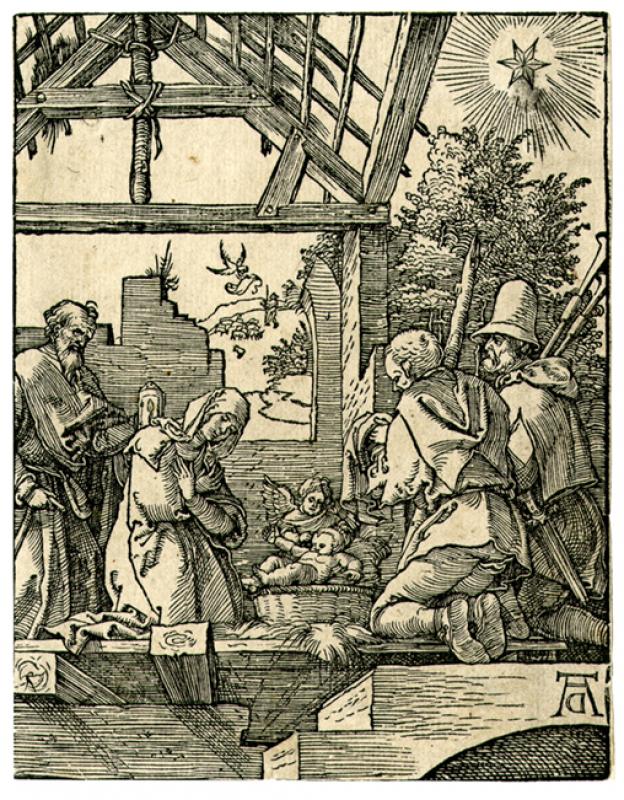
ALBRECHT DÜRER (1471 Nürnberg 1528)
The Nativity. (Ca. 1510) Fine impression of the b-c state after the Latin edition of 1511. Tip of lower left corner replaced and joined small tear. Right corner small tear. Woodcut depicting the birth of Christ. Mary and Joseph kneel before the newborn child, who lies on the ground in the center. An angel hovers above, while shepherds approach on the right. The scene takes place in a simple, partially dilapidated stable, with a landscape opening up in the background. The star of Bethlehem appears above the scene. The woodcut is clear and rich in contrast. Strong lines and hatching form the figures, clothing and architecture. A typical religious print from Durers early period, combining a comprehensible, narrative representation with precise observation and technical precision
Sachgebiete: Deutschland, Graphik, Holzschnitt, Kunstgeschichte, Renaissance
3100,- EUR
inkl. 7% USt./incl. 7% VAT
Auf Merkliste setzen 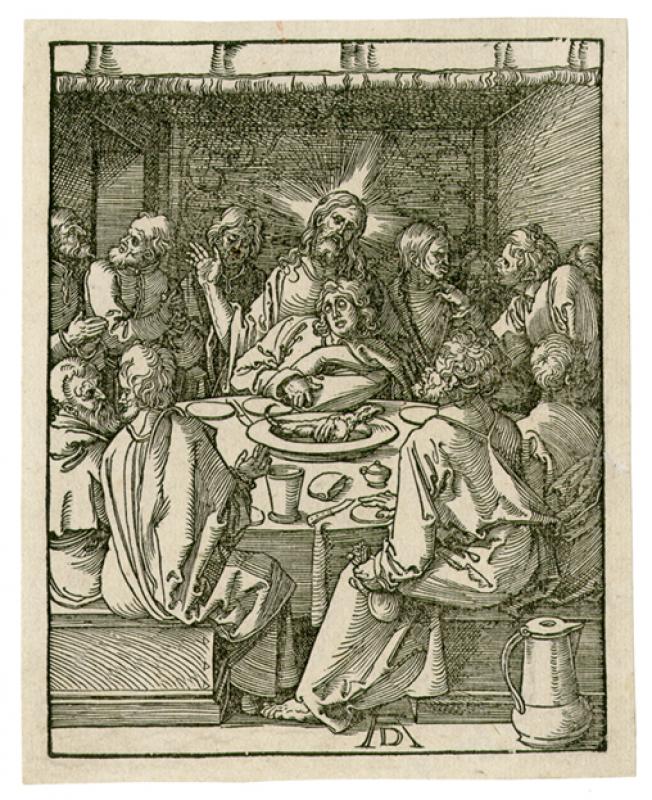
ALBRECHT DÜRER (1471 Nürnberg 1528)
The last supper. (Ca. 1508/09) The Small Passion is Dürer's most extensive series of prints. The 37 woodcuts, including the title page, were created over a period of approximately three years. In 1511, he self-published them as a book entitled “Passio Christi ab Alberto Durer Nurembergensi effigiata cum varij generis carminibus Fratris Benedicti Chelidonij Musophili.” For the Last Supper, which takes place at a round table, Durer chooses the moment when Christ announces his betrayal by one of his disciples. The disciples are visibly agitated and discuss wildly with each other, only John, leaning against Christ, is resting carefree. On the right in the foreground, somewhat isolated, sits Judas, frozen in shock, recognizable by the heavily filled bag in his hand. Beautiful print according to the text with a beautiful 5 mm border. Tear in the middle of the right margin.
Sachgebiete: Deutschland, Graphik, Holzschnitt, Kunstgeschichte, Renaissance
2700,- EUR
inkl. 7% USt./incl. 7% VAT
Auf Merkliste setzen 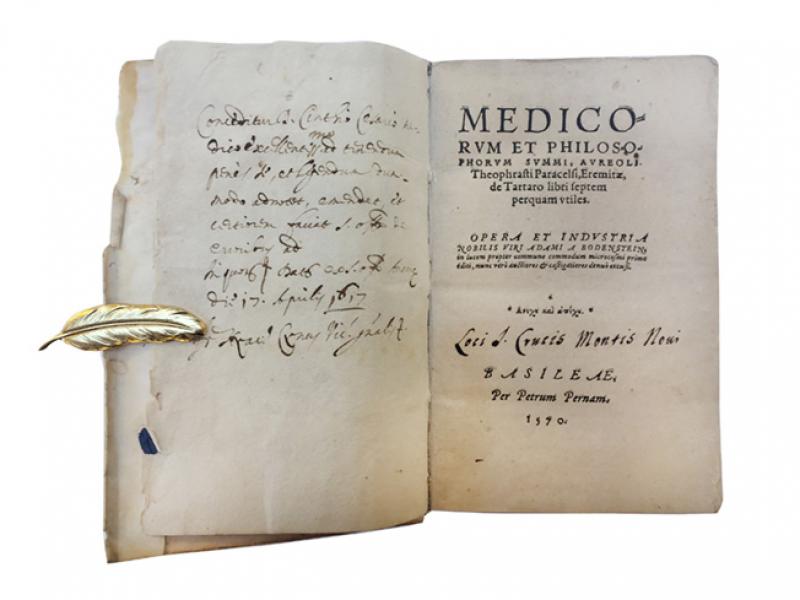
THEOPHRASTUS PARACELSUS (BOMBASTUS VON HOHENHEIM) (Egg 1494 - 1541 Salzburg)
De tartaro libri septem perquam utiles. Opera et industria... Adami a Bodenstein in lucem... primo editi, nunc vero auctiores dt castigatiores excusi. (1570) Woodcut portrait of Paracelsus. 8 unn. ll., 451 (recte 453) pp., 11 unn. pp., index. Sm. 8vo. Basel, Petrus Perna, 1570. Contemp. limp vellum (without ties). The first comprehensive treatment of tartaric diseases, i.e. disorders associated with deposits in blood vessels and the stomach, edited by his pupil Adam von Bodenstein. Bodenstein (d. 1577), son of the Reformer Karlstadt, published Paracelsus' writings from his literary estate beginning in 1560.
Sachgebiete: Alchemie, Medizin, Naturwissenschaften, Renaissance , Schweiz
2350,- EUR
inkl. 7% USt./incl. 7% VAT
Auf Merkliste setzen 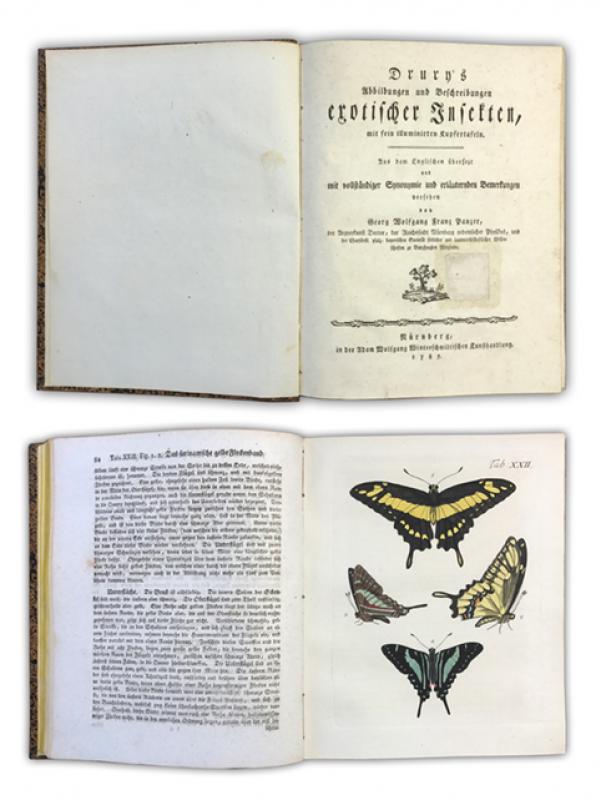
DRU DRURY (London 1725 – 1804 Turnham Green) / GEORG WOLFGANG FRANZ PANZER (Etzelwang 1755 - 1829 Hersburg)
Drury’s illustrations and descriptions of exotic insects, with finely illuminated copper plates. (1770) Dru Drury was the son of a silversmith. Thanks to a fortunate marriage and the inheritance of his parents’ business, Drury became a wealthy man and was thus able to devote himself to his great passion, entomology. He was president of the Entomological Society in London, and his collection was already very famous during his lifetime. Print of the first German edition.
Sachgebiete: Entomologie , Großbritannien, Kupferstich, Naturwissenschaften, Zoologie
6600,- EUR
inkl. 7% USt./incl. 7% VAT
Auf Merkliste setzen 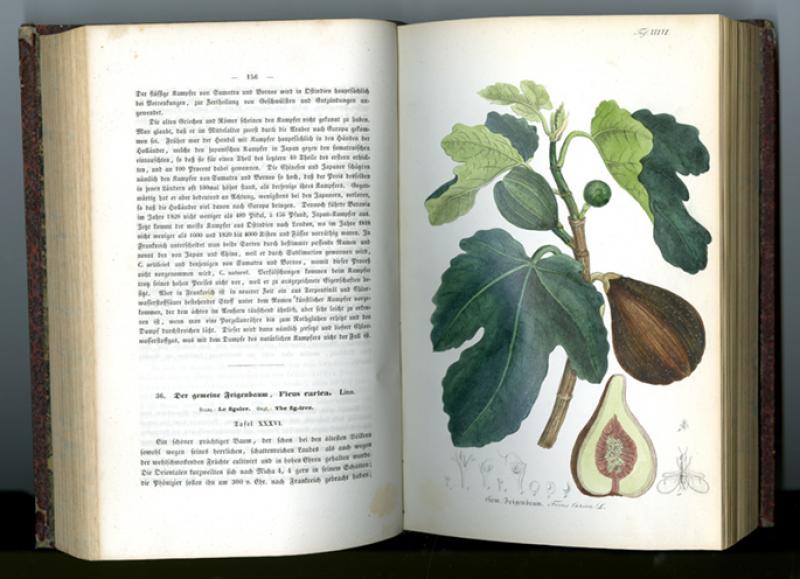
J. F. U. EICHELBERG
Lifelike illustrations and detailed descriptions of all domestic and foreign plants which provide the most important products for trade and industry, as a foundation for mercantile commodity studies. These two rare works are brought together in a single volume with finely coloured illustrations. The text has some minor foxing; otherwise, it is a fine copy. The work on plants describes mainly exotic, edible or medicinal plants of significant commercial importance, such as pepper, rice, coconut, ginger, figs, dates, etc. Similarly, the animals described belong to economically significant genera.
Sachgebiete: Botanik, Lithographie, Naturwissenschaften, Wirtschaft, Zoologie
1300,- EUR
inkl. 7% USt./incl. 7% VAT
Auf Merkliste setzen .jpg)
JOHANNES HEGETSCHWEILER (Rifferswil 1789 – 1839 Zürich)
Sammlung von Schweizer Pflanzen: nach der Natur und auf Stein gezeichnet / von J. D. Labram; Text von Joh. Hegetschweiler. (Collection of Swiss plants: drawn from nature and on stone / by J. D. Labram; Text by Joh. Hegetschweiler) (1834) First edition. One of the masterpieces of botanical book illustration in Switzerland. The illustrations with the accompanying text are usually bound behind each other. The text pages explain, in addition to the botanical description, also the medical use and give the typical places where they are found.
Sachgebiete: Botanik, Kräuterbücher, Lithographie, Naturwissenschaften, Schweiz
4000,- EUR
inkl. 7% USt./incl. 7% VAT
Auf Merkliste setzen 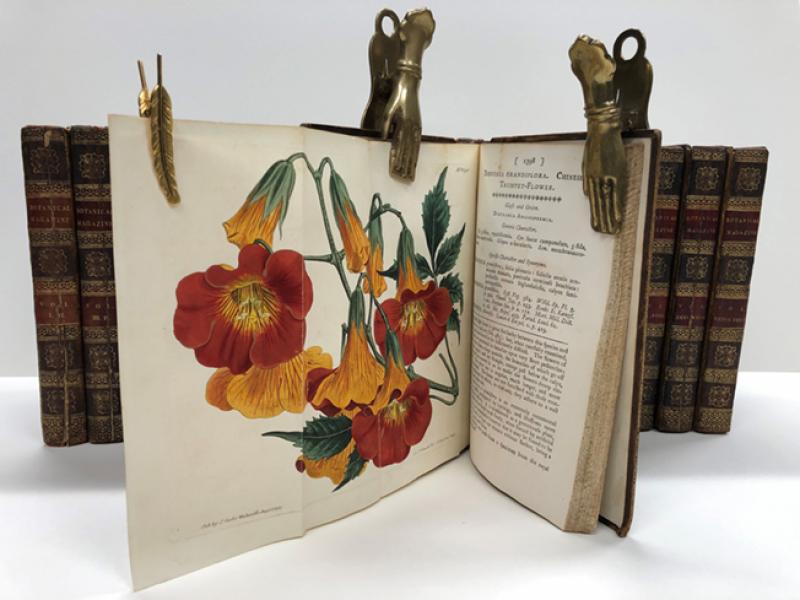
WILLIAM CURTIS (Alton 1746 - 1799 Brompton)
The Botanical Magazine; or, Flower-Garden Displayed: London, Stephen Couchman, 1787 – 1813. Parts 1 – 38 bound in 19 volumes. Portrait of William Curtis and dedication with a preface. 1593 engraved and colored plats with the adjoining Text. Each volume with an Index. Contemporary calf bindings with gilded back and red labels ( Five volumes lightly broken in the back)Bookplate of Richard – Cope Hopton, esq. of Canon Frome (1738 – 1810) Manuscript entry by this wife Dorothy Hopton, daughter of James Nelson esq. of London wedded to her husband in January. (1817) William Courtis founded the Journal in 1787. First working as an apothecary in Hampshire and London, where he moved in 1766. He abandoned his profession for an unsecured live by teaching and righting on flora and fauna. His first publication was a pamphlet on collecting and preserving insects. By 1777 he opened his own Botanic Garden in London and on February 1, 1787 he published the first issue of Curti’s Botanical Magazin, this journal is still being published to this day; it is the oldest periodical in existence featuring colored plates, of which more than 11,000 have now been produced. The work of many acclaimed botanical artists, its volumes provide an exceptional pictorial record of floral fashions and plant introductions in Great Britain over the past two centuries. A small, octavo format publication, the first issue consisted of three hand colored plates accompanied by brief letterpress descriptions, it was an immediate success; the first issue sold about 3000 copies. The first plate, depicting the Persian Iris, was drawn by James Sowerby. The artist who dominated the early years of the magazine, however, was Sydenham Teast Edwards (1768-1819). He was only nineteen when his first plate was published in the Botanical Magazine in 1788. More than 1700 followed in the next 27 years - some published posthumously. At first Edwards drew and engraved the plates himself, but from 1792 Francis Sansom took over the engraving. As Curtis states in the preface to the first issue, the plates were drawn 'always from the living plant, and colored as near to nature, as the imperfection of coloring will admit'. The beautiful hand colored plates are the chief glory of the magazine. At one times, some 30 people were ingaged in coloring the Botanical Magazine. The plates were hand colored until as late as 1948, when the periodical adopted photographic reproduction. Curtis died in 1799 when the magazine had reached its thirteenth volume. His friend John Sims (1749-1831), a botanist and physician, became the new editor. Sims renamed the publication Curtis's Botanical Magazine. In 1826, William Jackson Hooker (1785-1865) took over the editorship. He was also an experienced author on exotic plants. Furthermore, was he a skilled draughtsman, and became the chief illustrator of the magazine for nearly a decade. Under his editorship the magazine became decidedly more scientific and scholarly. Floral dissections were included and the subjects generally became more wide ranging. In 1845, he made another change when lithography replaced copper engraving as the method of producing the plates.
Sachgebiete: Einbände, Großbritannien, Illustrierte Bücher, Kupferstich, Naturwissenschaften
17000,- EUR
inkl. 7% USt./incl. 7% VAT
Auf Merkliste setzen 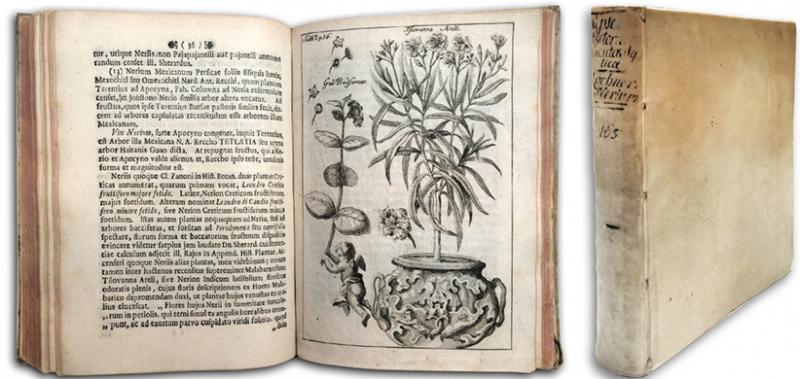
JOHANN JAKOB WEPFER (1620 Schaffhausen 1695)
Historia cicutae aquaticae, qua non solum plantae hujus venenatae structura naturalis… Adjectae sunt ad calcem dissertationes de thee Helvetico ac cymbalaria. Curante Theodoro Zvingero. (1716) A treatise on Swiss tea, containing a detailed description of the varieties of medicinal herbal tea commonly found in Switzerland. Bound with: Lochner, Michael, *Nerium sive Rhododaphne vet. Et rec…* Nuremberg: Erben J. Hoffmann, 1716. With an engraved frontispiece, 1 title page and 1 leaf, 112 pages, 8 copperplate plates, 2 copperplate vignettes and 2 woodcut vignettes. Contemporary parchment binding.
Sachgebiete: Botanik, Kupferstich, Naturwissenschaften, Pharmazie, Schweiz
1600,- EUR
inkl. 7% USt./incl. 7% VAT
Auf Merkliste setzen 
GASPARD-MARIE RICHE BARON DE PRONY (Chamalet 1755 - 1839 Asnières-sur-Seine)
Nouvelle architecture hydraulique, contenant l'art d'élever l'eau au moyen de différentes machines, de construire dans ce fluide, de le diriger, et généralement de l'appliquer, de diverses manières, aux besoins de la société. Paris, Firmin Didot. (1790 - 1796) First edition. 2 volumes in large 4° with 55 plates overall. Contemporary half calf with red labels. Vol. I: XII incl. half-title and title, 624 pp., 72 pp., 15 plates. Vol. II: title, 203 pp., 1 white sheet, 38 pp., numbered plates 16 to 52 and 2 plates I + II und plate XVI between pages 28/29. Volume II broken spine end, inside a very nice, fresh copy. De Prony worked in the harbour of Dunkirk as an engineer, hydraulic engineer and French Encyclopedist before he was sent to Italy by Bonaparte to work in the ports of Genoa, Pola, Venice, and Ancona. He was responsible for draining the marshes of Poitiers and the Pontine Plains. Together with Monge he founded the Polytechnic, where he was co-chair of Mechanics with Lagrange.
Sachgebiete: Architektur, Frankreich, Maschinenbau, Mathematik, Technik
8200,- EUR
inkl. 7% USt./incl. 7% VAT
Auf Merkliste setzen 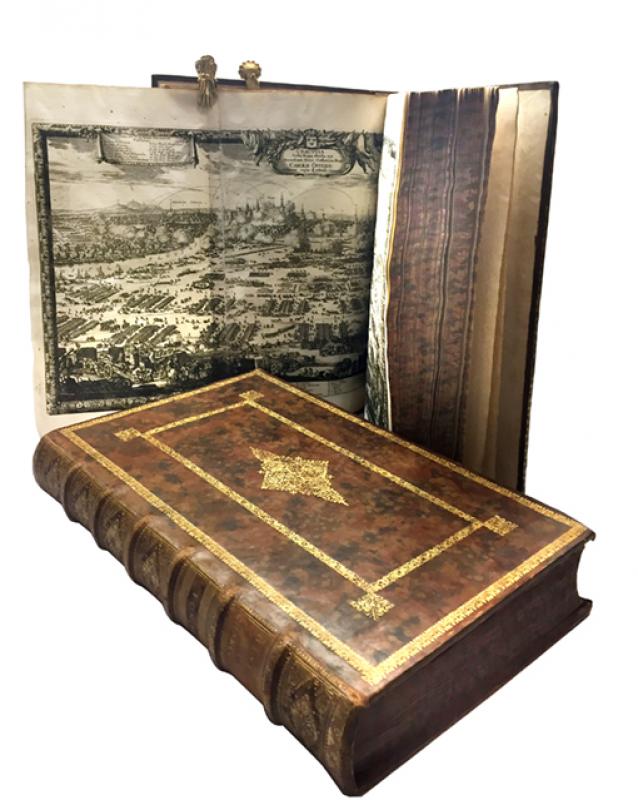
SAMUEL PUFENDORF (Freiherr von Pufendorf) (Dorfchemnitz 1632 – 1694 Berlin)
Histoire du Règne de Charles Gustave Roy de Suède comprise en sept commentaires enrichis de tailles douces traduite en francois sur le latin de Monsieur le Baron Samuel de Pufendorf. Avec trois Indices. Imprime à Nuremberg aus frais de Christophle Riegel par Knorz Imprimeur. (1697) The pastor's son Pufendorf initially studied theology at his father's request, but soon turned to jurisprudence and natural philosophy. Through the mediation of his brother Esaias, who was a diplomat, he was offered a position as tutor to the Swedish ambassador Peter Julius Coyet in Copenhagen. Shortly after his arrival, he was taken prisoner in the Swedish-Danish war and followed Coyet to The Hague in 1660, where he published his best-known work “Grundlagen einer allgemeinen Rechtslehre”. In 1661, Pufendorf was appointed to Heidelberg, where he taught natural and international law at the new chair. After harsh criticism of the imperial constitution, he left Heidelberg and went to Sweden. The Swedish King Charles XI finally appointed him court historiographer, privy councillor and secretary of state, and he was also elevated to the rank of baron in 1694. In 1688 he moved to the Brandenburg court in Berlin as court historiographer and privy councillor. Richly illustrated edition of the first French edition, which was published posthumously.
Sachgebiete: Biographien/Autobiographien , Geschichte, Kupferstich, Politik, Skandinavien
18100,- EUR
inkl. 7% USt./incl. 7% VAT
Auf Merkliste setzen 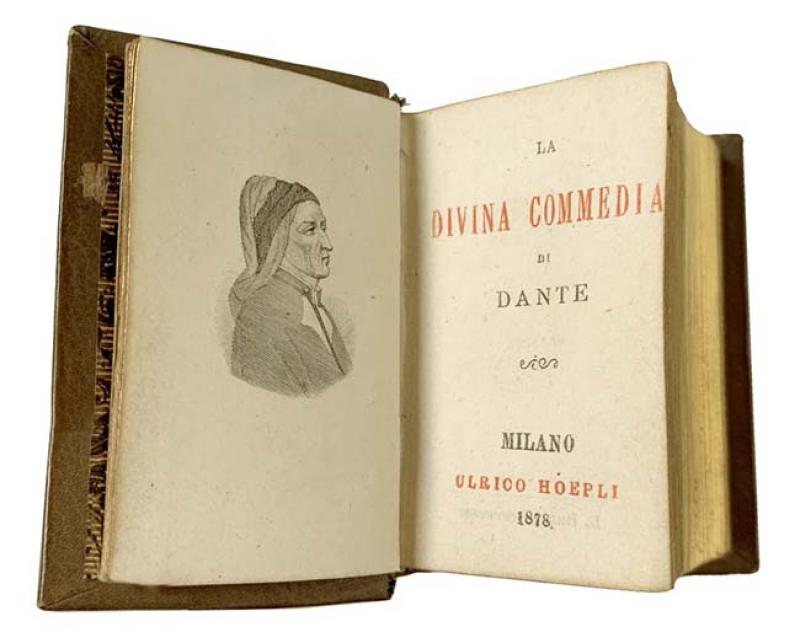
DANTE ALIGHIERI (Florenz 1265 - 1321 Ravenna)
La divina commedia die Dante. Milano, Ulrico Hoepli. (1878) Belonging to an edition of 1000 copies, with the typeface of the Salmin brothers. Ulrico Hoepli published this edition by purchasing the sheets of the “Dantino” made by Fratelli Salmin and giving the prints a second run with his own typographical data on the title page. His microscopic edition of the Divine Comedy is one of the smallest books printed with movable type. It remains a bibliographical curiosity to this day. A beautiful and flawless copy.
Sachgebiete: Bibliophilie, Einbände, Illustrierte Bücher, Italien, Literatur bis ca. 1900
3700,- EUR
inkl. 7% USt./incl. 7% VAT
Auf Merkliste setzen 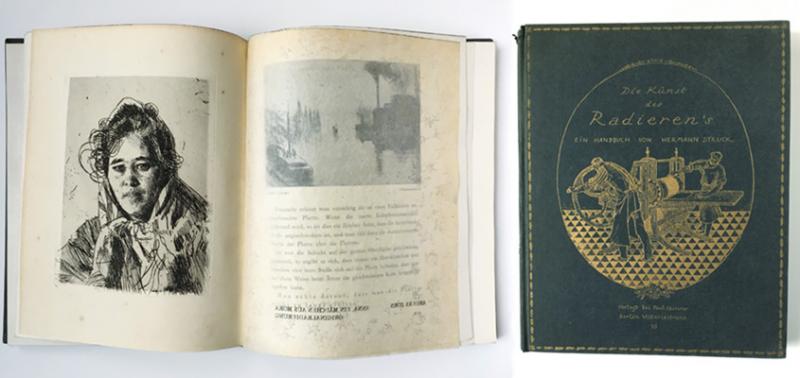
HERMANN STRUCK (Berlin 1876 - 1944 Haifa)
Die Kunst des Radierens. Ein Handbuch. (1923) Die Kunst des Radierens`s. Ein handbuch von hermann Struck, Verlegt bei Paul cassierer, Berlin Victoriastrasse 35. Illustr. Orig.-Leinen mit goldgeprägtem Deckelbild und Deckelrahmen, mit Farbkopfschnitt. Gr.- 8°. 1. Aufl.,. 347 SS., Bll., zahlr. Abb. Schönes Expl.., Mit je einer Orig.-Radierung von Max Liebermann, Hermann Struck, einer Orig.-Lithographie von Oskar Kokoschka und einem Orig.-Holzschnitt von Ernst Barlach.
Sachgebiete: Deutschland, Graphik, Kunstgeschichte, Kunsthandwerk, Technik
750,- EUR
inkl. 7% USt./incl. 7% VAT