伴源平, BAN, Genpei, editor.  Auf Merkliste setzen
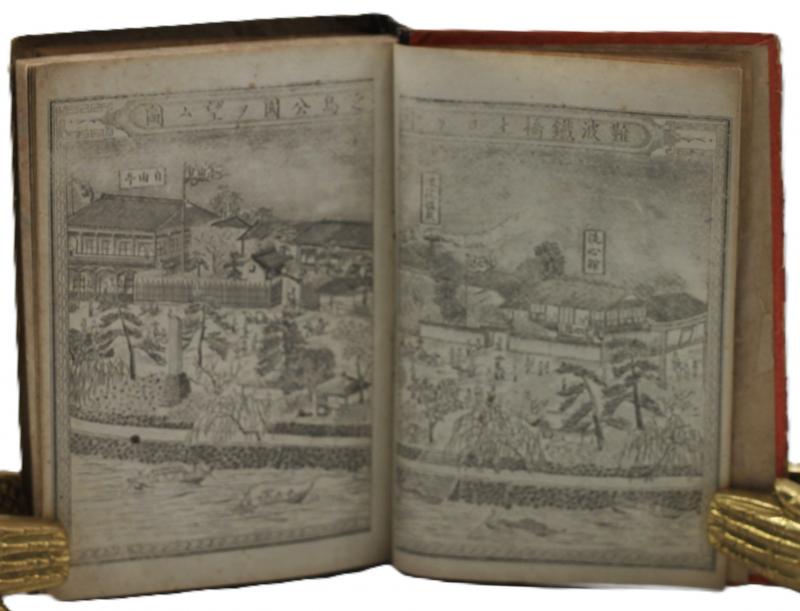
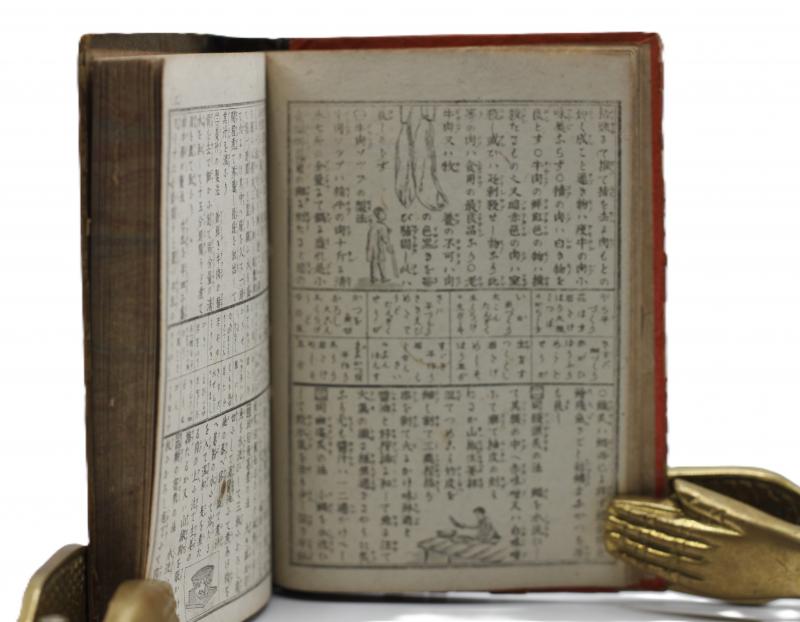
日本・西洋・支那三風料理滋味之饗奏 Nihon seiyō shina: sanfū ryōri umami no kyōsō [Three styles of cuisine: Japanese Western Chinese; a festive symphony of flavor] Osaka : 赤志忠雅堂 Akashi Chūgadō, Meji 2o (1887). First edition. In Japanese. Octavo (145x100mm) reverse binding, western quarter bound black cloth, Japanese-style folded leaves, stiffened with publisher waste, red printed paper boards, all edges marbled, [12],72pp. Three full-page woodblock illustrations, frontispiece, numerous small in-text copper-plate illustrations of dishes, ingredients and kitchen implements. Presented in a burgundy chitsu case. Boards lightly soiled, light wear to edges; endpapers offset toned, fragile, small chip to fore-edge; rear hinge softening.
¶ A rare and significant Meiji -era culinary manual, notable for the earliest recorded use of the term nihon ryōri (“Japanese cuisine”), here in 1887. The expression appears at a pivotal moment in the formation of the idea of a distinct national cuisine. Until this period, there was no established Japanese term for a homogeneous cuisine representative of Japan, while seiyō ryōri (“Western cuisine”) had been in use since 1872 for predominantly American, British, and French cooking. The appearance of nihon ryōri reflects the Meiji-era encounter with Western culture and the consequent redefinition of Japanese domestic and cultural identity. The work is one of three publications of 1887 in which the term is first recorded, alongside The Cooking Guide: An Introduction to the Cuisine of Japan, China, Korea and the West and Iizuka Eitarō’s Japanese Hygienic Cooking. The recipes are divided into Western, Chinese, and Japanese sections, concluding with pickles. The extensive Western section includes beef, butter, roasting, cutlets, beefsteak, sandwiches, pheasant, fish and shellfish, vegetables, sauces, croquettes, mutton, pork, rabbit, duck, and beer, with several entries incorporating English terminology and illustrations. The Chinese section consists principally of dim sum, while the Japanese section covers sea and river fish, poultry, vegetables, and numerous vegetarian dishes. Ban was an active Meiji-period editor, publisher, and map-maker specialising in practical and educational manuals. Particularly noteworthy is the hybrid construction of the manual: the text follows the traditional right-to-left format and is printed on folded washi-paper leaves, while the binding is European in form, the illustrations are engraved copperplate rather than traditional Japanese woodblock and the leaves are stiffened by an internal sewn leaf of printed publisher's waste. An important early document in the history of Japanese cuisine and Meiji cultural exchange, recording the moment at which nihon ryōri emerged as a conscious expression of national culinary identity. Rare. An excellent copy. § OCLC records only two holdings, National Diet Library, and UC Berkeley (apparently digitised). Item #11739
2000,- EUR
Differenzbesteuert/Subject to margin taxation
Sachgebiete: China, Einbände, Gastronomie, Japan, Kochbücher
Kontakt zum