歌川國芳 KUNIYOSHI, Utagawa (1797 - 1861)  Auf Merkliste setzen
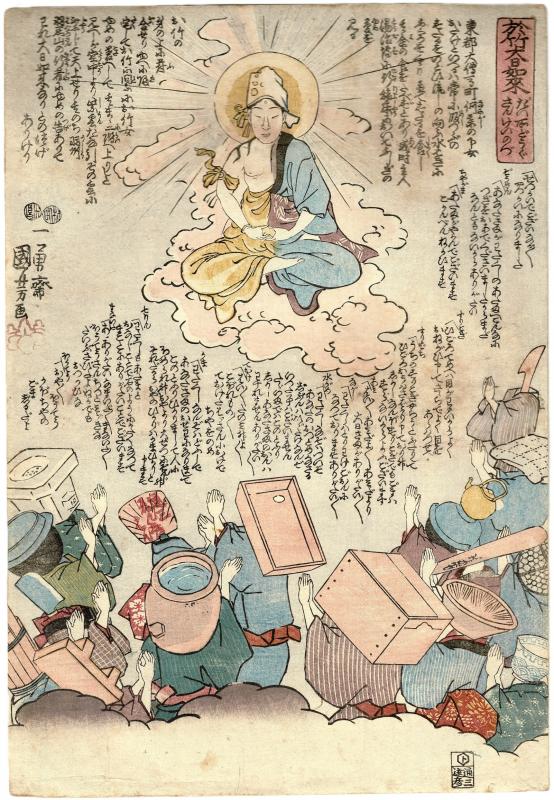
於竹大日如来 だい所どうぐさんけいのづ Otake Dainichi Nyorai daidokoro dōgu sankei no zu [The Kitchen Implements’ Pilgrimage to Otake, the Buddha Dainichi] [Edo (Tokyo)] : Enshūya Hikobei, circa Kaei 2 (1849). Signed Ichiyūsai Kuniyoshi-ga above Kuniyoshi's yoshi-kiri (paulownia-flower) seal and below the double nanushi censor seals of Mera and Murata, Vertical oban tate-e, single leaf (360x245mm) colour ukiyo-e woodblock print, paper backed. Small spot near bottom edge, faint soiling to edges to blank margins; else crisp and bright.
¶ An inventive satirical composition by Utagawa Kuniyoshi, depicting the humble maidservant Otake transformed into a manifestation of Dainichi Nyorai, the cosmic Buddha. Beneath her radiant halo, a lively assembly of anthropomorphised kitchen implements, pots, boxes and household utensils march on a mock pilgrimage offering prayers, in the hope of securing prosperity, plentiful rice and domestic good fortune. The subject derives from the popular contemporary legend of Otake of Odenma-chō, a servant renowned for her extraordinary diligence. According to the tale, Buddhist ascetics seeking the reincarnation of the Nyorai during the early edo-period, discovered her divine nature when a halo appeared as she stooped to gather grains of rice from the floor. Otake was depicted as a very religious woman of great Buddhist virtue giving all she had to the poor, performing the most menial chores with extreme diligence, eating hardly any food, instead gathering nourishment from scraps from the sink and rice-strainer. The legend achieved considerable popularity in Edo in the Spring and Summer of 1849 due to the exhibition of sacred objects associated with Otake brought from the Zenkō-ji temple to the Eikōin Temple in Ryōgoku. Among the artifacts displayed was the actual sink and rice-strainer supposedly used by Otake to feed herself. The popularity of the exhibition led to the publishing of a wide-range of ephemeral commercial objects, all designed as 'devotional prints' to side-step the Shogunate's 1841-1843 Tenpō reforms which had banned the publication of many of the popular ukiyo-e subjects such as luxury items, geishas, and kabuki actors. Kuniyoshi treats the popular religious legend and the exuberant commercial reaction to the popularity of the exhibition with his characteristic humour and visual ingenuity. The devotional scene is a satire of everyday aspirations: the implements of domestic life are elevated into votive objects, whilst the text features satirical prayers from Edo merchants begging the "Kitchen Buddha" for an abundance of rice, higher profit margins, unbroken kitchen inventory, and massive foot traffic to their storefronts. Contrasting the sacred, the hyper commercial mindset of the period and the mundane is especially characteristic of Kuniyoshi's imaginative treatment of contemporary Edo life. A rare and engaging example of Kuniyoshi's giga, comic and satirical ukiyo-e, the print combines popular religion, contemporary folklore and domestic imagery with a keen sense of satire and the absurd sustained by the artist's celebrated command of expressive figures and densely animated composition. The rarest of Kuniyoshi's Otake prints. A masterful parody. An excellent copy. § Held by Ryūkoku University Library, Kyoto, and the Edo-Tokyo Museum.
1850,- EUR
Differenzbesteuert/Subject to margin taxation
Sachgebiete: Buddhismus, Kochbücher, Gastronomie, Japan, Japanische Holzschnitte
Kontakt zum
