18602. Edward Browne.  Auf Merkliste setzen
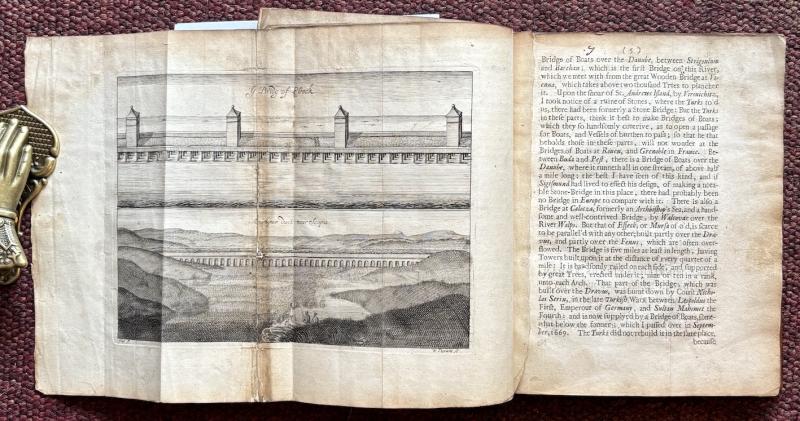
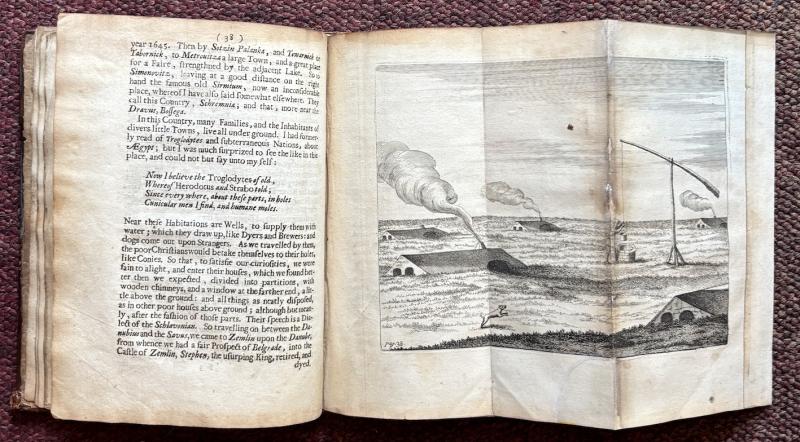
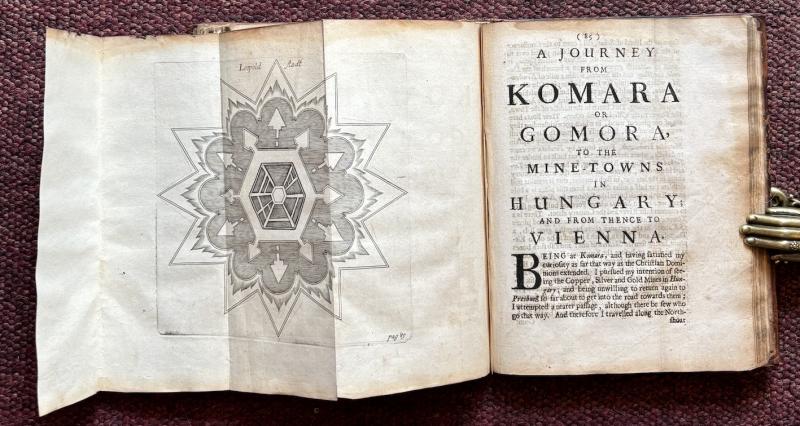
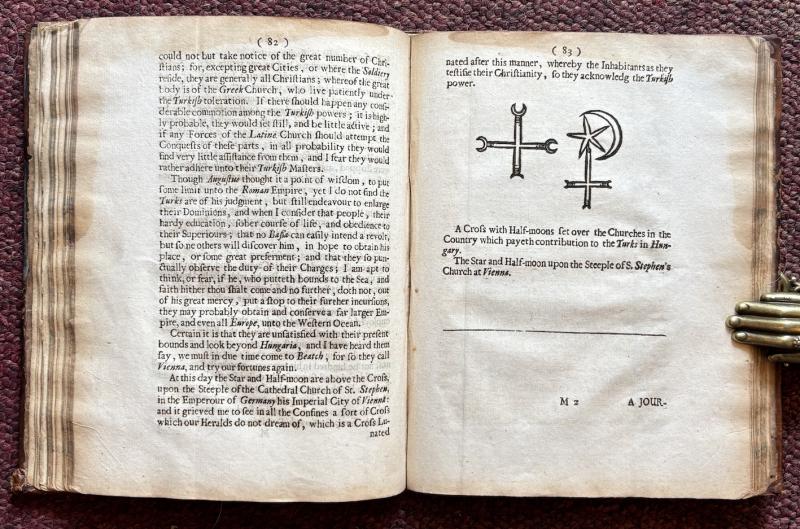
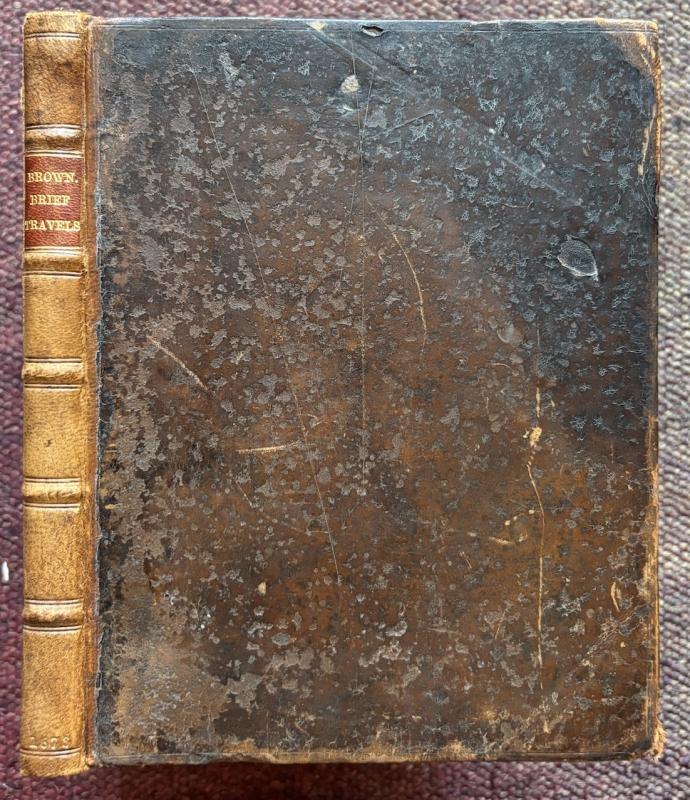
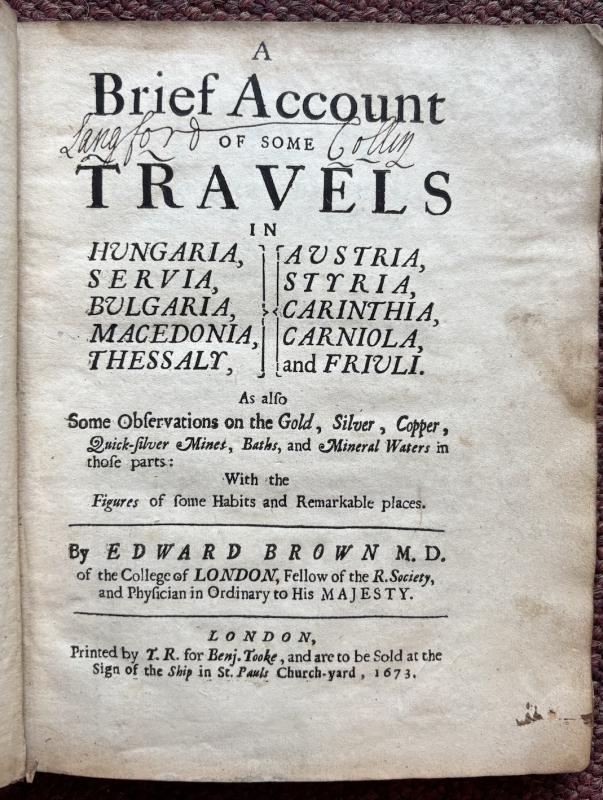
A BRIEF ACCOUNT OF SOME TRAVELS IN HUNGARIA, SERVIA, BULGARIA, MACEDONIA, THESSALY, AUSTRIA, STYRIA, CARINTHIA, CARNIOLA, AND FRIULI. AS ALSO, SOME OBSERVATIONS ON THE GOLD, SILVER, COPPER, QUICK-SILVER MINES, BATHS, AND MINERAL WATERS IN THOSE PARTS: WITH THE FIGURES OF SOME HABITS AND REMARKABLE PLACES. 1673, London, printed for T. R. for Benj. Tooke, and are to be sold at the sign of the Ship in St. Paul’s Church-Yard, small 4to, pp(iv) + 144 + (ii), 9 black and white engraved plates (including 4 folding), contemporary calf boards, later spine.
A second edition appeared in 1685, third edition appeared in 1687. ESTC, R35409; Wing B5110. “Browne, Edward (1644–1708), physician and traveller, was born in Norwich, the eldest of the eleven children of Sir Thomas Browne (1605-1682), physician and author, and his wife, Dorothy Mileham (1621–1685). He was educated at Norwich grammar school and in 1657 was admitted a pensioner at Trinity College, Cambridge, where he graduated MB in 1663. He continued his medical studies with his father and, in 1664, with Christopher Terne (1620/21 - 1673), physician to St Bartholomew's Hospital, London. In April of that year Browne left for the continent, where he widened his medical experience through visits to the Paris hospitals (April–August 1664), and rounded off his education as a gentleman by making a grand tour. A Journal of a Visit to Paris in the Year 1664, edited by G. Keynes, was published in 1923. Browne returned home in October 1665, having seen Italy (Rome, Naples, Venice, Bologna, and Padua) and France (Arles, Montpellier, Toulouse, La Rochelle). The journey was also a social success, since Browne made the acquaintance of several distinguished people, including Sir William Trumbull, Sir Samuel Tuke, and Sir Christopher Wren. He now enrolled at Merton College, Oxford (19 June 1666), and on 4 July 1667 received his MD (incorporated at Cambridge in 1670). Since he had decided on a medical career in London, it was necessary for him to join the College of Physicians, and on 16 March 1668 he was accepted as a candidate. However, Browne did not wish to begin a practice immediately, and persuaded his father to let him make another foreign journey. From August 1668 until Christmas 1669 he visited the Low Countries, Germany, Austria, Hungary, Serbia, Bulgaria, and northern Greece, where at Larissa he saw the court of the ‘Grand Seigneur’. Browne had become a fellow of the Royal Society on 2 January 1668, and while abroad he sent letters to its secretary, Henry Oldenburg, containing, among other things, information on the gold, silver, and copper mines in Hungary, Transylvania, and Austria. In 1669–70 three letters were published in Philosophical Transactions (4, no. 54; 5, nos. 58, 59). Browne remained fairly active in the society until 1684, serving on its council in 1670, 1678, and 1683. His last foreign journey took place in the summer of 1673, when he and many other gentlemen joined Sir Joseph Williamson and Sir Leoline Jenkins on their mission as plenipotentiaries to the peace congress at Cologne. This allowed Browne to visit several cities in the Southern Netherlands and the mineral waters at Aix-la-Chapelle and Spa. On 30 April 1672, two years after Browne had started building up his medical practice, he married Henrietta Susan (d. 1712), daughter of his former teacher Christopher Terne, at whose house in Lime Street, London, the couple lived until 1674, when they moved to Salisbury Court, Fleet Street. They had eleven children, only four of whom lived to adulthood. Browne worked hard at his profession; on 14 June 1675 he was chosen lecturer at Surgeons' Hall, and on 29 July 1675 he became a fellow of the College of Physicians, which he eventually served as treasurer (1694–1704) and president (1704–8). He had a large and lucrative medical practice, with many aristocratic patients; he was also consulted by King Charles II. On 7 September 1682 Browne became physician to St Bartholomew's Hospital. Numerous travellers used Browne as a vade-mecum, copying relevant passages into their own journals. William Nicholson asked Browne for permission to quote him for his volume of The English Atlas (1681). The critics were equally pleased with Browne's books. Philosophical Transactions (8, no. 94, 1673; 11, no. 130, 1676) published brief abstracts, but those in the Leipzig journal Acta Eruditorum (suppl., 1692, 337–46) and the Dutch Boekzaal (March–April 1697, 301–10) occupied a full ten pages each. In the introduction to A. Churchill's and J. Churchill's A Collection of Voyages and Travels (1704; 2nd edn, 1, 1732; xcii), John Locke called the book an 'ingenious piece, in which he has omitted nothing worthy the observation'; he particularly liked the account of the countries in central Europe 'which are not the common track of travellers'. Browne had 'composed a work of great use and benefit’.” [Oxford DNB]
2250,- EUR
inkl. 19% USt./incl. 19% VAT
Sachgebiete: Österreich, Europa, Griechenland, Ungarn , Reisen/Reiseliteratur
Kontakt zum