LANCRE, PIERRE DE  Auf Merkliste setzen
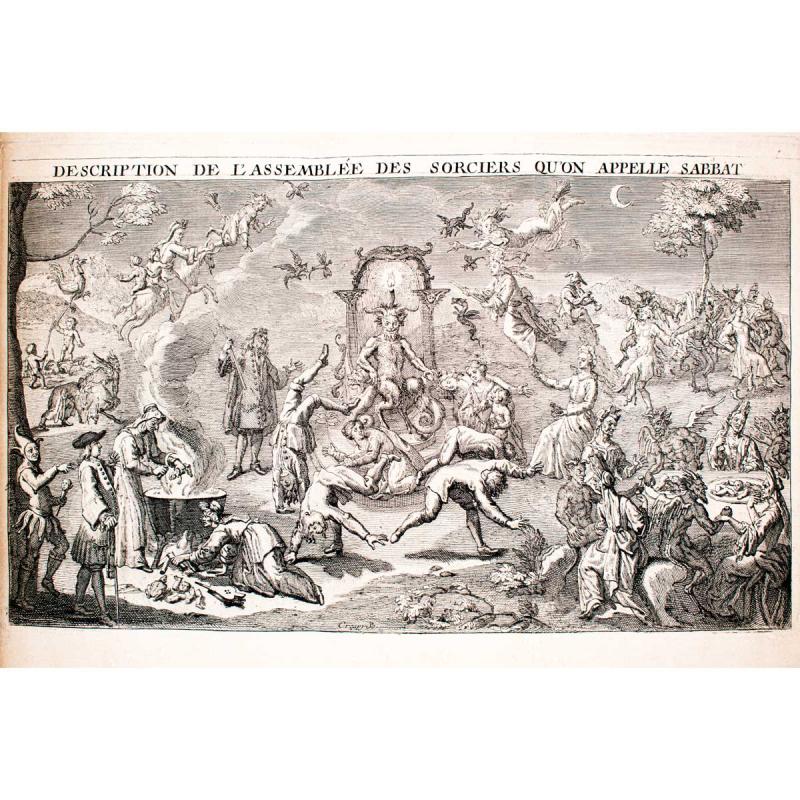
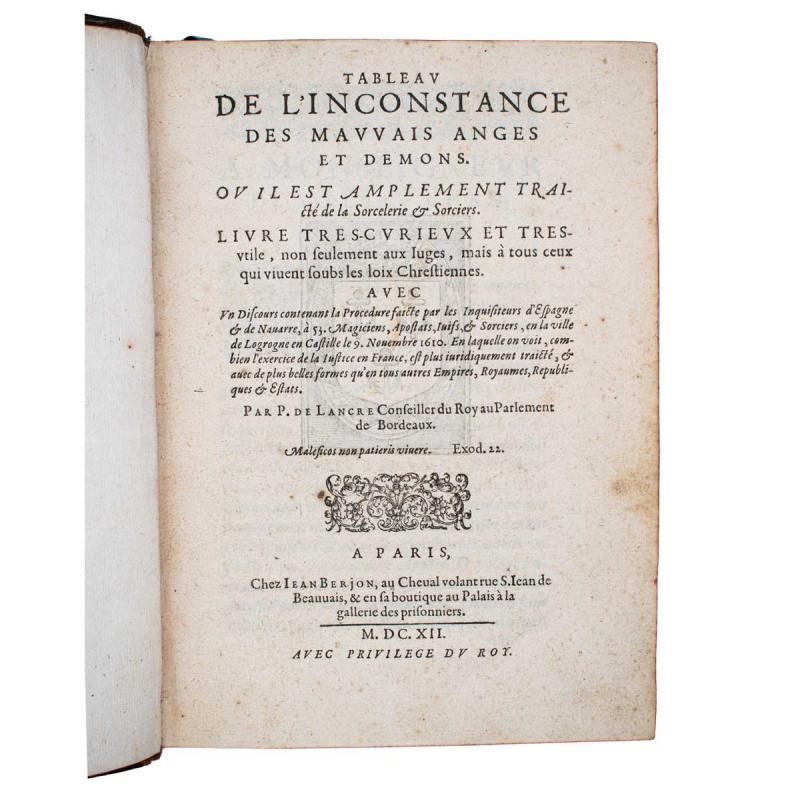
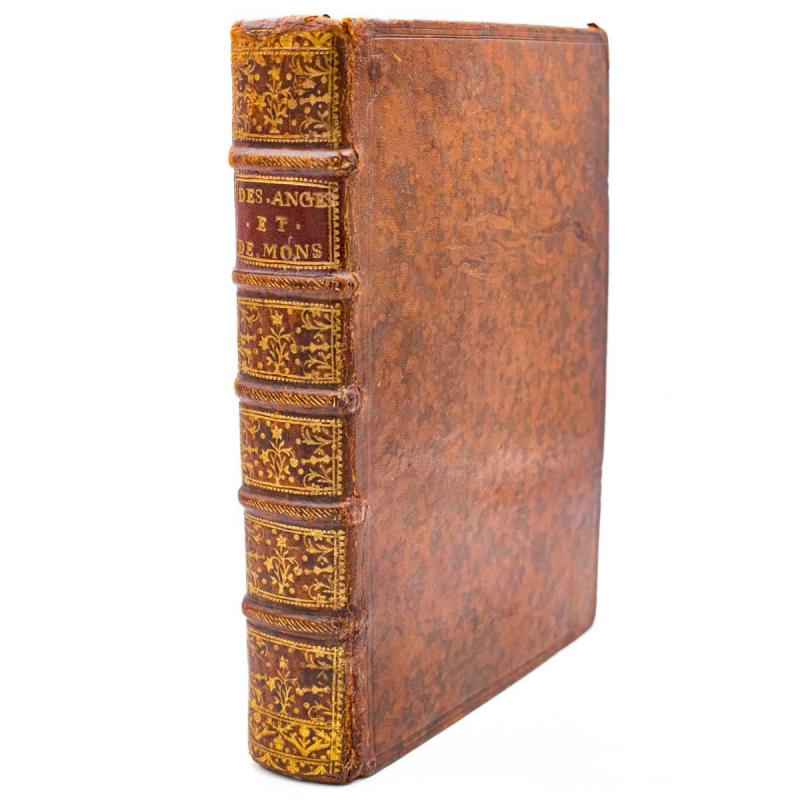
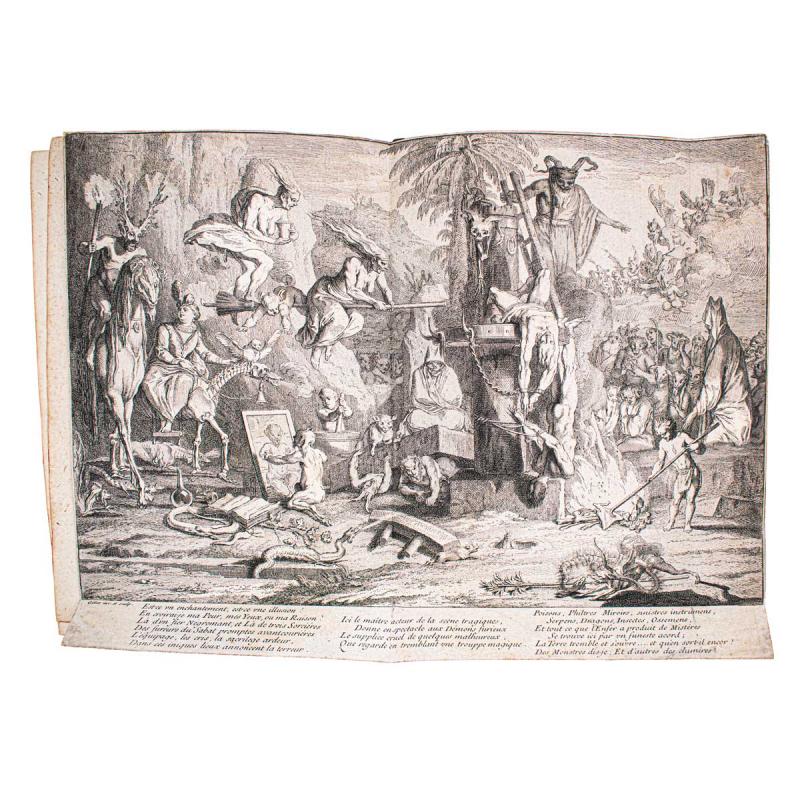
Tableau De L’Inconstance des Mauvais Anges et Demons. Ou Il Est Amplement Traieté de la Sorcellerie & Sorciers. FIRST EDITION, [28], 568, 2 engraved folding plates inserted, woodcut printers device, head and tailpieces, inhabited initials, marginal annotations in an old hand, marbled endpapers, full mottled calf, spine gilt, a.e.r., 4to, Paris, Jean Berjon, 1612 “... the last author on this subject who possessed judicial authority and himself carried out violent repression” - Julio Caro Baroja First Edition of the first, and most influential, of de Lancre’s work on demonology. Born in 1553, de Lancre studied in Toulouse and Turin. In 1583 he joined the Bordeaux parliament as a magistrate. De Lancre was one of the immensely learned lawyers who, towards the last third of the sixteenth century, gave a destructive twist to the witchcraft debate. He was entirely convinced of women’s inclination toward witchcraft and their universal threat to the individual, the community, and the state. He felt especially convinced that such practices threatened the political and economic stability in the French border regions, especially since the French religious wars had made it imperative to secure French territories. In 1609 King Henry IV of France appointed him head of a commission to investigate the activities of witches in the Labourt, the Basque region of France. According to de Lancre, most of these people engaged in active satanic associations and practices. During the course of a visit that lasted just four months, de Lancre, by his own account led investigations against forty-six suspected witches, among them twelve priests, and thirty-five informants. At least two dozen suspects were executed. This judicial operation had significant repercussions on both sides of the border with Spain. Accused witches fleeing south triggered the final witch-hunt undertaken by the Spanish Inquisition, ending in a major auto-da-fé in 1610. De Lancre’s frequent comments on the antisocial and antinationalist behaviours of the Basque people make it clear that the witch prosecutions had not only religious but political motives as well. These prosecutions clearly formed part of the French move toward the absolutist state. The rampage was finally stopped by de Lancre’s own colleagues, the judges of the Parlement of Bordeaux. In Spain, the episode soon led the Inquisition to stop executing witches altogether. In France, similar scepticism provoked de Lancre to publish ‘Tableau De L’Inconstance des Mauvais Anges et Demons’. A report on his extraordinary stay in the Basque country, de Lancre based the ‘Tableau’ on the original trial records. Since these records were destroyed in the eighteenth century, de Lancre’s report is the only surviving account of the proceedings of the trials. ‘Tableau’ is divided into six books, which deal with the more important problems which confronted him during his investigation. First he establishes the inconstant nature of demons, their number, and their special appeal to women. Books II and III enlarge the sabbath; de Lancre then returns to themes already suggested at the beginning: the ability of demons to change their shape, either in fact or through illusion. Book V enumerates the cures a man might adopt to counteract the wiles of the Devil. De Lancre concludes his work with an important discourse on priests and witchcraft, a learned rebuttal of the Canon Episcopi which leads him to stress the need to exact the severest punishment for crimes of witchcraft. Pierre de Lancre, is perhaps the greatest expert on the witch’s sabbath, constructing one of the most vivid descriptions based on the trials and testimonies in the Basque. Few demonologists blended learned and popular beliefs as effectively as he did. He described children being presented with toads in velvet suits, to be guarded while their parents amused themselves with the unspeakable pleasures of the sabbath feast. De Lancre believed that the witches’ sabbath was ongoing but only visible to the witches themselves. His ‘Tableu’ had celebrated authority in action against witches. De Lancre produced a report that went beyond the established parameters on witchcraft indictments and warnings. The reasons for this departure are two fold; his account is clearly more politically motivated than comparable works of the period. De Lancre is writing for his colleagues to convince them of the need to exercise control. He firmly believed witches to be a threat to the body politic, offering a detailed argument as to why secular magistrates and the government had to move with firmness and vigour against the menace witches posed. De Lancre dedicated his work to Chancellor Sillery, who set in motion the banishment of magicians, devils and sorcerers. Additionally, his vigorously argued legal tract can be read as an ethnological exploration of the Lambourt region and its Basque inhabitants. His descriptions of the religious, demonological, and judicial aspects of the witchcraft phenomena have much in common with contemporary reports of travel to the New World. Two eighteenth-century plates have been inserted into this work. The first work is by Jean Crespy, for Laurent Bordelon’s ‘L'Histoire des Imaginations Extravagantes de Monsieur Oufle’ (1735). This satirical work tells the story of a Mr. Oufle who reads so much about ghosts, witches, devils that he begins to have all sorts of strange visions. Mr. Oufle is shown here bottom left observing the bizarre sabbath scene accompanied by a jester. The devil worshipers are banqueting on babies and performing somersaults before the devil who is seated at centre. The work captures all the stereotypes of a witches sabbat including crones riding broomsticks, cauldron magic, dancing and dining with demons. The second engraving is by Claude Gillot, from a pair of engravings titled “Les Sabbats” (1722) depicting a witches’ sabbath. In the centre a stag-horned shaman presides over the torture of two men tied to a spinning device. On the left two masculinised crones ride on a broomstick with a small child. An elegant woman mounted on the skeleton of a horse, accompanied by a stag-horned man on a lion-faced horse. In the background hordes of animal-faced demons gather to watch the night's proceedings. [USTC:6011140; Witchcraft and Catholic Theology, Baroja; Defining Dominion, Williams, 1995; The Damned Art, 2012; The Oxford Handbook of Witchcraft in Early Modern Europe and Colonial America, 2013]
14600,- EUR
inkl. 19% USt./incl. 19% VAT
Sachgebiete: Volkskunde, Frankreich, Jura, Occulta
Kontakt zum