GEISWEILER, Maria. Three translations, published in London 1799–1800.  Auf Merkliste setzen
3 works in one vol., 8vo (211 × 128 mm) in half-sheets, pp. [4], 116; [2], 5–126, [2], printed on tinted paper; 43, [1], complete with half-title; a couple of marks to the title of the first work, some light browning elsewhere; contemporary sprinkled calf, elegantly tooled gilt, smooth spine gilt in compartments, gilt morocco lettering-piece; some surface wear, but very good overall.
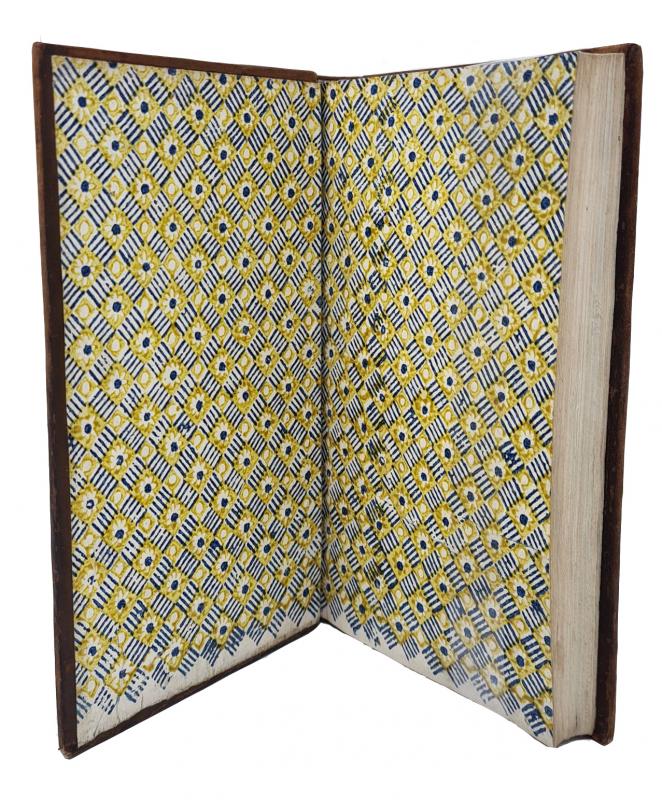
KOTZEBUE, August von. Johanna of Montfaucon, a dramatic Romance, in five Acts. Taken from the Fourteenth Century … The original Translation of the Manuscript from which Mr. Cumberland has formed his Drama, as performed at the Theatre-Royal, Covent-Garden. London: Printed by C. Whittingham … for C. Geisweiler … sold also by H. D. Symonds, and West and Hughes … J. Richardson … and W. Miller … Hoffmann, Hamburg; Willmanns, Bremen; and Beygang, Leipzig … [1800]. [Bound with:] —————. Poverty and Nobleness of Mind: a Play. In three Acts. Translated from the German … Second Edition. By Maria Geisweiler … London: Printed for C. Geisweiler … G. G. and J. Robinson, and H. D. Symonds … J. Richardson … and Carpenter and Co. … G. C. Keil, Magdeburg; B. G. Hoffmann, Hamburg, and J. G. Beygany [sic], Leipzig. 1799. [And:] —————. The Noble Lie; a Drama, in one Act: being a Continuation of the Play of Misanthropy and Repentance, or The Stranger; now being acted with the greatest Applause, at the Theatre-Royal, Drury-Lane. Translated from the German … by Maria Geisweiler. The second Edition. London: Printed for C. Geisweiler … G. G. and J. Robinson … J. Richardson … and Carpenter, & Co. … 1799. First English translations of Johanna von Montfaucon (1800), Armut und Edelsinn (1795), and Die edle Lüge (1792), testament to the time when German plays, in particular those of August von Kotzebue, held the English stage and with it the fascination of English theatregoers. Jane Austen was famously struck by one, Das Kind der Liebe (translated as Lovers’ Vows), which she incorporated into Mansfield Park. ‘Of the short but brilliant “Glanzperiode” of the German stage in England (1798–1802), when it dominated all dramatic interests, Kotzebue is the central figure and prime factor. It would be necessary here to devote a chapter to him alone …’ (Stockley, German Literature as known in England 1750–1830, p. 181). ‘The enthusiasm for Kotzebue and all his works reaches its maniacal climax in 1799, in which year I count twenty-seven translations or adaptations from Kotzebue, and there may well have been more’ (Stokoe, German Influence in the English Romantic Period 1788–1818, pp. 48–9). The translator Maria Geisweiler (1763–1840) and ‘her Swiss-born husband Constantine (originally a printseller) had in the years 1799–1801 set up what can only be described as an extraordinarily ambitious programme to promote German literature in England. This comprised a bookshop (latterly in Parliament Street) selling imported German books, a short-lived literary magazine called The German Museum, and a series of translations of contemporary German authors for which both Maria and Constantine were responsible. In 1801 they travelled to Germany to promote their programme at the Leipzig Easter Book Fair and to solicit support from Goethe, Schiller and Wieland at Weimar. ‘The Geisweilers’ literary efforts received what one might politely call “mixed” reviews. The visit to Germany was also a failure and the business folded in 1801 or early 1802. About this time Constantine began to show signs of mental illness (described by one contemporary as a “Paroxysmus”). Although he tried other trades (dealing in wines), within a few years he was entirely unable to work. In April 1805 Maria, now over 40 years old, appears to have given birth to a son named Constantine who died very shortly after. ‘Clearly Maria needed great personal resources (and the help of others) to manage this situation. She had born in London into a typically bilingual Anglo-German family. Her father was a merchant called Frederick Heinzelmann, her mother an Englishwoman called Elizabeth. Maria’s background was therefore well-to-do. When she married the much younger Constantine in 1799 she was 36 years old and had already lost one, aristocratic husband (an unidentified Count von Schulenberg). ‘By 1816 Maria’s situation must have been desperate. Nevertheless she tried to do her best for herself and her husband in possibly the only way she knew how, not merely by lobbying the government for financial support but also but by translating … Maria Geisweiler died in 1840. Her husband survived her by nine years. Her attempts to secure his future may have been successful. At the time of the 1841 census he was living in a private “madhouse” in Kensington’ (Graham Jefcoate, ‘Maria Geisweiler, translator’, British Library European studies blog, 12 May 2014). The Noble Lie was Geisweiler’s first translation. In her Advertisement here, she comments that ‘I am sensible perfection of style is not to be expected; though the thorough knowledge I have of the German language, enables me to say with confidence, that I have faithfully given the meaning of the original throughout. To female writers, the British nation has ever shewn great indulgence …’ The Monthly Review noted that ‘this is her first literary attempt. The German, we suppose, is her native tongue … but we find very few defects in her English’ and Morgan, in a rare moment of praise, marks the translation with an asterisk (‘indicates excellence’), likewise her translation of Poverty and Nobleness of Mind. It is fascinating to see three of Geisweiler’s translations bound up together here and treated to a rather smart English binding, with striking, and very un-English, block-printed endpapers. (They look to be Italian, or possibly Austrian, but I cannot locate the pattern in any of the usual reference books. As to the binding itself, it is English, but possibly the work of a German binder working in London. My thanks to Professor Nicholas Pickwoad for his thoughts on this.) The editions are certainly all rare. ESTC locates two copies only of Johanna of Montfaucon (Huntington and Columbia), three of the present edition (‘Apparently a reissue of the sheets of the first edition [also 1799] with a new titlepage’) of Poverty and Nobleness of Mind (BL, Bodley (wanting the advertisement leaf), Michigan (ditto)), and six of The Noble Lie (‘a reissue of the first edition published in the same year, with the statement of responsibility reset and edition statement added’): BL (lacking the half-title), Cambridge, Bodley, Sutro, Illinois, Kansas. Jefcoate 1800.11, 1799.10, and 1799.6; Morgan 5282, 5204, and 5266; Nicoll III, 264. For the original versions, see Goedeke V, 280, 61; V, 278, 38; V, 277, 30.
2950,- EUR
inkl. 7% USt./incl. 7% VAT
Sachgebiete: Papier/Buntpapier, Literatur ab ca. 1900, Theater
Kontakt zum