Hemingway, Ernest. American writer and Nobel Laureate (1899-1961).  Auf Merkliste setzen
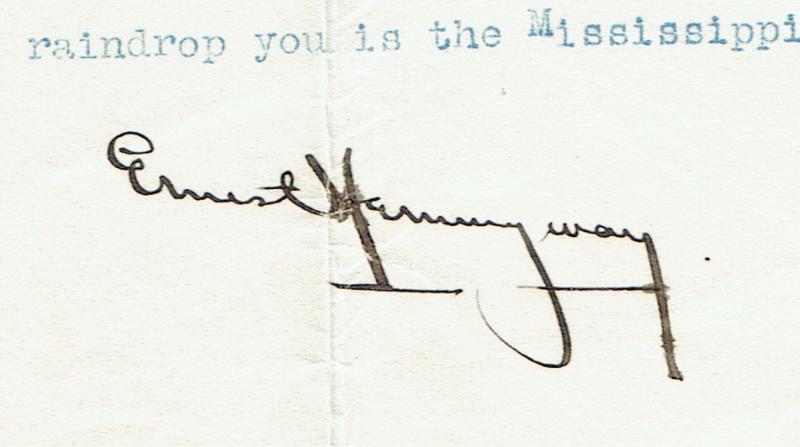
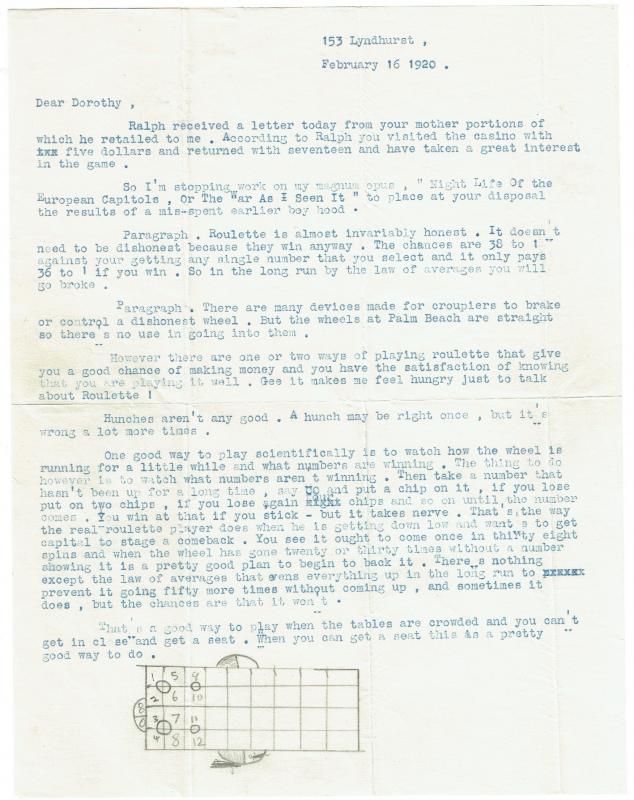
Typed letter and illustrated of a roulette table, signed „Ernest Hemingway“. Lyndhurst [Avenue, Toronto]. 16th February 1920. 4to. 2 pp. (separate leaves).
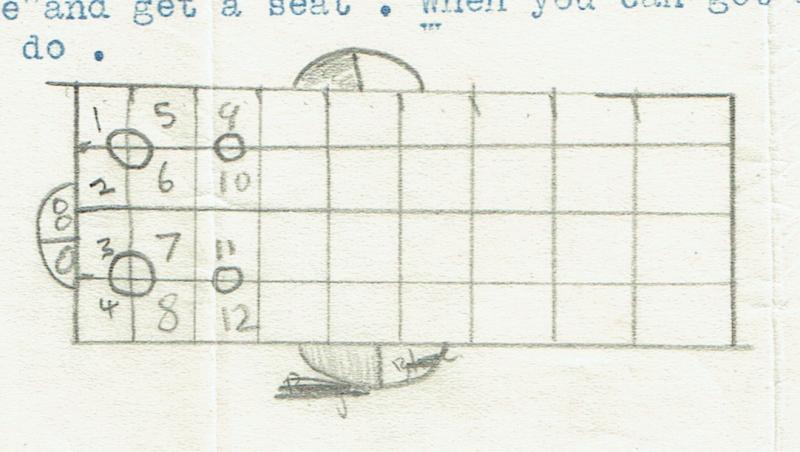
Exceptional early illustrated letter on probability, roulette, and statistical reasoning, written during Hemingway's Toronto years and featuring an original sketch of a roulette table. Written shortly after beginning his career as a reporter for the Toronto Star, Hemingway responds to the news that Dorothy Connable had been playing roulette by interrupting work on what he jokingly calls his "magnum opus" to share "the results of a misspent early boyhood." What follows is an unexpectedly sophisticated discussion of probability and gambling strategy, in which Hemingway rejects intuition and superstition in favour of statistical reasoning. Explaining the mathematical structure of roulette, he notes that the game is fundamentally honest because "the chances are 38 to 1 against your getting any single number that you select and it only pays 36 to 1," emphasizing the house advantage. Rather than relying on hunches—"A hunch may be right once, but it's wrong a lot more times"—he advocates observing the distribution of outcomes, identifying numbers that have not appeared for an extended period, and employing a progressive betting strategy based on the "law of averages." To illustrate his system, Hemingway adds an original pencil drawing of an American roulette table, complete with numbered layout and betting chips indicating his preferred combinations. He concludes with a second probability-based method using the three dozens of the roulette board before humorously describing the letter as "merely a treatise on the evils of gambling." Viewed today, the letter is a fascinating example of intuitive probabilistic thinking decades before modern game theory, behavioural economics, or artificial intelligence formalized decision-making under uncertainty. Hemingway's reflections on randomness, expected outcomes, and betting systems illustrate a practical engagement with mathematical concepts that continue to underpin contemporary fields ranging from quantitative finance to machine learning. His roulette diagram transforms the letter into an exceptional visual document at the intersection of literature, mathematics, and probability theory. The letter was written to Dorothy Connable, daughter of Harriet Connable, whose support proved decisive in Hemingway's early career. The Connable family provided the young writer with a home in Toronto and helped launch his career at the Toronto Star during one of the formative periods of his life. An outstanding early Hemingway letter, combining literary charm with an original and surprisingly analytical discussion of probability, statistical inference, and gambling strategy. The autograph roulette diagram makes it a particularly appealing piece not only for collectors of literary manuscripts but also for those interested in the history of mathematics, decision theory, and the origins of probabilistic thinking.
22500,- EUR
inkl. 7% USt./incl. 7% VAT
Kontakt zum