WIT, Kornelis de.  Auf Merkliste setzen
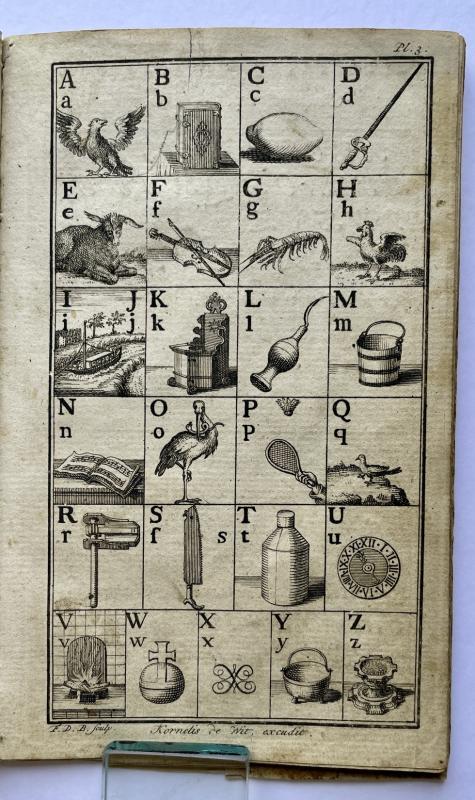
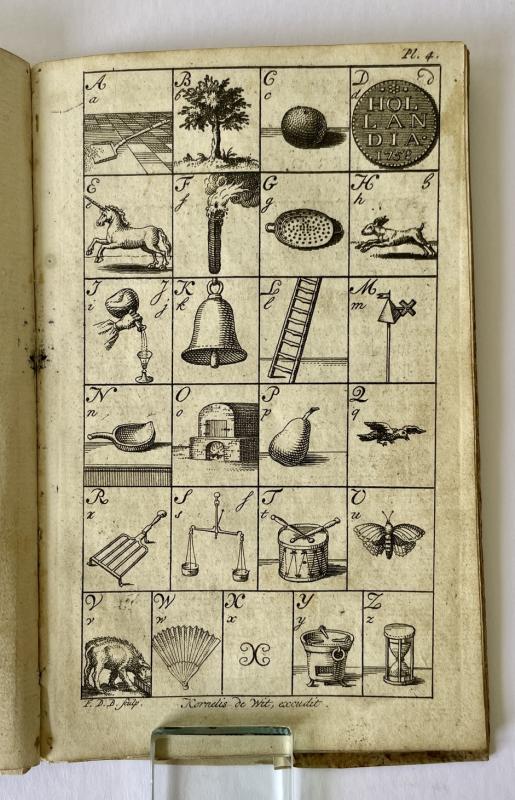
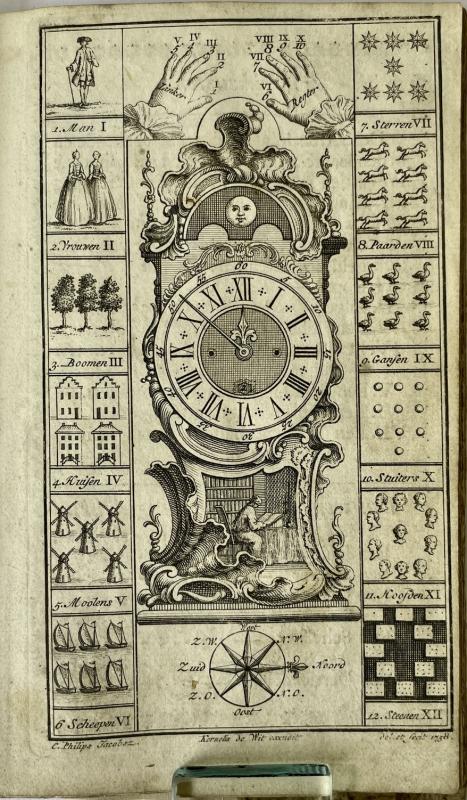
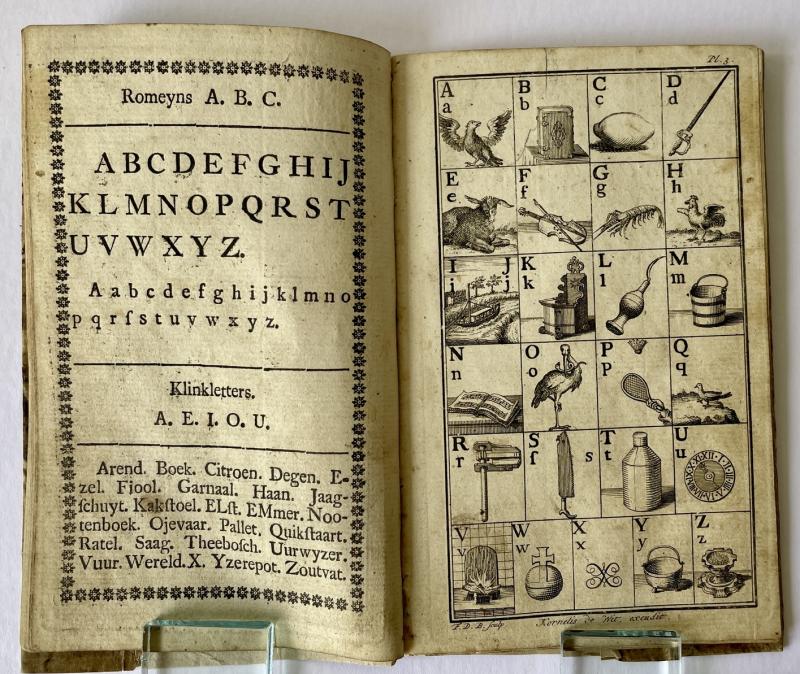
Innovative ABC Book WIT, Kornelis de. Een Nieuwlyks Uitgevonden A.B.C. Boek. Om de kleine kinderen, op eene gemakkelyke Wijze de verscheide Soorten van Letteren te leeren kennen en noemen: door Middel van Figuuren, by de Kinderen bekend: en welker Naamen de Klank der Letteren zo veel mogelijk Uitdrukken. Hier by is gevoegd Enn nieuw Manier om de kinderen, door Afbeeldinngen, te leeren Tellen: D byzondere Soorten van Cyfer - Letters te leeren kennen en noemen... Amsterdam, Kornlis de Wit, 1759. 8vo (155 x 93 mm), pp. [xxiv], including engraved title, 4 numbered engraved illustrated ABC plates with letterpress text to verso, 1 unnumbered plate, illustrating numbers and the clock, and 3 numbered engraved plates of coins, two with letterpress text to verso; pp. 24 letterpress; old pastepaper wrappers; printed on strong bright paper, in good impressions.
First edition of a highly innovative Dutch ABC book. De Wit abandoned the usual Hahnenfibel format, but instead produced an entirely new genre of primer. Aware that children happily and easily memorise from looking at pictures, especially when they illustrate everyday familiar objects, de Wit uses this to introduce the letters of the alphabet, numbers and also coins. In helpful repetition the alphabet is introduced four times, black letter, Roman, in upper and lower case and Italic. So the letter A is illustrated by a little image of an ‘Aap’ (Ape), c by a circle and g for glass, etc. Similarly numbers a illustrated with repeated objects. The introduction to coins and their respective values is particularly unusual for the intended age group. The second half of the little primer contains the usual Scriptural questions, the Ten Commandments, the Lord’s Prayer and a number of other daily prayers. ‘The idea of visual education steadily won over the enlightened minds of northern Europe. In 1759 (1755) Kornelis de Wit published Een nieuwlyks uitgevonden A.B.C. Boek - a newly invented ABC Book in Amsterdam, while the German Karl Philipp Moritz produced Neues ABC Buch (New ABC Book) in 1790. The images, accompanied by simple and rhythmic prose were intended to develop the elementary bases of reflection through observation. The Dutch bookseller and publisher Kornelis de Wit was active in Amsterdam between 1736 and 1762. The book was popular, in addition to this 1759 edition, there is an undated edition, which is sometimes tentatively dated 1755, which seems questionable. In this 1759 edition all the plates are signed, F.D.B del. et sculp. and de Wit exudit, wheras the undated edition has half the plates without the imprint. The text is partly reset with different fleurons. Children’s World of Learning (1759 edition), 98; OCLC: lists copies in Netherlands only: Rotterdam, Royal Library, Groningen, Amsterdam & Tresoar; second edition 1759, see B. Kuemmerling-Meibauer, The Routledge Companion to Picturebooks, 2017.
2000,- EUR
inkl. 7% USt./incl. 7% VAT
Sachgebiete: Kinderbücher, Pädagogik
Kontakt zum