BREITNER, Anton  Auf Merkliste setzen
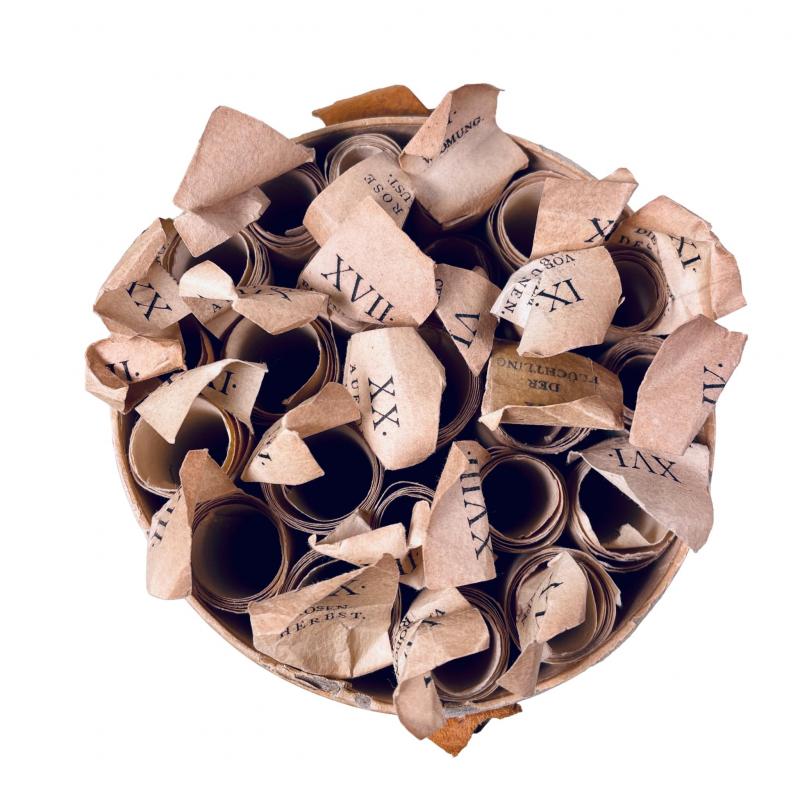
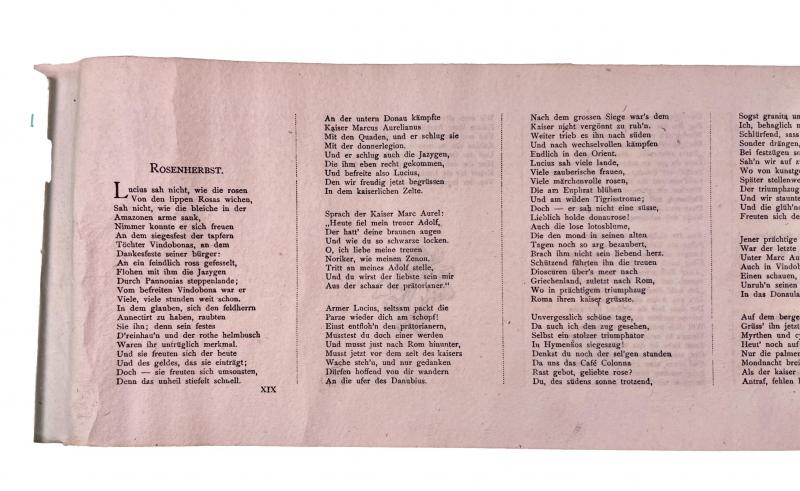
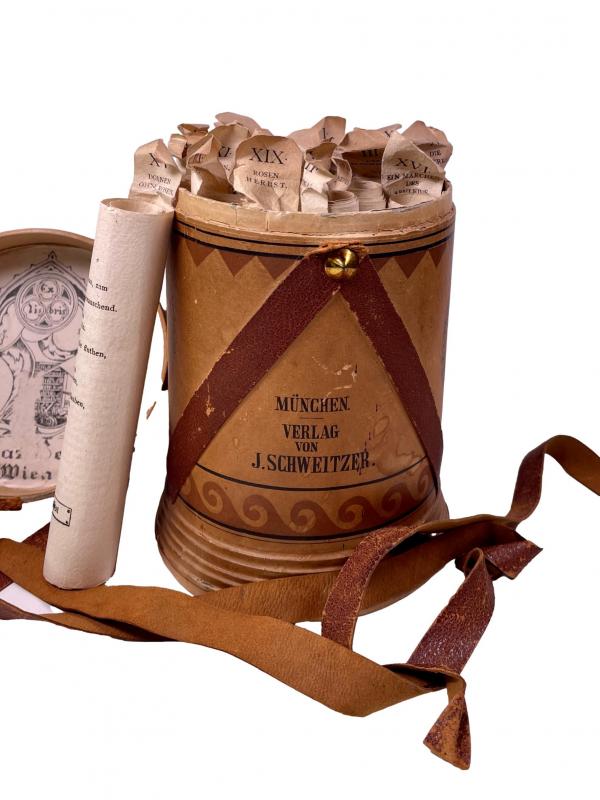
Printed in Scrolls and Preserved in a Capsa BREITNER, Anton. Vindobonas rose. Vienna (Therese Dorfmeister) & Munich J. Schweitzer, 1890. Capsa containing 23 scrolls (complete) of various lengths with text on both sides and printed vignettes, with number tags on the top, inserted in the original papier-mache box (15,5 cm x 10 cm / 6.1 x 3.9 inches) with a lid and leather bands and two metal pins, bookplate of Ignaz Benda, an Austrian bibliophile and author, mounted on the inner side of the cover and at the bottom of the box (good with only minor traces of use and shelf wear, box with minor scratches and staining, one of the leather bands torn off, but present, bookplate on the inner side of the cover with light scratch, scrolls with only minor damages, mostly to the exposed parts with numbers).
An inventive and highly attractive book object: Breitner’s spirited poem ‘Vindobona’s Rose’, each of its 23 verses printed in a pretty Antiqua font on an individual scroll and preserved in a capsa, a cylindrical box made out of beechwood, just as in Roman times. This extraordinarily elaborate object was produced by Anton Breitner (of Mattsee), inventor of all manner of whimsical and ingenious innovations in book arts and crafts. Also published in book form, the epic narrative ‘Vindobonas Rose; or ‘The Rose of Vienna’, is set in Roman antiquity and is part of the wedding travel journal of Father Danubius. It was written by Anton Breitner (1858-1928), an Austrian collector, archaeologist, and writer who was the illegitimate son of Anton Dreher, one of the wealthiest brewery owners in Europe. The family wealth allowed him to pursue his hobbies freely, and he settled in Mattsee, northeast of Salzburg, where he created one of the most prominent private collections in the region, called ‘Scheffel Museum’ (Verzeichniß des Scheffel-Museums in Mattsee). The unique design of this object encapsulates the zeitgeist of the poem’s Roman, capitalising on a growing awareness of the excavations of Roman sites, notably Pompeii, which heightened contemporary fascination with antiquities. The engineered form of the capsa, often reinforced with materials such as leather or wood, served to protect the contents during transit. This functionality sustained its popularity into the modern era, evolving into luxury packaging for various products, including cigar boxes and vintage travel accessories. Significantly, the cover of the conventional edition, produced by the same Viennese printer (Therese Dorfmeister, who operated the historic firm della Torre’s Buchdruckerei), features an illustration of a woman attired in Roman garb, prominently displaying a ‘capsa’ that is similar to the design here. The book version was published by J. Schweitzer in Munich. In this form the work is very rare indeed, with just the Staatsbibliothek Berlin copy listed. Breitner also produced a work in the form of an ancient urn made of papier-mâché, with the title Litterarisches Scherbengericht (Moderner Ostrakismos), containing 50 imitations of ostraca, featuring portraits and written sayings by German poets and archaeologists. Börsenblatt, no. 288, 1888, p. 868; WorldCat and KVK, apparently only Staatsbibliothek Berlin (OCLC 248025235) in this format.
4800,- EUR
inkl. 19% USt./incl. 19% VAT
Sachgebiete: Antike, Bibliophilie, Buchwesen, Vorzugsausgaben
Kontakt zum