Riefelbild - Triscenorama.  Auf Merkliste setzen
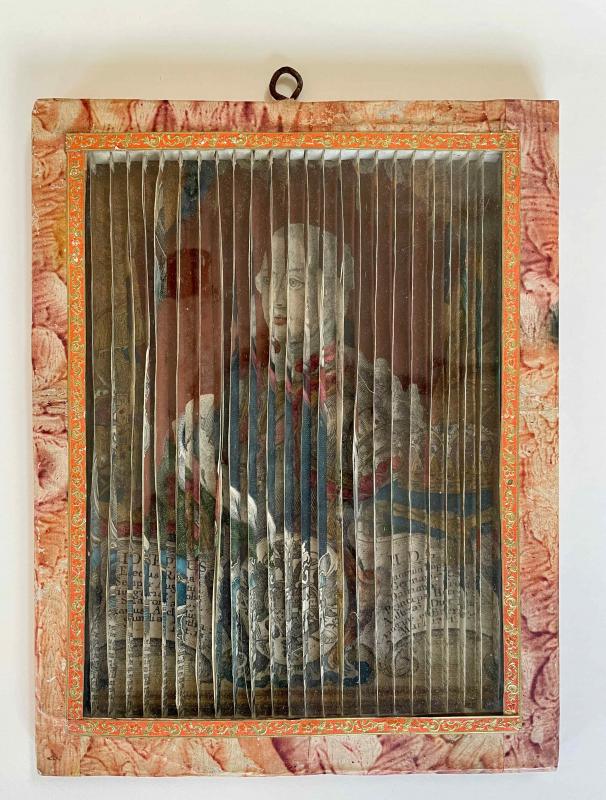
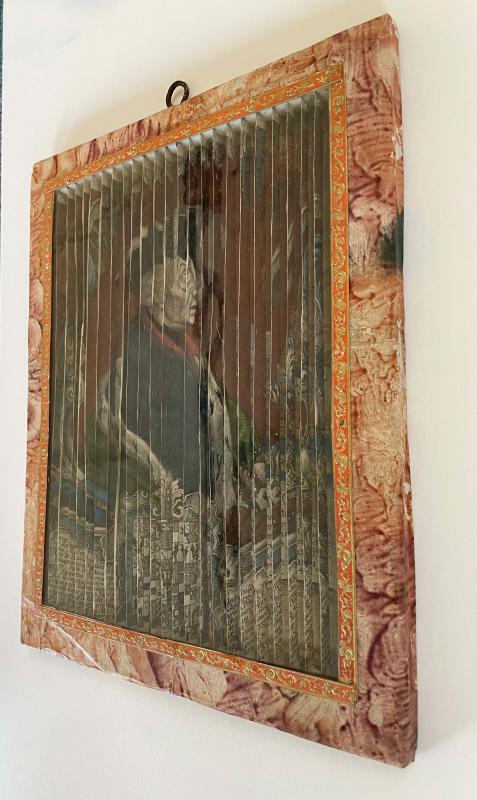
Riefelbild - Triscenorama. Wechselbild mit drei kolorierten Kupferstichen, zwei davon in Segmenten montiert, einer als Hintergrund. Dargestellt sind Joseph II (1741-1790), seine Mutter Maria Theresia (1717-1780) und Friedrich II von Preußen (1712-1786). Deutschland oder Österreich, um 1770. Zeitgenössisch montiert und unter Glas gerahmt, Rahmen (280 x 218 x 10mm), Portraits (230 x 171mm); Rahmenleiste mit Kleisterpapier und goldgeprägter Bordüre aus Luxuspapier überzogen, original Metallöse zum aufhängen; die Papierstreifen sind teilweise leicht verbogen, wodurch die optische Illusion etwas beeinträchtigt wird, insgesamt aber von sehr guter Erhaltung.
Sehr seltenes, frühes Beispiel eines dreiteiligen Riefel- oder Wechselbildes, einer optische Illusion. Von vorne sieht man ein Portrait von Joseph II, schaut man von links, sieht man seine Mutter Maria Theresia (1717-1780), schaut man von rechts, dann Friedrich II von Preußen (1712-1786). Auf interessante Weise wird Joseph II in seinem historischen Kontext dargestellt. Friedrich der Große und Joseph II. gehörten zu den bedeutendsten „aufgeklärten Despoten“ des 18. Jahrhunderts, doch ihre Regierungszeiten waren von erbitterter Rivalität geprägt. Friedrich von Preußen war ein pragmatisches militärisches Genie, während Joseph II. von Österreich ein revolutionärer Idealist war. Ihr Konflikt prägte das politische Schicksal Mitteleuropas. Zweiseitige Wechselbilder, als Tabula Scalata bezeichnet, bei denen zwei Motive auf die Seiten eines Dreiecks montiert wurden, während die dritte Seite die Verbindung mit dem Hintergrund schafft, sind seit dem 16. Jahrhundert bekannt, frühe Beispiele im Handel aber nicht zu finden. Riefelbilder waren beliebt, allerdings zumeist mit religiösen Motiven. Vor allem im 19then Jahrhundert wurden viele Wechselbilder aus Lithographien hergestellt. Ein Triscenorama aus dem 18ten Jahrhundert mit politisch historischem Thema ist nicht nur ungewöhnlich sondern auch besonders attraktiv. Three Royals in One [TABULA STRITTA.] TRISCENORAMA Three-way picture of three engraved portraits of Joseph II (1741-1790), his mother Maria Theresa (1717-1780) and Frederick II of Prussia (1712-1786). Germany or Austria, ca 1770. Mounted and framed under glass; sides and frame edge covered with paste-paper, with gold-stamped luxury paper border; original 18th-centruy glass and metal hook at the back. Some of the image strips a little bent, which slightly impairs the illusion, but in very good overall condition Very rare, early example of a three-part alternating picture, a tabulata stritta which is in fact a variation on the tabula scalata. Tabula scalata are pictures with two images divided into strips on different sides of a corrugated carrier. Each image can be viewed correctly from a certain angle. Most tabula scalata have the images in vertical lines so the picture seems to change from one image to another while walking past it. Tabula stritta has three images, two on each side of perpendicular slats in front of a third picture. The portraits of Frederick II and Maria Theresa are cut into narrow strips, glued together on both sides and mounted in the frame with brackets so that different viewing angles only reveal one view at a time. If you look at the picture from the front, you see Joseph II. It is particularly appealing to have the tabula stritta depict a political or historical situation rather than the more common religious ones. The Latin term "Tabula scalata" was introduced in 1646 by Athanasius Kircher and can be roughly translated as "staircase-shaped picture". The terminology in the English language has been somewhat diffuse: many different words have been used for the same type of corrugated pictures. "Perspective picture" and "anamorphic picture" have been common but not very precise terms; these are also used for very different types of pictures. Furthermore, it has been suggested that "anamorphic" should be reserved for the flat type of pictures with a distorted perspective. "Turning pictures" is more precise but less common. The term "double portrait" is not uncommon, but does not cover any tabula scalata that depict different subjects.
5000,- EUR
inkl. 19% USt./incl. 19% VAT
Sachgebiete: Aufklärung, Curiosa, Friedrich II., der Große, Österreich, Preußen
Kontakt zum