Paisios Ligarides  Auf Merkliste setzen
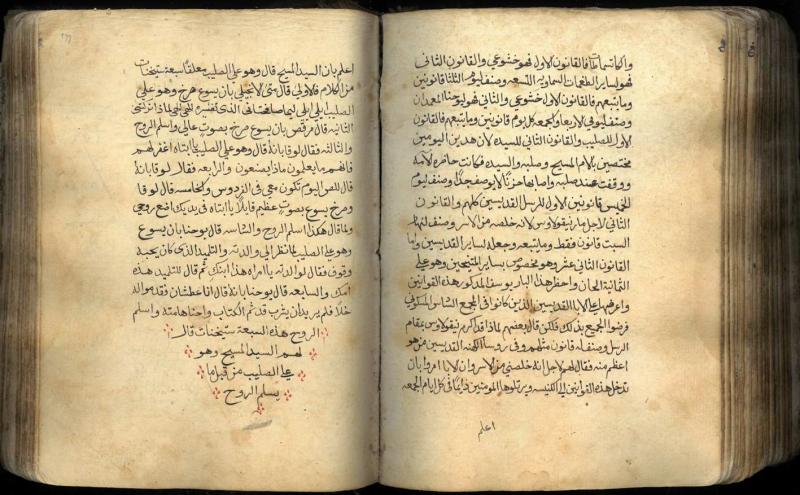
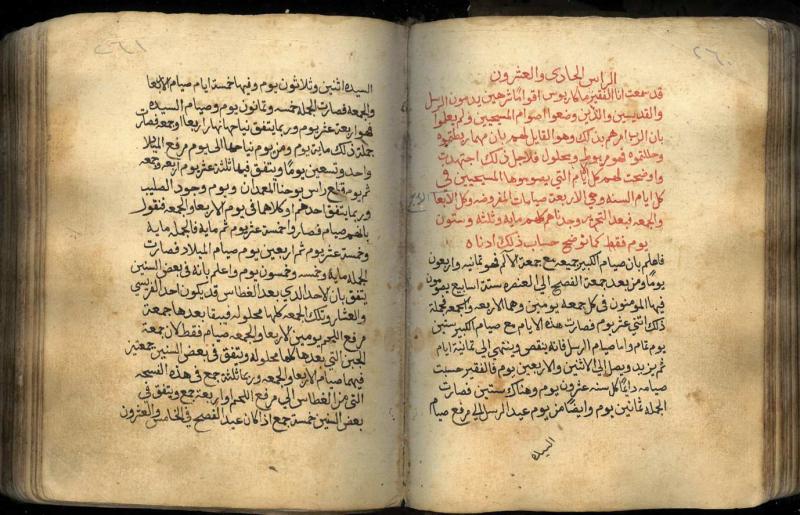
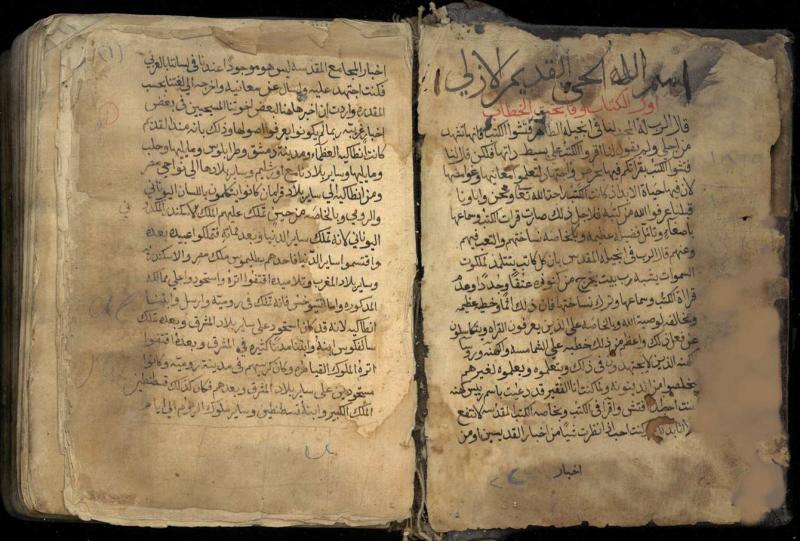
A402)The book of Signs Extremely rare Arabic Orthodox Christian manuscript written on thick laid and mostly unpolished paper comprised of two connected books, both titled Kitāb ar-Rumūz (‘Book of Signs’, but, curiously enough, also called Kitāb an-Naḥla, or ‘Book of the Bee’ in the colophon) and composed by Paisios Ligarides (ar.: Bayīsyūs aṣ-Ṣāqizī, d. AD 1678 in Russia – see below for further information on this point), who would be the Orthodox Metropolitan of Gaza from AD 1652 to his death. This manuscript is the Arabic translation of Paisius’ Chrēsmologion (gr.: χρησμολόγιον, ‘Oracle Book’, or ‘Book of Prophecies’, see infra) carried out by Makāriyūs (Makarios) IIIrd ibn Zaᶜīm, dated on Friday, the 4th Tammūz (July), AD 1740 (along with other dating systems). This manuscript was realized quite certainly in an Orthodox monastery located somewhere in the then Ottoman Southern Levant. 291 ll. [from 1v. to 291r.: 580 pages in all, just textblock with no endleaves], complete. Average leaf size: mm. 220 x 160; written space measurements: mm. ca. 155 x 100; text written in a clear and sober Levantine nasḫ style in black ink, arranged on a 17-line single column, with chapter headings and noteworthy terms in red (‘rubricated’). No other decorative means embellishes the manuscript. The upper right part of l. 103 has been ripped off causing text loss, albeit minimal; ll. 152 (r./v.)-153r. look unorganized as they are not ruled by any mise en page (maybe is just about pen proofs). Three loci with inconsistent catchwords at ll. 5, 35, and 270. The catchword at l. 5 finds its text displaced at l. 36, that needs replacing (which explains the inconsistent catchword at l. 35. Consequently, the catchword at l. 36 matches with the beginning word at l. 6). Catchwords at ll. 112 and 126 are missing, nevertheless the text seems to be sound and complete. In terms of calligraphy and paper, the text at ll. 88-96 might have been written either in a slightly different hand, or, if by the same copyist, simply by means of another qalam. At l. 195r. we can read in the text the Greek expression: Mē tēs tōn katēkhouménōn: (“not of those who are catechumens”, that is “those who have been instructed and taught the Christian faith and way of life”), and another single Greek word stands out as a marginal gloss at l. 286v.: ekporèuseōs (“of the procession”, “of the ekpòreusis”. This is a theological concept meaning that the Father is the only principle that does not imply Trinity, as of the “sole cause” of the Son and the Spirit. This was a key point in Orthodoxy regarding the Filioque controversy: the Holy Ghost, according to the Orthodox Churches, proceeds only and exclusively from the Father). This codex is bound with a marvelous byzantine wooden binding covered with brown leather, an exquisite characteristic of Orthodox Christian Arabic manuscripts. The manuscript has been preserved in overall very good condition, set aside some waterstains and other sings of time and use – e.g., the burn-stained hole at ll. 54-55. This writing represents a highly valuable testimony of the revival of Greek Orthodox mystical-apocalyptic literature amid the Orthodox faithful communities in the Ottoman-ruled Levant, and it must be considered, beyond all doubts, an enthralling example of the much-neglected literature of the Middle Eastern Orthodox Christians, now so clearly endangered by the threat of annihilation by Islamist jihadi radical groups. On this Manuscript As previously acknowledged, this beautiful codex contains the Arabic translation of the ‘Book of Prophecies’, which ultimately consists in an extensive collection of oracles and various teleological elaboration aimed at heralding the prophetic hint at a reestablishment of the (Christian Orthodox) rule over the lands that were conquered by the Ottoman Turks ensuing the fall of Constantinople in May 1453. The text is authored by the Metropolitan of Gaza Paisius Ligarides (see infra on him), who is mentioned several times in the introduction of this work by the Arabic form of his name, i.e.: Bayīsyūs aṣ-Ṣāqizī (lit.: Paisios of Chios). We can reckon some of his work in the index of the Mingana Collection of Manuscripts (see: Vol. II, on Christian Arabic Manuscripts, ms. 60, also labelled ‘The Book of the Bee’). The manuscript was quite possibly written by an (either Egyptian or Palestinian) Arabic-speaking copyist, as certain dialectological features seem to give it away. For instance, at 250v., we read “second” (m.) written as tānī (with t-) instead of the Classical Arabic or MSA form ṯānī (with ṯ-), whereas at 227r. we find the standard form with the interdental fricative. In the very same fashion, we spot every now and then some substitution of ḏ with d, as in the form ad-dikīya used instead of the Classical form aḏ-ḏikīya at l. 10v. At l. 10v. the author states that this book is “the result of many other books” (ar.: haḏā al-kitāb min-kutub kaṯīra), was called Book of the Bee, the work of Makarios, the Patriarch of Antioch (namely Makāriyūs bin az-Zaᶜīm, d. AD 1672) as its value proved to be working in a very similar way to that of “[…] a hovering bee, flying around from a fresh flower to another fragrant blossom, thus picking up [the best] from them. […]” (ar.: kamā an-naḥla taṭawwaf ᶜalá sāyir al-azhār ad-dikīya [! See above] ar-rawāiḥ, wa taǧannī min-hum. […]”). By this it is meant the miscellaneous and select nature of the work, its many sources and encyclopaedical character, stylistically rich in elaborate metaphors. By virtue of all these elements, the style of Paisios was defined, at least as far as the original Greek text was concerned, as a significant example of the ‘Byzantine baroque’. We noticed that this codex is subdivided into two parts, both of them being entitled Kitāb ar-Rumūz, (‘Book of the Signs’). The first part is subdivided into 40 chapters (ru’ūs, pl. of rā’s, lit.: “head”), and runs from 1v. to 223r., followed suit by the second one, which is articulated into 27 chapters, beginning at 223v. until the end of the manuscript at 291r. The content of the first part of this work deals mostly with the prophetical hagiography, the story of the Patriarchs, and in general on fundamental ‘signs’ of great spiritual significance for the Levant Orthodox community, through the mystically conceived traditional lines of interpretation of the Biblical texts, Greek Orthodox Fathers’ commentaries, and doctrinal elements. The second part, on the other hand, focuses on the eschatological meaning of the historical figures of the Eastern Roman (Byzantine) Empire, especially emperor Constantin the Great (ar.: Qusṭanṭīn al-Kabīr), culminating with the messianic prospect of a redemption by Muscovite Russia (the ‘Third Rome’ myth) in restoring the ancient empire of Orthodoxy, all this within the framework of a readjustment to contemporary politics of the ‘Danielite’ theory of the Four Empires and ‘imperial cycles’, against the backdrop of the inevitable triumph of the One True Faith (by which here it is obviously meant the Greek Orthodox faith) over the infidels. Encyclopaedical Section The manuscript is titled ‘Kitāb ar-rumūz (‘The Book of Signs’), followed by the words al-maḏkūr aᶜlāhu mawǧūdān hāhunā, i.e.: ‘the above-mentioned presently here’, by which it is meant that such title is to be intended as a label or a nickname in use among the monastic community within which it was compiled. However, this mysterious Arabic text hides a fascinating history for us to unfold. A key figure we have to carefully consider in order to delve into the meaning of this manuscript is that of Makarios Chalepites (of Aleppo), Patriarch of Antioch (Μακαριος ο Χαλεπιτης ο πατριαρχης της Αντιοχειας, مكاريوس الحلبى بطريرك انطاكية). He was born and raised in Aleppo, and in AD 1635 became Metropolitan of his city and Exarch of Amida and Antioch. In 1647 he became Patriarch of Antioch, and in 1652 he left Damascus with his son Paul and went to Istanbul. In 1653, he left Istanbul and arrives to Iaşi in (now Romanian) Moldova. Then, he went to Târgovişte in Wallachia. From there, he traveled to Kyiv, then to Moscow. In 1659 he returned to Damascus, after having collected payments for the debts of the Antiochian Patriarchy. In 1666, the Constantinopolitan Synod ordered him and Paisius Patriarch of Alexandria to travel to Moscow to resolve the conflict between King Alexius and Nikon Patriarch of Moscow. He died in AD 1672. Macarius and his son Paul wrote many books, many of which were translations done by them from Greek to Arabic. Some of their notable books are: “The Arranged Pearls on the History of the Romans” (ar.: al-Durru’l-Manẓūm fi Tārīḫi’r-Rūm); “The Magnificent Roman History from the Age of Adam to the Days of Constantine the Fortunate Emperor” (ar.: at-Tārīḫ ar-Rūm al-ᶜaǧīb min-Ahd Ādam ilá Ayyām Qusṭanṭīn al-Maliki’s-Saᶜīd); and “The Book of the Bee” (ar.: Kitāb an-Naḥla), as well as the description of their travels to Wallachia, Moldavia, Cossack Land and Muscovy. The Kitāb an-Naḥla is mentioned in our manuscript at l. 10v. It is a collection of remarks, excerpts and short tracts that are the fruit of Macarius’ reading, mainly of Greek books. Quoting from the case study article by Carsten Walbiner titled Traces of Russian (Church) History in the Writings of Makarios ibn al-Zaʿīm (in: Arabic Christianity between the Ottoman Levant and Eastern Europe, Brill, Leiden – Boston, 2021): « Chronologically, the first text in Makarios’s oeuvre that addresses Russian affairs comes from a work which he translated from Greek, Chrēsmologion Kōnstantinopoleōs, the ‘Book of Prophecies Past, Present, and Future about Constantinople’, by Paisius Ligarides (d. 1678), a Greek prelate who would play later on, after he moved to Russia in 1662, an important role in Russian church history, namely at the Great Moscow Synod of 1666 1667 and in the fight against “heresy.” The work—finished in1656—contains, in the words of Paul of Aleppo: Prophecies from the prophets, predictions of the wise men, and denunciations of the saints, in the matters foretold by them concerning the events in the East brought about by the Children of Hagar [i.e., the Muslims], and concerning Constantinople and their capture of the city; things of great curiosity, as regarding the past; and likewise, their prophecies of the prepared and predestined dispositions of the future. The Chrēsmologion was dedicated to the Russian tsar, who was given a very prominent place in the prophecies of Paisius. Makarios came across a copy in Romania when on his way back from Russia in 1657 and translated it into Arabic under the title Kitāb al-rumūz (Book of the Signs). » (op. cit., pp. 97-98). The scholar goes on stating something interesting regarding the relationship between the Russian internal political affairs and the Levantine Orthodoxy: « The 27th chapter of the Arabic version, entitled “Regarding King Basilius, Leontius, and his Son, and the Christianization of the Russians (tanaṣṣur al-Rūs),” contains a short description of the conversion of the Russians to the Christian faith. Two peculiarities can be observed in the account: 1. The conversion of the Russians is described as a long process of success and failure. […]. 2. In nearly all spheres, a central role is assigned to Byzantium, which goes beyond the historically proven facts, and contradicts the Russian tradition, explicitly mentioned as the source of Paisios’s narrative, albeit with an interesting restriction: “This is mentioned in the books of the Russians but not in the books of the Greeks (Rūm)”. Thus, the three Varangian progenitors of the later rulers of the Kyivan Rus’ are turned into Greeks/Byzantines (Rūm), and Queen Regent Olga did not direct to the German king, but to the Byzantine emperor the request for a bishop and support in the Christianization of her people. In the story of the final conversion of the Russians under Vladimir, there appears a certain Byzantine metropolitan named Alexius, unknown in the common sources, who through a miracle prepares the ground for the Russians’ turning to Christ. Only after this miracle does Vladimir ask the Byzantine emperor for the hand of his sister. On the other hand, there is a tendency to uphold Greek influence in all events. Whether this is due to the pro-Greek leanings of patriarch Nikon, who was the dominant figure in the Russian Church when Paisios accomplished his work in the second half of the 1650s, or the narrator of the story in Greek also had a hand in that has to remain open, as we do not know the source from which Paisios drew his information. » (ibid., pp. 98-99). Moreover, as Nikolas Pissis proves in his article Epistemic Entanglements in SeventeenthCentury Books of Prophecies (in: Wissensoikonomien – Ordnung und Transgression vormoderner Kulturen, Harassowitz Verlag, Wiesbaden, 2021): « […] In 1655, while in Wallachia, he [Paisios Ligarides, T/n] compiled in vernacular Greek his most important work, the voluminous Book of Prophecies, or, more precisely, Collection of Oracles regarding Constantinople (Χρησμολόγιον Κωνσταντινουπόλεως), a compilation of most heterogeneous material, from biblical prophecy, sibylline oracles and Byzantine vaticinia to divination, oneiromancy, and magic, alongside commentaries and reflections on the knowledge of things to come. It is divided – a step with major interpretative, epistemic consequences – into two parts: already fulfilled prophecies from the Creation to the fall of Constantinople in 1453, and future prophecies up to the Restoration of the Greek/East Roman Empire and the subsequent End of the World with the Last Judgment. Ligaridis’ opus can be described as an encyclopedic endeavor in collecting and rearranging a vast tradition while at the same time constructing, indexing, and fixing it as such in a new context – in other words a case study for a preserving venture that precisely through selection, canonization and re con textualization modifies knowledge. This venture is informed by various cultural models and references combining encyclopedic ideals such as Byzantine polymathia, Jesuit antiquarianism, and early modern polyhistory. The image of the “industrious bee” (ως φιλόπονος μέλισσα) collecting the “scattered prophecies and the dust¬-covered oracles” (τας διεσπαρμένας προφητείας και τους σκονισμένους χρησμούς) is emblematic both for those epistemic variants and for their overlapping. The first aspect to address is the negotiation of the epistemic status the compiled knowledge aspires to, its legitimacy and its validity. The challenge which every Christian futurology had to face, namely Jesus’ prohibition of prognostication regarding the Eschata (Ap 1:7), is rejected by the equally commonplace reference to God’s signs and the divine inspiration of Sibyls and Prophets for the sake of human consolation. […] » (op. cit., pp. 304-305). And again, the long-term political goal of this mint-new book of prophecies has a lot to do with intricate networking and manipulation within emerging powers, particularly Russia: « The third set of factors pertains to the political context. Ligaridis was involved in the heightened project activity of the 1650s in Southeastern Europe triggered by the Cretan War, the Cossack Rebellion, and the subsequent Northern War. The Patriarch of Jerusalem, Paisios Lampardis (1645-1660), who more or less orchestrated a fair part of this lobbying, initiated Ligaridis into his projects and into his networks. The dedication of the Book of Prophecies to Tsar Aleksei Mikhajlovich and all the more the pro-Russian line of interpretation he adopted ascribing to the Tsar a messianic mission in the near future, make sense in this political and intellectual climate. In Ligaridis’ interpretation Muscovy is the heir to the Eastern Roman Empire, the Tsar destined to liberate Constantinople and rule there as Roman Emperor. Several of the “future”, i. e. not yet fulfilled, prophecies point to the Russians, the “blond people” of the Byzantine apocalyptic tradition, as the messianic avengers and redeemers of the enslaved Greeks. In other words, the book belongs at least partially to a context of political activity among groups of the Greek clergy, who deployed widespread messianic discourses in favor of antiOttoman lobbying at the Muscovite court. The subsequent antiOttoman coalitions in the latter part of the seventeenth century once more triggered publications of prophetic compilations across Europe which prominently deployed the same Byzantine prophecies. […] » (ibid., p. 308). It should be now very clear how much the author of the present book, namely the aforementioned Metropolitan of Gaza Paisios Ligarides, has been an exceptional figure in many ways. To know more on Paisios’ count, one can read the suggestive reckoning of the great scholar Philip Longworth (b. 1933, who was Professor of History at the McGill University) in his article The strange career of Paisios Ligarides (1995), where the author suggests that Paisios Ligarides had acted as a sort of secret agent, perhaps pursuing his own ‘double’ political goals as well, while at the Tsar’s court. His article also readable here: https://www.thefreelibrary.com/The+strange+career+of+Paisios+Ligarides.-a017011053 The meeting between Paisios and Makarios was held while the latter was on a mission in Wallachia: «On the other hand, to the recorded admirers of Ligaridis scholarly efforts belong the Arab Patriarch of Antioch Makarios III Za’im and his son the deacon Paul of Aleppo, who left a valuable account of their travels to Muscovy and back. They first met Ligaridis in Wallachia soon after he had finished his book. The Arab guests not only managed to obtain copies of the book, but later commissioned its (at least partial) translation into Arabic. We obtained from the aforementioned Metropolitan of Gaza another book in Greek whose contents he gathered from all lands and many authors. He called it ‘Oracle’ or ‘The Book of Prophets’, and it was altogether unique, there not existing any other copy of it […]. Whoever looks at this precious book is filled with admiration for the prophecies, proverbs and other contents […] It contained the prophecies of the prophets, wise men and saints and things that had been foretold in respect of the events in the East, fulfilled by Agar’s children, and relating to Constantinople and the conquest of this city; wonderful tales about the past; and, also, their prophecies about those things decided in the past in respect of the future. […] » (ibid., pp. 309-310). Thus, the meeting of these two Orthodox intellectuals in Eastern Europe gave rise to the present book, an object of great rarity and considerable importance for the understanding of Eastern Christian political theology in the mid-modern age.
12000,- EUR
Differenzbesteuert/Subject to margin taxation
Sachgebiete: Handschriften, Religion, Religionsgeschichte, Theologie
Kontakt zum