LEIBNIZ, Gottfried Wilhelm von.  Auf Merkliste setzen
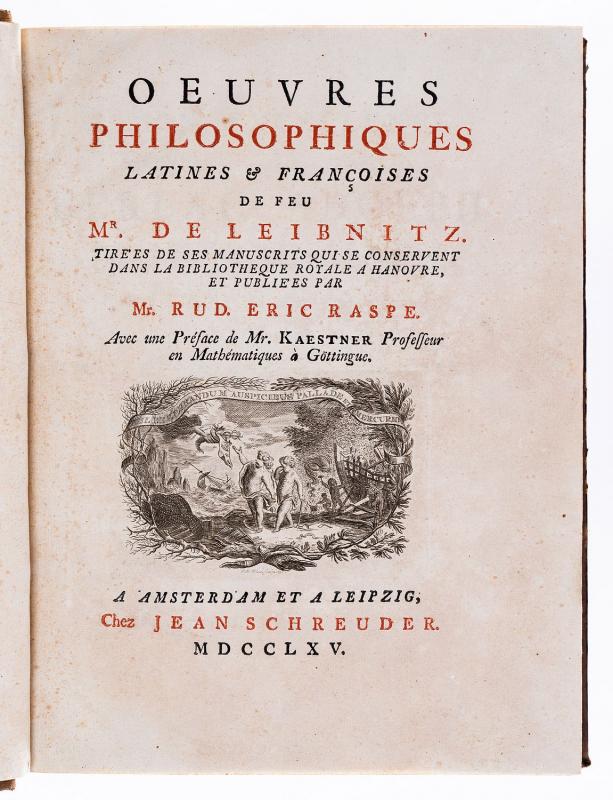
Oeuvres philosophiques latines & francoises de feu. Tirées de ses manuscrits qui se conservent dans la bibliotheque royale à Hanovre et publiées par Mr. Rud. Eric Raspe. Avec une Préface de Mr. Kaestner Professeur en Mathématiques à Göttingue. Amsterdam et Leipzig: Chez Jean Schreuder,1765.
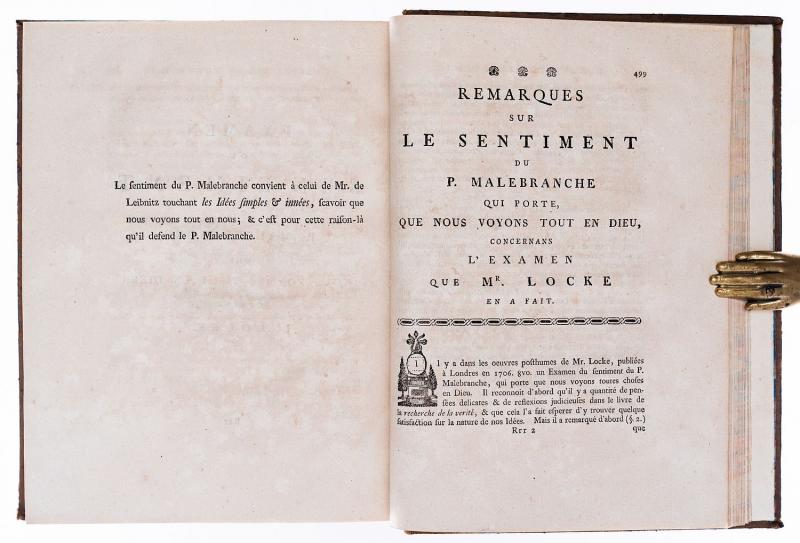
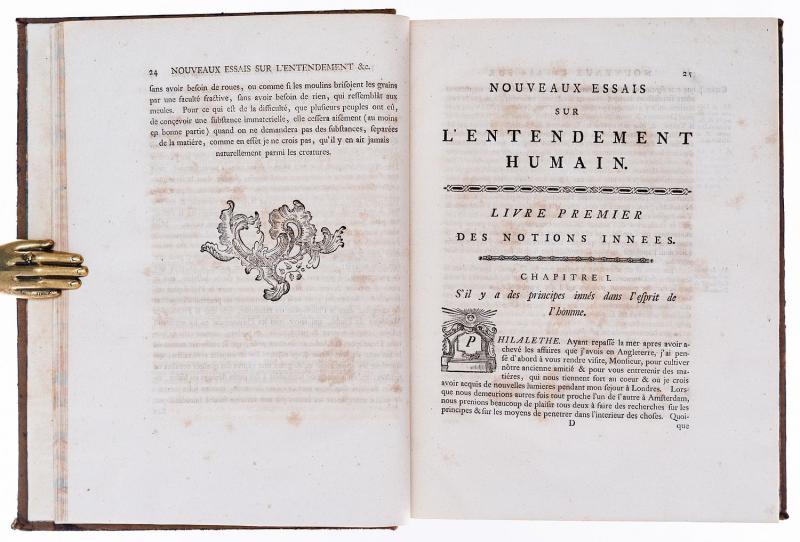
FIRST EDITION THUS. Large 4to.(26 x 19.5 cm). pp.xvi+[2, Table & Errata]+540+[16,Table des Principales Matières]. Contemporary full mottled calf, sides ruled in blind, spine with raised bands and gilt-decorated with floral motifs, red morocco label lettered in gilt, marbled endpapers and edges. Title-page printed in red and black. Engraved vignette to title-page by O. de Vries, decorative woodcut head-pieces, culs-de-lampe and initials throughout. Lightly rubbed, a few tiny wormholes to foot of spine, occasional browning and light spotting, generally an excellent copy in a handsome contemporary binding. First edition thus, being the first collected edition of Leibnitz' philosophical works in French and Latin, and containing the FIRST PRINTING of one of Leibnitz' most important philosophical works, his "Nouveaux essays sur l'entendement humain", a riposte to John Locke’s "Essay on Human Understanding" which Leibniz had read in Pierre Coste’s celebrated French translation of 1704. “The New Essays...are a detailed commentary on Locke’s Essay and thus represent an almost unique case in which one major philosopher produces a paragraph-by-paragraph critique of the principal work of another. Leibniz had practically completed the manuscript by 1704, but after learning that Locke had died he apparently lost interest in publishing it. He put it aside, and it did not appear in print until 1765, nearly fifty years after his death” (Benson Mates). Written directly in French, this extensive treatise (pp.1-496) comprises most of this collection and also constitutes one of the largest and most important of Leibniz’s philosophical contributions, being, (in addition to the Theodicy), one of only two full-length works which Leibniz ever produced. Like many philosophical works of the time, it is written in dialogue form. The two speakers in the book are Theophilus ("lover of God"), who represents the views of Leibniz, and Philalethes ("lover of truth"), who represents those of Locke. The famous rebuttal to the empiricist thesis about the provenance of ideas appears at the beginning of Book II: "Nothing is in the mind without being first in the senses, except for the mind itself". All of Locke's major arguments against innate ideas are criticized at length by Leibniz, who defends an extreme view of innate cognition, according to which all thoughts and actions of the soul are innate. In addition to his discussion of innate ideas, Leibniz offers penetrating criticisms of Locke's views on personal identity, free will, mind-body dualism, language, necessary truth, and Locke's attempted proof of the existence of God.
2930,- EUR
Differenzbesteuert/Subject to margin taxation
Kontakt zum