HOMER.  Auf Merkliste setzen
[The Odyssey] Odysseia. (With the Batrachomyomachia and the Life of Homer). Strasbourg: Wolfgang Köpfel,1525.
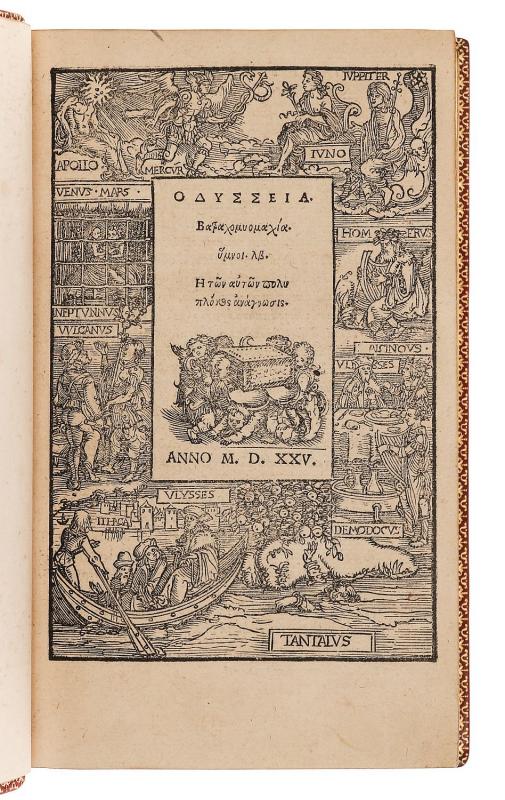
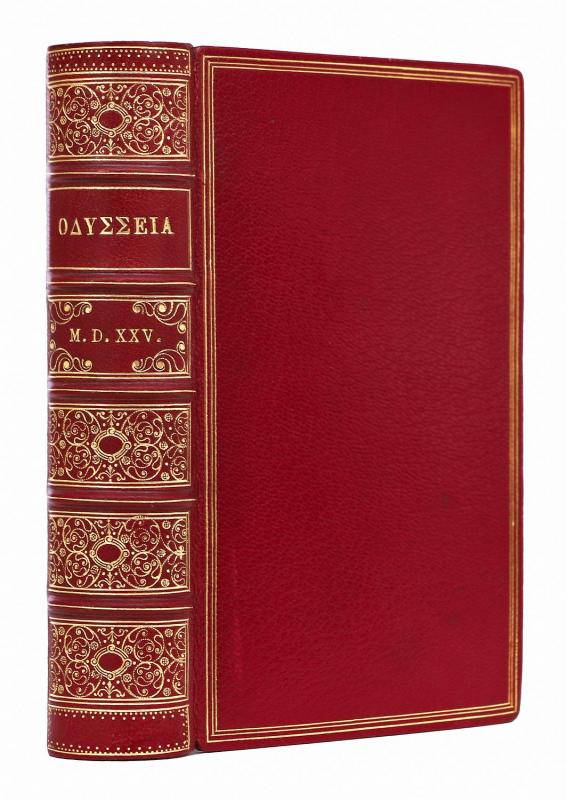
8vo. (16 x 9.5 cm). Collation: A8 b-z8 A-I8 aa-gg8. Nineteenth-century crushed red morocco by Adolphe Bertrand, (signed at foot of front inner dentelle) sides ruled with three gilt fillets, spine with raised bands and richly gilt-decorated compartments, gilt lettering direct to two panels, gilt inner dentelles, marbled endpapers, all edges gilt. Text in Greek. Title and woodcut printer's device within attractive woodcut borders depicting scenes from the work, printer’s device repeated on verso of leaf preceding the Batrachomyomachia, capital spaces with guide-letters One trivial scuff to back board, a very pretty copy. Provenance: the Bibliotheque du Château des Rozais, with their book plate designed by Henry-André to front pastedown. The Château des Rozais Library was a prestigious private collection that belonged to the Pommery family, founded in 1908 in the Rilly-la-Montagne estate (Marne). A significant early edition of the Odyssey, being the first complete edition printed outside Italy, with an exceptional provenance. The preface is addressed to Philip Melanchthon, who would use the Greek text of Homer, as well as books of the New Testament, to teach his students the Greek language at the Wittemberg University. Wolfgang Kopfel was a printer and publisher in Strasbourg, France, a leading intellectual figure in the Strasbourg Reformation, and the nephew of Wolfgang Capito. Köpfel’s Strasbourg-based operation utilised Greek print intended to emulate ancient handwriting, demonstrating a pioneering example of the humanistic shift in attention from Latin to Ancient Greek texts in the German Renaissance. This particular 1525 edition is rare, especially in a contemporary binding and the two volumes together. Indeed, Didbin states that all the works of Cephalus (Köpfel) are a rare occurrence, especially these two volumes. (Dibdin, 46). The woodcut on the title pages have been found attributed to the hand of Hans Weiditz the younger, the German Renaissance artist also known as the Petrarch Master. Weiditz was one member of an elite circle of artists which included Hans Holbein and Albrecht Dürer. The woodcuts are from his time working with publishers in Strasbourg, where he lived from 1522 to 1536. They depict key tales and characters from the epic poems as well as the Muses and an artist’s impression of the blind poet himself. The Odyssey woodcut depicts key deities as well as a detailed portrayal of the eternal torture of Tantalus in the underworld.
3510,- EUR
Differenzbesteuert/Subject to margin taxation
Kontakt zum