Sammelband.  Auf Merkliste setzen
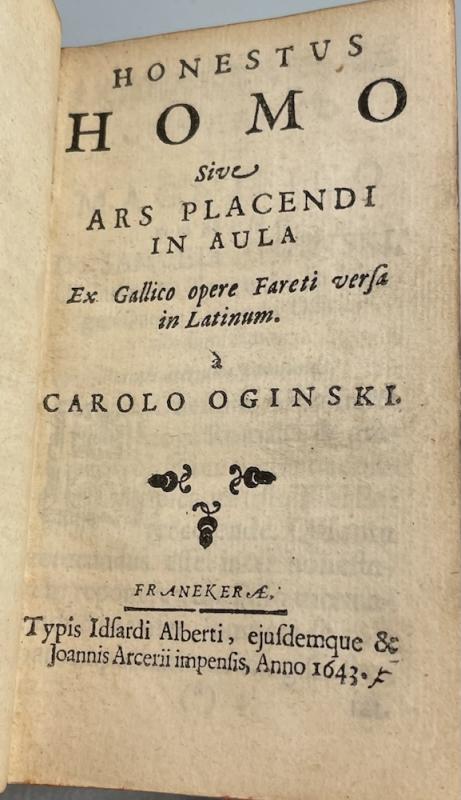
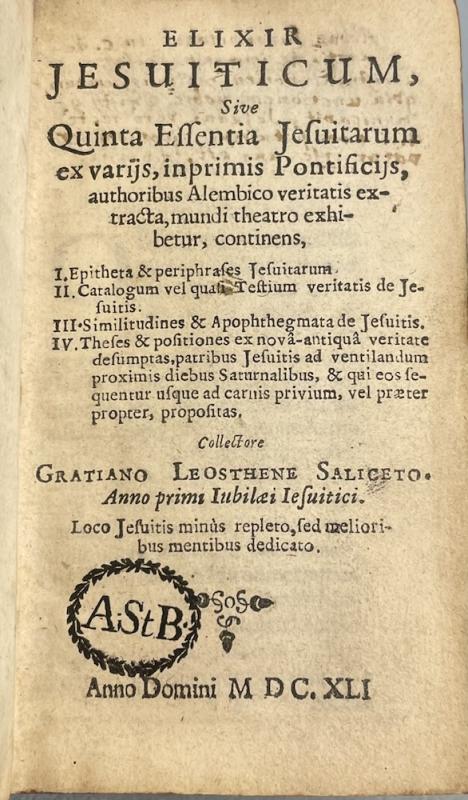
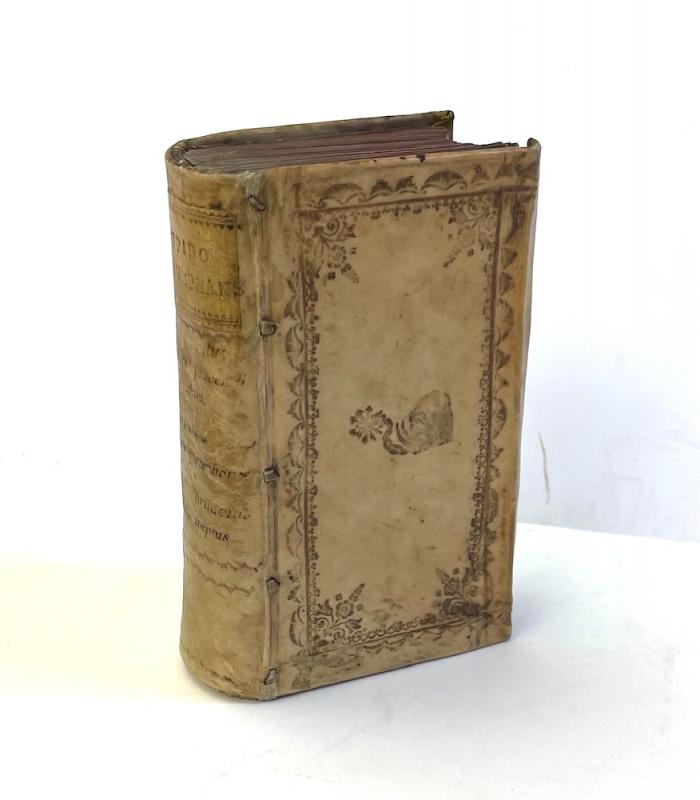
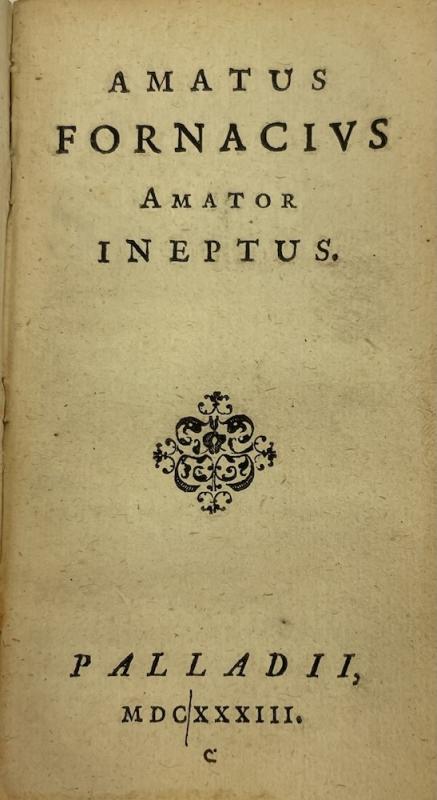
(WEIDNER, Johann Leonhard.) Elixir jesuiticum, sive quinta essentia jesuitarum ex variis, inprimis pontificiis, authoribus Alembico veritatis extracta, mundi theatro exhibetur, continens, I. Epitheta & periphrases jesuitarum. II. Catalogum vel quasi testium veritatis de jesuitis. III. Similitudines & apophthegmata de jesuitis. IV. Theses & positiones ex nova-antiqua veritate desumptas, patribus jesuitis ad ventilandum proximis diebus saturnalibus, & qui eos sequentur usque ad carnis privium, vel praeter propter, propositas. Collectore Gratiano Leosthene Saliceto. No place, 1641. 12mo. (4),+ 137 pp. The unpaginated dedication leaves to William Laud are bound between p. 130 and 131. Bound together with: FARET, Nicolas. Honestus homo sive ars placendi in aula. Ex Gallico opere Fareti versa in Latinum à Carolo Oginski. Franeker, Idsardi Alberti, 1643. 12mo. (15),+ (blank),+ 145, 186-188,+ (10) pp. Bound together with: Cupido triumphans, vel ratio cur sexus muliebris omni amore, & honore sit dignissimus. Autore H.H.V.O.G. Frisio. Utrecht, Wilhelmum Strick, 1644. 12mo. 137,+ (3),+ (4 blanks) pp. Bound together with: Amatus Fornacius Amator ineptus. Palladius (=fictious imprint), 1633. 12mo. 93,+ (1) pp. Contemporary vellum, spine with beige label with oxidizied text, boards with gilt but also ozidized floral frames, the front with the elephant head superexlibris of Luxdorph, all edges red. Owner’s signature or Luxdorph on front fly leaf, and the first title page with library stamp ”A.St.B”. Old ink annotations on fly-leaves.
Fine sammelband with four rare 17th Century satires/ tracts from the library of the Danish collector Bolle Willum Luxdorph. The first work is an anti-jesuit tract, ”Elixir jesuiticum”. This is the second edition, first published in 1640. Johann Leonhard Weidner (1588-1655). Printed dedication to the English Archbishop William Laud. VD17 39:118502Q The second work is a Latin translation of Nicolas Faret’s ”L’Honnête homme ou l’Art de plaire à la cour”, published in 1630. A treatise of well behaviour and refined manners at the aristocratic courts. It was also translated into German. USTC 1512172. The third anonymous ”Cupido triumphans” is a early pro-woman treatise, defending the dignity of women and argues that the female sex is worthy of all love and honor. It is assumed to be a response to the misogynistic work ”Hippolytus Redivivus”. USTC 1020598 Number 4 is a rare probably French satire. De Smet have identified 6 known copies of which four like the present are in sammelband. Gay (I. p. 89) mentions a second edition from 1644 which is otherwise unknown. The hero Amatus is a clumsy lover whose awkward behavior attracts the opposite sex. The love plot is however very simple and ”...appear to be a mere pretext for the author to express his satirical views of seventeenth-century society with its refined manners and strict social code” (De Smet p. 239). It’s full of sexual tendencies and humour against the papacy so the author had all reasons to be anonymous and escape the censors. Ingrid A.R. De Smet. Amatus Fornacius, ”Amator ineptus” (Palladii 1633): a Seventeenth-Century Satire in ”Humanistica Lovaniensia”, Vol. 38 (1989), pp. 238-306. Gay, Jules. Bibliographie des ouvrages relatifs à l'amour... 1-4, Paris 1894-1900. Bolle Willum Luxdorph (1716-88) collected, inspired by his uncle Christian Worm, books his whole life and gathered a large library, that at the time of his death contained around 15.000 volumes. They are normally identified by the elefant head stamp on the front boards.
2500,- EUR
Differenzbesteuert/Subject to margin taxation
Sachgebiete: Feminismus, Geschichte, Jesuiten, Satire
Kontakt zum