WILLIAM CURTIS (Alton 1746 - 1799 Brompton)  Auf Merkliste setzen
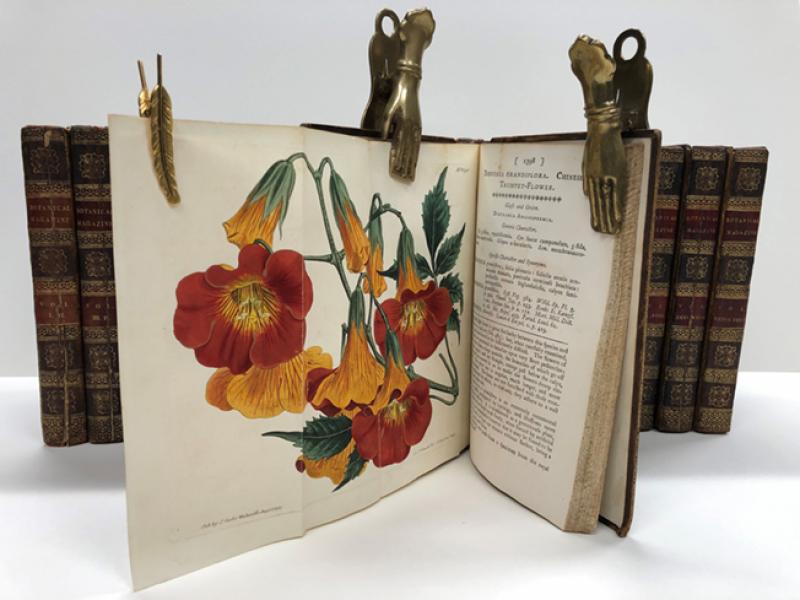
The Botanical Magazine; or, Flower-Garden Displayed: London, Stephen Couchman, 1787 – 1813. Parts 1 – 38 bound in 19 volumes. Portrait of William Curtis and dedication with a preface. 1593 engraved and colored plats with the adjoining Text. Each volume with an Index. Contemporary calf bindings with gilded back and red labels ( Five volumes lightly broken in the back)Bookplate of Richard – Cope Hopton, esq. of Canon Frome (1738 – 1810) Manuscript entry by this wife Dorothy Hopton, daughter of James Nelson esq. of London wedded to her husband in January. (1817) William Courtis founded the Journal in 1787. First working as an apothecary in Hampshire and London, where he moved in 1766. He abandoned his profession for an unsecured live by teaching and righting on flora and fauna. His first publication was a pamphlet on collecting and preserving insects. By 1777 he opened his own Botanic Garden in London and on February 1, 1787 he published the first issue of Curti’s Botanical Magazin, this journal is still being published to this day; it is the oldest periodical in existence featuring colored plates, of which more than 11,000 have now been produced. The work of many acclaimed botanical artists, its volumes provide an exceptional pictorial record of floral fashions and plant introductions in Great Britain over the past two centuries. A small, octavo format publication, the first issue consisted of three hand colored plates accompanied by brief letterpress descriptions, it was an immediate success; the first issue sold about 3000 copies. The first plate, depicting the Persian Iris, was drawn by James Sowerby. The artist who dominated the early years of the magazine, however, was Sydenham Teast Edwards (1768-1819). He was only nineteen when his first plate was published in the Botanical Magazine in 1788. More than 1700 followed in the next 27 years - some published posthumously. At first Edwards drew and engraved the plates himself, but from 1792 Francis Sansom took over the engraving. As Curtis states in the preface to the first issue, the plates were drawn 'always from the living plant, and colored as near to nature, as the imperfection of coloring will admit'. The beautiful hand colored plates are the chief glory of the magazine. At one times, some 30 people were ingaged in coloring the Botanical Magazine. The plates were hand colored until as late as 1948, when the periodical adopted photographic reproduction. Curtis died in 1799 when the magazine had reached its thirteenth volume. His friend John Sims (1749-1831), a botanist and physician, became the new editor. Sims renamed the publication Curtis's Botanical Magazine. In 1826, William Jackson Hooker (1785-1865) took over the editorship. He was also an experienced author on exotic plants. Furthermore, was he a skilled draughtsman, and became the chief illustrator of the magazine for nearly a decade. Under his editorship the magazine became decidedly more scientific and scholarly. Floral dissections were included and the subjects generally became more wide ranging. In 1845, he made another change when lithography replaced copper engraving as the method of producing the plates.
17000,- EUR
inkl. 7% USt./incl. 7% VAT
Sachgebiete: Einbände, Großbritannien, Illustrierte Bücher, Kupferstich, Naturwissenschaften
Kontakt zum