(wunderkammer) KUNDMANN, Johann Christian.  Auf Merkliste setzen
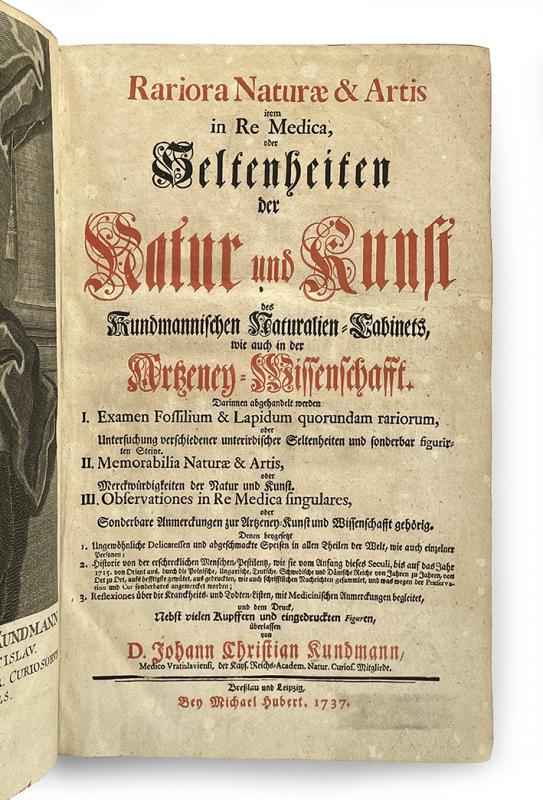
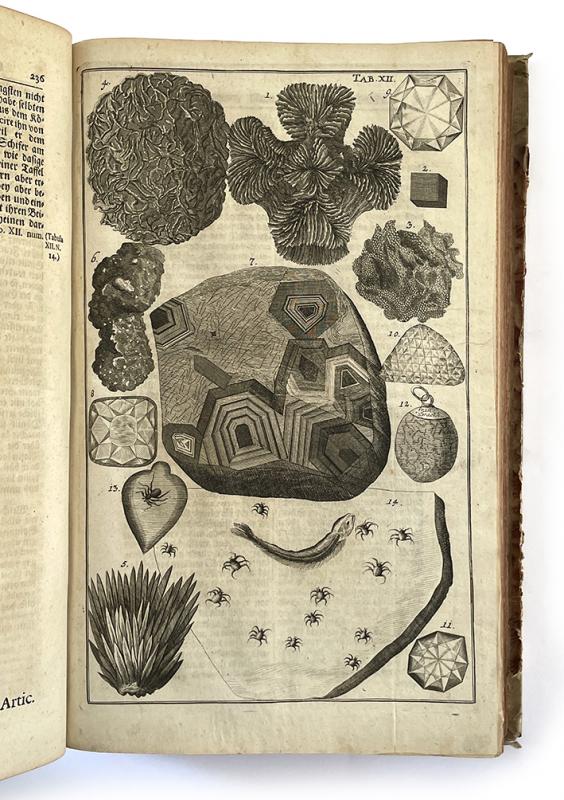
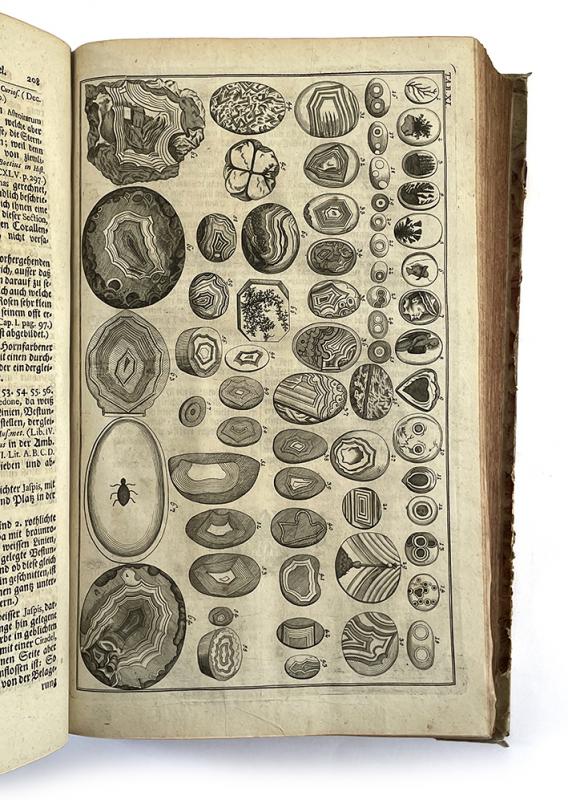
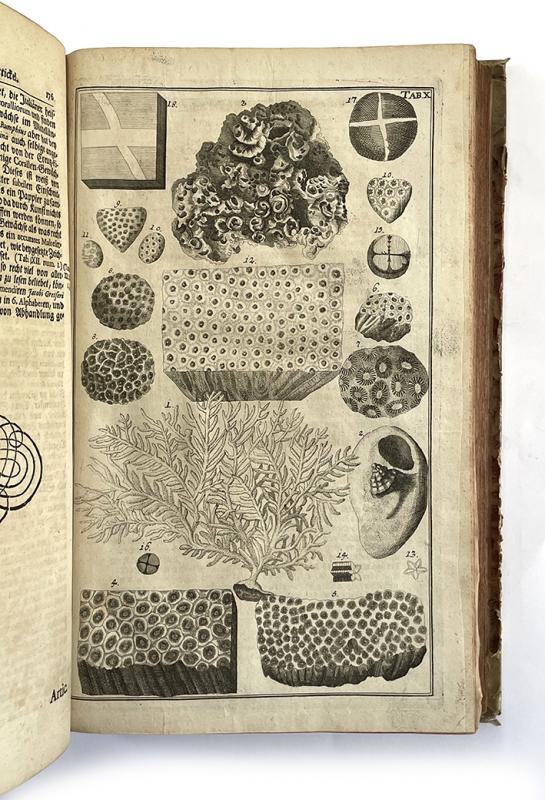
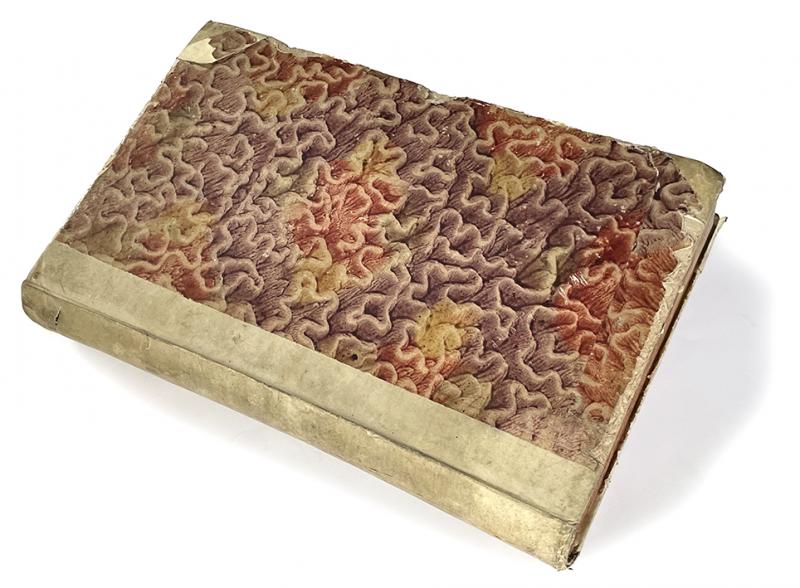
Rariora Naturae & Artis item in Re Medica, oder Seltenheiten der Natur und Kunst des Kundmannischen Naturalien= Cabinets, wie auch in der Artzeney= Wissenschafft., Darinnen abgehandelt werden I. Examen, Fossilum & Lapidum quorundam rariorum, oder Untersuchung verschiedener unterirdischer Seltenheiten und sonderbar figuriten Steine. II. Memorabilia Naturæ & Artis, oder Merckwürdigkeiten der Natur und Kunst. III. Observationes in Re Medica singulares, oder Sonderbare Anmerkckungen zur Artzeney= Kunst und Wissenschafft gehörig. Denen beygesezt I. Ungewöhnliche Delicatessen und abgeschmackte Speisen in allen Theilen der Welt, wie auch einzelner Personen; 2. Historie von der erschrecklichen Menschen= Pestilentz, wie sie vom Anfang dieses Seculi, bis auf das Jahr 1715. von Orlent aus, durch die Polnische, Ungarische, Teutsche, Schwedische und Dänische Reiche von Jahren zu Jahren, von Ort zu Ort, aufs besstigste gewütet, aus gedruckten, wie auch schrifftlichen Nachrichten gesammlet, und was wegen der Præservation und Cur sonderbares angemercket worden; 3. Reflexiones über die Kranckheits= und Todten= Listen, mit Medicinischen Anmerkungen begleitet, und dem Druck, Nebst vielen Kupffern und eingedruckten Figuren, überlassen … Breßlau und Leipzig, (Wroclaw & Leipzig) Bey Michael Hubert. 1737. Folio (340 x 210 mm). 12 Bll., column 9 - 728, 2 Bll., column 745 - 1084, 1 Bl., pp. 1093 - 1096, 1097 - 1312 columns, 17 Bll. with front-title, title printed in red and black, engraved portrait of the author, 19 engraved plates (two fold.), 7 Bll. tables (two on two sheets), and numerous text woodcuts. Contemporary half vellum over Kleisterpapier boards, red sprinkled edges, evenly browned, partly spotted, some old ownership entries darkened (19. cent ?); repair to foot of spine.
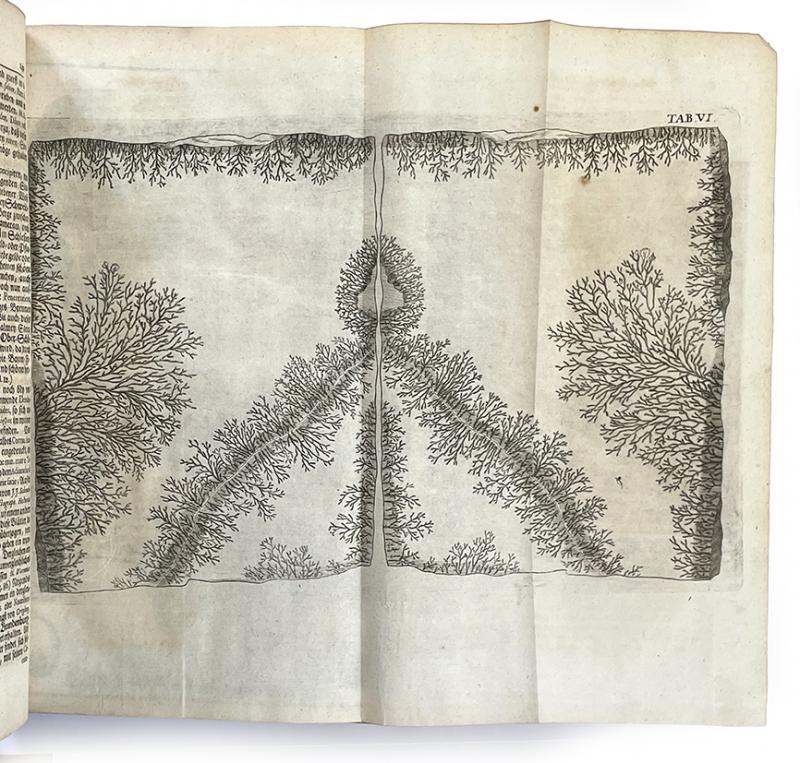
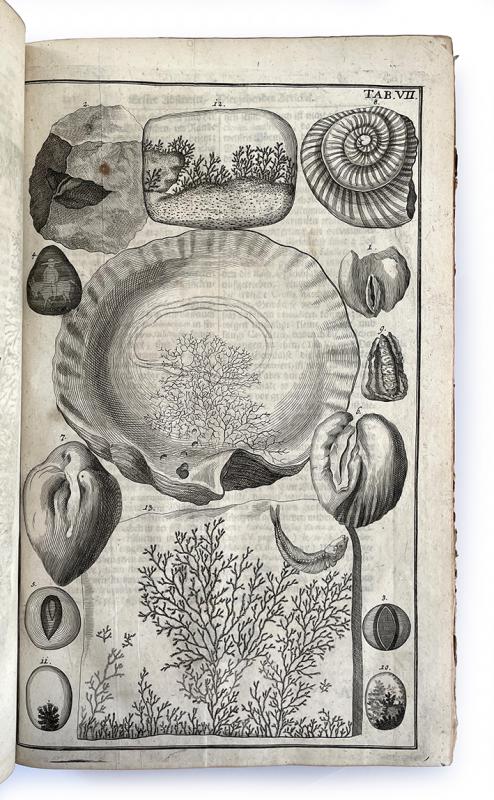
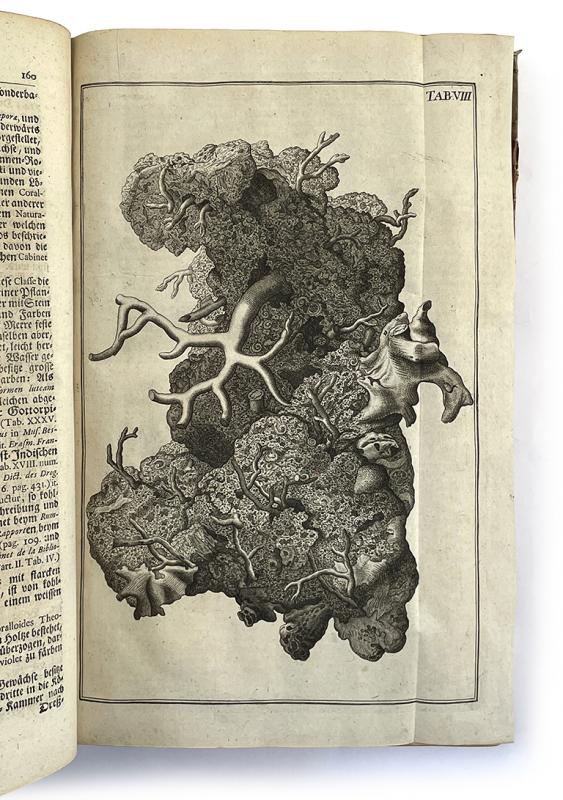
Rare first edition of the extensive catalogue of Johann Christian Kundmann’s celebrated wunderkammer, one of the most beautiful and comprehensive German natural history collections of the eighteenth century. An account of natural, "artificial," and medical wonders, based largely upon the author's own Wunderkammer of oddities and extraordinary objects gathered from many nations of the world: objects include stones, gems, corals, fossils of animals and plants, ancient pottery, remarkable animals, eggs, living plants, strange astronomical events, Chinese porcelains, human monsters, Siamese twins, gall stones, etc. There is an important section describing the history of the plague from 1700 to 1715 with Kundmann's reflections on causes and prevention of the plague. Included is a bill of mortality of Breslau in the early 18th century. There is another section giving an early description of the six-sided snowflake with references to Johannes Kepler's Sterna seu de Niue Sexangula (1611). The physician Johann Christian Kundmann (1684–1751) was another avid collector of minerals, fossils and other curious objects. Between 1704 and 1707, he studied medicine in Frankfurt (Oder) and Halle, and obtained his doctorate in 1718. He travelled through the Holy Roman Empire to complete his scientific education, before he finally settled in Breslau, his hometown. Kundmann assembled fine collections of natural history specimens, coins, archaeological and art objects. In the first catalogue of his cabinet published in 1726, he recorded “ossium petrefactorum” (fossil bones) “ex lapide calcario Querfurtensi” (from the calcareous stone of Querfurt). In 1737, Kundmann published his Rariora Naturae & Artis. In this lavishly illustrated in folio catalogue of his Naturalienkabinet, he gave the description and a figure of a vertebra embedded in a Triassic shell limestone from Querfurt. Kundmann identified this specimen as a “versteinerter Rücken-Würbel von einem Menschen” (petrified dorsal vertebra of a human). He based this conclusion on a similar identification made by Scheuchzer. Indeed, the Zürich naturalist believed that two vertebrae from the Toarcian of Altdorf bei Nürnberg, which turned out to be those of an ichthyosaur, were remains of a human, witness of the biblical Flood. For physicist - theologians, the discovery of fossil “human” remains was a crucial piece of evidence to support the Flood hypothesis, since the Universal Deluge was sent to Earth precisely to punish the human race for becoming corrupt. However, Scheuchzer’s interpretation was not shared by all naturalists of the time. Two other similar vertebrae from Altdorf near Nürnberg were also figured by Johann Jakob Baier [1677–1735] and interpreted by him as those of fish, known at the time under the name “Ichthyospondyli”. The Kundmann’s specimen can be identified as a sauropterygian vertebra. Kundmann had also noted its resemblance to those illustrated in plate XXIII of Büttner’s Rudera diluvia testes. After Kundmann’s death, his collections were sold by auction in 1753. It included 872 books and nearly 5,000 animals, shells, plants, stones, minerals, fossils, art objects and coins. The so called “Menschen”(human) vertebra from Querfurt mentioned above is described in the sales catalogue under number “h. 44”: “Ein sehr vollkommener Rückenwürbel eines Menschen, in einem sehr harten Meermuschelsteine; Seltenh. der N. und K. Tab. III. n. i. (A very perfect dorsal vertebra of a human, in a very hard sea shell stone; Seltenheiten der Natur und Kunst des Kundmannischen Naturalien-Kabinets”. The petrified bone in limestone from Querfurt, already mentioned in 1726 is listed in the auction catalogue under number “h.32”.- Hoover 497; Waller 5457; Cobres, I, 109-10; Freilich no. 323; Murray, II, 313; Blake 249; Wellcome III, 420; Nissen ZBI, 2326; Hirsch-H. III, 632.
4000,- EUR
inkl. 7% USt./incl. 7% VAT
Sachgebiete: Geologie, Mineralogie, Naturwissenschaften, Schlesien
Kontakt zum