(Paper Instrument; Astronomy) GALLUCCI, Giovanni Paolo (1538 - 1621).  Auf Merkliste setzen
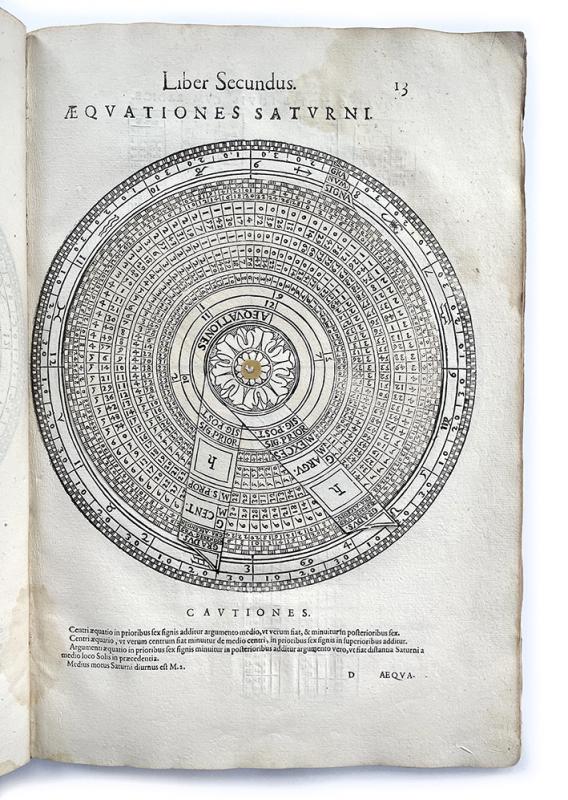
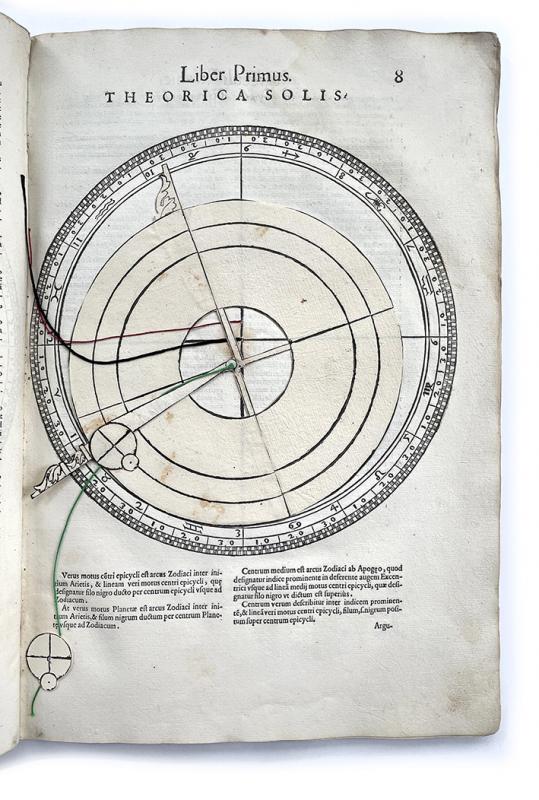
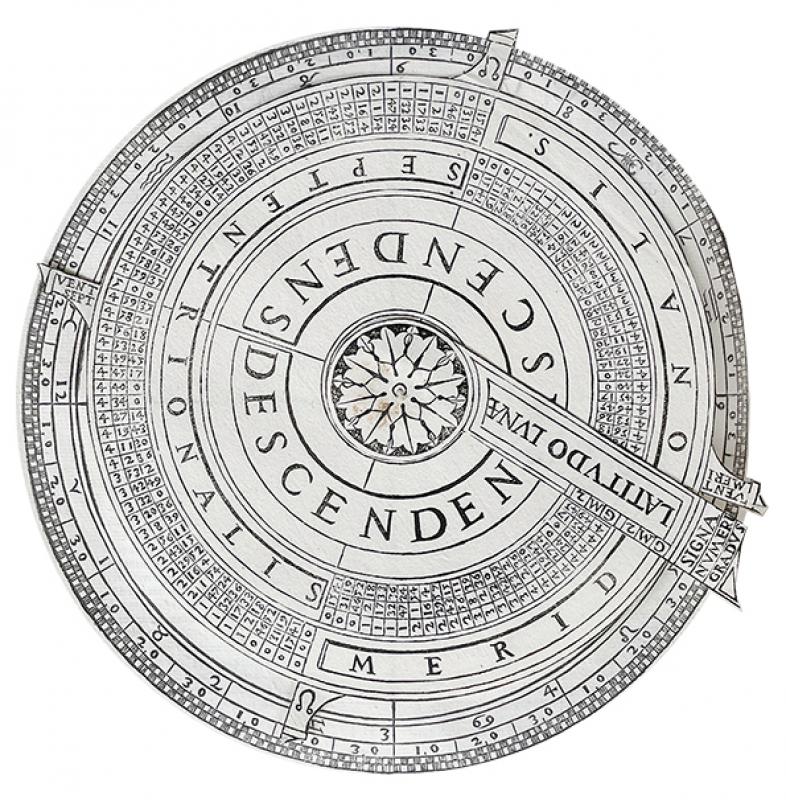
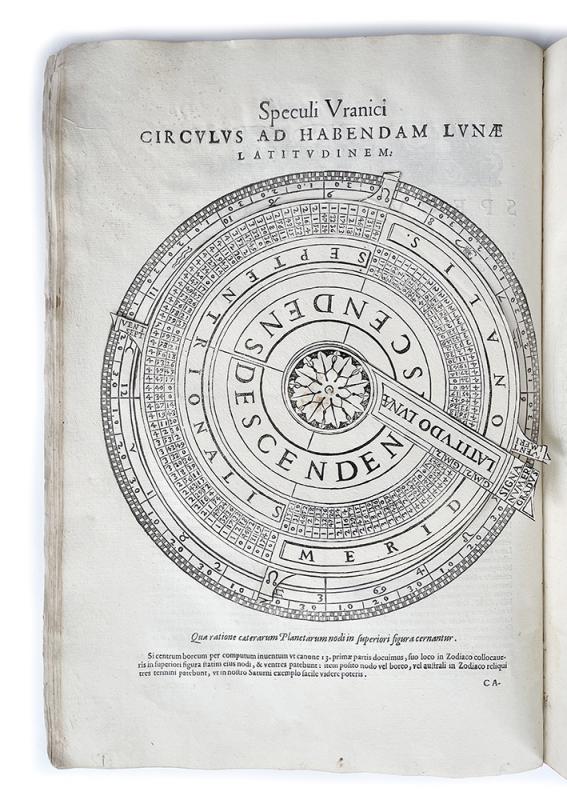
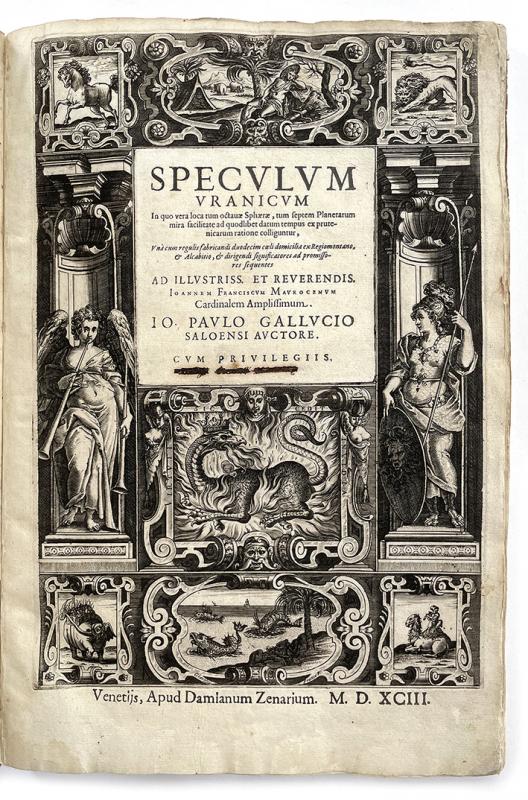
Speculum Uranicum: In quo vera loca tum octauæ Sphaerae, tum septem Planetarum mira facilitate ad quodlibet datum tempus ex prutenicarum ratione colliguntur, Vnà cum regulis fabricandi duodecim coeli domicilia ex Regiomontano, & Alcabitio, & dirigendi significatores ad promissores sequentes.- Venice: Damiano Zenaro, 1593. Folio (420 x 280 mm). [4] nn. Bll., 43 num. Bll., 4 nn Bll., one blank leaf. Title with engraved border by Giacomo Franco incorporating Zenarus’s dragon device, 17 large circular woodcut diagrams, 16 with attached large volvelles with a total of 39 moving parts, pasted correction slip on A4v, „De Harum Paginarum“ (8 pp.) as well as ‚Canon sexagenarius…‘ bound at rear, margin of title extended at gutter, the moving parts of the woodcuts partly renewed in expert facsimile, light stain to upper corner through second half of volume, repaired wormholes at gutter of last few gatherings. Early vellum, re-backed with portions of original spine laid down, endpapers preserved.
An astrological paper instrument. First edition, complete, of a very rare scientific instrument in book form, commonly called „paper instrument“ for working out his own horoscope; „every copy has some fault: at least one loose, missing, or miss - positioned piece.“ (Gingerich) With the eight - page user’s manual that Houzeau & Lancaster note is usually lost, as it was loosely inserted. Named after Urania, muse of astronomy, and introduced by a magnificent allegorical engraved frontispiece, Giovanni Paolo Gallucci’s book, with the help numerous moving parts (volvelle), charts the movements of the heavenly bodies by the methods of Regiomontanus. The book was clearly intended to be used for computing the positions of the planets, undoubtedly for astrological purposes. It seems that the book was more to be admired than actually used for computations. Publishing his work soon after the papal bull of 1586 forbidding astrology, Gallucci, a mathematician, cartographer & translator, who tutored the Venetian nobility and a founder of the Second Venetian Academy, asserts the importance of the rational, scientific investigation of the heavens - ushering in the Galilean era of observation - based knowledge. When Gallucci’s Speculum Uranicum was published both Galileo and Kepler were alive. Both would become enthusiastic converts to the Copernican system, and the two most important figures in persuading a skeptical public that the heliocentric cosmology was a physically real description of the world. But in 1593 neither had yet published anything hinting of the earth as a spinning planet. In the closing decades of the 16th century the overwhelming majority of astronomers accepted ‚De revolutionibus‘ as a recipe book for computing the positions of the planets, but not as an actual physical cosmology. „Nevertheless, the fact that only one tally sheet for each planet was provided suggests the set of small tally sheets was intended for one - time use as the owner personalized his copy by working out the planetary positions for his own horoscope. The volume could then take its place as a vanity press or trophy book. Today it remains as a trophy specimen for that transitional period when Copernicus was appreciated for his numbers but scarcely for his cosmology.“ (Gingerich, 2020) on this copy see Gingerich, 2020: https://archive.nyu.edu/bitstream/2451/61288/62/17.%20Gingerich.pdf Provenance: deleted inscription on title - page; some early marginalia; Reiss 138/1425 (Oct. 2010); Owen Gingerich; present owner. see: Houzeau & Lancaster 12742; Riccardi I, 570; Lalande 125; Widler pp. 410; BEA I, 402/03; not in Tomash, Barchas, Kenney; Beltrame sale no. 50. ( Astronomie, Instrument, Volvellen, PopUp, Renaissance, Galilei, Astrologie )
9800,- EUR
inkl. 7% USt./incl. 7% VAT
Sachgebiete: Astrologie, Astronomie, Instrumente (Technik), Naturwissenschaften, Wissenschaftsgeschichte
Kontakt zum