BÜTTNER, David Sigmund.  Auf Merkliste setzen
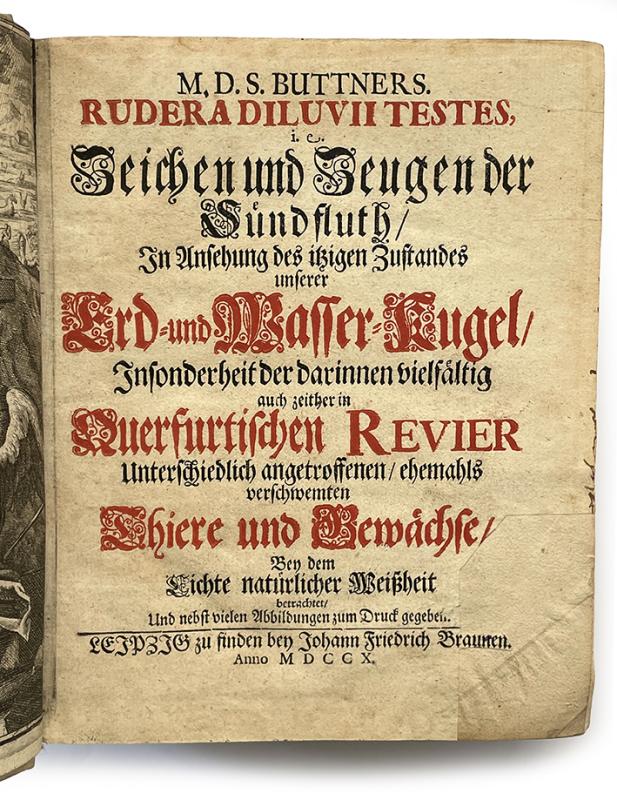
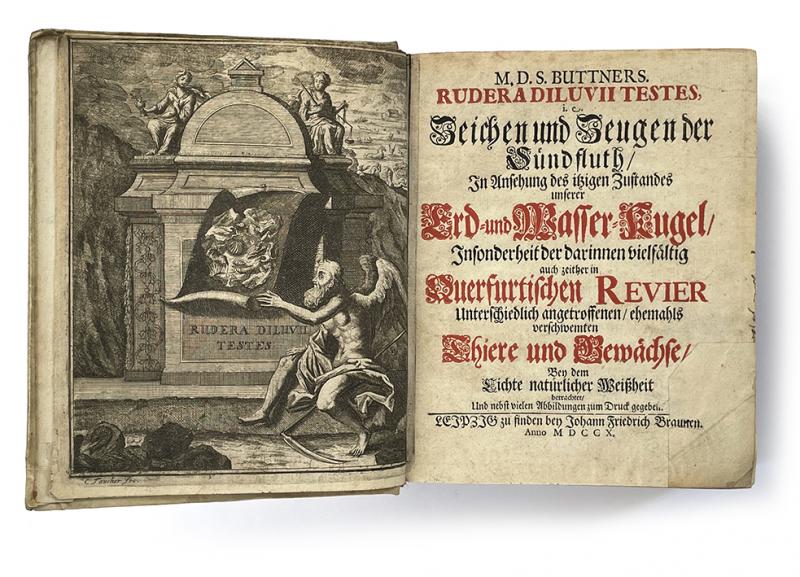
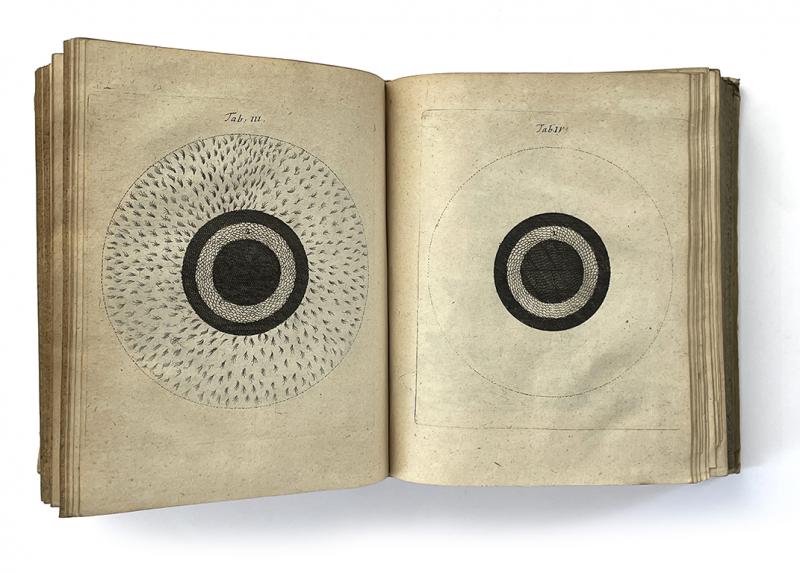
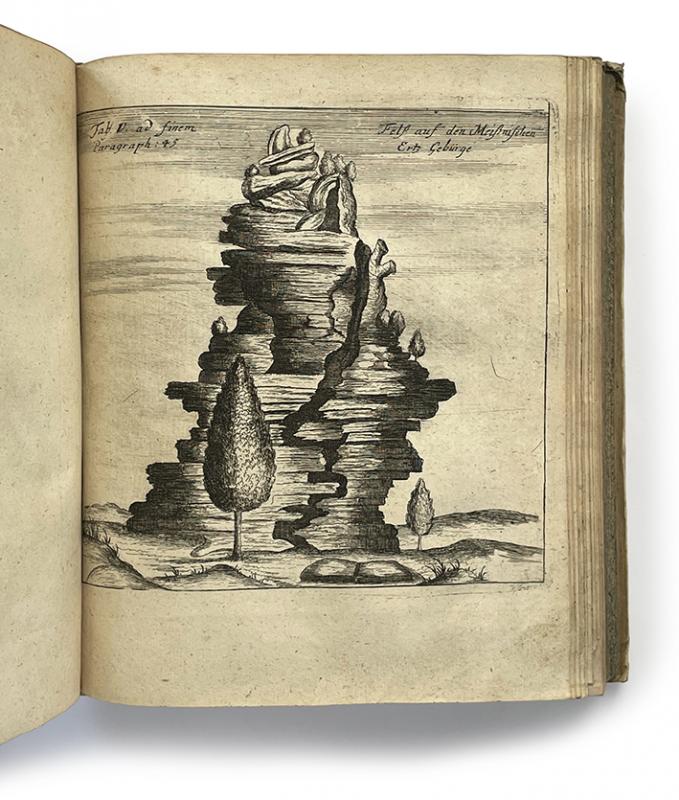
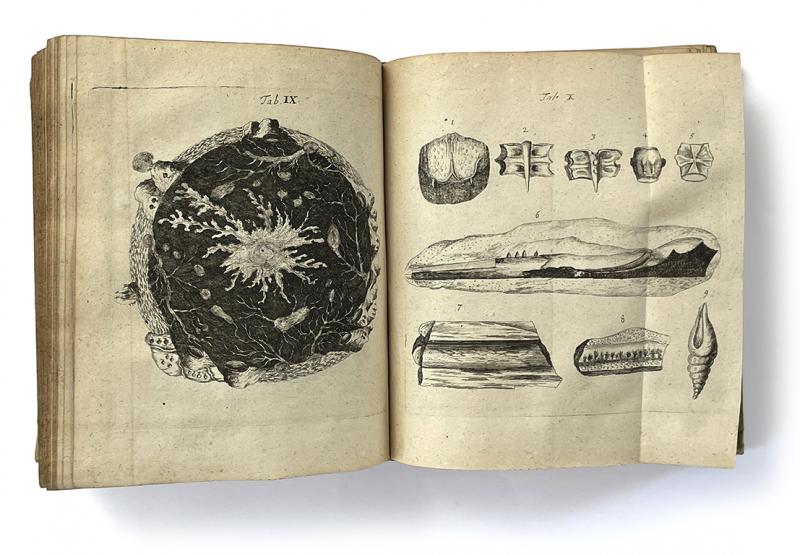
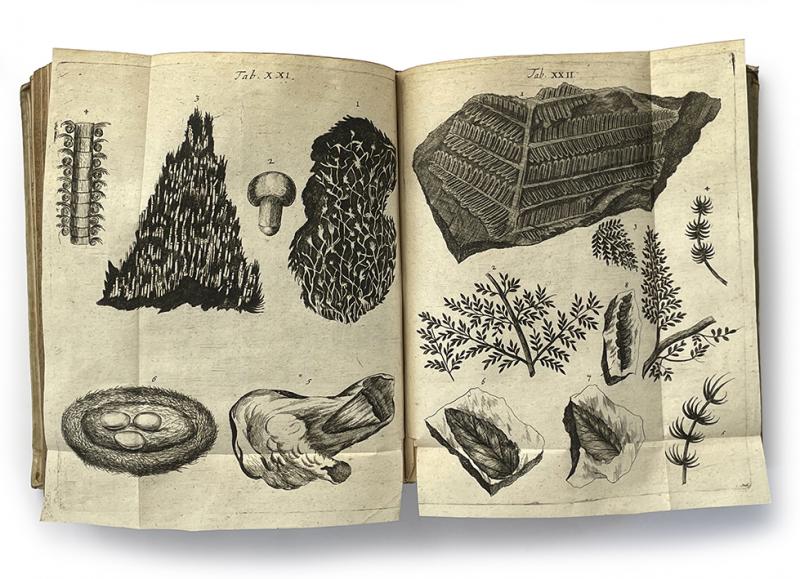
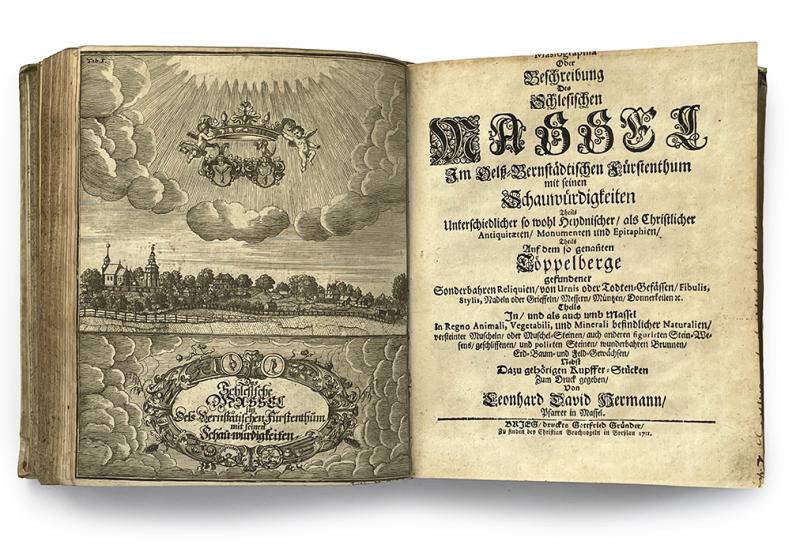
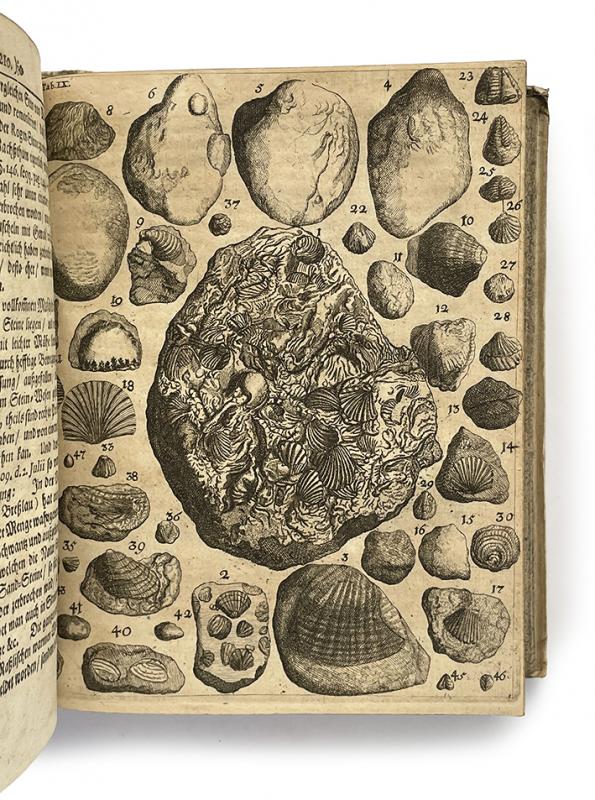
Rudera Diluvii Testes, i.e. Zeichen und Zeugen der Sündfluth In Ansehung des itzigen Zustandes unserer Erd- und Wasser- Kugel, Insonderheit der darinnen vielfältig auch zeither in Querfurtischen Revier Unterschiedlich angetroffenen, ehemals verschwemten Thiere und Gewächse, Bey dem Lichte natürlicher Weissheit betrachtet, Und nebst vielen Abbildungen zum Druck gegeben.- Leipzig: Johann Friedrich Braunen, 1710. 4to (195 x 160 mm). (8), 314 pp., (2) with engraved allegorical frontispiece, 30 plates (numbered I-XXX, many folding, some double-page, Plate XXIV split into parts A and B), head- and tail-pieces, initials. Gothic type, title page printed in black and red. Without folding view of Querfurt, typically seen after the preface, and errata leaf (Tt3). (bound with:) HERMANN, Leonhard David. Maslographia oder Beschreibung des schlesischen Massel im Oelß - Bernstädtischen Fürstenthum mit seinen Schauwürdigkeiten theils unterschiedlicher so wohl heydnischer, als christlicher Antiquitaeten, Monumenten und Epitaphien, theils auf dem so genannten Töppelberge gefundener sonderbahren Reliquien. von Urnis oder Todten-Gefässen/ Fibulis ... theils / in als auch umb Massel ... befindlicher Naturalien/ versteinter Muscheln/ auch anderer figurirten ... Steinen ... Brieg: Gründer for Brachvogel in Wroclaw, 1711. 4to. (8), (2), (7), (9), pp. 19, 21-76, 78-172 (pp. 109 double), 1 Bl., pp. 173-329, (7) with engraved frontispiece (plate one) and 18 engraved plates (plate 6 with continum. plate 8 on one sheet, and plate 11, 12 on two sheets)
First edition, rare, of this study of the fossils of Querfurt in Saxony, considered as 'relics of the universal deluge'. Büttner (1660-1719) deacon of Querfurt, was a theologian and naturalist, and wrote this work in order to demonstrate that fossils were the remnants of the Flood. 'Büttner ... was firmly convinced of the diluvial origin of fossils, and was strongly opposed to those who attributed these "reliquiae diluvianae" to either the "lusus naturae" or the spermatic principle. Büttner, in his Treatise on the Deposits which are Evidence of the Deluge, refers in surprisingly scurrilous terms to Lhwyd and his animalculae' (Melvin E. Jahn and Daniel J. Woolf in The Lying Stones of ... Beringer, pp. 178). The work established the historicity of the Genesis flood, examining the modern scientific proof found in marine life, plants, and the contemporary state of the seas. It includes descriptions of fossil bones from the palaeolithic site at Bilzingsleben. The plates depict fossils, minerals, a world map, and two sections of the earth after Athanasius Kircher's famous model. This is his best-known work, followed in 1714 by Corallographia Subterranea, the first treatise on a particular fossil group, fossil coral. His Naturalienkabinett was especially renowned, and was bought on his death by the merchant Johann David Geysel.- Roller & Goodman, Cat. 1976. I, 183. Bound with the rare first edition of a treatise on the archaeological and mineralogical finds excavated in Massel, Lower Silesia. The Maslographia is certainly the most important of Hermann’s works. In his archaeological section, Hermann referred to observations he had made during his numerous excavations on the Töppelberg and combined these with conjectures about the cultural-historical context of the monuments. For example, he suggested an apparently multi-phase burial ground as an "idolatrous grove" of the "Lygians and Chatti.“ The truly special and novel aspect of the Maslographia was that Hermann was one of the first to present the finds in context. Each object is embedded in its context and shown in its state of preservation in the ground. This type of illustration demonstrates an anatomical interest in the deposits. Hermann thus no longer conceived of his finds merely as isolated objects, but recognized their relationship to other objects and the associated findings. In this way, he was able to support the theory put forward by Troels Arnkiel (1638–1712) through the observable differences in the grave construction, according to which the extent of the grave architecture reflects the social standing of the deceased. Leonhard David Hermann was born on June 27, 1670, in Massel, the fifth of ten children of Pastor Abraham Hermann. In 1691, he began his theological studies in Leipzig, and from 1695 he was a preacher in Oels/Oleśnica. Four years later, he replaced his ailing father as pastor in his birthplace. He held this position until his death on May 1, 1736. Hermann and his family still felt the economic hardship following the Thirty Years' War quite severely. His duties as a village pastor required Hermann to farm himself to provide for his family. Of his thirteen children from two marriages, eight died in childhood. Despite these extremely difficult circumstances, he was a prolific author, of whom twenty works are known.
3600,- EUR
inkl. 7% USt./incl. 7% VAT
Sachgebiete: Archäologie, Geologie, Geschichte, Schlesien
Kontakt zum