KRATZENSTEIN, Friedrich Wilhelm.  Auf Merkliste setzen
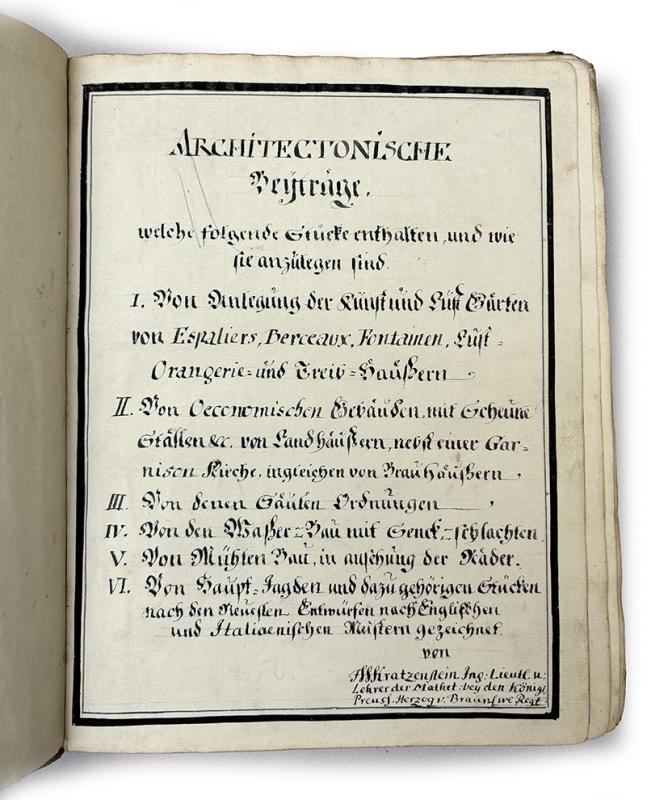
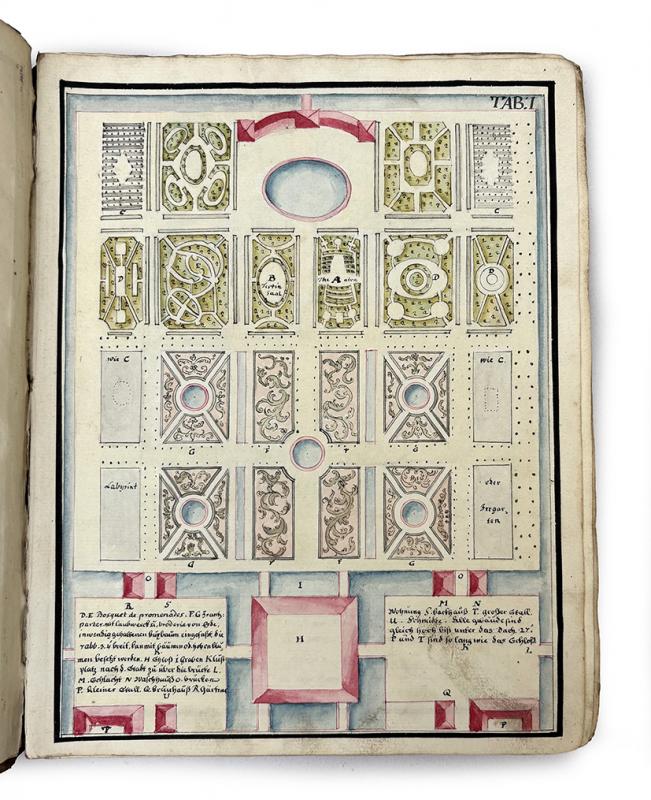
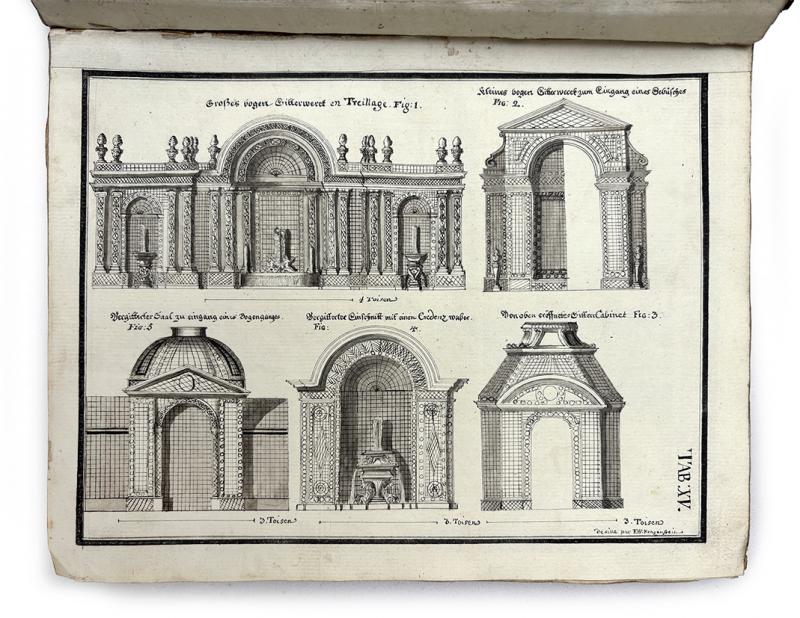
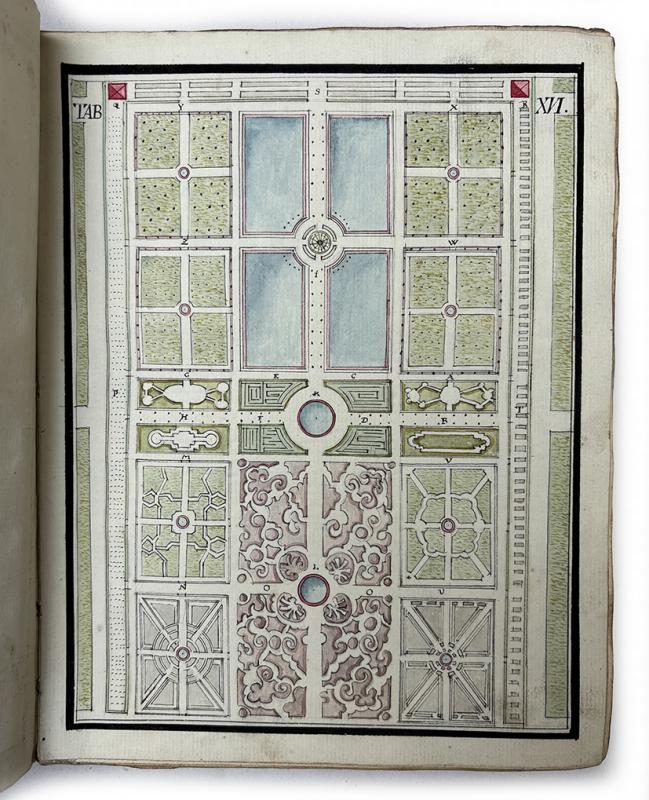
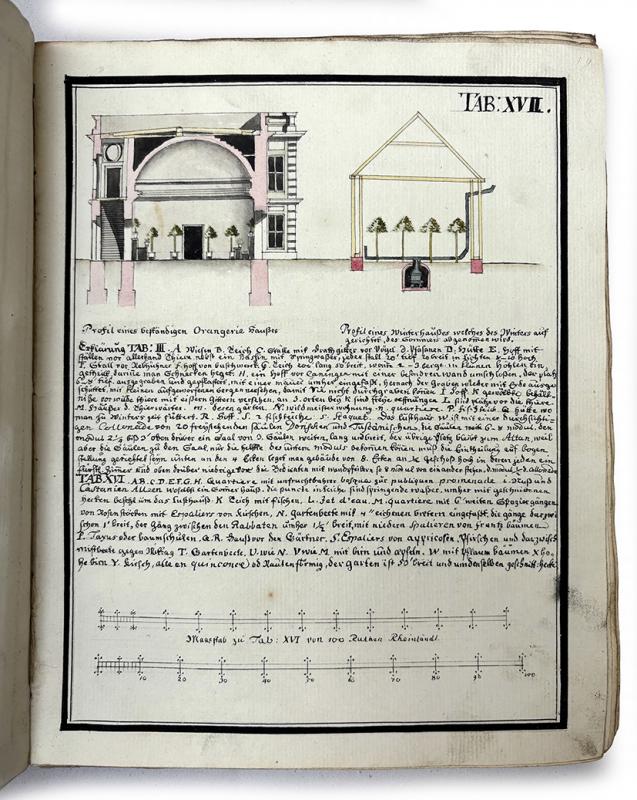
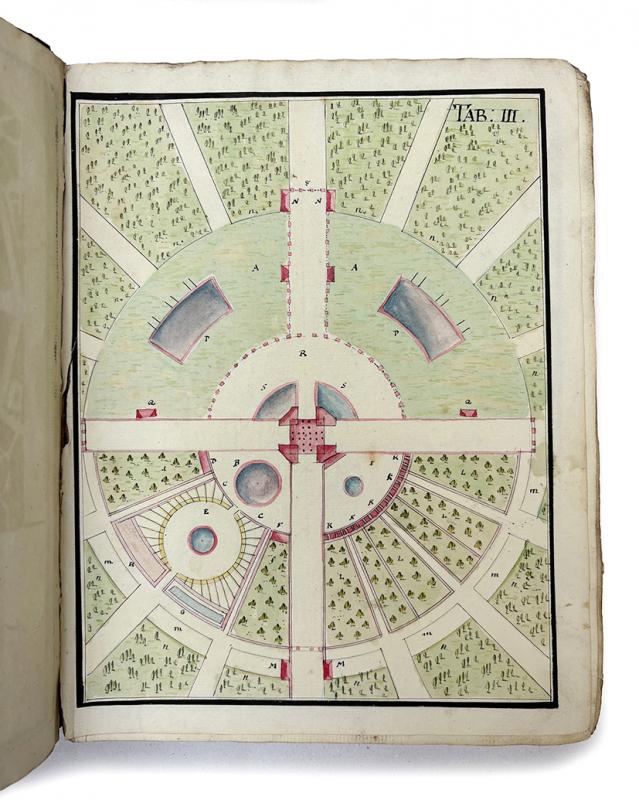
Architectonische Beyträge, welche folgende Stücke enthalten und wie sie anzulegen sind. I. Von Anlegung der Kunst und Lust Gärten von Espaliers, Berceaux, Fontainen, Lust= Orangerie und Treib= Häusern, II. Von Oeconomischen Gebäuden, mit Scheune, Ställen &cc. von Landhäusern, nebst Garnison Kirche, ingleichen Brauhäusern, … IV. Von den Wasser-Bau mit Senck= Schlachten, V. Von Mühlen-Bau, in Ansehung der Räder, VI. Von Haupt-Jagden.… von F.W. Kratzenstein, Ing.-Lieutd. u. Lehrer der Mathe. bey den Königl. Preuss. Herzog v. Braunschweig Reg. (German manuscript in ink and water color on paper).- (Germany, maybe Braunschweig, 1755 - 1775) 4to (240 x 195 mm) Title and 100 hand drawings in ink and/or ink and wash color on plates. Contemporary half calf with Kleister-papier on boards, strongly rubbed and soiled, spine partly defective, used copy. A childish hand has scribbled in pencil mostly on the blank back of some sheets.
Fine manuscript (maybe with intention to print) by Friedrich Wilhelm Kratzenstein on the Design of Ornamental and Pleasure Gardens, Including Espaliers, Berceaux, Fountains, Pleasure Orangeries, and Greenhouses; II. On Farm Buildings, Including Barns, Stables, etc., of Country Houses, Along with Garrison Churches, as well as Breweries, … IV. On hydraulic engineering with drainage ditches, V. On mill construction, with regard to the wheels, VI. On major hunting grounds. Not much is known of the author: Kratzenstein (ca. 1729 - 1806) was a Captain (Ober- Ingenieur- Capitaine) in the Prussian Corps of Engineers in Leipzig, Halberstadt and the area. This was a high-ranking technical officer’s career that required both military and civil engineering expertise. In 1766 he published a book on the art of technical drawing. The book was conceived as a systematic textbook designed to standardize the quality of technical drawings within the Prussian administration and military. Kratzenstein provided detailed instructions on color mixing and application. One focus was on the art of coloration. At that time, colors were not merely decorative but served as a coding system. For example, stone walls were often depicted in shades of gray, wooden elements in shades of brown, and earthen ramparts in shades of green or yellow. The work is divided into practical exercises ranging from simple geometric shapes to complex fortress floor plans. It was aimed at “beginners and enthusiasts” as well as experts in artillery and architecture. Through his publications, he contributed to making the training of engineers in Prussia more systematic, which later led to the founding of specialized civil engineering and military academies. One of his most significant surviving documents is a “Plan of Halberstadt” from 1784. He surveyed and drew this map himself. It shows the city still surrounded by its medieval city walls and serves as an important historical source for the topography of Halberstadt in the 18th century. He died there in 1806. The manuscript includes only text on the plates, and might be the manuscript for a plate volume of an unpublished text on architecture. (Gartenbau, Gardening, Architektur,
5000,- EUR
inkl. 19% USt./incl. 19% VAT
Sachgebiete: Architektur, Design, Gartenbau, Handschriften, Wasserbau
Kontakt zum