HAMMER (-PURGSTALL), JOSEPH VON.  Auf Merkliste setzen
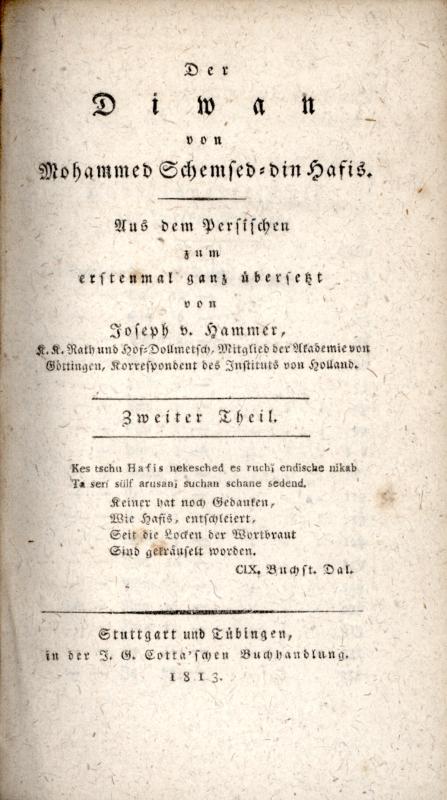
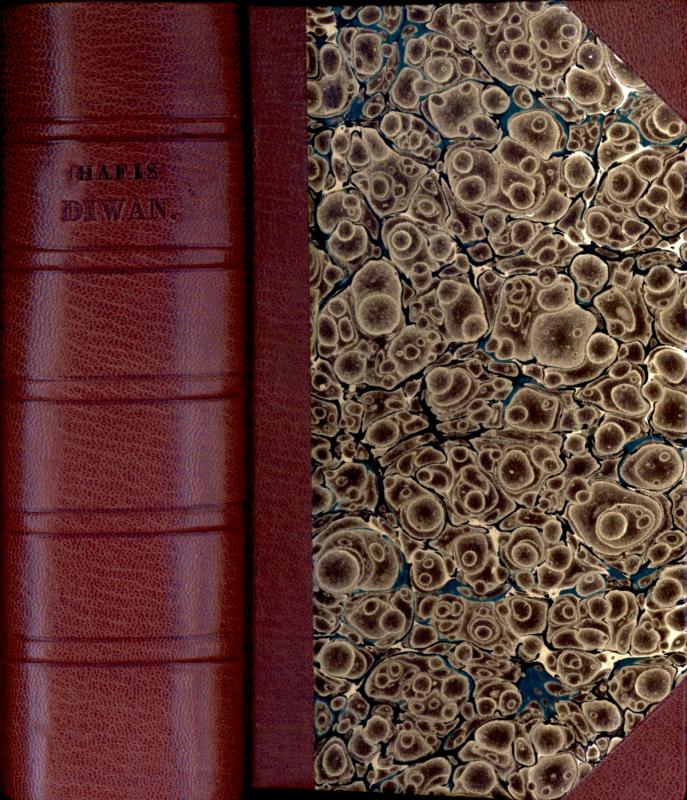
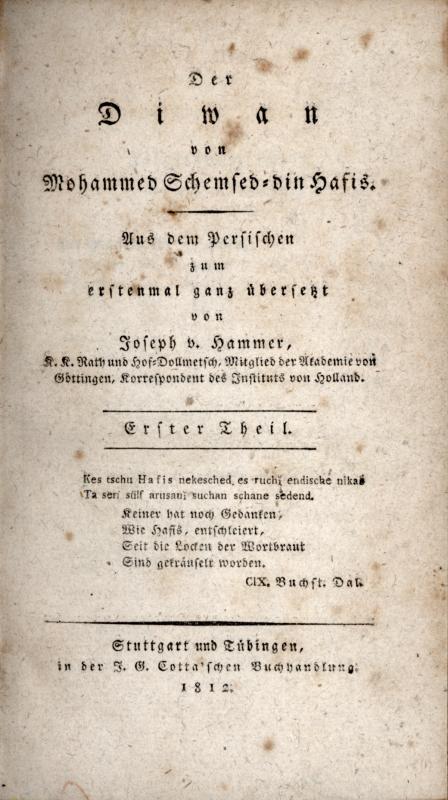
Der Diwan von MOHAMMED SCHEMSED-DIN HAFIS. Aus dem Persischen zum erstenmal ganz übersetzt. Erster (- Zweiter) Theil. In einem Band. Stuttgart und Tübingen, in der J.G. Cotta’schen Buchhandlung 1812 – 1813 [r.1814]. 168x98 mm. (5) Bll., XLII S., (2) Bll., 454 S., (1) Bl. (weiß); (2) Bll., 574 S. Kastanienbrauner, geglätteter Halbmaroquinband (20.Jhdrt) auf unechten Bünden mit geprägtem Rückentitel. //// Chestnut-brown, smoothed half-maroquin binding (20th century) on imitation bands with the embossed title on the spine. //// Reliure en demi-maroquin lisse, couleur marron (XXe siècle), sur des nerfs factices, avec le titre en relief sur le dos.
Erste Ausgabe (Goedeke VII,160,29; Rabenlechner S.121; Fischer, Cotta 956). – Etwas fleckig. Ungewöhnlich gemusterter Schnitt. J.V.HAMMER (Graz 1774 – 1856 Wien) hatte 1796 in WIELANDs Teutschem Merkur mit der Übersetzung eines türkischen Gedichts debütiert. Seine Beschäftigung mit HAFIS reicht in das Jahr 1794 zurück, als er den Grafen HARRACH, dem die Übersetzung gewidmet ist, im Persischen unterrichtet hatte. 1799 als Dolmetscher der österr. Botschaft in Konstantinopel begann er mit der vollständigen Übertragung des „Diwan“, die 1806 weitgehend fertig war. In den folgenden Jahren waren Proben im "Merkur" und in COTTAs Morgenblatt zu lesen, jedoch feilte er weiter an Text und Kommentar. Die vollständige Buchausgabe erschien entgegen den im Impressum genannten Jahren erst zur Ostermesse 1814. GOETHE las den "Diwan" im Juni d.J. „Schon im vorigen Jahre waren mir die sämtlichen Gedichte HAFIS‘ in der VON HAMMERschen Übersetzung zugekommen, und wenn ich früher den hier und da in Zeitschriften übersetzt mitgeteilten einzelnen Stücken dieses herrlichen Poeten nichts abgewinnen konnte, so wirkten sie doch jetzt zusammen desto lebhafter auf mich ein, und ich mußte mich dagegen produktiv verhalten, weil ich sonst vor der mächtigen Erscheinung nicht hätte bestehen können. Die Einwirkung war zu lebhaft, die deutsche Übersetzung lag vor, und ich mußte also hier Veranlassung finden zu eigener Teilnahme.“ (Tag- und Jahreshefte 1815). Sein "West-östlicher Diwan" ist kongeniales Zeugnis dessen. „Wenn er auch in den Jahren bis zum Erscheinen des (West-oestlichen) Divan durch intensives Studium orientalischer Werke ... noch weitere orientalische Dichtungen ... kennenlernte und ihnen zahlreiche Motive entlehnte, so blieb doch HAFIS derjenige Dichter, dem er sich am tiefsten geistesverwandt fühlte, sein ‚Zwilling‘, mit dem er in eigenen Nachdichtungen wetteifern wollte.“ (KNLL 6,524). „In der Lyrik des HAFEZ hat die persische Dichtung einen ihrer höchsten Gipfel erreicht. ... Überall in HAFEZ‘ dichterischem Werk treten klar die Kennzeichen einer einzigartigen, überragenden Persönlichkeit hervor ... alles ist durchpulst von einer schöpferischen Genialität, die in Hunderten von Gedichten die gleichen Themen immer wieder neu zu gestalten weiß. Die Grundstimmung der Gedichte ist die Heiterkeit des durchgeistigten Rausches, die, fern aller Dämonie, auch das Dunkle - den Schmerz der Vergänglichkeit, die Qualen der Trennung und der verschmähten Liebe – mit leichter Hand zur künstlerischen Form fügt ...“. (a.a.O. 7,159f.). //// First edition (Goedeke VII,160,29; Rabenlechner p. 121; Fischer, Cotta 956). – Slightly stained. Unusually patterned edges. J.v HAMMER (Graz 1774 – 1856 Vienna) made his debut in 1796 in WIELAND’s *Teutscher Merkur* with the translation of a Turkish poem. His engagement with HAFIZ dates back to 1794, when he taught Persian to Count HARRACH, to whom the translation is dedicated. In 1799, as an interpreter for the Austrian embassy in Constantinople, he began the complete translation of the “Diwan,” which was largely finished by 1806. In the following years, excerpts appeared in the *Merkur* and in COTTA’s *Morgenblatt*, though he continued to refine the text and commentary. Contrary to the dates listed in the colophon, the complete book edition was not published until the Easter fair of 1814. GOETHE read the *Diwan* in June of that year: “As early as last year, I had received all of HAFIZ’s poems in VON HAMMER’s translation, and while I had previously found little to appreciate in the individual pieces by this magnificent poet that had been published here and there in magazines, they now had a far more vivid effect on me when taken together, and I had to respond to them creatively, for otherwise I could not have stood up to this powerful phenomenon. The impact was too vivid, the German translation was at hand, and so I had to find a way to engage with it myself.” (Tag- und Jahreshefte 1815). His *West-oestlicher Divan* is a fitting testament to this. “Even though, in the years leading up to the publication of the *West-oestlicher Divan*, through intensive study of Oriental works … became acquainted with even more Oriental poetry... and borrowed numerous motifs from them, HAFEZ nevertheless remained the poet with whom he felt the deepest spiritual kinship—his ‘twin’—with whom he sought to compete in his own adaptations.” (KNLL 6,524). “In the poetry of HAFEZ, Persian poetry has reached one of its highest peaks. ... Throughout HAFEZ’s poetic oeuvre, the hallmarks of a unique, outstanding personality clearly emerge ... everything is imbued with a creative genius that knows how to constantly reinvent the same themes in hundreds of poems. The underlying mood of the poems is the serenity of a spiritual ecstasy which, far removed from any demonic elements, also weaves even the dark aspects—the pain of transience, the torments of separation, and spurned love—into artistic form with a light touch...” (ibid. 7,159f.). //// Première édition (Goedeke VII, 160, 29 ; Rabenlechner, p. 121 ; Fischer, Cotta 956). – Légèrement taché. Tranche présentant un motif inhabituel. J.v. HAMMER (Graz 1774 – 1856 Vienne) avait fait ses débuts en 1796 dans le *Teutscher Merkur* de WIELAND avec la traduction d’un poème turc. Son intérêt pour HAFIS remonte à 1794, année où il avait enseigné le persan au comte HARRACH, à qui la traduction est dédiée. En 1799, alors qu’il était interprète à l’ambassade d’Autriche à Constantinople, il entama la traduction intégrale du « Diwan », qui fut en grande partie achevée en 1806. Au cours des années suivantes, des extraits furent publiés dans le Merkur et dans le "Morgenblatt" de COTTA, mais il continua à peaufiner le texte et les commentaires. Contrairement aux dates mentionnées dans les mentions légales, l’édition complète ne parut qu’à l’occasion de la foire de Pâques de 1814. GOETHE lut le Diwan en juin de cette année-là : « Dès l’année précédente, j’avais reçu l’intégralité des poèmes de HAFIZ dans la traduction de VON HAMMER, et si, auparavant, je ne trouvais aucun intérêt aux morceaux isolés de ce magnifique poète publiés ici et là dans des revues, ils m’ont désormais touché d’autant plus vivement dans leur ensemble, et j’ai dû réagir de manière créative, car sinon je n’aurais pas pu résister à cette puissante manifestation. L’influence était trop vive, la traduction allemande était à ma disposition, et je devais donc trouver ici l’occasion de m’y consacrer personnellement. » (Tag- und Jahreshefte 1815). Son « West-oestlicher Divan » en est un témoignage éloquent. « Même s’il a découvert, au cours des années qui ont précédé la parution du (West-oestlicher) Divan, grâce à une étude intensive des œuvres orientales … découvert d’autres poèmes orientaux … et s’en était inspiré pour de nombreux motifs, HAFEZ restait néanmoins le poète avec lequel il se sentait le plus profondément en affinité, son « jumeau », avec lequel il voulait rivaliser dans ses propres adaptations. » (KNLL 6,524). « La poésie persane a atteint l’un de ses plus hauts sommets dans l’œuvre lyrique de HAFEZ. … Partout dans l’œuvre poétique de HAFEZ, les traits caractéristiques d’une personnalité unique et exceptionnelle ressortent clairement… tout est imprégné d’un génie créateur qui sait, dans des centaines de poèmes, réinventer sans cesse les mêmes thèmes. L’atmosphère fondamentale des poèmes est la sérénité d’une ivresse spirituelle qui, loin de toute démence, intègre avec légèreté même les aspects sombres – la douleur de la fugacité, les tourments de la séparation et de l’amour rejeté – dans une forme artistique… » (op. cit., 7,159 et suivantes).
1500,- EUR
inkl. 7% USt./incl. 7% VAT
Sachgebiete: Literatur bis ca. 1900, Lyrik, Orient, Weimarer Klassik
Kontakt zum