(SALE Catalog incl. the ‚unicorn horn‘) WEICKMANN, Christoph.  Auf Merkliste setzen
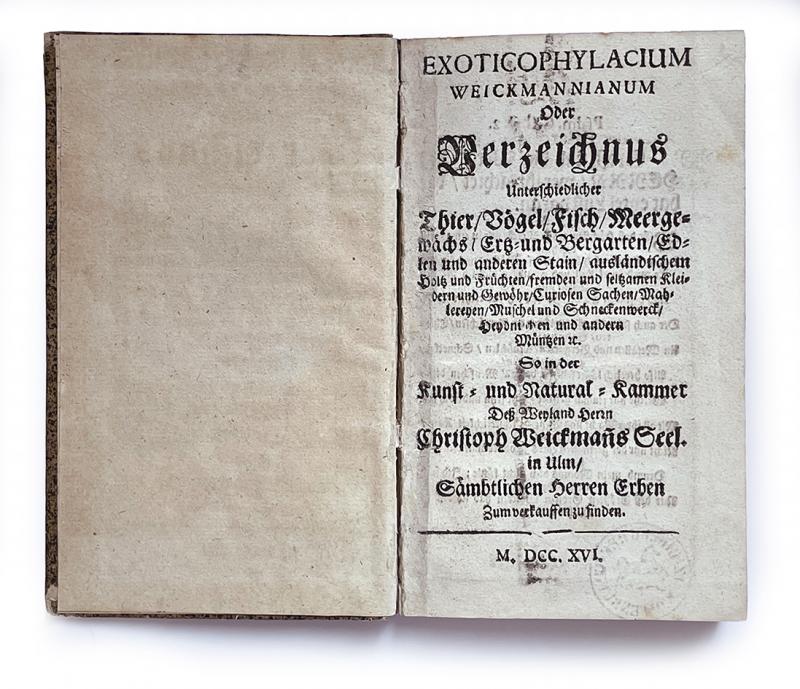
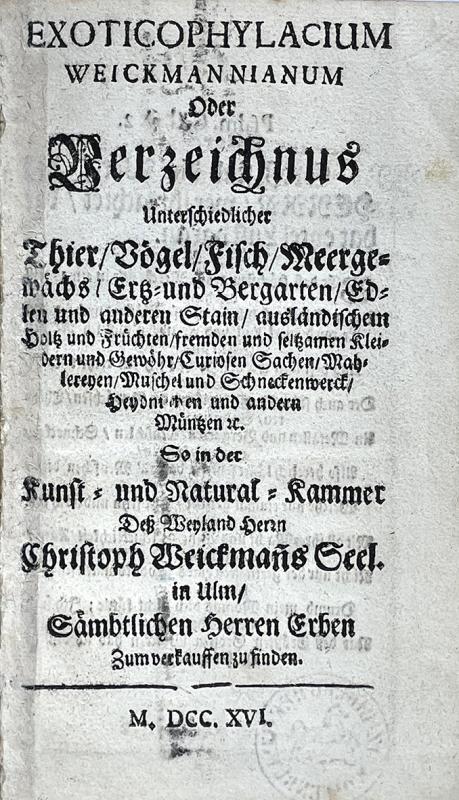
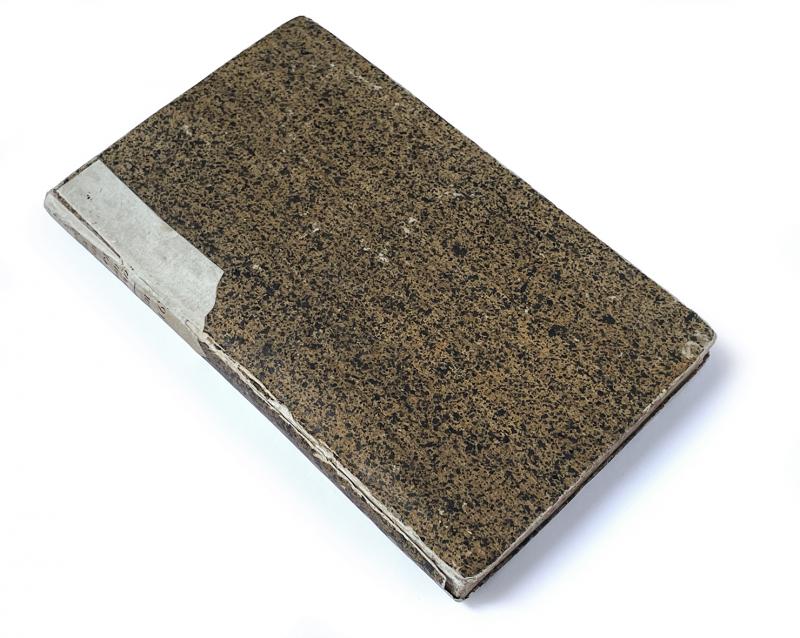
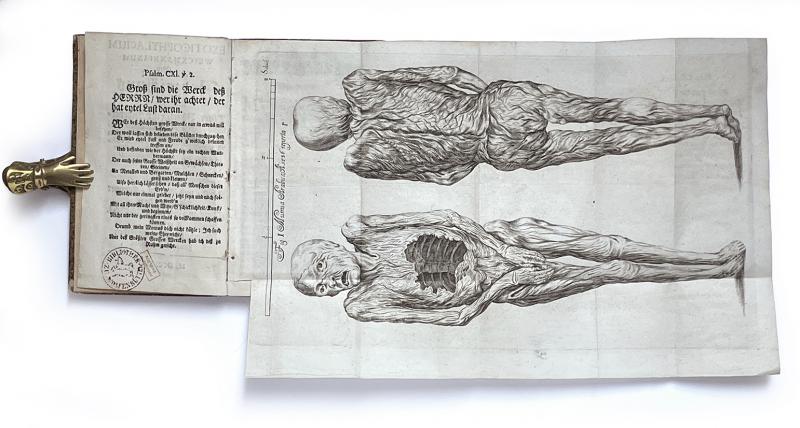
Exoticophylacium Weickmannianum Oder Verzeichnus Unterschiedlicher Thier, Vögel, Fisch, Meergewächs, Ertz- und Bergarten, Edlen und anderen Stain, ausländischem Holtz und Früchten ... Müntzen [et]c. So in der Kunst- und Natural-Kammer Deß ... Christoph Weickmann[n]s Seel. in Ulm, Sämbtlichen Herren Erben Zum verkauffen zu finden.(with-out place or printer), 1716. 8vo (160 x 95 mm) 75 (recte 77) pp., (1) with two engraved fold. plates. Contemporary Kleisterpapier boards with handwritten title label on spine, rubbed and soiled, spotted, Exlibris (Duke Brunswick - Lüneburg; stamp HAB Wolfenbüttel, deceased stamp).
Exceedingly rare sale catalogue of the „wunderkammer“ assembled by the prosperous Ulm merchant Christoph Weickmann (1617–1681); a collection of some 122 works of art and natural specimens that he obtained through exchange networks of various Danish, Dutch, German, and Swedish trading companies, including the world’s oldest datable textiles and carvings from West Africa. The plates show the mummies and the unicorn horn. Christoph Weickmann came from an eminent Ulm family. As a merchant, member of a guild, and, from 1667 onward, city councilman, he ranked among the urban elite. As a collector, he had considerable influence in shaping the material landscape of his city. His collection may have been modest in comparison to some of the grander collections in Stuttgart, Munich, and Gottorf, yet it is well known to scholars of collecting and material culture. Christoph Weickmann lived in an impressive residence, locally referred to as the ‚Schlößle‘ (little castle), in the well-to-do Frauengraben area of Ulm. From 1653, this building—which no longer stands, having been destroyed in World War II—also housed his cabinet of curiosities. By that time, there was nothing new about commoners curating such collections. In cities like Basel and Nuremberg, the second half of the sixteenth century saw the rise of the first patrician-owned cabinets of curiosities. Nor was Weickmann the only collector in Ulm. Close by, there was another cabinet of curiosities: that of the master builder and architect Joseph Furttenbach (1591–1667), imposing townhouse since 1640. While Furttenbach gravitated toward artifacts of engineering, Weickmann favored natural and ethnographical objects. Four surviving sources, dating to 1655, 1659, 1716, and 1741, provide information about the profile of Weickmann’s collection. In 1655, the travel writer Martin Zeiller published a first inventory of the collection in the appendix of his Handbuch von allerley nützlichen Erinnerungen. Four years later, in 1659, a new inventory appeared as a stand-alone publication. A comparison of the two inventories reveals that the collection, now called Exoticophylacium Weickmannianum, had been expanded considerably. A few decades after Christoph Weickmann’s death, the collection was dissolved. When disposing of the items, Weickmann’s heirs had two further inventories printed, one in 1716 and another in 1741. These were little more than sales catalogs. The majority of objects from the Weickmann collection have since been lost, especially the naturalia. Only around eighty of the more than 1,000 objects that originally constituted the collection survive today, kept at the Museum Ulm. Natural objects constituted the vast majority of Weickmann’s collection. In the 1659 inventory, they are subdivided into several categories. The first category is “Of Mankind,” followed by categories dedicated to animals, marine flora, minerals, types of soil, and types of wood. These holdings included some rarities as well as some common items: an Arabian mummy, taxidermized crocodiles, some hooves of moose, gold nuggets and precious stones, nutmegs, sugar cane, “Lebanese” cedar, and many other objects. The last category listed “Shellfish, mussels, and snails.” The second-to-last, likewise extensive, category was dedicated to “Foreign Art Objects and Curiosities.” Weickmann relegated all kinds of artifacts to this category. It included paintings and wax images; majolica; coins; scientific instruments and models, for example, an instrument for measuring body heat, a magnifying glass, a compass, and a sundial; as well as a miniature grotto with waterworks and the model of a pleasure garden featuring galleries and fountains. The category also included some unusual items: some pieces of African clothing and jewelry, a Chinese baptismal shirt, “Indian” deity statues, accessories and drinking vessels, weapons from West Africa, the Ottoman Empire, and Japan, ivory carvings, Chinese paper, an Arabic book, Sami shoes, and many others. Christoph Weickmann was especially interested in African objects as the corresponding entries in the Exoticophylacium appear considerably more well-informed than other entries. While objects from the Americas were usually described with next to no precision as “Indian,” Weickmann was able to identify the origin of his African objects down to the region and nation on the West African coast. Weickmann’s information may not always have been correct, but the Exoticophylacium still shows him as a connoisseur of the subject.- Lit.: Kim Siebenhüner. Colonial Objects in the Cabinet of Curiosities ? Christoph Weickmann’s ‚Outlandish Things‘ in Ulm; in: Encountering the Global in Early Modern Germany. Microhistories of Mobility, Materiality, and Belonging. Edited by Christina Brauner, Renate Dürr, Philip Hahn, Anne Sophie Overkamp, Simon Siemianowski (2025) chapt. 14; VD18 11639334. ( wunderkammer , Ornithology, Shells, Minerals, Geologie, Fossilien, Fossils, collection )
2800,- EUR
inkl. 7% USt./incl. 7% VAT
Sachgebiete: Naturwissenschaften, Ornithologie, Zoologie
Kontakt zum