(Europa/Japan) (Workshop of) Kawahara Keiga (1786 – c.1860), attrib.  Auf Merkliste setzen
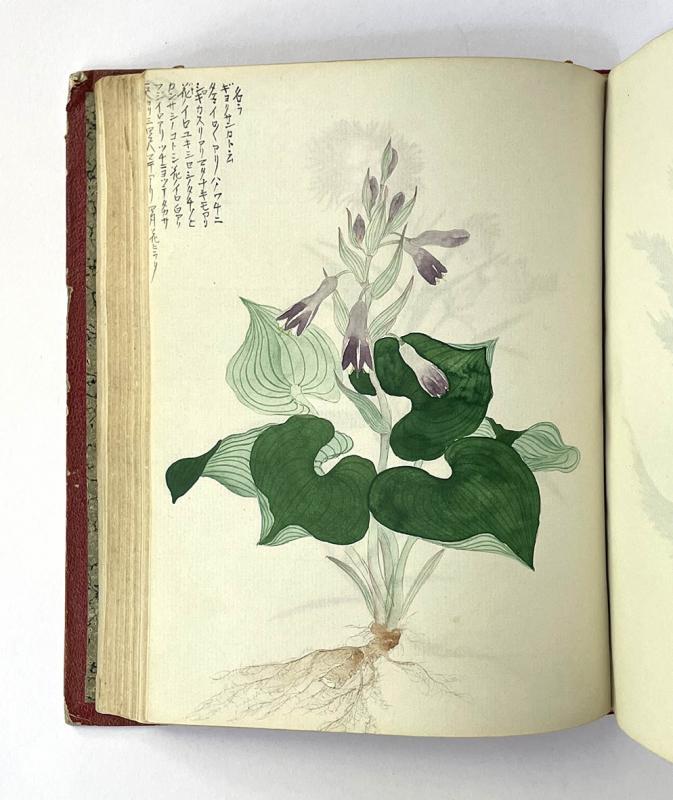
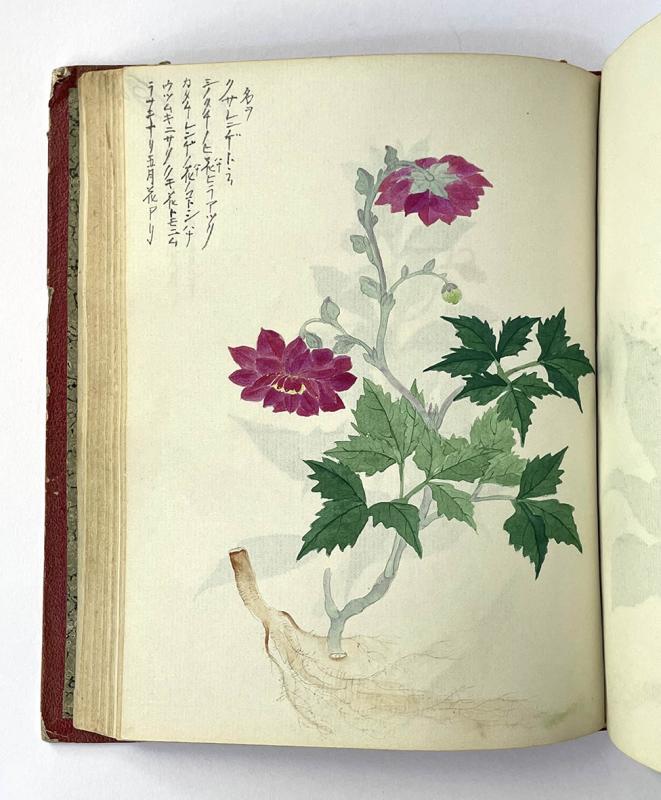
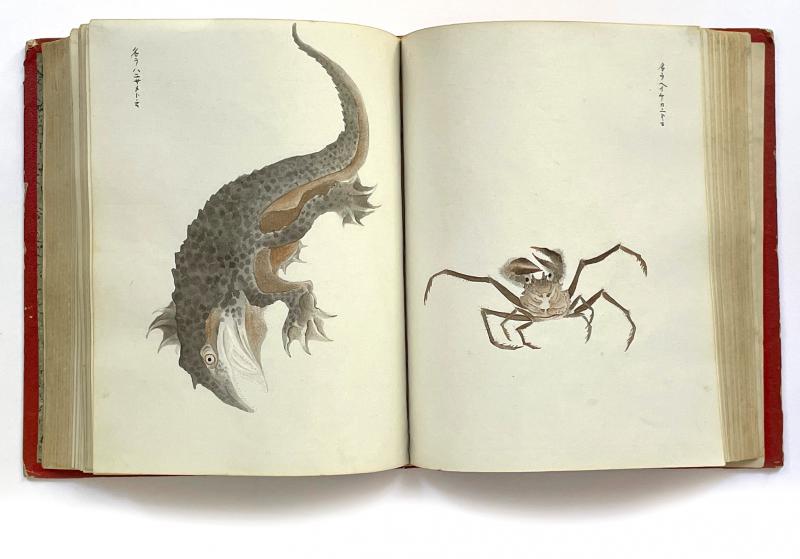
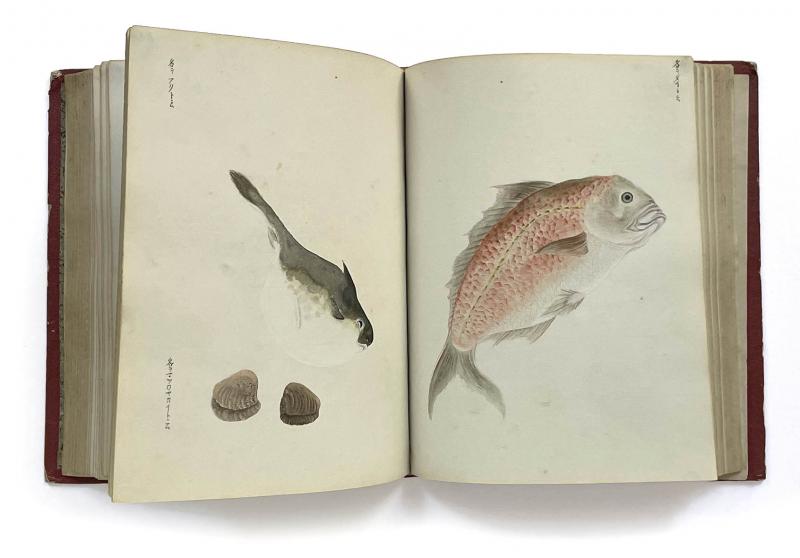
Flora et Fauna du Japon (gilt printed title on spine). Late Edo period album of natural history drawings in a mid 19th cent. European half calf binding incl. first 101 drawings of flowers, and than 101 drawings of cats & bats, amphibians, fish, shells, and insects.- Japan (Nagasaki ?), 1833 - not later then 1850. small 4to. (195 x 155 mm). Album containing 202 watercolor drawings (mostly one on each page) with Japanese manuscript captions, on thin laid (japanese ?) paper without watermark. The sheets are mostly unsigned, yet can be attributed to the Kawahara Keiga workshop. European red half calf binding (ca. 1850 - 1865) with gilt title on spine, rubbed and soiled. The binding is slightly later then the Ex Libris by Baumann (before 1850). The binder has bound the flower part in European style (each drawing facing a blank), while the animal part was bound like the original Japanese binding (two drawing facing each other). The last plate (Pfingstrose; Botan) is bound out of order and should be at the front. The drawings generally very well preserved, with occasional light spotting and minor toning, colors fresh.
A charming album of 202 Japanese water-color drawings of local plants and animals made in the European scientific pictorial tradition, offering an intriguing blend of the interaction of Japanese and Western culture. The delicate drawings depict flowers, insects, amphibians, fish, shells and other marine animals, provided with calligraphic titles. No title or title-page given. The sheets are mostly unsigned, yet can be attributed to the natural history drawings associated with Kawahara Keiga, the Nagasaki-based painter who, under commission from Philipp Franz von Siebold, produced extensive visual documentation of Japanese flora and fauna for Western scientific use. Kawahara maintained a studio in Nagasaki, where assistants produced copies and variants of his compositions for Dutch clients on Deshima. These workshop pieces likewise remained unsigned, complicating attribution in individual cases. Kawahara Keiga (1786 - ca. 1860), also known by his family name Toyosuke, was a painter from Nagasaki active during the late Edo period and ranks among the most significant Japanese artists associated with Philipp Franz von Siebold. Kawahara studied under Ishizaki Yūshi, Inspector of Chinese Painting in Nagasaki, who had access to Chinese and Dutch works and introduced Western pictorial techniques to his pupils. In 1823, the year of Siebold’s arrival in Japan, Kawahara was appointed dejima deiri eshi (“painter with access to Deshima”). Under Siebold’s commission, he produced highly detailed natural history paintings of Japan’s flora and fauna, which served as the visual basis for Siebold’s scientific publications, including Fauna Japonica and Flora Japonica. His oeuvre encompasses depictions of fish, crustaceans, reptiles and plants, executed with remarkable precision and informed by Western modes of observation. To support his research, Siebold arranged in 1825 for Carl Hubert de Villeneuve and Heinrich Bürger to come from Batavia to Nagasaki. Kawahara worked closely with both: Villeneuve instructed him in European painting techniques, while Bürger oversaw zoological and botanical studies. After Siebold’s expulsion from Japan in 1829, Bürger continued the collaboration, commissioning further zoological and botanical drawings for Siebold. In a letter dated 1831, Bürger reported that Kawahara had drawn 400 species of fish from life, of which 200, accompanied by detailed descriptions, were sent to Siebold. These drawings, together with numerous depictions of plants, crustaceans and reptiles, are now preserved in the Siebold Collection of the National Museum of Natural History (Naturalis), Leiden. The sheets are mostly unsigned, yet can be securely attributed to Kawahara through Bürger’s correspondence. Kawahara maintained a studio in Nagasaki, where assistants produced copies and variants of his compositions for Dutch clients on Deshima. These workshop pieces likewise remained unsigned, complicating attribution in individual cases. In a letter written in 1830, Siebold praised the high quality of Kawahara’s plant and fish paintings, recommending that he be employed primarily in these fields, while Villeneuve executed the depictions of mammals and anatomical studies. Kawahara’s works for Siebold represent a key intersection between Japanese pictorial tradition and Western scientific illustration, forming a central corpus in the visual documentation of Japan’s natural history in the early nineteenth century. „Kawahara's images have been fundamental for biological publications by C. J. Temminck and Hermann Schlegel. Kawahara’s work represents a highly developed synthesis of Japanese pictorial practice and European empirical observation, and the present album clearly draws on this visual language, while differing from it in significant respects. Comparison with the Kawahara album (RV-360-958) in the Wereldmuseum Leiden suggests indeed a close relationship in format, subject matter, and compositional approach. Provenance: Joachim Moritz Wilhelm Baumann (1766 - 1849; his Ex Libris), owner of the castle Trebsen an der Mulde with a library of 7.000 titles, containing mainly works on natural history. It also housed the extensive collection of astronomical, physical, natural history, and musical instruments and objects. The books were sold in September 1850 at Theodor Oswald Weigel in Leipzig; German Auction before 1990 (maybe Lempertz); German private collection. ( Naturgeschichte, Fische, Meer, Botanik, Zeichnungen, Japan, Expedition, Wissenstransfer )
18000,- EUR
inkl. 19% USt./incl. 19% VAT
Sachgebiete: Botanik, Handschriften, Handzeichnungen, Japan, Naturwissenschaften
Kontakt zum